
August 6, 2026
Strategic Supply Chain Vulnerabilities in Modern Energy Architecture
Complex energy supply networks operate through interdependent systems where disruption in one segment cascades through multiple layers of global commerce. When major crude oil export routes face systematic interference, the resulting market dynamics reveal fundamental weaknesses in how nations structure their energy security frameworks. These vulnerabilities extend beyond simple supply shortages, creating compounded effects across shipping, refining, and financial markets that reshape international trade patterns within weeks rather than months.
The emergence of coordinated maritime enforcement campaigns against specific oil-producing nations demonstrates how traditional geopolitical tools adapt to modern energy markets. Furthermore, the recent decision for the US to blockade Venezuela oil flows illustrates how naval interdiction combined with financial sanctions architecture creates multi-dimensional pressure that affects not only target nations but also their trading partners, shipping companies, and downstream industrial consumers across multiple continents.
When big ASX news breaks, our subscribers know first
Understanding Economic Warfare Through Maritime Control
Modern economic warfare leverages naval positioning to create systematic disruption without direct military confrontation. The implementation of comprehensive maritime enforcement against Venezuelan energy exports represents a fundamental evolution in geopolitical strategy, combining traditional naval interdiction with sophisticated financial sanctions mechanisms.
Strategic Implementation Components:
- Naval vessel seizures targeting pre-sanctioned tanker fleets
- Discretionary tariff mechanisms reaching up to 25% on importing nations
- Asset forfeiture operations through established court systems
- Third-party deterrence through financial exposure risks
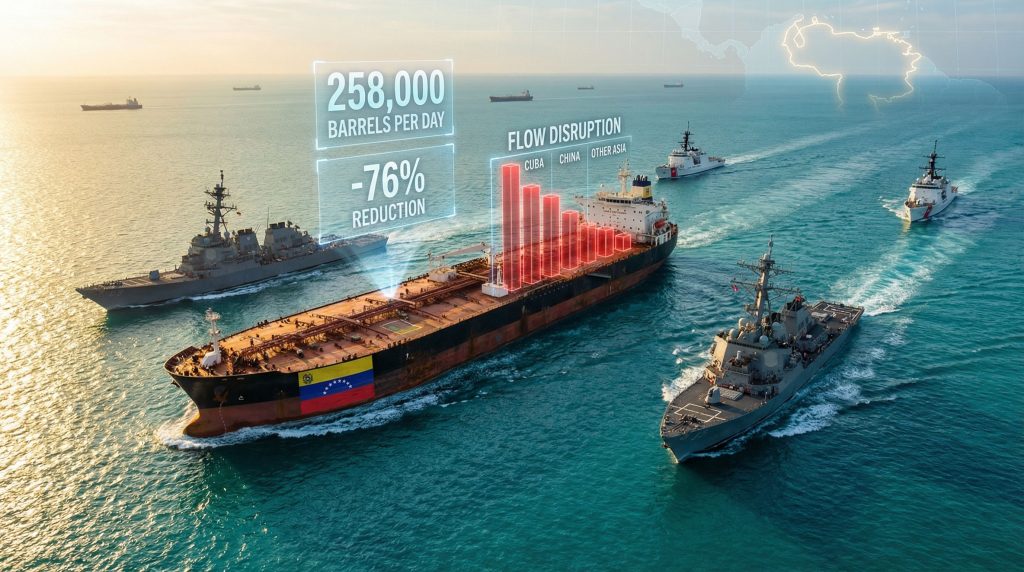
Current enforcement operations have reduced Venezuelan crude flows to approximately 258,000 barrels per day in December 2025, compared to 1.08 million barrels per day during the same period in 2024. This 76% reduction demonstrates the operational effectiveness of coordinated maritime interdiction when combined with financial pressure mechanisms.
However, these oil price movements create significant market volatility that extends far beyond Venezuelan exports. The positioning of naval forces creates what military strategists term "area denial" effects, where the mere presence of enforcement capabilities influences commercial shipping decisions far beyond actual seizure operations.
More than 30 tankers currently operate within potential reach of US naval forces positioned near Venezuela, creating ongoing uncertainty for shipping companies and oil traders. According to reports from major news outlets, this represents the most significant maritime enforcement operation in the Caribbean since the Cold War era.
How Supply Chain Disruptions Cascade Through Energy Markets
The systematic reduction of Venezuelan oil exports creates immediate disruptions across Caribbean and Gulf Coast shipping markets, with secondary effects rippling through Asian refining centers and European trading hubs. These disruptions reveal the interconnected nature of modern energy supply chains and mirror the challenges facing Australia energy exports challenges in global markets.
Flow Disruption Analysis:
| Destination | Pre-Enforcement (Dec 2024) | Current Status (Dec 2025) | Percentage Change |
|---|---|---|---|
| Cuba | 200,000+ bpd | 0 bpd | -100% |
| China | 600,000+ bpd | Severely limited | -80% |
| Malaysia/Asia | 180,000 bpd | Minimal flows | -90% |
| US (Licensed) | 100,000 bpd | Maintained | 0% |
The enforcement campaign creates ripple effects that extend beyond direct crude oil movements. VLCC (Very Large Crude Carrier) rates have reached three-year highs as charterers adopt defensive positioning strategies, fundamentally altering regional tanker economics throughout the Caribbean basin.
Market participants have implemented what industry sources describe as wait-and-see approaches that contribute to overall slowdowns in Caribbean and Gulf of Mexico chartering activity. This behavioral shift demonstrates how enforcement actions influence commercial decision-making through risk perception rather than direct prohibition.
Operational Timeline Effects:
- September 2025: US naval forces positioned near Venezuela
- October 2025: Initial shipping route diversions begin
- December 10, 2025: First tanker seizure triggers market reaction
- December 17, 2025: Formal blockade declaration escalates enforcement
Seven cargoes departed Venezuela in early December 2025, with four destined for the US, one for Malaysia, one for China, and one for Cuba. This distribution pattern illustrates how enforcement campaigns create selective pressure on different trading relationships whilst maintaining some commercial flows through licensed arrangements.
Primary Economic Impact Assessment by Nation
Cuba: Complete Energy System Disruption
Cuba faces the most severe immediate consequences from Venezuelan supply disruption, having relied heavily on steady crude deliveries for domestic refining operations. Cuban Premier Miguel Diaz-Canel acknowledged that the disruption of crude supplies from Venezuela creates dire economic conditions across the island nation.
The elimination of Venezuelan crude flows to Cuba represents a complete cessation of a supply relationship that previously provided over 200,000 barrels per day. This dependency elimination creates immediate energy crisis conditions as alternative supply sources prove economically unviable at current market pricing structures.
China: Refining Hub Complications
Chinese refiners, particularly in Shandong province, face significant supply chain restructuring requirements. The Shandong refining hub experienced delayed import quota allocations that were not resolved until late November 2025, compounding operational challenges created by Venezuelan supply disruptions.
China-bound tankers laden with Venezuelan oil previously utilised quick stops in Cuba to offload partial crude volumes, but this traffic has largely ceased following the December 10 seizure operation. This routing change demonstrates how enforcement actions create cascading effects across multiple supply chain segments simultaneously.
Asian buyers of Venezuelan crude maintain some inventory buffers from earlier shipments that have yet to be fully processed, potentially masking the complete impact of supply disruption in the near term. However, these inventory overhangs represent temporary mitigation rather than sustainable alternative sourcing.
Trinidad and Tobago: Strategic Realignment
Trinidad and Tobago has positioned itself as a US logistics hub, providing airport facilities for military supply replenishment and personnel rotations during current operations. This strategic cooperation creates economic benefits through infrastructure utilisation agreements whilst simultaneously severing long-standing Venezuelan partnership arrangements.
Venezuela responded by cancelling plans for future natural gas supply from joint development projects in Venezuelan waters near their maritime border. Venezuelan Vice President Delcy Rodriguez characterised Trinidad's position as turning the country into a US aircraft carrier to attack Venezuela, indicating the broader diplomatic implications of energy enforcement campaigns.
Legal Frameworks Governing Maritime Energy Enforcement
Modern maritime enforcement operates within complex legal boundaries that distinguish between traditional naval blockade (considered an act of war) and sanctions enforcement (economic pressure through legal mechanisms). Current operations leverage established sanctions authority rather than new military actions.
Sanctions-Based Legal Authority:
- Vessel seizures target entities on pre-established sanctions lists
- Asset forfeiture proceeds through existing court procedures
- Financial institution compliance requirements create third-party pressure
- Maritime law protocols govern international waters operations
The tanker seized on December 10 was previously sanctioned for alleged involvement in transporting Iranian oil, demonstrating that enforcement targets vessels with existing legal violations rather than implementing new prohibitions. This legal distinction maintains operational boundaries that differentiate current actions from traditional military blockade.
What Congressional Approval is Required?
US lawmakers briefed by defence officials expressed uncertainty about the ultimate objectives of military operations near Venezuela. The escalation to formal blockade declaration raises questions about congressional approval requirements for sustained naval operations that significantly impact international commerce.
Consequently, the situation reflects broader concerns about the US to blockade Venezuela oil flows without clear legislative oversight. These questions become particularly relevant when considering how such actions affect global energy markets and international relationships.
Market Adaptation Mechanisms and Price Discovery
Venezuelan crude typically trades at $8-12 discounts to Brent benchmark pricing due to quality characteristics and transportation risks. Enforcement actions widen these spreads as buyers demand additional risk premiums for potential seizure exposure, creating distorted price discovery mechanisms.
Market Adaptation Strategies:
- Alternative routing through non-US allied ports
- Insurance market restructuring for sanctions risk coverage
- Floating storage utilisation during enforcement periods
- Barter trade mechanisms bypassing traditional finance systems
Caribbean and Gulf Coast refineries configured specifically for heavy crude processing face feedstock supply challenges that reduce operational flexibility. These complex refineries lose competitive advantages when preferred crude sources become unavailable through enforcement actions, potentially requiring expensive feedstock substitution or reduced utilisation rates.
The next major ASX story will hit our subscribers first
Cyber Warfare and Parallel Disruption Mechanisms
Beyond maritime enforcement, Venezuelan state oil company PdV experienced significant cyber attacks starting December 13, 2025, that infected company computers with viruses designed to erase operational information. These attacks appeared focused on operations in the Oriente Norte division, where multiple pipelines, refineries, and Orinoco heavy crude upgraders operate.
The cyber component suggests multi-layered disruption strategies that combine maritime interdiction with digital infrastructure targeting. Workers were instructed to operate in emergency mode under extremely risky conditions whilst systems underwent restoration efforts.
US oil major Chevron, operating through four joint ventures with PdV including two in the Oriente Norte area, reported that its operations continue without disruption, indicating selective targeting or protective measures for licensed operations. This selective approach demonstrates how enforcement operations can target specific entities whilst protecting others.
Investment Flow Reallocations and Sector Implications
Energy enforcement campaigns typically trigger capital flows toward alternative supply sources and transportation infrastructure. Current market conditions benefit several distinct sectors whilst creating risk exposure in others, particularly in regions where trade war oil markets create additional uncertainty.
Beneficiary Investment Sectors:
- Alternative heavy crude producers in Canada and Mexico
- Tanker shipping companies operating compliant vessel fleets
- US domestic crude production and pipeline infrastructure
- Non-Venezuelan refining capacity expansion projects
Risk Exposure Categories:
- Sanctioned vessel ownership structures and management companies
- Venezuela-dependent refining operations in the Caribbean
- Commodity trading firms with significant Venezuelan crude exposure
- Regional energy infrastructure with Venezuelan partnership components
Long-term strategic positioning accelerates energy supply chain diversification initiatives as countries and companies reduce single-source dependencies through multi-supplier contract structures, strategic petroleum reserve buildouts, and geopolitically neutral supply partnerships.
Regional Security Architecture Transformations
Naval presence expansion creates new regional security dynamics that extend beyond immediate energy enforcement objectives. US force positioning near Venezuela affects relationships with multiple Caribbean nations and establishes precedents for future maritime operations.
Regional Relationship Impacts:
- Trinidad and Tobago logistics cooperation agreements
- Colombian maritime boundary security considerations
- Caribbean nation neutrality position pressures
- Cuban isolation intensification through energy dependency elimination
The US Navy has reported destroying 25 boats allegedly carrying drugs near Venezuelan and Colombian coasts since early September, killing 98 crew members. These operations, occurring alongside energy enforcement, demonstrate the expansion of naval activities beyond traditional counter-narcotics missions.
Escalation Risk Factors:
- Accidental engagement scenarios in congested shipping lanes
- Third-party vessel involvement in enforcement operations
- International waters jurisdiction disputes with non-aligned nations
- Humanitarian impact considerations affecting civilian populations
Historical Asset Dispute Context and Legal Claims
Venezuela's nationalisation of foreign energy assets during Hugo Chavez's presidency created extensive legal liability that influences current enforcement strategies. Almost $60 billion worth of claims have been advanced against Caracas and state-owned PdV in US courts and international tribunals.
A US federal court ordered the sale of PdV-owned US refiner Citgo to partially satisfy outstanding legal claims, demonstrating how asset seizure mechanisms extend beyond maritime enforcement to include domestic corporate holdings. This legal framework provides additional leverage points for sustained economic pressure.
The complexity of asset disputes creates ongoing uncertainty for international energy companies considering Venezuelan partnerships. Companies must evaluate not only operational risks but also potential legal exposure through association with sanctioned entities or disputed asset claims.
Global Supply Security and Systemic Risk Assessment
Removing over 800,000 barrels per day from global crude oil markets creates supply tightness that affects strategic petroleum reserve utilisation rates, refinery optimisation requirements, and price volatility amplification mechanisms across multiple regions. These effects compound the broader US-China trade war impacts on global energy markets.
Market Vulnerability Indicators:
- Strategic petroleum reserve drawdown requirements
- Alternative supplier capacity constraint identification
- Refinery utilisation rate optimisation pressures
- Regional price differential expansion patterns
Supply chain resilience testing reveals both adaptation capabilities and critical dependencies in specific refining configurations. Markets demonstrate short-term resilience through rapid supplier substitution whilst exposing longer-term vulnerabilities in heavy crude processing capacity.
System Adaptation Metrics:
- Average crude export levels from Venezuela: 785,000 b/d (Sept-Dec 2025) vs 792,000 b/d (same period 2024)
- December 2025 dramatic reduction: 258,000 b/d vs 1.08 million b/d (Dec 2024)
- Sanctioned vessel fleet exposure: 30+ tankers within operational reach
Multipolar Energy Architecture Development
Sustained enforcement campaigns accelerate the development of parallel energy trading systems that operate independently of US-dominated financial infrastructure. This evolution creates alternative payment mechanisms, bilateral energy cooperation agreements, and regional energy security partnerships.
Alternative System Development:
- Non-dollar energy trading mechanism expansion
- Independent shipping and insurance market growth
- Regional energy cooperation framework strengthening
- Strategic resource control diversification initiatives
Energy enforcement demonstrates the weaponisation of supply chain dependencies, encouraging nations to develop domestic alternatives and reduce import vulnerabilities through comprehensive diversification strategies. These adaptations reshape global energy architecture toward more resilient but potentially fragmented trading systems.
In addition, alternative exploration opportunities such as Saudi Arabia exploration licenses may gain increased strategic importance as traditional supply chains face disruption.
How Will This Affect Long-Term Energy Security?
The long-term implications of the US to blockade Venezuela oil flows extend beyond immediate supply disruption to fundamental changes in how nations structure energy security, international payment systems, and strategic resource partnerships in an increasingly multipolar global economy.
Countries are already beginning to diversify their energy portfolios and reduce dependency on single suppliers or regions. This trend is expected to accelerate as enforcement actions demonstrate the vulnerability of concentrated supply relationships.
According to recent analysis from oil market experts, these developments may permanently alter global energy trading patterns and create more regionalised supply chains.
This analysis is based on publicly available information and industry reporting. Energy market developments involve significant uncertainties, and actual outcomes may differ from current projections. Readers should consult multiple sources and professional advisors when making investment or policy decisions related to energy markets.
Could the Next Energy Market Disruption Create Investment Opportunities?
The systematic restructuring of global energy supply chains creates unprecedented market dynamics for investors seeking to capitalise on sector shifts and supply chain realignments. Discovery Alert's proprietary Discovery IQ model delivers real-time alerts on significant ASX mineral discoveries, instantly empowering subscribers to identify actionable opportunities in the energy and resources sector ahead of the broader market. Begin your 30-day free trial today and secure your market-leading advantage in these volatile times.