June 25, 2026
Strategic Supply Security in Global Energy Markets
Modern energy procurement strategies increasingly prioritise reliability frameworks over simple production volumes. As geopolitical tensions reshape global supply chains, purchasing decisions now factor in operational continuity during crises, infrastructure independence, and regulatory stability alongside traditional cost considerations.
The current market environment demonstrates how quickly traditional supply sources can become compromised. Recent events in the Strait of Hormuz, where traffic has declined by 70-80% following regional tensions, illustrate the vulnerability of concentrated supply routes. This disruption has pushed Brent crude above $80 per barrel for the first time since July 2024, emphasising the premium markets now place on secure supply chains.
Energy security encompasses five critical operational dimensions that extend beyond raw production capacity. These include production consistency during crisis periods, measured by the ability to maintain baseline output during geopolitical events, and infrastructure resilience through transportation systems that function independently of volatile regions. Additionally, regulatory predictability enables long-term contracting without policy reversals, while reserve sustainability ensures extraction economics remain viable across $30-120 per barrel price ranges. Finally, product diversity allows suppliers to serve specialised refinery requirements including heavy crude, synthetic oil, and refined products.
When big ASX news breaks, our subscribers know first
Canada's Emerging Geopolitical Advantage
Democratic Stability in Resource Development
Canada's position as a stable energy supplier stems from fundamental structural advantages that distinguish it from traditional oil-producing regions. The country ranks first globally in the Fragile States Index for political stability amongst resource-rich nations, according to the Fund for Peace 2025 assessment.
The federal-provincial resource development framework has maintained continuity through more than ten federal government transitions since 1980, creating predictable investment conditions. This contrasts sharply with Middle Eastern suppliers facing ongoing conflicts and sanctions regimes. Furthermore, Canada's energy transition demonstrates how the nation balances resource development with environmental commitments, creating long-term market confidence.
Canadian energy producers operate with zero active sanctions exposure and function under WTO-compliant trade frameworks, enabling reliable contract enforcement. Moreover, analysts examining the oil price rally analysis highlight how stable jurisdictions benefit disproportionately during supply disruptions.
Key Stability Indicators:
- Canadian Dollar volatility has remained below 5% annually against the USD during 2020-2026
- Banking system maintained AAA credit ratings through the 2008 financial crisis
- Trade relationships with 51 nations under formal agreements
- USMCA framework providing predictable dispute resolution mechanisms
Sanctions Risk Differential Analysis
While Middle Eastern suppliers face 35+ separate sanctions regimes across multiple countries, Canadian operations encounter no such restrictions. This creates substantial advantages for long-term supply agreements, particularly with allied nations seeking supply diversification.
The contrast becomes evident during crisis periods. Iran's March 2026 declaration of Strait of Hormuz closure, combined with threats to "set ablaze" vessels attempting passage, demonstrates the operational risks inherent in geopolitically sensitive regions. Meanwhile, Canadian facilities maintain consistent output regardless of international tensions, reinforcing Canada as the market's most reliable oil supplier.
Portfolio manager perspectives emphasise these advantages. As reported by Bloomberg, senior portfolio manager Eric Nuttall characterised Canada's position as uniquely stable, noting that current equity valuations do not yet reflect the increased market importance of supply security over supply volume. This suggests significant upside potential as markets increasingly prioritise reliability metrics.
Massive Reserve Base Supporting Long-Term Supply
Oil Sands Resource Foundation
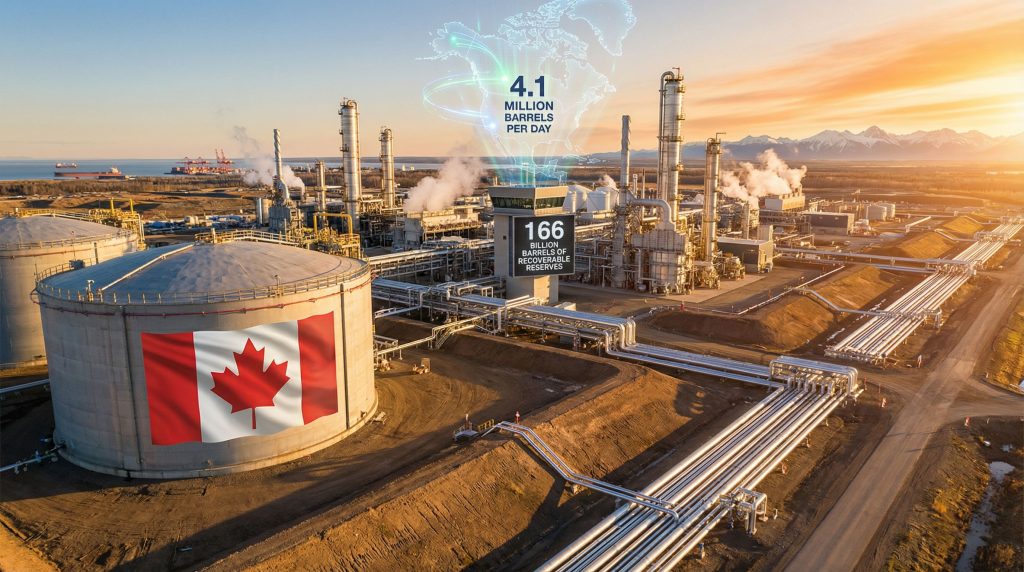
Canada's oil sands contain approximately 166 billion barrels of recoverable reserves, representing the third-largest proven oil reserves globally after Venezuela and Saudi Arabia. This massive resource base provides decades of consistent production capacity without depletion concerns.
The Clearwater Formation in Alberta holds particularly significant potential, with estimated in-place volumes exceeding 70 billion barrels in the Cold Lake area alone. Industry estimates suggest Clearwater production could reach approximately 400,000 barrels per day by 2031, adding substantial capacity to Canada's export potential.
Production Characteristics Comparison:
| Reserve Type | Annual Decline Rate | Production Lifespan | Capital Requirements |
|---|---|---|---|
| Oil Sands Operations | 2-5% | 20-30 years | Moderate expansion |
| Conventional Wells | 15-30% | 5-10 years | Continuous exploration |
| Shale Operations | 30-60% | 2-5 years | Intensive drilling |
These low decline rates create substantial advantages for supply reliability. Oil sands operations feature Steam-Assisted Gravity Drainage (SAGD) technology enabling steady output expansion without mining-related environmental constraints. Integrated upgrading facilities co-located at production sites reduce transportation bottlenecks and enable product diversification for specialised refinery markets.
Reserve Replacement Economics
Unlike conventional fields requiring continuous exploration spending to maintain production, oil sands development provides natural reserve replacement as new deposits are brought online. This structural advantage ensures long-term supply availability without the exploration risk inherent in conventional operations.
Modern oil sands operations achieve breakeven prices between $35-45 per barrel, maintaining viability across historical price ranges of $30-120 per barrel. Current market pricing, with WTI and Brent trends showing WTI crude at $75.10 per barrel and Brent at $81.40 per barrel as of March 2026, creates substantial margins above breakeven costs.
Infrastructure Development Transforming Export Capacity
Pipeline Expansion Projects
Current infrastructure constraints limit Canadian oil exports to approximately 4.1 million barrels per day despite production capacity exceeding 5 million bbl/d. This represents an 18-20% export capacity shortfall that strategic pipeline projects could address.
Trans Mountain Expansion became operational in 2024, increasing westward capacity by 590,000 barrels per day and bringing total capacity to approximately 890,000 bbl/d. The $30.7 billion CAD project represents Canada's second-largest capital project in the current cycle, enabling direct access to Asian markets and reducing dependence on US Gulf Coast refineries.
Industry experts have called for additional infrastructure development. As reported by Bloomberg, Nuttall emphasised the need for Canadian Parliament approval of "new export pipelines, including a one-million-barrel-per-day project" to address global supply-demand imbalances.
Proposed Infrastructure Developments:
- Northern Gateway alternatives with potential 1 million bbl/d Pacific coast capacity
- Enhanced US connectivity through regional pipeline networks
- Rail transport backup systems for supply security
- Year-round shipping technology for Arctic regions
Specialised Terminal Requirements
Pacific coast facilities require specialised infrastructure for heavy oil handling, including heated storage systems maintaining 30-50°C temperatures for viscous crude flowability. Very Large Crude Carriers (VLCCs) need deepwater port facilities with 15+ metre drafts for efficient loading operations.
Current Pacific coast capacity centres on the Trans Mountain terminal at Westridge Marine, operating a single VLCC loading dock. Atlantic export potential exists through Irving Oil refinery facilities in Saint John, New Brunswick, providing direct European market access.
Production Economics Supporting Market Leadership
Cost Structure Competitiveness
Canadian producers demonstrate strong financial performance across current market conditions. Peyto Exploration & Development reported a 29% increase in funds from operations year-over-year in Q3 2025, with a dividend yield of 5.19% and 52-week share returns of 87.1%. The company maintains a market capitalisation of $3.9 billion CAD.
Cenovus Energy achieved record oil sands production in Q4 2025 and expects a 4% year-over-year production increase in 2026. The company's $8.6 billion acquisition of MEG Energy is projected to deliver $150 million in annual synergies in 2026, growing to over $400 million by 2028.
Canadian Energy Sector Performance Metrics:
| Company | Market Cap | Dividend Yield | 52-Week Returns |
|---|---|---|---|
| Peyto Exploration | $3.9B CAD | 5.19% | 87.1% |
| Cenovus Energy | $42B CAD | 2.6% | 79.8% |
| Suncor Energy | $68.6B CAD | 3.0% | 61.1% |
Economic Resilience Factors
Oil sands operations provide economic stability through integrated business models combining extraction, upgrading, and refining capabilities. This vertical integration creates hedging against price volatility while generating consistent cash flows across market cycles.
Suncor Energy's integrated approach (oil sands + refining + retail) exemplifies this strategy. The company actively reduces share count through buybacks targeting up to 10% by March 2027 while increasing dividend payments. Such capital allocation strategies demonstrate confidence in long-term cash flow generation.
The sector benefits from technological improvements lowering extraction expenses annually, carbon capture investments improving environmental compliance, and economies of scale benefiting large-scale operations. These factors support sustained profitability across diverse market conditions.
Technology Enhancement Driving Operational Excellence
Digital Operations Management
Real-time monitoring systems utilise satellite-based pipeline integrity monitoring and predictive maintenance algorithms to reduce operational downtime. Automated production optimisation platforms and supply chain visibility systems enhance operational efficiency across the production network.
Advanced extraction technologies continue improving recovery rates. Enhanced Steam-Assisted Gravity Drainage (SAGD) methods and solvent-assisted extraction techniques increase resource recovery while reducing water and energy intensity. These innovations support sustainable production expansion whilst minimising environmental impact.
Environmental Technology Integration
Carbon management systems incorporating industrial carbon capture and storage capabilities position Canadian operations for evolving environmental requirements. Methane emission reduction technologies and renewable energy integration at production facilities demonstrate commitment to sustainable operations.
Circular economy waste utilisation programmes convert operational byproducts into useful materials, reducing environmental footprint whilst generating additional revenue streams. These technological advances support both environmental compliance and operational efficiency objectives.
The next major ASX story will hit our subscribers first
Strategic Market Positioning Scenarios
Middle East Supply Disruption Response
Regional conflicts affecting 20+ million barrels per day of global supply create opportunities for Canadian producers to increase market share. Canada possesses the capability to increase production by 500,000-750,000 barrels per day within 12-18 months through existing spare capacity utilisation and emergency production protocols.
The current Strait of Hormuz situation, where Iran declared closure with threats against vessel passage, demonstrates the vulnerability of concentrated Middle Eastern supply routes. Additionally, the tariff impact analysis shows how trade tensions further complicate traditional supply relationships. Canadian operations face no similar chokepoint risks, providing supply security advantages during crisis periods.
Energy Security Partnership Development
Allied nations increasingly seek supply diversification through long-term agreements replacing volatile spot market purchases. Canada's NATO alliance membership, established trade relationships, and compatible regulatory standards position it favourably for strategic petroleum reserve partnerships.
Geographic Market Diversification Strategy:
- 40% North American markets (US, Mexico)
- 35% Asian markets (China, Japan, India, South Korea)
- 15% European markets (UK, Germany, Netherlands)
- 10% emerging markets (Brazil, Turkey, Southeast Asia)
Transition Period Optimisation
During the global energy transition, Canadian producers can leverage lower-carbon production methods, carbon offset integration, and renewable energy powered operations. This positioning supports gradual production optimisation whilst maintaining market competitiveness during decarbonisation efforts.
The combination of massive reserves, advanced technology, and environmental innovation creates sustainable competitive advantages. Product mix optimisation spanning heavy crude for specialised refineries, upgraded synthetic crude for general markets, and refined products for regional distribution maximises market opportunities.
Investment Performance and Market Recognition
The energy sector's strong performance reflects growing recognition of supply security value. The State Street Energy Select Sector SPDR ETF (NYSEARCA:XLE) has gained approximately 24% year-to-date, significantly outperforming the S&P 500's -1.0% return during the same period.
Canadian energy stocks demonstrate particular strength as markets increasingly value stability and reliability. The sector benefits from current pricing environment with Western Canadian Select at $58.88 per barrel, representing strong margins above production costs whilst maintaining competitive pricing for international buyers.
Portfolio managers emphasise the "security of supply" premium now evident in energy markets. This represents a fundamental shift from previous decades when supply volume dominated pricing, creating significant opportunities for stable suppliers like Canada to command premium valuations.
Implementation Timeline for Market Leadership
Phase 1: Infrastructure Foundation (2026-2028)
Completion of existing pipeline projects, expansion of port and terminal facilities, implementation of digital monitoring systems, and establishment of initial Asian market contracts form the foundation for enhanced export capacity. This phase focuses on utilising existing infrastructure more effectively whilst developing new capacity.
Phase 2: Production Optimisation (2028-2030)
Increased oil sands production capacity deployment of advanced extraction technologies, development of comprehensive carbon management systems, and expansion of refining and upgrading capabilities drive operational excellence. This phase emphasises technological advancement and environmental performance improvement.
Phase 3: Market Leadership (2030-2035)
Achievement of diversified global customer base, establishment of premium reliability pricing, leadership in low-carbon oil production, and integration of renewable energy operations solidify market position. This phase represents full realisation of Canada's supply reliability advantages, establishing Saudi exploration dynamics as secondary considerations compared to Canadian stability.
Regulatory Framework Supporting Development
Canada's established environmental assessment processes, clear taxation frameworks, and Indigenous consultation requirements provide social licence for resource development. Federal and provincial coordination on major projects creates predictable approval timelines compared to more volatile regulatory environments elsewhere.
The regulatory framework balances resource development with environmental protection through streamlined approval processes for strategic projects, enhanced environmental monitoring systems, community partnership development, and technology investment in emission reduction. This approach supports sustainable industry growth whilst maintaining public support.
International climate commitment alignment ensures Canadian production methods remain acceptable to environmentally conscious importing nations. Carbon management integration and renewable energy adoption demonstrate commitment to responsible resource development practices.
Furthermore, as detailed in Canada's oil industry overview, comprehensive regulatory frameworks provide long-term investment certainty whilst maintaining high environmental standards.
Conclusion: Canada's Strategic Supply Advantage
Canada's unique combination of massive reserves, political stability, advanced technology, and strategic infrastructure positions it exceptionally well to become the world's most reliable oil supplier. The convergence of Middle Eastern supply disruptions, increasing focus on energy security, and Canadian production capabilities creates unprecedented market opportunities.
Success requires coordinated policy development, private sector investment, and international partnership cultivation. The current geopolitical environment demonstrates the critical importance of supply reliability, creating lasting advantages for stable suppliers capable of consistent delivery across diverse market conditions.
The transformation of global energy markets from volume-focused to security-focused procurement creates structural advantages for Canadian producers. As Canada as the market's most reliable oil supplier becomes recognised internationally, premium valuations and long-term supply agreements will reward the strategic investments in infrastructure, technology, and operational excellence that position Canada for energy leadership in an increasingly uncertain world.
Ready to Position Yourself in Canada's Energy Market Advantage?
Discovery Alert's proprietary Discovery IQ model delivers real-time alerts on significant ASX mineral discoveries, including critical energy transition metals and resource companies with Canadian exposure, instantly empowering subscribers to identify actionable opportunities ahead of the broader market. Begin your 14-day free trial today and secure your market-leading advantage in the evolving energy sector.