June 24, 2026
Strategic Technology Partnerships: Reshaping Continental Energy Innovation Frameworks
Continental energy markets face unprecedented pressures as traditional resource development models encounter systemic constraints across operational, financial, and technological dimensions. The convergence of aging infrastructure, declining production curves, and capital efficiency demands has fundamentally altered how national oil companies approach innovation investment strategies. Rather than pursuing isolated development paths, leading African energy producers increasingly recognise collaborative research frameworks as essential mechanisms for maintaining competitive positioning while addressing shared technical challenges across diverse geological and operational contexts.
This transformation reflects broader industry evolution trends that demonstrate how individual operators cannot efficiently address the full spectrum of upstream technology gaps through standalone investment programs. The financial burden of developing advanced subsurface imaging capabilities, implementing artificial intelligence-driven interpretation systems, and deploying real-time reservoir monitoring infrastructure exceeds practical capital allocation limits for most national oil companies when pursued independently. Furthermore, collaborative approaches enable risk distribution, accelerate technology deployment timelines, and create sustainable pathways for knowledge transfer across regional operations.
When big ASX news breaks, our subscribers know first
Understanding the Strategic Framework Behind Cross-Border Upstream R&D Collaborations
Economic Pressures Driving Partnership Formation
African national oil companies confront fundamental economic realities that make collaborative research and development strategies increasingly attractive. Production decline pressures exemplify these challenges, with Algeria's Sonatrach experiencing crude oil output reduction from approximately 1.2 million barrels per day in 2020 to roughly 0.9 million bpd by 2024, according to U.S. Energy Information Administration data. This 25% decline over four years demonstrates the natural depletion pressures affecting mature African assets and underscores the urgent need for enhanced recovery technologies and operational optimisation strategies.
The Sonatrach GNPC upstream R&D collaboration addresses these economic pressures through shared investment in advanced technical capabilities. Rather than each company independently developing digital subsurface analysis systems or artificial intelligence-enabled interpretation platforms, the partnership enables cost distribution across multiple asset portfolios while accelerating technology implementation timelines. This collaborative approach reflects strategic recognition that individual capital constraints limit the scope and speed of technology deployment when pursued through isolated development programs.
Infrastructure modernisation requirements further intensify economic pressures driving partnership formation. Many West African upstream assets operate with infrastructure aged 15-25 years, requiring substantial capital investment for digital transformation and enhanced recovery implementation. Ghana's Jubilee field, discovered in 2007 and operational since 2010 with initial production capacity of 120,000 bpd, exemplifies the asset optimisation challenges facing African operators as production curves mature and require technology-enabled recovery enhancement.
Technology Gap Analysis and Capability Development Priorities
The Sonatrach GNPC upstream R&D collaboration specifically targets critical technology gaps including advanced onshore and offshore seismic technologies, 4D seismic monitoring, real-time reservoir modelling, and enhanced oil recovery optimisation. These technical focus areas reflect systematic assessment of capability requirements necessary for maintaining competitive operational performance while extending asset productive life cycles through improved recovery factors and operational efficiency gains.
Digital transformation priorities encompass AI in drilling innovation that enable artificial intelligence-enabled subsurface interpretation, automated drilling optimisation systems, and integrated data management platforms that enable real-time decision-making capabilities. The partnership framework establishes protocols for joint development of these digital capabilities while creating standardised approaches for implementation across diverse operational contexts and regulatory environments throughout the African continent.
Well integrity and corrosion management represent additional technical priorities where collaborative research generates shared benefits across partner operations. Advanced monitoring systems, predictive maintenance algorithms, and materials science innovations developed through joint research programs can be deployed across multiple asset portfolios, creating economies of scale in technology development while addressing common operational challenges affecting aging infrastructure throughout African upstream operations.
Regional Cooperation Mechanisms and Institutional Frameworks
The African Petroleum Producers Organization (APPO) serves as the institutional framework facilitating the Sonatrach GNPC upstream R&D collaboration, demonstrating how regional multilateral organisations create governance structures enabling competitive national oil companies to pursue joint technology development initiatives. APPO, established in 1987 and comprising 16 member states representing the continent's major oil-producing nations, provides neutral platforms for structuring collaborative agreements while managing intellectual property protocols and dispute resolution mechanisms.
This institutional approach addresses fundamental challenges inherent in cross-border technology partnerships between competing energy producers. APPO's governance framework establishes standardised procedures for knowledge sharing, creates transparent protocols for intellectual property management, and provides dispute resolution mechanisms that enable sustainable collaboration despite potential commercial tensions between participating national oil companies.
The memorandum of understanding signed under APPO auspices establishes technical cooperation protocols covering exploration, production, and reservoir management while creating joint evaluation frameworks for identifying additional R&D opportunities. This structured approach demonstrates how regional organisations can facilitate innovation partnerships that might otherwise be difficult to implement through bilateral agreements alone.
The Economics of Shared Upstream Technology Development
Financial Architecture and Investment Risk Distribution
Collaborative upstream R&D models fundamentally restructure the financial architecture of technology development by enabling cost distribution across multiple asset portfolios while reducing individual operator exposure to development risks. The partnership framework allows participating companies to share infrastructure investment requirements, accelerate technology deployment timelines, and achieve enhanced bargaining power when engaging international service providers for specialised technical services.
Risk distribution mechanisms operate across multiple dimensions within collaborative R&D frameworks. Technical development risks are shared among partners, reducing the financial impact of unsuccessful research initiatives on individual operators. Moreover, market deployment risks are similarly distributed, as technologies developed through joint programs can be tested across diverse operational contexts, improving the probability of successful commercial implementation while reducing per-company investment requirements.
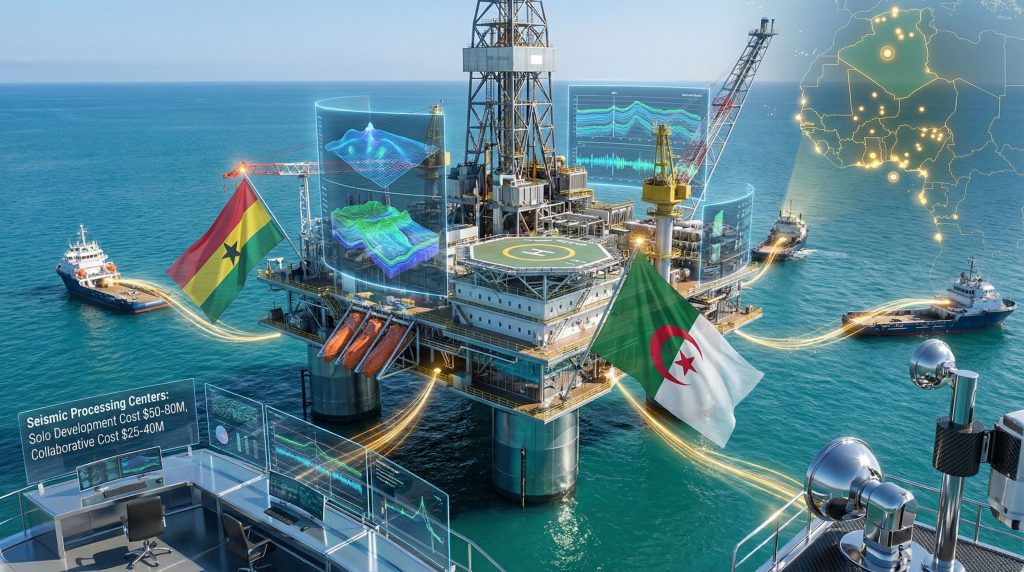
The economic rationale for collaborative approaches becomes particularly compelling when considering the capital intensity of advanced upstream technologies. Seismic processing centres, artificial intelligence development platforms, and specialised laboratory facilities require substantial upfront investment that may be difficult to justify through standalone business cases, particularly for mid-tier national oil companies operating in challenging fiscal environments.
Disclaimer: Specific cost reduction estimates for collaborative R&D models vary significantly based on technology categories, implementation timelines, and operational contexts. Investment decisions should be evaluated based on detailed technical and economic analysis specific to individual partnership structures and participating company circumstances.
Return on Investment Measurement and Performance Metrics
ROI evaluation for collaborative upstream R&D initiatives requires comprehensive measurement frameworks encompassing production efficiency improvements, capital cost reductions, asset life extension quantification, and technology transfer value assessment. The Sonatrach GNPC upstream R&D collaboration establishes performance metrics targeting operational optimisation through enhanced recovery techniques, improved reservoir management, and digital transformation of legacy operations.
Production efficiency improvements serve as primary ROI indicators, measuring enhanced recovery factors, optimised well placement outcomes, and reduced operational downtime through predictive maintenance systems. These metrics enable quantification of technology deployment benefits across partner asset portfolios while establishing baseline performance standards for evaluating collaborative research programme effectiveness.
Asset life extension calculations represent another critical ROI measurement dimension, particularly relevant for mature field operations where enhanced recovery technologies can significantly extend economic production timeframes. The partnership framework enables sharing of enhanced recovery techniques, reservoir modelling innovations, and production optimisation strategies that collectively contribute to improved asset economics and extended operational lifecycles.
Technology transfer value quantification encompasses licensing potential to third-party operators, knowledge capital development, and workforce capability enhancement achieved through collaborative research programs. These benefits extend beyond immediate operational improvements to create sustainable competitive advantages for participating national oil companies while strengthening regional technical capabilities.
Technical Innovation Areas Driving African Upstream Transformation
Subsurface Intelligence and Advanced Reservoir Characterisation
The technical scope of the Sonatrach GNPC upstream R&D collaboration encompasses advanced subsurface intelligence capabilities including 4D seismic monitoring, artificial intelligence-enabled interpretation systems, and real-time reservoir modelling platforms. These technologies represent critical capability requirements for optimising production from mature assets while improving exploration success rates in frontier basins across the African continent.
4D seismic monitoring enables time-lapse reservoir surveillance, providing detailed insights into fluid movement patterns, pressure distribution changes, and production optimisation opportunities throughout field lifecycles. This technology particularly benefits mature asset operations where enhanced recovery implementation requires precise understanding of remaining hydrocarbon distribution and optimal injection strategies for secondary and tertiary recovery programs.
Machine learning algorithms for geological pattern recognition enhance exploration efficiency by identifying optimal drilling locations, reducing exploration risks, and improving resource confidence assessments. The collaborative development of these AI-enabled interpretation capabilities creates shared technical assets that can be deployed across diverse geological contexts while accelerating learning curves for participating operators.
Integrated subsurface modelling combines seismic data, well logs, production history, and pressure measurements to create comprehensive reservoir characterisation models supporting optimised development planning and production forecasting. The partnership framework enables sharing of modelling methodologies, calibration techniques, and validation approaches that collectively improve subsurface understanding across partner operations.
Digital Operations Infrastructure and Automation Systems
Digital transformation initiatives within the collaboration encompass IoT sensor networks for continuous asset monitoring, cloud-based data integration platforms, automated drilling optimisation systems, and remote operations capabilities for offshore assets. These digital infrastructure investments enable real-time decision-making, reduce operational costs, and improve safety performance across upstream operations whilst supporting data-driven operations future strategies.
IoT sensor deployment provides continuous monitoring of downhole conditions, surface equipment performance, and operational parameters, enabling predictive maintenance strategies that reduce equipment failures and operational downtime. The shared development of sensor networks and data integration systems creates economies of scale while standardising monitoring capabilities across partner operations.
Cloud-based data integration platforms centralise disparate information sources including seismic data, production measurements, equipment performance metrics, and geological interpretations, creating comprehensive operational dashboards supporting integrated asset management. The collaborative approach enables sharing of platform development costs while creating standardised data management protocols facilitating cross-border knowledge sharing.
Automated drilling optimisation systems adjust drilling parameters in real-time based on subsurface conditions, hole stability analysis, and equipment performance monitoring, improving wellbore quality while reducing non-productive time and drilling costs. Joint development of these automation systems enables sharing of algorithmic innovations and operational learnings across diverse drilling environments.
Enhanced Recovery Technologies and Environmental Compliance
Enhanced recovery technology development represents a core focus area for the partnership, encompassing CO2 injection systems for mature field revitalisation, chemical flooding techniques for heavy oil reservoirs, thermal recovery methods adapted for African geological conditions, and water management solutions supporting sustainable operations. These technologies address critical operational requirements for extending asset productive life while improving recovery factors from existing reserves.
The collaboration framework also addresses emissions management and carbon footprint reduction technologies, aligning with energy transition strategies while maintaining operational performance. This dual focus reflects industry recognition that sustainable upstream operations require integration of environmental compliance technologies with core production optimisation systems.
Well integrity and corrosion management innovations developed through the partnership address common operational challenges affecting aging infrastructure throughout African upstream operations. Advanced monitoring systems, predictive maintenance algorithms, and materials science innovations create shared solutions for equipment reliability and operational safety improvement across partner asset portfolios.
Regional Market Dynamics and Production Optimisation Strategies
West African Production Challenges and Technology Solutions
Ghana's upstream revitalisation strategy demonstrates how technology partnerships address specific regional production challenges while supporting broader energy security objectives. The Ghana National Petroleum Corporation's collaboration with international partners including Tullow Oil and Kosmos Energy on Jubilee field development illustrates integrated approaches combining enhanced recovery technologies with digital transformation initiatives supporting extended asset productive life.
The Jubilee field redevelopment programme, targeting expansion through continued drilling and production optimisation campaigns, exemplifies how collaborative R&D programs support field development strategies. Rather than independent technology development, partnership approaches enable cost-effective deployment of advanced subsurface analysis, enhanced recovery techniques, and digital monitoring systems supporting optimised production performance.
Gas monetisation initiatives represent additional technology deployment opportunities where collaborative research programs generate shared benefits. Advanced processing technologies, pipeline optimisation systems, and power generation integration capabilities developed through partnership frameworks can support domestic energy security objectives while creating export revenue opportunities for participating operators.
Algeria's Infrastructure Modernisation and Regional Technology Transfer
Algeria's production sustainability framework encompasses comprehensive infrastructure modernisation targeting enhanced recovery implementation across mature assets, digital transformation of legacy operations, and exploration expansion in unconventional resources. The Sonatrach GNPC upstream R&D collaboration provides mechanisms for sharing technological innovations developed through Algeria's modernisation programs while accessing technical capabilities developed by partner operators.
Enhanced recovery implementation across Sonatrach's mature asset portfolio creates opportunities for technology validation and optimisation that benefit all partnership participants. Advanced reservoir modelling techniques, injection optimisation strategies, and production monitoring systems tested in Algerian operations can be adapted for deployment across diverse geological contexts throughout West Africa.
The infrastructure modernisation programme's emphasis on digital transformation creates shared learning opportunities for implementing advanced operational technologies across African upstream operations. Partnership frameworks enable knowledge transfer regarding automation system deployment, data management platform implementation, and workforce development strategies supporting technology adoption across regional operations.
Investment Implications and Strategic Market Positioning
Competitive Positioning Through Collaborative Innovation
The Sonatrach GNPC upstream R&D collaboration creates strategic advantages for participating national oil companies through reduced dependence on international technology providers, enhanced negotiating power in service contracts, improved operational efficiency metrics, and strengthened regional energy security positioning. These competitive benefits extend beyond immediate operational improvements to create sustainable market positioning advantages for African energy producers.
Technology licensing potential represents significant value creation opportunities for partnership participants. Innovations developed through collaborative research programs can generate additional revenue streams through licensing agreements with other African operators while establishing technological leadership positions in specific technical specialisation areas. Consequently, this approach transforms R&D investment from pure cost centres into potential profit-generating business activities.
Enhanced ESG profiles resulting from emissions reduction technologies, environmental compliance innovations, and sustainable operational practices developed through the partnership attract sustainable investment capital while improving access to international financing markets. These benefits become increasingly important as global energy markets emphasise environmental performance alongside operational efficiency in investment decision-making processes.
Regional hub development opportunities emerge as partnership participants establish technological capabilities that can serve broader African upstream markets. Specialised service provision, technology licensing, and technical consultation services create additional business opportunities while strengthening regional energy industry capabilities and reducing continental dependence on external technology providers.
Continental Energy Security and Strategic Independence
Collaborative R&D programs contribute to continental energy security through reduced technology import dependencies, enhanced local technical capability development, improved resource recovery rates across African operations, and strengthened intra-African energy cooperation frameworks. These strategic benefits extend beyond participating companies to support broader regional energy security objectives.
The partnership approach enables African national oil companies to develop indigenous technical capabilities that reduce reliance on international service providers while creating sustainable technology transfer mechanisms supporting broader regional development objectives. This strategic independence becomes increasingly important as global energy markets experience supply chain disruptions and geopolitical tensions affecting technology access and service provider availability.
Improved resource recovery rates achieved through collaborative technology deployment contribute to continental energy security by maximising production from existing reserves while extending asset productive lifecycles. These efficiency improvements reduce the need for aggressive exploration programs in environmentally sensitive areas while supporting sustainable development objectives through optimised resource utilisation.
The next major ASX story will hit our subscribers first
Implementation Roadmap and Success Metrics
Performance Measurement and Milestone Development
Successful implementation of collaborative upstream R&D programs requires comprehensive performance measurement frameworks encompassing operational efficiency improvements, technology deployment success rates, cost reduction achievements, and knowledge transfer effectiveness. The partnership framework establishes clear milestone deliverables while maintaining flexibility for programme adaptation based on changing market conditions and technological developments.
Disclaimer: Performance targets and implementation timelines for collaborative R&D programs should be established based on detailed technical assessments, market analysis, and participating company capabilities. Projected outcomes may vary significantly based on implementation approaches, market conditions, and operational factors specific to individual partnership contexts.
Technology deployment speed metrics measure the acceleration of innovation implementation achieved through collaborative approaches compared to standalone development programs. These measurements enable evaluation of partnership effectiveness while identifying optimisation opportunities for future collaborative research initiatives. However, faster deployment timelines create competitive advantages while reducing technology development costs through shared investment approaches.
Knowledge transfer effectiveness assessment encompasses workforce development outcomes, technical capability enhancement, and cross-border collaboration success rates achieved through partnership programmes. These metrics evaluate the sustainable impact of collaborative research initiatives while identifying best practices for scaling successful approaches across broader regional cooperation frameworks.
Scaling Framework and Future Partnership Development
The success of the Sonatrach GNPC upstream R&D collaboration creates precedents for expanding collaborative approaches across additional African national oil companies while establishing standardised frameworks for cross-border technology development partnerships. Phased implementation strategies enable gradual programme expansion while maintaining quality control and performance standards throughout scaling processes.
Integration opportunities with renewable energy innovations, advanced automation systems, satellite-based monitoring capabilities, and blockchain applications for resource tracking represent future development pathways that can leverage collaborative research frameworks for addressing evolving industry requirements. These emerging technology areas benefit from shared investment approaches while creating additional value creation opportunities for partnership participants.
The collaborative model established through the partnership framework can influence global industry standards by demonstrating effective approaches for climate-adapted upstream technologies, low-cost exploration techniques for frontier basins, and sustainable development models balancing economic and environmental objectives. These innovations position African energy producers as technological leaders while creating export opportunities for specialised technical capabilities developed through collaborative research programs.
Want to Stay Ahead of Major Energy Market Discoveries?
Discovery Alert's proprietary Discovery IQ model delivers real-time alerts on significant ASX mineral discoveries, instantly empowering subscribers to identify actionable opportunities ahead of the broader market. Begin your 30-day free trial today and secure your market-leading advantage in the evolving energy and resources sector.