July 21, 2026
Strategic Underground Operations: Engineering Competitive Advantage Through Advanced Transport Architecture
Material handling in deep mining environments has evolved from a necessary operational expense into a sophisticated competitive differentiator. Modern underground operations require integrated transport systems that respond dynamically to geological variations, production demands, and equipment performance metrics. This transformation reflects a fundamental shift in mining engineering philosophy where transforming material movement into strategic capability drives overall operational excellence.
Traditional approaches to underground material movement focused primarily on moving tonnage from extraction points to surface processing facilities. Contemporary strategic frameworks integrate real-time geological data, predictive maintenance algorithms, and autonomous coordination systems to maximize both throughput efficiency and operational resilience.
The economic impact of strategic material movement extends beyond direct transport costs. According to the International Council on Mining & Metals, material movement represents 20-30% of total operating costs in underground mining operations. Operations implementing integrated transport systems typically achieve 15-25% efficiency improvements through optimized routing, predictive maintenance, and dynamic fleet allocation.
When big ASX news breaks, our subscribers know first
Core Elements of Strategic Material Transport Systems
Real-Time Integration and Decision Intelligence
Strategic material transport architecture operates on the principle of integrated demand sensing, where ore grade analysis dynamically influences transport routing and priority sequencing. This represents a departure from traditional fixed-schedule transport models that treat all material equally regardless of economic value.
Modern systems incorporate X-ray Fluorescence (XRF) or similar grade analysis technology at extraction points, enabling real-time identification of high-value ore streams. This data integrates with inventory management systems to prioritize material movement based on grade and processing requirements.
Key Performance Indicators for Strategic Systems:
• Tonnes per Operating Hour (TPOH): Measures net material throughput efficiency
• Equipment Availability Rate (EAR): Tracks fleet utilization percentage
• Cost Per Tonne Moved: Direct operational cost metric
• Cycle Time Variance: Identifies consistency and reliability of transport systems
• Energy Consumption Per Tonne: Environmental and cost efficiency indicator
Supply Chain Visibility and Operational Response
IoT-enabled tracking systems provide end-to-end visibility of individual load movements from stope to surface processing facilities. These systems utilize mesh network topology to maintain coverage in deep underground environments, typically requiring 1-5 Mbps bandwidth per vehicle depending on sensor data transmission requirements.
Decision intelligence systems employ ai in mining optimization algorithms that analyze historical transport data to predict optimal routing patterns. Constraint optimization modeling coordinates multiple vehicles simultaneously while adapting to real-time operational conditions including equipment failures and production changes.
Operational response mechanisms include automated alerts for equipment performance degradation, dynamic maintenance scheduling to minimize production impact, and rapid fleet reallocation protocols for system failures.
Quantifying Transport Bottleneck Economics
Hidden Cost Analysis Framework
Underground transport inefficiencies create cascading economic impacts that extend far beyond direct equipment operating costs. Production loss from transport constraints averages 12-18% throughput reduction in operations lacking integrated systems. This reduction translates to significant opportunity costs through reduced mill utilization and extended fixed cost allocation per tonne processed.
Cost Categories in Material Movement Inefficiencies:
Direct Operating Costs:
• Fuel/energy consumption during idle periods
• Operator labor during non-productive cycles
• Maintenance triggered by extended operating hours
Opportunity Costs:
• Lost production from throughput reduction
• Mill processing capacity underutilization
• Deferred revenue impact from delayed material processing
Equipment Capital Costs:
• Additional fleet size required to maintain minimum throughput
• Higher depreciation from idle asset utilization
• Extended equipment replacement cycles
Critical Bottleneck Identification
Systematic bottleneck analysis requires evaluation across three temporal categories: structural limitations in system design capacity, operational constraints from maintenance or staffing factors, and contingent limitations that emerge under specific operating scenarios.
Vertical transport capacity typically represents the primary system constraint in deep mines, with shaft hoisting capacity limiting overall production potential. Furthermore, optimized shaft scheduling can improve utilization by 20-30% through better sequencing of material types and maintenance windows.
Horizontal haulage networks face constraints from roadway width limitations that restrict vehicle size and speed, intersection design impacts on cycle times, and grade limitations affecting payload capacity and fuel consumption. Network density determines routing flexibility during equipment downtime, making redundant pathway design essential for operational resilience.
Critical Bottleneck Metrics:
| Bottleneck Type | Typical Impact | Optimization Potential |
|---|---|---|
| Shaft Capacity | 15-25% production limit | 20-30% improvement |
| Loading Cycles | 30-50% cycle time | 15-20% reduction |
| Maintenance Windows | 10-15% production loss | 60-80% elimination |
| Network Congestion | 12-18% throughput reduction | 25-35% improvement |
Battery-Electric Vehicle Integration in Deep Mining
Performance and Economic Analysis
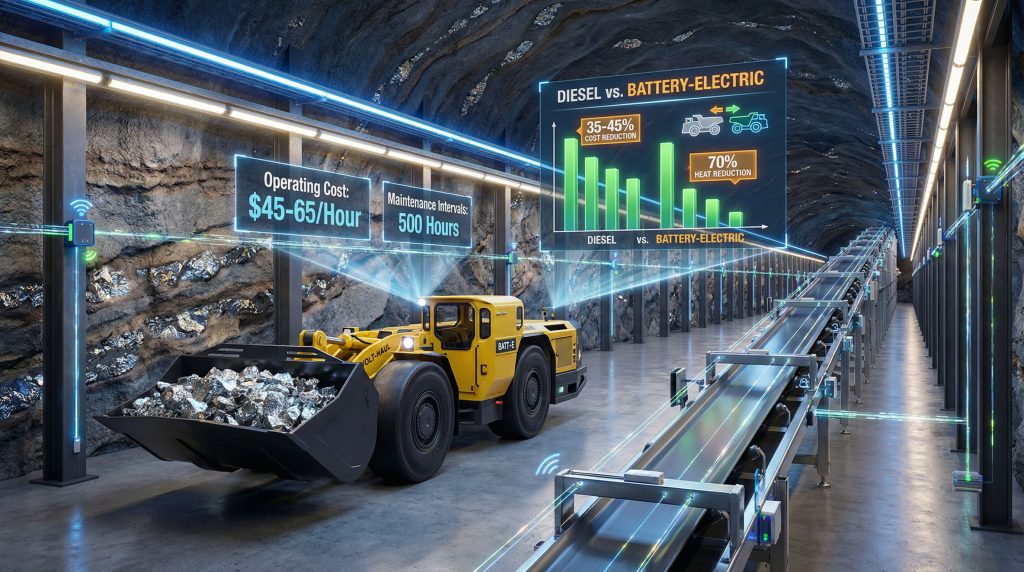
Battery-electric Load-Haul-Dump (LHD) vehicles represent a fundamental technology shift in underground material transport, offering significant operational and environmental advantages over diesel-powered equivalents. The elimination of diesel emissions reduces ventilation infrastructure requirements, decreasing both capital expenditure and operating costs.
Comparative Performance Metrics:
| Performance Factor | Diesel LHD | Battery-Electric LHD | Improvement Factor |
|---|---|---|---|
| Operating Cost/Hour | $85-120 | $45-65 | 35-45% reduction |
| Ventilation Requirements | High | Minimal | 60-80% reduction |
| Heat Generation | 35-45 kW | 8-12 kW | 70% reduction |
| Maintenance Intervals | 250 hours | 500 hours | 100% increase |
| Energy Consumption | 8-15L diesel/hour | 0.8-1.2 kWh/km | Variable by application |
Battery-electric systems demonstrate superior performance consistency across varying load ranges compared to diesel engines, which experience efficiency degradation during frequent start-stop cycles common in underground operations. Electric powertrains maintain peak torque availability across their operating range, enabling consistent performance regardless of payload variation.
Additionally, sustainable ev solutions are driving industry adoption through improved battery recycling processes and circular economy principles.
Technical Implementation Requirements
Battery-electric LHD systems typically incorporate 150-300 kWh battery capacity depending on vehicle size and operational requirements. Fast-charging infrastructure positioned every 2-3 km of haulage distance enables 30-60 minute partial charge cycles supporting multi-shift operation.
Charging infrastructure requires careful electrical system design to handle simultaneous vehicle charging while maintaining mine power system stability. Underground charging stations must meet stringent safety requirements for explosive atmosphere classification and provide reliable operation in challenging environmental conditions.
Performance factors affecting battery-electric implementation include depth of operation, where battery performance may degrade slightly in deeper, cooler environments, and infrastructure requirements for charging station installation versus traditional fuel supply systems.
Autonomous Fleet Management and Coordination
Advanced Control Architecture
Autonomous fleet management in underground environments requires sophisticated sensor fusion and communication systems capable of functioning in GPS-denied environments with significant radio frequency challenges. Current operational systems primarily operate in semi-autonomous modes with remote operator oversight rather than fully autonomous operation.
Real-time coordination mechanisms process sensor data at 10-100Hz frequency depending on vehicle speed requirements. Multi-vehicle path optimization algorithms continuously track position data from all fleet units while managing collision avoidance protocols and dynamic routing adaptations.
Essential Sensor Technologies:
• LiDAR scanning systems for obstacle detection and three-dimensional mapping
• Inertial measurement units for position estimation in GPS-denied environments
• Proximity sensors providing collision avoidance capabilities
• Wheel slip detection systems for traction control and stability
Predictive Maintenance Integration
IoT sensor arrays monitor critical component performance including battery state-of-health for electric vehicles, hydraulic pressure signatures, temperature monitoring across critical systems, and vibration analysis for bearing and drivetrain health assessment. These safe haulage operations benefit from predictive maintenance through enhanced operational safety and reliability.
Machine learning algorithms identify degradation patterns 200-400 hours before typical failure points, enabling maintenance scheduling that minimises production impact. Predictive maintenance systems integrate with fleet management to optimise maintenance windows and parts inventory requirements.
Communication infrastructure utilises mesh network topology maintaining coverage throughout deep underground environments. System requirements include latency below 100 milliseconds for real-time coordination and redundancy systems for mission-critical operations.
Continuous Transport and Conveyor Solutions
High-Angle Conveyor Implementation
Continuous transport systems offer alternative technology pathways to discrete vehicle-based transport, providing advantages in specific operational contexts while facing constraints in others. High-angle conveyor systems transport material on inclines up to 35-40 degrees compared to 15-20 degrees for standard horizontal conveyors.
Conveyor System Specifications:
• Throughput capacity: 500-2,000 tonnes per hour depending on belt width and speed
• Technology: Troughed belt design with cleats or self-cleaning surfaces
• Application: Reducing vertical hoisting requirements in specific mine configurations
• Maintenance requirements: Scheduled maintenance every 2,000-4,000 operating hours
Pneumatic and Rail-Based Transport
Pneumatic transport systems handle bulk material movement for specific ore types, particularly suited to fine-grained materials or concentrates. These systems operate through pressure differential creating material flow through enclosed piping systems.
Rail-based systems provide heavy-duty transport capabilities for high-volume operations, offering consistent throughput with lower energy consumption per tonne compared to rubber-tired vehicles. Rail systems require significant infrastructure investment but provide long-term operational cost advantages in suitable applications.
The next major ASX story will hit our subscribers first
Implementation Strategy and Economic Returns
Strategic Assessment Framework
Successful transformation to strategic material movement requires systematic evaluation across multiple operational dimensions. The 30-day strategic assessment framework begins with comprehensive current state analysis including material flow mapping, bottleneck identification, and baseline performance measurement.
Technology readiness evaluation assesses infrastructure requirements for advanced systems, including electrical capacity for battery-electric vehicles, communication system capabilities for autonomous operations, and maintenance facility upgrades for new equipment technologies. Research indicates that strategic capabilities development requires integrated organisational transformation alongside technological upgrades.
Implementation Timeline:
Phase 1 (Months 1-6): Infrastructure preparation and pilot system deployment
• Electrical system upgrades for charging infrastructure
• Communication network installation and testing
• Operator training and change management programs
Phase 2 (Months 7-18): Gradual fleet modernisation and system integration
• Staged vehicle replacement maintaining operational continuity
• Integration testing between autonomous systems and existing operations
• Performance monitoring and optimisation refinement
Phase 3 (Months 19-24): Full autonomous operation and optimisation refinement
• Complete system integration and autonomous coordination
• Advanced analytics implementation for continuous improvement
• Expansion planning for additional operational areas
Return on Investment Analysis
Economic benefits from strategic material movement systems derive from both direct cost reductions and indirect value creation opportunities. Direct cost reduction typically includes 30-40% reduction in operating costs through labour optimisation, energy efficiency gains, and maintenance cost reduction through predictive maintenance and improved equipment longevity.
Investment Return Scenarios:
• Conservative Estimate: 18-22% Internal Rate of Return over 10-year operational period
• Optimistic Projection: 28-35% IRR with full system integration and optimisation
• Break-even Analysis: Typical payback period of 3.5-4.5 years for comprehensive upgrades
Indirect value creation includes production flexibility enabling rapid response to grade variations, operational resilience through reduced dependency on manual operations, and environmental compliance benefits through lower emissions and improved air quality metrics.
Future Technology Integration and Market Evolution
Emerging Technology Convergence
Fifth-generation (5G) connectivity enables enhanced real-time communication and control systems supporting more sophisticated autonomous operations. Digital twin technology provides virtual modelling capabilities for optimisation and predictive analysis, while machine learning applications create adaptive systems that improve performance over time.
However, data‑driven mining operations require careful integration of multiple data streams to achieve transforming material movement into strategic capability effectively.
Technology Integration Priorities:
• Enhanced sensor fusion for improved autonomous navigation
• Advanced battery chemistry extending operational range and reducing charging time
• Improved communication protocols enabling larger fleet coordination
• Predictive analytics refinement for maintenance and performance optimisation
Sustainability and Regulatory Drivers
Carbon footprint reduction through electric vehicle adoption and renewable energy integration aligns with evolving environmental regulations and corporate sustainability commitments. Circular economy principles guide equipment lifecycle optimisation and recycling program development.
Regulatory compliance requirements continue evolving toward stricter environmental standards and expanded reporting requirements. Operations implementing strategic material movement systems demonstrate competitive advantages through improved compliance capabilities and reduced environmental impact.
Market Evolution Factors:
• Critical mineral demand increasing focus on efficient extraction and processing
• Labour shortage mitigation through automation addressing skilled worker availability challenges
• Operational cost pressures making efficiency improvements competitive necessity
• Technology cost reduction enabling broader implementation across mining operations
Strategic material movement transformation represents more than equipment upgrades or operational improvements. It fundamentally restructures underground mining operations to create sustainable competitive advantages through integrated technology systems, optimised operational processes, and resource integration capabilities that position operations for long-term success in an increasingly competitive mining environment.
The transformation of transforming material movement into strategic capability requires comprehensive evaluation of existing operations, systematic implementation planning, and ongoing optimisation refinement to realise full potential benefits across operational, environmental, and economic dimensions.
This analysis is based on industry research and operational data. Readers should conduct independent evaluation of specific operational conditions and requirements before implementing strategic material movement systems. Investment decisions should consider operational risk factors, regulatory requirements, and long-term market conditions.
Ready to Capitalise on Underground Mining Innovation?
Discovery Alert's proprietary Discovery IQ model delivers real-time alerts on significant ASX mineral discoveries, instantly empowering subscribers to identify mining technology leaders and operational innovators ahead of the broader market. Begin your 14-day free trial today and secure your market-leading advantage in the rapidly evolving underground mining sector.