May 20, 2026
Strategic Vulnerabilities in Global Aluminium Trade Networks
Critical supply chain dependencies have transformed modern industrial metals markets into complex webs of geographic concentration and logistical fragility. The aluminium sector exemplifies this evolution, where production consolidation in politically sensitive regions creates systemic risks that extend far beyond immediate price volatility. Understanding these vulnerabilities requires examining the intersection of geopolitical tensions, energy security, and industrial capacity distribution across global trade corridors.
Gulf Region Production Concentration Creates Market Instability
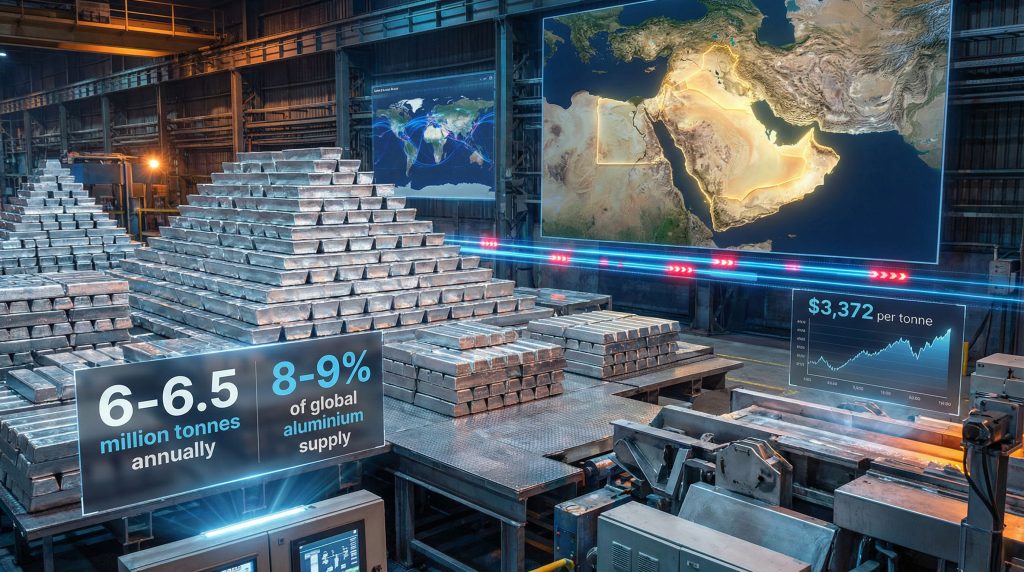
The Middle East conflict impact on aluminium industry reveals fundamental weaknesses in global supply architecture. Gulf Cooperation Council nations collectively contribute 6.5 million tonnes annually to worldwide aluminium production, representing approximately 8.5% of global output. This concentration becomes particularly problematic when considering export dependencies, with regional producers shipping 5.3 million tonnes to international markets each year.
Production capacity analysis across the region demonstrates significant concentration risks:
| Country | Annual Capacity (Mt) | Export Volume (Mt) | Primary Markets |
|---|---|---|---|
| UAE | 2.9 | 2.6 | Asia, Europe |
| Saudi Arabia | 1.9 | 1.7 | Asia, Americas |
| Bahrain | 1.3 | 1.1 | Europe, Asia |
| Qatar | 0.9 | 0.8 | Asia, Europe |
Regional smelting operations face dual exposure through input material dependencies and output market access constraints. Gulf producers import 97% of bauxite requirements and 95% of alumina feedstock, creating compounding vulnerabilities when maritime corridors experience disruption. This dependency structure amplifies regional conflicts into global supply chain crisis scenarios.
Energy infrastructure interconnectedness further complicates production stability. Furthermore, natural gas trends affect smelting operations, with industrial consumers competing against power generation and fertilizer production for limited supplies. Analysis of energy distribution patterns shows 30% of natural gas consumption directed toward fertilizer manufacturing, while 21% supports combined cycle gas generation and 13% powers thermal plants.
Immediate Supply Disruptions Trigger Operational Responses
Maritime corridor closures have prompted immediate operational adjustments across Gulf aluminium facilities. Production curtailments at major smelting complexes reflect the interconnected nature of regional energy systems and raw material flows. These adjustments demonstrate how the Middle East conflict impact on aluminium industry translates directly into industrial capacity constraints.
Critical supply chain bottlenecks include:
- Alumina inventory depletion at accelerated rates due to shipping delays
- Bauxite stockpile management challenges affecting medium-term production planning
- Energy supply prioritisation impacting smelting operations continuity
- Export logistics coordination requiring alternative transportation solutions
The region's operational model relies on maintaining minimal working inventories, typically holding 3-4 weeks of alumina stocks under normal conditions. This lean inventory approach, while cost-effective during stable periods, creates immediate vulnerability when supply chains experience disruption.
Force majeure declarations by regional producers signal the severity of logistical constraints. These legal protections allow companies to suspend delivery obligations during extraordinary circumstances, effectively transferring supply risk to global buyers who must secure alternative sourcing arrangements.
Global Market Response Mechanisms and Price Discovery
International aluminium markets have responded to supply constraints through multiple adjustment mechanisms. London Metal Exchange pricing reached $3,372 per tonne, with forward projections extending toward $4,000 per tonne under sustained disruption scenarios. Consequently, these price movements reflect both immediate supply concerns and anticipatory positioning by market participants.
Regional premium structures have experienced significant recalibration:
Premium Analysis by Market:
- European P1020 premium: $425/tonne (+20% above historical averages)
- US Midwest premium: $1.07/lb (approaching record levels)
- Asian spot premiums: 20% elevation from baseline pricing
- Forward curve premiums: Sustained elevation through 12-month horizon
Alternative sourcing strategies have emerged as buyers seek supply security. Australian and Canadian producers report increased inquiry volumes, while recycled aluminium streams experience heightened demand as manufacturers explore feedstock diversification. Additionally, bauxite project benefits become more apparent as companies seek supply security. These shifts indicate structural changes in procurement strategies extending beyond immediate crisis response.
Market participants are implementing strategic inventory accumulation, building 60-90 day consumption buffers to reduce exposure to future supply disruptions while accepting higher working capital requirements.
Financial markets have responded through derivative instrument activity, with hedging volumes increasing 40% as industrial consumers seek price volatility protection. This hedging activity reflects expectation of sustained elevated pricing and supply uncertainty extending into medium-term planning horizons.
Transportation Alternatives and Logistics Constraints
Alternative transportation corridors present significant operational challenges for maintaining export flows. Overland logistics solutions through Saudi Arabia and UAE road networks offer limited capacity compared to maritime shipping volumes. Truck transportation costs exceed sea freight by 3-5 times, while adding 10-15 days to delivery schedules.
Overland Route Analysis:
- Capacity limitations: Road transport cannot accommodate full production volumes
- Cost implications: Transportation expense increases reduce producer margins significantly
- Infrastructure constraints: Port facilities at alternative discharge points operate near capacity
- Transit time extensions: Extended delivery schedules disrupt just-in-time manufacturing
Cape of Good Hope routing provides another alternative despite substantial trade-offs. Extended transit times of 18 days to European markets and freight cost increases of 50% make this option economically challenging for many product categories. Marine insurance premiums increase proportionally with voyage duration and route risk assessment.
Railway infrastructure represents an underutilised alternative, though Saudi rail network capacity and UAE-Oman connections require significant coordination to achieve meaningful volume handling. However, intermodal solutions combining truck and rail transport offer potential efficiency improvements while maintaining reasonable cost structures.
Raw Material Dependencies Amplify Supply Chain Risks
Bauxite and alumina import dependencies create compounding effects during transportation disruptions. Gulf smelters rely entirely on seaborne raw material imports, with Guinea supplying 40%, Australia contributing 35%, and Brazil providing 25% of bauxite requirements.
Alumina sourcing distribution follows similar concentration patterns:
- Australian refineries: 60% of Gulf alumina imports
- Brazilian operations: 25% of supply volumes
- Other global suppliers: 15% from diversified sources
These dependency structures create timeline synchronisation challenges. Bauxite processing into alumina requires 4-6 weeks, while alumina conversion to primary aluminium adds another 2-3 weeks to the production cycle. Supply disruptions at any stage create cascading effects throughout the entire value chain.
Quality specifications further limit sourcing flexibility:
- Metallurgical grade requirements restrict acceptable bauxite sources
- Chemical composition standards limit alumina supplier options
- Processing technology compatibility constrains rapid supplier switching
- Long-term contract obligations reduce short-term sourcing agility
Strategic petroleum reserve analysis provides relevant context for understanding supply security approaches. India maintains 74 days of oil storage capacity, combining 9.5 days in Strategic Petroleum Reserves with 64.5 days in commercial storage. This model demonstrates how nations approach critical resource security through diversified inventory strategies.
Industrial Consumer Adaptation Strategies
Automotive sector impacts extend beyond immediate material costs into fundamental design and production strategies. The industry consumes 25% of global aluminium production, making supply security essential for lightweight vehicle programs and emission compliance strategies.
Manufacturing response mechanisms include:
- Body panel material substitution toward steel alternatives in cost-sensitive applications
- Production schedule adjustments to accommodate extended material lead times
- Supplier diversification programmes reducing dependence on Middle East sources
- Strategic inventory accumulation building 90-day material buffers
Cost implications for automotive manufacturers show 15-20% increases in body panel expenses, directly impacting profit margins and vehicle pricing strategies. Lightweight material programmes face particular pressure as alternative materials may compromise fuel efficiency targets and regulatory compliance objectives.
Construction industry adaptation follows similar patterns, with curtain wall and structural component applications experiencing immediate cost pressures. For instance, project delays have become commonplace as material availability uncertainty affects construction scheduling and budget planning.
Long-Term Structural Market Realignment
Extended supply disruptions catalyst permanent changes in global aluminium trade architecture. Geographic diversification away from concentrated production regions becomes a strategic imperative for supply security, while regional self-sufficiency initiatives gain political and economic support.
Supply chain resilience enhancement involves:
- Multiple sourcing strategies reducing single-region dependencies
- Strategic inventory policies accepting higher working capital requirements
- Technology innovation accelerating recycling capabilities and alternative production methods
- Regional capacity development supporting domestic production initiatives
Investment patterns are shifting toward alternative production regions with stable political environments and diversified energy supplies. Aluminium prices surge as Australian, Canadian, and Norwegian aluminium projects receive increased attention from global consumers seeking supply security.
Financial hedging evolution reflects permanent changes in risk management approaches:
- Extended contracting periods from 12-month to 36-month terms
- Price volatility insurance products gaining market acceptance
- Currency hedging integration for alternative supplier regions
- Supply chain financing supporting inventory accumulation strategies
Risk Management Framework Evolution
Corporate risk management approaches are incorporating lessons from current supply disruptions into permanent operational strategies. Enhanced supply chain visibility systems enable real-time monitoring of material flows and early warning of potential disruptions.
Inventory management optimisation balances:
- Carrying cost implications against supply security benefits
- Working capital allocation between raw materials and finished goods
- Storage facility investments supporting strategic stockpiling
- Logistics coordination managing multiple supplier relationships
Government policy responses indicate recognition of strategic material security importance. National aluminium reserves similar to petroleum stockpiles receive consideration, while trade finance support facilitates alternative sourcing arrangements during crisis periods.
Additionally, understanding how tariffs impact markets becomes crucial as nations implement protective measures for strategic materials. Moreover, tariff economic implications affect global trade flows and pricing structures.
Future Market Structure and Investment Implications
The Middle East conflict impact on aluminium industry extends beyond immediate supply disruptions into fundamental market structure evolution. Regional production concentration risks drive investment toward geographically diversified capacity, while supply chain resilience becomes a competitive advantage rather than operational overhead.
Investment priorities are shifting toward:
- Recycling technology advancement reducing primary material dependencies
- Alternative energy integration supporting smelting operations in stable regions
- Transportation infrastructure enabling flexible logistics solutions
- Digital supply chain management improving visibility and coordination
Long-term price forecasting must incorporate geopolitical risk premiums reflecting permanent changes in supply chain architecture. Markets previously characterised by cost optimisation are evolving toward security-weighted procurement strategies accepting higher baseline costs for reduced disruption exposure.
The transformation of global aluminium markets demonstrates how regional conflicts create cascading effects throughout interconnected industrial systems. Furthermore, middle east tensions impact aluminium supply chains more significantly than previously anticipated. Organisations adapting quickly to these new realities position themselves advantageously for navigating future disruptions while maintaining competitive operations in an increasingly volatile global trade environment.
Disclaimer: This analysis contains forward-looking statements and market forecasts subject to significant uncertainty. Industrial commodity markets involve substantial risks, and past performance does not guarantee future results. Readers should conduct independent research before making investment or business decisions based on this information.
Looking to Capitalise on Commodity Market Disruptions?
Discovery Alert's proprietary Discovery IQ model delivers instant notifications on significant ASX mineral discoveries, helping investors identify actionable opportunities as global supply chains face increasing disruption. With aluminium and other critical commodities experiencing unprecedented volatility, subscribers gain rapid insights into potential market-leading positions ahead of the broader market, turning complex commodity data into clear investment opportunities.