July 21, 2026
Understanding Strategic Waterway Vulnerabilities in Modern Trade
The interconnected nature of global energy supply chains creates fundamental structural weaknesses that become starkly apparent when key maritime corridors face operational disruptions. Recent developments demonstrate how quickly ships abort Hormuz transit attempts when geopolitical tensions escalate, with tracking data indicating significant operational impacts across multiple vessel categories. These vulnerabilities extend far beyond immediate shipping delays, manifesting as cascading economic shocks that ripple through international commodity markets and challenge the resilience of established trade relationships.
Modern energy security depends heavily on a handful of critical chokepoints where geographic constraints force massive volumes of seaborne trade through narrow passages. The concentration of energy flows through these strategic waterways creates systemic risks that can rapidly transform from localised shipping concerns into global economic disruptions affecting everything from manufacturing supply chains to consumer energy prices.
Recent events demonstrate how quickly maritime access uncertainty can force at least 21 vessels to abort Hormuz transit attempts, with tracking data indicating that at least 15 of these vessels were tankers across multiple size classes that had been trapped in the region since conflict began on February 28, 2026. This operational reality highlights the complex decision-making calculus that vessel operators must navigate when geopolitical tensions intersect with commercial shipping requirements.
The Strait of Hormuz represents a particularly critical vulnerability point, with approximately 21% of global petroleum passing through this narrow waterway annually, making it one of the world's most strategically important chokepoints. At its narrowest point, the strait spans only 33 nautical miles with shipping channels restricted to 2-nautical-mile-wide corridors in each direction, creating natural bottlenecks that amplify the impact of any access restrictions.
When big ASX news breaks, our subscribers know first
What Drives Vessel Operators to Reverse Course Mid-Transit?
Risk Assessment Protocols in Uncertain Waters
The decision to abort a transit attempt represents a complex calculation involving multiple risk factors that extend far beyond immediate safety considerations. Vessel operators must weigh insurance liability exposures, cargo protection priorities, crew safety requirements, and legal compliance frameworks when navigation permissions remain unclear or contested.
Recent transit reversal metrics provide insight into the scale of these decisions. Data shows that vessels had been trapped in the region for approximately seven weeks since conflict onset, accumulating significant demurrage and crew cost exposure while owners evaluated evolving risk conditions. The financial pressure created by extended detention periods creates additional complexity in transit decision-making.
Insurance liability calculations become paramount when vessels enter disputed waters where coverage exclusions for acts of war or government intervention may apply. Standard maritime policies often exclude coverage for detention, cargo loss, or damage in conflict zones, creating substantial financial exposure for vessel operators regardless of cargo value or charter party obligations.
Cargo protection priorities versus schedule adherence pressures create competing incentives for operators. While charter parties typically include demurrage penalties for delays, the potential for cargo seizure, contamination, or total loss in disputed waters may outweigh these contractual costs.
Economic Decision-Making Under Maritime Uncertainty
Modern shipping economics require split-second decisions when faced with rapidly changing access conditions. Industry analysis indicates that shipping association representatives acknowledge the inaccuracy of official reopening announcements when mine threat status within established traffic separation schemes remains unresolved.
The case of three product tankers that successfully exited on April 18 illustrates these decision-making protocols. Despite being rated as high sanctions-risk vessels by marine consultancy firms, these operators proceeded with transit based on cargo origin documentation that reduced regulatory compliance exposure compared to competitors carrying Iranian-origin products.
Force majeure clauses and charter party obligations create additional layers of complexity. Vessel owners must evaluate whether current conditions qualify for force majeure protection while considering potential legal challenges from cargo owners or charterers seeking to enforce delivery obligations despite security concerns.
Port demurrage penalties versus transit risks require careful cost-benefit analysis. Extended detention periods can generate daily costs ranging from thousands to tens of thousands of dollars depending on vessel size and charter terms, but these predictable costs must be weighed against the uncertain but potentially catastrophic risks of transit through disputed waters.
How Do Geopolitical Tensions Transform Maritime Logistics?
Container Shipping Vulnerability Analysis
Geopolitical disruptions create immediate and measurable impacts on global logistics performance that extend far beyond the immediate geographic area of conflict. The transformation of maritime logistics during periods of heightened tension follows predictable patterns that affect multiple industry sectors simultaneously.
Manufacturing supply chains experience disruption through multiple pathways:
- Just-in-time delivery system failures when predictable shipping schedules become unreliable
- Component shortage cascades as suppliers struggle to maintain inventory buffers
- Regional production hub isolation effects when alternative transportation routes prove inadequate
- Quality control challenges when expedited shipping through alternative routes bypasses normal inspection protocols
Consumer market impacts manifest through:
- Retail inventory depletion patterns as importers delay purchase decisions pending shipping clarity
- Price volatility in imported goods sectors as supply uncertainty creates temporary market imbalances
- Alternative sourcing strategy acceleration as buyers seek suppliers in regions with more stable logistics networks
- Demand substitution effects as consumers shift toward domestically produced alternatives
Energy Commodity Flow Disruption Modelling
Current disruption data provides concrete evidence of how geopolitical tensions transform energy logistics. Analysis shows that only approximately 25,000 tons per day of clean oil products exited Hormuz in April 2026, compared to approximately 300,000 tons per day across the full month in April 2025, representing a 91.7% reduction in clean product outflows year-over-year.
Vessel Detention Impact Analysis
| Vessel Category | Pre-Conflict Daily Volume | Current Daily Volume | Disruption Level | Economic Impact |
|---|---|---|---|---|
| Clean Products | 300,000 t/d | 25,000 t/d | 91.7% reduction | Multi-decade price highs |
| Crude Tankers | Variable | Limited transits | Severe restriction | Supply chain stress |
| Container Vessels | Normal flow | Minimal activity | Near-complete halt | Manufacturing delays |
| LNG Carriers | Regular schedules | Suspended operations | Complete disruption | Regional energy shortages |
The concentration of approximately 18 clean product tankers remaining in the Gulf since before conflict began represents significant trapped capital and inventory that creates downstream market distortions. This inventory immobilisation forces buyers to seek alternative supply sources at premium pricing, contributing to clean product prices and premiums reaching multi-decade highs.
Regional market arbitrage opportunities emerge as price differentials develop between supply-constrained and supply-abundant regions. Furthermore, sophisticated traders can exploit these temporary imbalances through strategic inventory positioning, forward contract hedging, and alternative route optimisation, though execution requires careful navigation of regulatory and insurance frameworks.
What Alternative Route Strategies Emerge During Chokepoint Closures?
Strategic Rerouting Economics
When primary maritime corridors become unavailable or unreliable, shipping operators must rapidly evaluate alternative routing strategies that balance additional costs against delivery certainty. These decisions involve complex calculations of distance penalties, fuel consumption increases, port capacity constraints, and alternative infrastructure availability.
Distance and time penalties for alternative routes typically include:
- Additional sailing days that can extend voyages by 7-14 days depending on origin and destination
- Increased fuel consumption calculations that may double bunker costs for certain route diversions
- Crew rotation and vessel scheduling impacts that disrupt established operational patterns
- Charter party implications when alternative routes trigger force majeure clauses or voyage modifications
Evidence of routing optimisation appears in vessel movement data, where the VLCC V. Advance altered course from westbound ballasting in the Arabian Sea to head toward either the Mideast Gulf or Fujairah, suggesting real-time route re-optimisation based on evolving access conditions.
Infrastructure capacity constraints become critical bottlenecks during major route diversions:
- Alternative port handling capabilities may lack specialised equipment for certain cargo types
- Pipeline and overland transport options require additional infrastructure connections that may not exist
- Storage facility availability at interim locations becomes scarce as demand concentrates at alternative hubs
- Customs and regulatory processing delays at unfamiliar ports can extend total transit times
Regional Market Arbitrage Opportunities
Chokepoint disruptions create temporary price differentials that sophisticated market participants can exploit through strategic positioning and hedging strategies. However, successful arbitrage requires deep understanding of regulatory frameworks, insurance coverage, and alternative logistics capabilities.
Regional price premium emergence patterns follow predictable dynamics:
- Supply-constrained regions experience rapid price increases as inventory buffers deplete
- Supply-abundant regions may see temporary price depression as redirected cargoes seek discharge options
- Transportation cost premiums develop for routes that avoid restricted waterways
- Time charter rates increase for vessels capable of serving alternative route networks
Inventory positioning strategies become critical for market participants seeking to capitalise on disruption-driven arbitrage:
- Floating storage optimisation allows traders to hold inventory in strategic locations pending route clarification
- Pre-positioning of inventory in alternative discharge locations reduces exposure to routing uncertainty
- Forward contract hedging mechanisms help lock in favourable price differentials before market conditions normalise
- Alternative supply relationship development provides long-term resilience beyond immediate disruption periods
How Do Insurance Markets Respond to Maritime Security Escalations?
War Risk Premium Calculations
Maritime insurance markets rapidly adjust pricing and coverage terms in response to escalating security conditions, with war risk premiums becoming a critical factor in vessel operator decision-making. These adjustments reflect sophisticated risk assessment processes that evaluate multiple threat vectors and potential loss scenarios.
Vessel detention probability assessments consider:
- Historical patterns of vessel seizure or detention in similar conflicts
- Current military positioning and rules of engagement by conflicting parties
- International maritime law framework applicability and enforcement mechanisms
- Diplomatic relationship status between flag states and conflict participants
Cargo loss or damage risk factors include:
- Physical damage potential from military action or explosive devices
- Contamination risks from exposure to conflict-related environmental hazards
- Theft or confiscation probability under various detention scenarios
- Quality degradation during extended detention periods
Crew safety and evacuation cost provisions encompass:
- Medical evacuation capabilities from conflict zones
- Ransom and kidnapping protection for crew members
- Legal representation costs for crew detained by foreign authorities
- Repatriation arrangements if normal crew rotation becomes impossible
Coverage Exclusion Frameworks
Insurance providers implement increasingly restrictive coverage frameworks during periods of maritime conflict, creating significant financial exposure gaps for vessel operators. Understanding these exclusions becomes critical for operational decision-making and risk management planning.
Standard maritime policies often exclude coverage for acts of war or government intervention, creating significant financial exposure for vessel operators in disputed waters where the distinction between legitimate regulatory action and hostile government intervention becomes blurred.
Exclusion categories typically include:
- War and hostile acts by recognised governments or military forces
- Government intervention including detention, inspection, or routing requirements
- Mine damage when mines are deployed for military rather than civilian purposes
- Terrorism and piracy in regions where these activities intersect with state-sponsored actions
The complexity of modern maritime conflicts creates grey areas where standard exclusions may not clearly apply. Vessel operators must often purchase additional coverage or accept uncovered risk exposure when operating in disputed waters.
What Long-Term Strategic Implications Emerge from Chokepoint Vulnerabilities?
Energy Security Diversification Imperatives
Persistent maritime chokepoint vulnerabilities force nations and companies to reevaluate fundamental assumptions about energy supply security and develop more resilient infrastructure networks. These strategic implications extend beyond immediate crisis management to reshape long-term energy policy and investment priorities. Moreover, energy security challenges continue to evolve as global supply chains face increasing disruption risks.
Strategic petroleum reserve expansion programmes become critical national security initiatives:
- Reserve capacity increases to provide longer buffer periods during supply disruptions
- Geographic diversification of storage facilities to reduce single-point-of-failure risks
- Quality specifications optimisation to ensure stored products meet evolving market requirements
- Automated draw-down procedures to enable rapid market response during crisis periods
Domestic production capacity development gains renewed strategic importance:
- Unconventional resource development acceleration in regions with stable political environments
- Renewable energy infrastructure investment to reduce dependence on imported hydrocarbons
- Refining capacity optimisation to process available domestic crude grades efficiently
- Emergency production surge capability maintenance for crisis response scenarios
Alternative energy transition acceleration receives increased policy support:
- Grid infrastructure hardening to reduce vulnerability to supply chain disruptions
- Battery storage capacity expansion to buffer renewable energy intermittency
- Hydrogen production and distribution network development as a transport fuel alternative
- Nuclear power capacity considerations for baseload electricity generation security
Infrastructure Investment Priorities
Long-term resilience requires systematic infrastructure development that provides alternative pathways for energy commodity flows when primary routes face disruption. These investments often require decades to implement and significant capital commitment from both public and private sectors.
Pipeline network expansion projects offer land-based alternatives to seaborne transport:
- Cross-border pipeline capacity increases to enable supply source diversification
- Bidirectional flow capability installation to maximise network flexibility
- Strategic connection development between previously isolated regional networks
- Compression and pumping station redundancy to maintain flow during partial system outages
Alternative port facility development reduces dependence on limited gateway infrastructure:
- Deep-water terminal construction in previously undeveloped coastal areas
- Specialised handling capability installation for specific commodity types
- Storage capacity integration to enable inventory buffering during market disruptions
- Intermodal connection development to efficiently move cargo to inland destinations
Overland transport corridor enhancement provides backup capacity for maritime routes:
- Rail network capacity expansion for bulk commodity movement
- Highway infrastructure improvement for trucking-based distribution
- Cross-border customs and regulatory streamlining to reduce transit times
- Security enhancement for land-based transport infrastructure protection
The next major ASX story will hit our subscribers first
How Do Market Participants Adapt to Persistent Transit Uncertainty?
Trading Strategy Evolution
Energy commodity traders increasingly focus on strategies that provide flexibility and downside protection when maritime transit reliability becomes unpredictable. These adaptations reflect sophisticated understanding of how geopolitical risk intersects with commodity market dynamics. In addition, global commodity trends continue to influence trading patterns across various sectors.
Floating storage optimisation during transit disruptions enables traders to:
- Hold inventory in strategic locations while waiting for routing clarity
- Capture price appreciation during supply shortage periods
- Avoid forced sales at unfavourable pricing when discharge options become limited
- Maintain market presence without committing to specific discharge locations
Regional arbitrage opportunity identification requires enhanced market intelligence capabilities:
- Real-time tracking of vessel movements and cargo availability
- Price differential monitoring across multiple regional markets
- Alternative route cost calculation for various vessel classes and cargo types
- Regulatory framework analysis for different jurisdictional environments
Contract force majeure clause strengthening becomes standard practice:
- Expanded definition of covered events to include broader categories of government intervention
- Clear allocation of additional costs when alternative routes become necessary
- Dispute resolution mechanisms that account for rapidly changing security conditions
- Performance timeline adjustments that recognise extended transit periods during disruptions
Supply Chain Resilience Building
Industrial consumers implement increasingly sophisticated approaches to supply chain risk management that go beyond traditional diversification strategies. These adaptations recognise that modern supply chain vulnerabilities require systemic rather than tactical responses.
Multi-source procurement strategies evolve beyond simple supplier diversification:
- Geographic risk assessment integration into supplier evaluation criteria
- Alternative specification development to enable substitution between supply sources
- Contract portfolio optimisation to balance cost efficiency with supply security
- Supplier financial stability monitoring to identify early warning indicators of potential disruption
Strategic inventory buffer expansion requires careful balance between cost and security:
- Working capital allocation increases to fund higher inventory levels
- Storage capacity investment in secure, accessible locations
- Inventory rotation procedures to maintain product quality during extended storage periods
- Insurance coverage optimisation for increased inventory values and storage durations
Alternative transport mode development provides backup capabilities:
- Rail and truck transport capacity contracting for emergency supply scenarios
- Pipeline access agreements for applicable commodity categories
- Intermodal transfer capability development at key logistical nodes
- Emergency logistics plan creation for various disruption scenarios
What Role Do International Maritime Organisations Play in Crisis Resolution?
Regulatory Framework Coordination
International maritime organisations work to maintain operational frameworks that preserve commercial navigation rights while respecting legitimate security concerns of coastal states. This coordination becomes particularly challenging when military conflicts intersect with established maritime law principles.
Freedom of navigation principles under maritime law provide the foundation for commercial shipping rights:
- Innocent passage rights through territorial waters under established international conventions
- Transit passage rights through international straits that connect international waters
- Right of approach and emergency assistance for vessels in distress
- Non-discrimination principles requiring equal treatment of vessels from different flag states
Safety protocol standardisation across jurisdictions ensures consistent operational procedures:
- Traffic separation scheme maintenance in high-traffic waterways
- Navigation safety broadcast coordination between coastal states and international authorities
- Search and rescue responsibility allocation for emergency situations
- Environmental protection standard implementation during crisis periods
Analysis indicates that the International Maritime Organisation (IMO) is assessing Iran's announcement for compliance with freedom of navigation and use of the IMO-recognised traffic separation scheme, demonstrating how international regulatory bodies work to maintain operational standards during conflicts.
Diplomatic Channel Utilisation
Maritime disputes often require sustained diplomatic engagement that coordinates military, commercial, and regulatory stakeholders across multiple jurisdictions. Effective crisis resolution depends on maintaining communication channels between conflicting parties while protecting commercial interests.
Multilateral negotiation platforms provide neutral venues for dispute resolution:
- United Nations maritime law framework utilisation for legal guidance
- Regional security organisation engagement for conflict de-escalation
- Commercial shipping industry representation in diplomatic discussions
- Insurance and financial sector input on economic impact assessment
Industry stakeholder representation ensures commercial perspectives inform policy decisions:
- Shipping association advocacy for operational clarity and safety standards
- Cargo owner and trader input on market impact and alternative routing feasibility
- Port authority coordination on capacity allocation and emergency procedures
- Classification society involvement in technical safety standard maintenance
Technical expert consultation processes provide objective analysis:
- Navigation safety assessment by qualified maritime professionals
- Economic impact modelling by trade and commodity specialists
- Legal framework analysis by international maritime law experts
- Environmental impact evaluation by marine safety and protection specialists
How Do Economic Impacts Cascade Through Global Markets?
Market Volatility and Price Discovery Mechanisms
When vessels consistently abort transit attempts, the immediate market response involves rapid repricing of energy commodities based on supply availability concerns. Furthermore, tariffs impacting markets create additional layers of complexity for global trade relationships.
The current situation demonstrates how ships abort Hormuz transit attempts can trigger systematic market adjustments that extend far beyond the immediate geographic area of concern. Price discovery mechanisms become distorted when normal supply flows face interruption, leading to increased volatility across multiple commodity categories.
Moreover, the oil price rally has intensified as market participants reassess supply security assumptions. This demonstrates how maritime chokepoint vulnerabilities create ripple effects that influence global energy pricing patterns.
Regional Supply Network Reconfiguration
Persistent transit uncertainties force regional energy networks to establish alternative supply relationships that may persist long after immediate crises resolve. These reconfigurations often reshape Saudi exploration licenses and other strategic resource development programmes.
Regional suppliers must rapidly scale production capacity to meet demand previously satisfied through chokepoint-dependent imports. This demand surge creates opportunities for alternative energy suppliers while challenging traditional supply chain relationships that have developed over decades.
According to CNN, the ongoing situation has prompted emergency consultations between major energy importers and alternative suppliers to establish contingency supply agreements that provide greater security against future disruptions.
The Times of Israel reports that convoy formations and coordinated transit attempts represent industry efforts to maintain some level of commercial shipping activity despite elevated security risks.
Frequently Asked Questions About Maritime Chokepoint Disruptions
How quickly can alternative shipping routes be established?
Route diversification typically requires 2-4 weeks for full implementation, depending on vessel availability and port capacity. However, emergency rerouting can occur within days if vessels are already at sea. The challenge lies in coordinating alternative port facilities, customs procedures, and inland distribution networks to handle redirected cargo flows.
What percentage of global energy trade relies on vulnerable chokepoints?
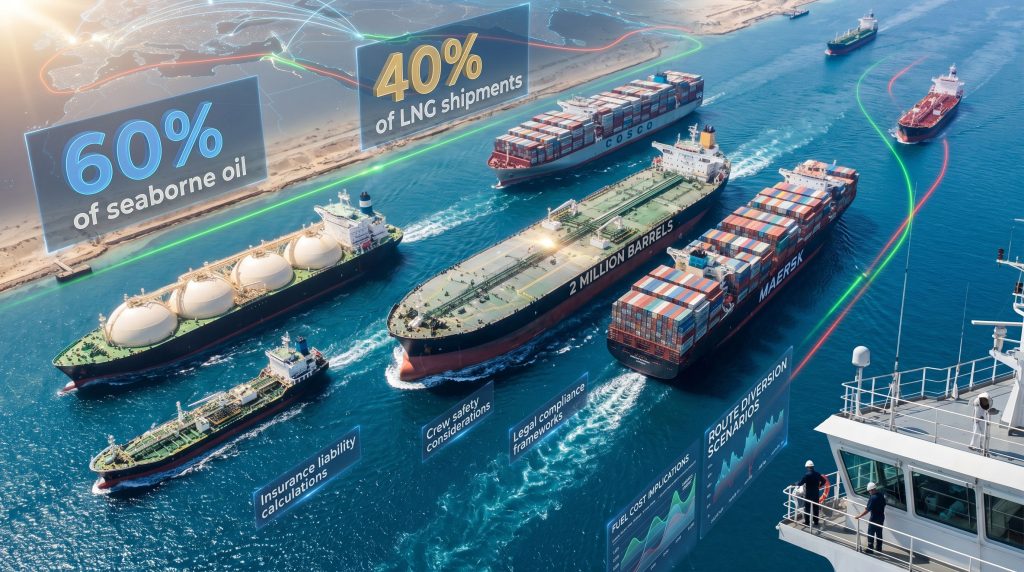
Approximately 60% of seaborne oil and 40% of LNG shipments transit through potentially restrictable waterways. The Strait of Hormuz alone handles about 21% of global petroleum flows, while other critical passages including the Suez Canal, Strait of Malacca, and Bab el-Mandeb collectively account for the remainder of chokepoint-dependent energy trade.
How do shipping costs change during chokepoint disruptions?
Freight rates can increase 50-200% for affected routes, with knock-on effects lasting 3-6 months after disruptions end. Current data shows clean product prices and premiums reaching multi-decade highs due to restricted Hormuz transit, while alternative route premiums reflect additional sailing distances and fuel consumption.
What early warning systems exist for maritime transit disruptions?
Industry tracking systems, satellite monitoring, and diplomatic intelligence networks typically provide 24-72 hour advance notice of potential disruptions. However, rapid policy changes can occur with minimal warning, as demonstrated by recent events where ships abort Hormuz transit attempts despite official reopening announcements.
How do insurance markets price war risk coverage during maritime conflicts?
War risk premiums can increase by factors of 10-50 times normal rates depending on threat assessment. Coverage may become unavailable entirely for certain routes or cargo types. Many standard policies exclude war-related losses, requiring separate coverage that becomes increasingly expensive and restrictive during active conflicts.
What constitutes force majeure in modern shipping contracts?
Force majeure definitions increasingly include government intervention, military action, sanctions implementation, and navigation restrictions by coastal states. However, the specific language varies significantly between contracts, and disputes often arise over whether particular circumstances qualify for protection from performance obligations.
Conclusion: Building Resilient Maritime Energy Systems
The complexity of modern maritime energy logistics demands sophisticated risk management approaches that account for geopolitical, economic, and operational variables simultaneously. Recent events demonstrate how quickly established shipping patterns can be disrupted and the cascading effects these disruptions create across global energy markets.
Strategic resilience building requires coordinated efforts among multiple stakeholders:
- Shipping operators must develop alternative route capabilities and enhanced risk assessment procedures
- Energy companies need diversified supply portfolios and expanded inventory management systems
- Insurance providers must create coverage frameworks that balance risk sharing with operational feasibility
- Government agencies should maintain diplomatic channels while supporting infrastructure development
Investment priorities for enhanced maritime security include:
- Alternative infrastructure development that provides backup capacity during primary route disruptions
- Technology advancement in vessel tracking, cargo monitoring, and emergency response systems
- International framework strengthening for dispute resolution and crisis management
- Regional cooperation enhancement for shared security and commercial interests
As global energy demand continues expanding, the strategic importance of maintaining open, secure shipping lanes becomes increasingly critical for international economic stability. The interconnected nature of modern energy markets means that disruptions in any major shipping corridor create ripple effects that extend far beyond the immediate geographic area of concern.
Successful navigation of these challenges requires recognition that maritime security is not merely a shipping industry concern, but a fundamental component of global economic infrastructure that affects energy security, industrial production, consumer markets, and international trade relationships. Building resilient systems demands sustained investment in both physical infrastructure and diplomatic frameworks that can adapt to evolving geopolitical realities while maintaining the commercial navigation rights essential for global energy trade.
Disclaimer: This analysis is based on publicly available information and market data as of April 18, 2026. Geopolitical situations and maritime security conditions can change rapidly, and readers should consult current sources for the latest developments. Investment and operational decisions should not be based solely on this analysis without additional professional consultation.
Looking for Opportunities in Energy Security Investments?
Discovery Alert's proprietary Discovery IQ model delivers real-time notifications on significant ASX mineral discoveries, helping investors identify actionable opportunities ahead of the broader market during periods of global energy uncertainty. Visit Discovery Alert's discoveries page to understand why historic discoveries can generate substantial returns, and begin your 14-day free trial today to position yourself strategically in the evolving energy landscape.