August 8, 2026
Strategic Workforce Development Initiative Reshaping Argentina's Shale Industry
Argentina's unconventional energy sector faces a fundamental challenge that extends far beyond geological complexity or technological hurdles. The rapid expansion of shale operations demands a sophisticated workforce capable of operating in high-pressure environments, managing complex automation systems, and maintaining safety standards that meet international benchmarks. This human capital bottleneck has emerged as the critical constraint limiting Argentina's ability to capitalise on its vast hydrocarbon resources.
Instituto Vaca Muerta represents Argentina's most comprehensive response to this strategic workforce challenge. The institution emerged from industry evolution trends recognising that sustainable growth requires systematic human resource development, moving beyond ad-hoc training programs toward integrated educational infrastructure. With over 13,000 initial enrollments recorded in its first registration period, the institute demonstrates unprecedented market demand for specialised energy sector education.
Multi-Stakeholder Collaboration Framework
The institute operates through an innovative public-private partnership model that brings together major operators, service companies, and educational institutions under unified training methodologies. This collaborative approach ensures curriculum alignment with real-world operational demands while maintaining industry-standard safety protocols across all participating organisations.
Current consortium members include eight major operators and numerous service companies, creating a comprehensive educational ecosystem. YPF serves as the founding partner and strategic coordinator, whilst international companies like TotalEnergies and Chevron contribute global best practices from mature shale regions.
Geographic and Economic Context
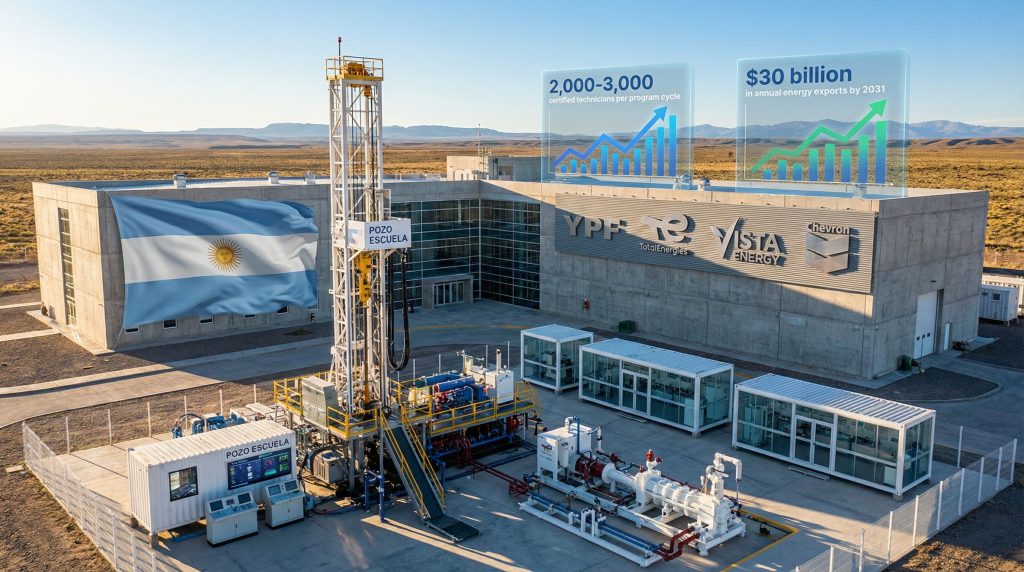
Located strategically in Neuquén Province at the Polo Tecnológico, Instituto Vaca Muerta positions itself at the operational heart of Argentina's unconventional energy revolution. The institute's secondary campus houses the "pozo escuela" (school well) facility, providing students with authentic field experience in controlled environments.
This geographic positioning creates direct pathways between educational programs and employment opportunities, reducing the traditional gap between theoretical training and practical application that characterises many technical education initiatives.
When big ASX news breaks, our subscribers know first
Comprehensive Technical Training Programs Targeting Upstream Operations
The institute's curriculum focuses on specialised upstream competencies critical to unconventional operations. Furthermore, programs integrate theoretical knowledge with hands-on experience using industry-standard equipment and simulation technologies, creating graduates who can immediately contribute to operational excellence.
Training modules cover drilling operations, hydraulic fracturing, instrumentation, and maintenance protocols. Each program emphasises safety protocols as foundational elements, reflecting the energy industry's commitment to zero-incident operations and environmental stewardship. For instance, students preparing for job interview readiness must demonstrate comprehensive understanding of these safety procedures.
Practical Learning Infrastructure
| Facility Component | Operational Capability | Training Application |
|---|---|---|
| Pozo Escuela (School Well) | High-pressure operations simulation | Real-world drilling and fracturing practice |
| Drilling Simulators | 3D operational environments | Risk-free skill development |
| Chemistry Laboratories | Fluid analysis and testing | Quality control procedures |
| Automation Labs | PLC and control systems | Digital operations training |
| Fracturing Simulators | Hydraulic fracturing operations | Stimulation technique mastery |
| Wireline Training | Logging and intervention | Downhole operations expertise |
The main headquarters provides students access to comprehensive simulation environments, including process control panels with programmable logic controllers (PLCs), automation laboratories, applied chemistry facilities, and electromechanical maintenance workshops. Additionally, advanced training incorporates AI in drilling operations to prepare students for the future of energy extraction technology.
Certification and Industry Recognition
Graduates receive industry-recognised credentials that validate both technical competencies and practical experience hours. These certifications are endorsed by the Neuquén Provincial Education Council and recognised across all consortium partner companies, creating direct pathways into high-demand energy sector positions.
The institute targets annual graduation of 2,000 to 3,000 certified technicians per program cycle, representing substantial workforce output capacity designed to support Argentina's energy export ambitions.
Innovation Through Real-World Simulation and Industry Integration
Instituto Vaca Muerta's distinctive approach combines traditional classroom instruction with immersive operational simulations, allowing students to experience authentic field conditions without exposure to actual operational risks. This methodology represents a significant pedagogical innovation in technical energy education.
Industry-Led Curriculum Development
Training modules are designed and delivered by active industry professionals, ensuring content relevance and immediate applicability to current operational challenges and technological advances. Consequently, this creates a dynamic feedback loop where practitioners immediately incorporate new techniques and problem-solving approaches into educational content.
The involvement of service companies like Halliburton, NOV, and Calfrac Well Services ensures students develop competencies on equipment and methodologies used across the industry. However, this multi-vendor approach prevents training programs from becoming overly specialised on single-company technologies.
Safety-First Training Philosophy
All programs emphasise safety protocols as foundational elements, reflecting the energy industry's commitment to zero-incident operations and environmental stewardship. Students learn risk assessment methodologies, emergency response procedures, and continuous improvement practices that characterise world-class unconventional operations.
Safety training extends beyond individual protective measures to encompass systems thinking, hazard identification, and collaborative safety culture development. These competencies become particularly critical as Argentina seeks to establish international credibility in unconventional energy production.
Corporate Partnership Ecosystem Driving Educational Excellence
The institute's success stems from comprehensive support across Argentina's energy value chain, with participation from international operators, national companies, and specialised service providers. This ecosystem approach ensures training programs reflect the full spectrum of operational requirements.
Founding Partners and Strategic Investors
Primary Operators:
- YPF serves as founding partner and strategic coordinator, leveraging its position as Argentina's largest energy producer
- TotalEnergies contributes international expertise from global unconventional operations
- Vista Energy provides operational methodology contributions from independent producer perspective
- Chevron offers technology transfer programs based on extensive North American shale experience
Service Company Participants:
- Halliburton delivers specialised equipment training on hydraulic fracturing technologies
- NOV provides drilling technology expertise and equipment familiarisation
- Calfrac Well Services contributes fracturing operations training and methodology
- San Antonio Internacional, DLS Archer, and Pason DGS expand service sector coverage
Recent Partnership Expansions
Pan American Energy formalised its incorporation during Argentina Week in New York, with CEO Marcos Bulgheroni emphasising that unconventional development represents the most relevant industrial project of recent decades in Argentina. The Instituto Vaca Muerta Opens Its Registrations announcement brought additional operational expertise and financial resources to support program expansion.
Pampa Energía also confirmed incorporation, with CEO Gustavo Mariani highlighting the importance of strengthening technical and professional training instances. Shell Argentina's recent participation adds another international operator perspective through President Germán Burmeister's emphasis on education and talent formation as fundamental pillars for Vaca Muerta development.
Additional operators participating include Pluspetrol and CGC, creating a comprehensive consortium of eight major operators alongside numerous service companies. This breadth of participation demonstrates growing industry confidence in the institute's strategic value and training effectiveness.
Workforce Development as Economic Strategy
The institute directly supports Argentina's ambitious goal of achieving $30 billion in annual energy exports by 2031, as articulated by YPF CEO Horacio Marín. This export target requires substantial workforce scaling to maintain operational efficiency and safety standards across expanded production operations, addressing energy export challenges facing the region.
Production Capacity Scaling Requirements
Annual Training Targets:
- 2,000-3,000 certified technicians per program cycle annually
- Multiple specialisation tracks addressing different operational needs across drilling, completion, and production phases
- Continuous education programs for existing workforce upskilling as technologies evolve
- Geographic expansion capability to serve additional shale development regions
The overwhelming initial response of over 13,000 enrollments indicates demand substantially exceeds current program capacity, suggesting potential for significant expansion to meet industry requirements.
Regional Economic Impact
The institute creates multiplier effects throughout Neuquén Province, generating employment opportunities, attracting educational investment, and establishing the region as Argentina's centre of excellence for unconventional energy training. These economic impacts extend beyond direct employment to encompass housing, services, and consumer spending associated with educational activities.
Local economic development benefits include:
- Direct employment in educational and support services
- Student spending on housing, food, and transportation
- Attraction of additional training-related businesses and services
- Enhanced regional reputation as technical education hub
Transforming Argentina's Energy Sector Human Capital Development
Beyond immediate training objectives, Instituto Vaca Muerta establishes sustainable frameworks for ongoing workforce development, ensuring Argentina's energy sector maintains competitive advantages in global markets. The institute represents more than technical education—it embodies Argentina's strategic commitment to developing world-class energy sector capabilities.
Technology Transfer and Innovation Hub
The institute serves as a conduit for international best practices, facilitating knowledge transfer from established shale regions while developing Argentina-specific operational methodologies. This technology transfer occurs through several mechanisms:
- International operator participation brings proven methodologies from North America and other mature regions
- Service company involvement ensures exposure to latest equipment and techniques
- Collaborative curriculum development creates Argentina-specific adaptations of global best practices
- Continuous feedback from operational experience refines training content
Furthermore, the institute explores emerging technologies such as EVs transforming mining transportation, preparing students for the evolving energy landscape.
Educational Infrastructure Legacy
The Instituto Vaca Muerta model may expand to other Argentine provinces or serve as a template for similar initiatives across Latin America, positioning Argentina as a regional leader in energy sector education. The consortium approach and industry-led curriculum development represent innovations that could be replicated in other unconventional resource regions.
Long-term strategic implications include:
- Sustainable workforce pipeline supporting decades of unconventional development
- Enhanced international credibility for Argentine energy operations
- Regional leadership in technical energy education
- Foundation for advanced research and development initiatives
The next major ASX story will hit our subscribers first
Industry-Specific Workforce Challenges and Solutions
Argentina's unconventional energy sector faces unique human capital challenges that distinguish it from conventional oil and gas operations. In addition, shale development requires specialised competencies in horizontal drilling, multi-stage hydraulic fracturing, and digital well monitoring that traditional energy education programs do not address comprehensively.
Technical Complexity and Safety Requirements
Unconventional operations involve significantly higher technical complexity than conventional production. Workers must understand:
- High-pressure hydraulic fracturing systems operating at pressures exceeding 10,000 PSI
- Automated drilling systems with real-time geo-steering capabilities
- Chemical handling and mixing for complex fracturing fluid systems
- Digital monitoring systems providing continuous operational data streams
These technical requirements demand specialised training programs that combine theoretical understanding with extensive hands-on practice using actual equipment configurations.
International Standards and Export Market Requirements
Argentina's energy export ambitions require operational standards that meet international buyer expectations. European and Asian energy importers demand assurance that production operations maintain environmental, safety, and quality standards comparable to established producing regions.
Instituto Vaca Muerta addresses these requirements through:
- Curriculum designed to international operational standards
- Safety training meeting global best practice benchmarks
- Quality control procedures aligned with export market requirements
- Environmental stewardship practices reflecting international expectations
Frequently Asked Questions About Instituto Vaca Muerta
What qualifications are required for Instituto Vaca Muerta programs?
Students need completed secondary education, basic digital literacy, and reliable internet access for hybrid learning components. Additional requirements vary by specialisation, with some programs requiring basic mechanical aptitude or previous industrial experience.
How long are typical training programs?
Most specialised courses run for four months, combining classroom instruction with practical field experience. Advanced programs may extend to six months, whilst basic certification courses can be completed in shorter timeframes.
Are training programs offered in languages other than Spanish?
Currently, programs are conducted exclusively in Spanish, reflecting the domestic focus of initial operations. International partnership expansions may introduce multilingual options as the institute develops relationships with global energy companies, as detailed on the official IVM website.
What career opportunities exist for Instituto Vaca Muerta graduates?
Graduates typically enter roles in drilling operations, production facilities, maintenance departments, or specialised service companies throughout Argentina's energy sector. Career progression often leads to supervisory positions, technical specialist roles, or field operations management.
How does the institute ensure job placement for graduates?
The consortium structure creates direct employment pathways through participating companies. Partner organisations commit to prioritising instituto graduates for relevant positions, though specific placement guarantees vary by program and market conditions.
What ongoing support does the institute provide after graduation?
Continuous education programs enable graduates to maintain current technical knowledge as technologies evolve. Alumni networks facilitate career advancement and professional development throughout the energy sector.
Instituto Vaca Muerta represents Argentina's strategic foundation for energy sector workforce development, combining innovative educational methodologies with comprehensive industry partnership. Through systematic technical training, safety-focused culture development, and international standard curriculum, the institute positions Argentina to capitalise on its unconventional energy resources whilst maintaining operational excellence and global competitiveness. The institute's success will ultimately be measured by its contribution to Argentina's energy independence, export competitiveness, and long-term economic development objectives.
Interested in Argentina's Strategic Energy Investments?
Discovery Alert's proprietary Discovery IQ model delivers real-time alerts on significant ASX mineral discoveries, instantly empowering subscribers to identify actionable opportunities ahead of the broader market. Begin your 14-day free trial today and secure your market-leading advantage.