June 13, 2026
Engineering resilience into industrial material handling systems demands sophisticated understanding of mechanical stress distribution and operational dynamics. Modern mining operations face unprecedented demands for throughput efficiency while maintaining safety standards across diverse geological conditions. The convergence of advanced materials science, precision manufacturing, and predictive maintenance protocols has fundamentally transformed how facilities approach conveyor system design, particularly when implementing a strong conveyor belt solution.
Heavy-duty applications require engineering solutions that transcend traditional belt specifications, incorporating multi-disciplinary approaches to address extreme operational parameters. Contemporary mining environments present complex challenges where equipment failure cascades through entire production networks, making reliability engineering a critical strategic consideration.
Understanding Conveyor Belt Strength Requirements in Modern Mining
Material handling infrastructure in modern mining operations must withstand forces that extend far beyond simple load calculations. The integration of advanced tensile strength engineering addresses fundamental challenges in high-volume production environments where continuous operation cycles create compounding stress factors. Furthermore, the latest industry innovation trends continue to shape how mining companies approach conveyor system design.
Critical Performance Metrics for High-Strength Conveyor Systems
Tensile Strength Classifications and Industry Standards
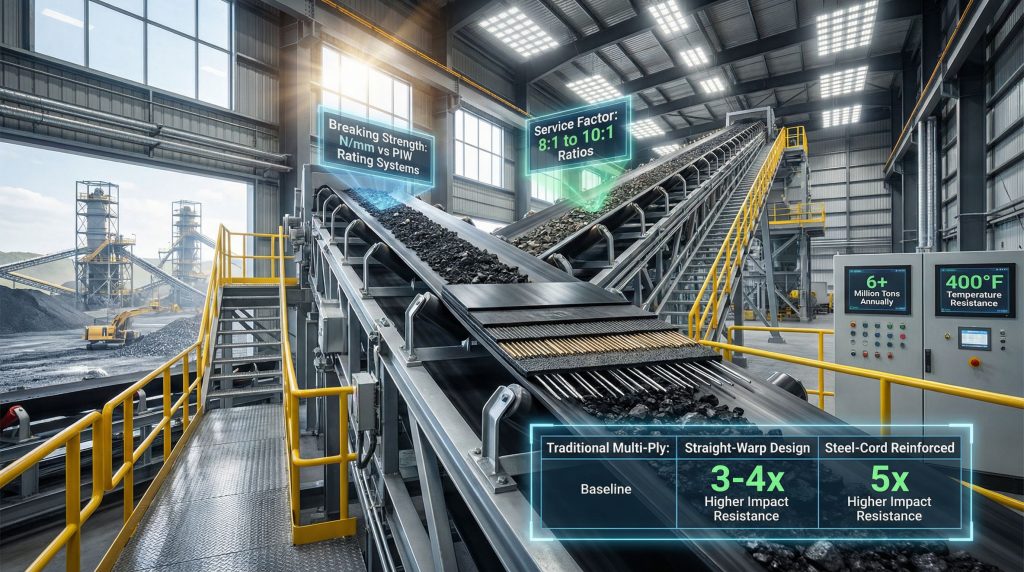
Contemporary belt rating systems utilise two primary measurement frameworks for breaking strength assessment. The N/mm rating system measures breaking strength per unit width, with modern high-capacity mining applications typically requiring 1,400 to 2,000+ N/mm specifications according to ISO 2231-1:2021 standards. North American operations commonly reference PIW (Pounds per Inch of Width) ratings, where high-strength mining applications demand 200+ PIW for slope belt systems.
Service factor calculations represent critical safety margins in mining operations. Industry standard ratios of 8:1 to 10:1 between belt breaking strength and maximum working load provide essential protection against shock loads and impact events characteristic of heavy mining environments. These safety margins account for dynamic stress distribution across belt width and length during variable loading conditions.
Impact Resistance Engineering Principles
Energy absorption capacity during material drop loading presents fundamental challenges in mining conveyor design. Coal handling operations commonly encounter impact forces exceeding 50 kJ during material transfer from considerable heights. Advanced belt constructions demonstrate capacity to absorb up to 5x the energy of traditional multi-ply designs without experiencing delamination failures.
Puncture resistance testing methodologies utilise standardised protocols to evaluate belt performance under concentrated loading conditions. Dynamic stress distribution analysis in high-volume applications requires comprehensive understanding of how impact forces propagate through carcass construction materials, often informed by material science insights developed specifically for mining applications.
Advanced Carcass Construction Technologies
Straight-Warp vs Traditional Multi-Ply Design Comparison
| Construction Type | Impact Resistance | Rip Resistance | Flexibility | Cost Factor |
|---|---|---|---|---|
| Traditional Multi-Ply | Baseline | Baseline | High | Low |
| Straight-Warp Design | 3-4x Higher | 2x Higher | Moderate | Medium |
| Steel-Cord Reinforced | 5x Higher | 4x Higher | Low | High |
Straight-warp construction with oriented warp fibres provides superior lateral stability and load distribution compared to conventional multi-ply systems. This design advantage proves particularly valuable in slope applications where directional stress concentration occurs, offering enhanced performance in demanding mining environments.
Reinforcement Material Selection Criteria
Nylon (PA6/PA66) serves as primary reinforcement material for high-fatigue mining applications due to excellent elasticity recovery and fatigue resistance over millions of belt revolutions. The molecular structure of nylon compounds provides optimal balance between strength and flexibility for continuous-duty mining operations.
Polyester/Nylon blends increasingly find application in deep slope mining operations, balancing impact resistance with flex life requirements. These hybrid materials offer engineered properties that address specific operational challenges in underground mining environments.
Steel-cord reinforcement systems support ultra-heavy-duty applications where tensile strength requirements exceed 2,500 N/mm. Typical steel cord diameters of 3-4mm provide 5x impact resistance compared to textile-only constructions, though with reduced flexibility characteristics.
Engineering Solutions for Extreme Operating Conditions
Contemporary mining operations demand conveyor solutions that address multiple operational parameters simultaneously. Advanced engineering approaches integrate material science innovations with sophisticated understanding of operational dynamics to deliver comprehensive performance improvements. Moreover, data-driven mining operations are increasingly utilising predictive analytics to optimise conveyor performance.
High-Tension Slope Belt Systems
Incline Angle Calculations and Belt Stress Analysis
Underground mining slope applications typically operate at angles of 12-20 degrees from horizontal, requiring complex tensile strength calculations that account for material weight, friction coefficients, and acceleration forces. These geometric considerations fundamentally influence belt specification requirements and safety factor calculations.
Vertical lift requirements in underground mining operations present unique engineering challenges. Continuous operation demands in 24/7 production environments require belt systems capable of sustained high-capacity performance without scheduled maintenance windows.
Heavy-Load Material Handling Specifications
Hard coking coal presents bulk density characteristics of approximately 1,400-1,500 kg/m³, significantly denser than thermal coal at approximately 1,200 kg/m³. This density differential requires enhanced structural support in conveyor systems and influences entire system design parameters.
Throughput capacity optimisation for facilities processing 6+ million tons annually demands sophisticated understanding of material flow dynamics. Load surge management during peak operational periods requires belt systems designed with appropriate safety margins for variable loading conditions. Additionally, conveyor belt durability solutions provide essential guidance for heavy-duty project requirements.
Material Composition Advances for Operational Challenges
Temperature Resistance Engineering
Critical Engineering Consideration: Standard EPDM rubber compounds maintain structural integrity at temperatures up to approximately 80°C for continuous operation, with specialised formulations achieving higher temperature thresholds for hot material handling applications in steel production and coal processing facilities.
Advanced rubber formulations incorporate oxidation resistance additives for materials handling at elevated temperatures. These specialised compounds address specific challenges in operations requiring processing of materials at 150-200°C while maintaining belt structural integrity.
Abrasion Resistance Innovations
Modern abrasion resistance technologies utilise advanced compound chemistry to extend service life in high-wear applications. Comparative wear testing across material types demonstrates significant performance differentials based on compound formulation and reinforcement structure.
Cost-per-ton analysis for high-abrasion applications validates premium belt investments when processing angular, abrasive materials such as iron ore and coarse aggregates. Extended service intervals justify higher initial investment through reduced replacement frequency and maintenance costs. Furthermore, implementing a strong conveyor belt solution often results in substantial long-term savings.
Installation and Maintenance Optimisation Strategies
Sophisticated installation protocols and maintenance frameworks maximise the performance potential of high-specification conveyor belt systems. Contemporary approaches emphasise predictive maintenance strategies and integrated engineering collaboration to optimise long-term operational efficiency. In addition, AI in mining processes is revolutionising how maintenance schedules are determined and executed.
Critical Design Considerations for Long-Term Performance
Splice Engineering and Installation Protocols
Five-stage splice design methodology addresses extreme tension applications through systematic engineering validation. This approach requires comprehensive testing and proof protocols prior to installation, ensuring splice integrity under operational loading conditions.
Pre-installation testing requirements include validation procedures for breaking strength verification at specified percentages of rated capacity. Certified installation supervision standards ensure proper implementation through manufacturer-qualified technician programmes.
Preventive Maintenance Framework
Tension monitoring systems provide continuous belt condition assessment through automated measurement protocols. Adjustment procedures maintain optimal operational parameters while preventing excessive wear from improper tensioning.
Inspection scheduling for high-capacity operations requires coordinated planning to minimise production impact. Predictive maintenance indicators enable proactive belt replacement timing based on condition assessment rather than arbitrary time intervals. Consequently, ultra-strong conveyor belt technology continues to advance industry standards.
Safety Standards Impact on Belt Selection
MSHA Fire-Resistance Compliance
Underground coal mining operations fall under MSHA 30 CFR Part 75 regulations, specifying comprehensive safety requirements for powered conveyor systems. Material certification requirements demand rigorous flame-spread testing protocols and approval processes for underground applications.
Emergency response considerations in confined mining environments influence belt material selection and installation procedures. Compliance protocols ensure worker safety while maintaining operational efficiency in underground conveyor galleries.
Operational Safety Enhancements
Advanced belt design features minimise mistracking through precise engineering of carcass construction and cover properties. This engineering approach reduces maintenance requirements and enhances worker safety during conveyor operations.
Spillage reduction engineering addresses environmental compliance obligations while improving operational efficiency. Reduced material loss contributes to both economic and environmental performance improvements in mining operations.
Cost-Benefit Analysis and ROI Optimisation
Financial analysis of strong conveyor belt solution implementations requires comprehensive evaluation of total cost of ownership factors. Advanced belt technologies demonstrate substantial economic benefits through extended service intervals and reduced operational disruptions.
Total Cost of Ownership Factors
Initial Investment vs Lifecycle Value
Financial Performance Analysis: Premium belt solutions featuring enhanced impact resistance can extend replacement cycles from typical 18-24 month intervals to 5-7 years in demanding applications, delivering substantial ROI through reduced downtime costs and maintenance requirements.
Lifecycle cost calculations must account for production loss during maintenance windows. High-capacity mining operations processing millions of tons annually experience significant economic impact from unscheduled downtime, justifying premium belt investments through improved availability.
Operational Efficiency Gains
- Throughput optimisation through extended maintenance intervals
- Labour cost reductions via decreased service requirements
- Energy efficiency improvements through reduced friction coefficients
- Material loss reduction from improved spillage control
- Safety enhancement through reduced maintenance exposure
Reduced maintenance frequency translates directly to improved operational efficiency. Extended service intervals allow mining operations to optimise production scheduling while reducing labour costs associated with belt replacement procedures.
Partnership Approaches for Solution Effectiveness
Integrated Engineering Collaboration Models
Successful implementation of ultra-high-strength conveyor solutions requires coordinated collaboration between end-users, engineering firms, and manufacturers. This partnership model ensures optimal solution design for specific operational requirements while maintaining installation quality standards.
Custom solution development addresses unique operational requirements through integrated engineering approaches. Collaborative design processes incorporate operational experience with technical expertise to deliver optimised performance solutions. However, 3D modelling techniques are increasingly being used to visualise and optimise conveyor system layouts.
Performance Monitoring and Continuous Improvement
Real-time belt performance tracking systems enable data-driven optimisation decisions. Continuous monitoring provides operational insights that inform maintenance scheduling and performance improvement initiatives.
Predictive analytics applications utilise operational data to forecast replacement planning requirements. This analytical approach optimises inventory management while preventing unexpected equipment failures.
Future Trends in Conveyor Belt Technology
Emerging technologies continue reshaping conveyor belt design and operational optimisation. Integration of smart systems and sustainable materials represents the next evolution in mining conveyor technology.
Emerging Technologies Shaping Next-Generation Solutions
Smart Belt Integration Capabilities
IoT sensor integration enables real-time condition monitoring through embedded sensing technologies. These systems provide continuous assessment of belt condition, tension, and wear patterns for proactive maintenance planning.
Machine learning applications analyse operational data patterns to predict maintenance requirements and optimise performance parameters. Advanced algorithms process multiple data streams to provide actionable insights for operational improvement.
Remote diagnostics capabilities allow centralised monitoring of distributed mining operations. Cloud-based platforms enable expert analysis and recommendation systems for global mining operations.
Sustainable Material Development
Recycled content integration research focuses on incorporating reclaimed materials without compromising performance characteristics. Advanced compound chemistry enables sustainable material utilisation while maintaining operational requirements.
Bio-based rubber compound development explores renewable material sources for conveyor belt manufacturing. Research initiatives investigate plant-based alternatives to traditional petroleum-derived compounds.
End-of-life recycling programmes address environmental considerations throughout the belt lifecycle. Comprehensive recycling frameworks support circular economy principles in mining operations.
Industry Standards Evolution
Performance Benchmark Advancement
New testing methodologies simulate extreme condition scenarios more accurately than traditional laboratory protocols. Advanced testing capabilities provide better correlation between laboratory performance and operational results.
International standards harmonisation efforts coordinate requirements across global mining operations. Standardised specifications facilitate equipment selection and performance comparison across diverse operational environments.
Certification processes for next-generation materials ensure quality and performance standards while enabling innovation in belt technology. Evolving standards accommodate technological advances while maintaining safety and reliability requirements.
Mining professionals seeking comprehensive guidance on conveyor belt selection and implementation can access additional technical resources through industry associations and specialised engineering publications for detailed application specifications.
Looking to Capitalise on ASX Mining Discoveries Before the Market Reacts?
Discovery Alert's proprietary Discovery IQ model delivers instant notifications when significant mineral discoveries are announced across all commodities, helping investors identify actionable opportunities before the broader market responds. Experience how major mining breakthroughs can generate exceptional returns by exploring historic discovery examples and begin your 30-day free trial today to secure your competitive advantage.