
June 5, 2026
Understanding the Structural Economics of Base Metal Processing
The global metals industry operates under fundamental chemical constraints that few investors fully appreciate. Modern copper and nickel production depends heavily on specialised processing techniques that require vast quantities of sulfuric acid, creating vulnerabilities that extend far beyond traditional supply and demand dynamics. The sulfur squeeze on copper and nickel production has become a critical factor reshaping commodity markets, as these chemical dependencies represent critical infrastructure bottlenecks that can disrupt entire metal supply chains when compromised.
When examining the economics of base metal extraction, the role of sulfuric acid becomes paramount for specific processing routes. Solvent extraction and electrowinning (SX-EW) operations, which handle approximately one-fifth of global primary refined copper production according to the International Copper Study Group, rely on sulfuric acid as their primary leaching reagent. This technology dominates oxide ore processing, particularly in regions where traditional smelting proves economically unviable.
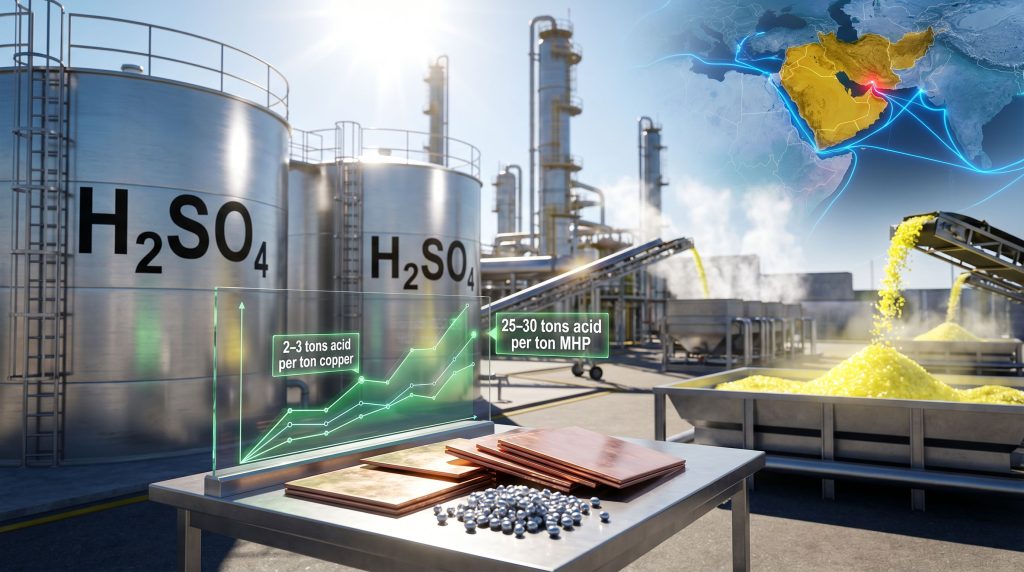
The chemistry underlying these operations cannot easily accommodate substitutes. High-pressure acid leach (HPAL) facilities require 25 to 30 tons of sulfuric acid per ton of mixed hydroxide precipitate (MHP), according to Morgan Stanley estimates. This enormous acid consumption reflects the aggressive chemical conditions necessary to extract nickel and cobalt from lateritic ores, making HPAL plants among the most acid-intensive industrial operations globally.
Critical Supply Chain Concentration Risks
Global sulfur production exhibits dangerous geographic concentration, with the Middle East contributing approximately 25% of world output, according to US Geological Survey data cited in recent market analysis. This concentration reflects sulfur's origin as a petroleum industry byproduct, tying metal production economics directly to oil and gas processing centres. Furthermore, this dependency creates systemic vulnerabilities that extend across multiple commodity sectors.
The implications extend beyond simple supply percentages. Regional production clusters create systemic vulnerabilities when geopolitical events disrupt transportation corridors. For instance, the trade war geopolitical impact demonstrates how international tensions can cascade through industrial supply chains, affecting everything from fertiliser production to battery metals processing.
Current Supply Distribution by Region:
- Middle East: ~25% of global production
- China: Largest sulfuric acid producer globally
- North America: Secondary production centre
- Other regions: Fragmented smaller producers
Transportation infrastructure represents another critical vulnerability. Seaborne sulfur trade relies on established shipping routes that pass through geopolitical chokepoints, creating delivery risks that extend far beyond production disruptions. However, insurance costs and freight premiums can escalate rapidly when regional tensions emerge, affecting delivered pricing even when production facilities remain operational.
When big ASX news breaks, our subscribers know first
How Recent Geopolitical Events Reshape Supply Dynamics
The closure of the Strait of Hormuz on February 28, 2026 created immediate disruptions to global sulfur flows, demonstrating how quickly transportation bottlenecks can affect industrial supply chains. This maritime chokepoint controls access for Middle Eastern sulfur exports, forcing producers to seek alternative routing or accept significant delivery delays.
Export restrictions have compounded transportation challenges. China announced a sulfuric acid export ban effective May 2026, while Turkey has already implemented similar measures according to Argus Media reports. Consequently, India continues evaluating comparable restrictions, suggesting a broader trend toward domestic supply protection.
These policy responses reflect fundamental prioritisation decisions by producing governments. Agricultural fertiliser demand, which accounts for approximately two-thirds of global sulfur consumption, receives policy protection over industrial uses. This hierarchy ensures that food security concerns override metals production requirements when supply constraints emerge, intensifying the sulfur squeeze on copper and nickel production.
Timeline of Recent Supply Disruptions:
- February 28, 2026: Strait of Hormuz closure
- May 2026: China implements sulfuric acid export ban
- Ongoing: Turkey maintains export restrictions
- Under consideration: India evaluating similar measures
The agricultural sector's preferential treatment creates structural disadvantages for metals producers during supply crises. Governments consistently prioritise fertiliser availability over industrial chemical supplies, making metals production vulnerable to policy-driven allocation decisions even when total supply capacity remains adequate.
Regional Vulnerability Analysis for Copper Production
The Democratic Republic of Congo faces particularly acute exposure to sulfur supply disruptions. SX-EW technology accounts for approximately half of copper production in this major producing nation, while the country relies on Gulf region imports for the majority of its sulfur requirements. This dual dependency creates compounded risks when both transportation and source region disruptions occur simultaneously.
Current operational responses already reflect supply stress. Mining companies are reducing acid consumption to extend existing chemical inventories as import prices surge and shipment cancellations increase. Nevertheless, the slow-moving nature of leaching processes means production impacts unfold gradually over weeks and months rather than immediately.
Chile presents a more resilient but still vulnerable position. The country processes approximately 1.125 million metric tons of copper through SX-EW operations and imports roughly 20% of its sulfuric acid requirements from China, according to Morgan Stanley analysis. Chile's partial insulation comes from domestic acid production as a copper smelting byproduct, providing some buffer against import disruptions, particularly in light of the current global copper supply forecast.
Key Regional Exposure Factors:
- Democratic Republic of Congo: 50% SX-EW dependency, heavy Gulf import reliance
- Chile: 1.125 million tons annual SX-EW capacity, 20% Chinese acid imports
- Zambia: Significant copper belt operations with import dependencies
- Other regions: Varied exposure based on processing technology mix
The time-lag characteristics of heap leaching operations create both advantages and disadvantages during supply disruptions. While immediate production cuts don't occur, the extended reaction time also means that supply restorations take longer to translate into normalised output levels.
Indonesian Nickel Industry Under Pressure
Indonesia's position as the world's largest nickel producer creates global market significance for any supply chain disruptions affecting the country's operations. The nation sources approximately 75% of its sulfur requirements from the Middle East while also importing processed sulfuric acid from China, according to Morgan Stanley data. In addition to these dependencies, this creates dual vulnerability risks when both raw material and processed chemical supplies face simultaneous constraints.
HPAL production represents one of the most acid-intensive industrial processes globally. The requirement for 25 to 30 tons of acid per ton of MHP means that even modest sulfur price increases translate into substantial cost pressures. With Indonesian MHP production reaching approximately 450,000 tons in the previous year and expected to increase by 100,000 tons annually, according to Macquarie estimates, the aggregate acid demand continues growing despite supply constraints. This trend aligns with broader Indonesian nickel trends that reflect the country's dominant market position.
The flow-through effects from sulfur supply disruptions affect nickel production more rapidly than copper markets. Lower existing inventory levels and higher acid intensity per unit output mean that Indonesian HPAL facilities experience immediate operational pressure when supply disruptions emerge. Some operations have already begun reducing run-rates to manage chemical supply constraints.
Indonesian HPAL Sector Characteristics:
- Supply dependency: 75% Middle East sulfur sourcing
- Acid intensity: 25-30 tons per ton MHP output
- Production scale: 450,000 tons MHP in 2025, targeting 550,000 tons in 2026
- Inventory levels: Lower working capital buffers than copper operations
The battery supply chain implications extend beyond immediate production impacts. MHP serves as feedstock for battery cathode materials, meaning that sulfur supply constraints in Indonesia can affect electric vehicle production chains globally. This creates pressure for automotive manufacturers to secure alternative nickel sources or accept higher input costs.
Economic Impact Quantification Across Metal Markets
Cost structure analysis reveals the magnitude of sulfur price impacts on metals production economics. Macquarie estimates indicate that sulfur price increases since early 2026 have added $4,000 per ton to Indonesian HPAL production costs, shifting the industry cost curve to $14,500 to $18,000 per ton. These increases help explain the London Metal Exchange nickel price surge to $18,655 per ton, representing an 11-week high.
For copper producers, particularly those operating SX-EW facilities in the Democratic Republic of Congo, sulfur represents approximately 20% of cash production costs according to Natixis calculations. The bank estimates that each $100 per ton increase in sulfur pricing translates to a 4% rise in operating costs, creating direct linkages between chemical input costs and metal production economics.
Cost Impact Analysis by Metal:
| Metal | Cost Impact | Source |
|---|---|---|
| Nickel (HPAL) | $4,000/ton increase | Macquarie |
| Copper (SX-EW) | 4% cost rise per $100/ton sulfur | Natixis |
| Cost curve shift | $14,500-$18,000/ton nickel | Industry estimates |
| Market response | LME copper above $13,000/ton | Market data |
These cost pressures support higher metal pricing through fundamental supply-demand mechanics. As marginal producers face elevated input costs, the industry supply curve shifts upward, supporting price increases that reflect the new cost structure. LME copper prices have responded by moving back above $13,000 per ton for the first time in a month, while nickel pricing reflects the elevated HPAL cost structure.
The duration and magnitude of these cost impacts depend heavily on supply chain normalisation timing. Extended disruptions could force permanent changes in production technology or supply sourcing strategies, while rapid resolution might allow temporary cost absorption through inventory management and operational flexibility.
Strategic Risk Mitigation Approaches for Producers
Mining companies are implementing diverse strategies to manage sulfur supply risks, ranging from operational adjustments to strategic supply chain restructuring. Immediate responses focus on extending existing acid inventories through consumption optimisation and process efficiency improvements. This approach reflects the broader mining industry evolution toward more resilient operational frameworks.
Supply diversification efforts involve identifying alternative sulfur sources beyond traditional Middle Eastern suppliers. Canadian, Russian, and other non-Gulf producers offer potential alternatives, though transportation costs and supply capacity constraints limit immediate substitution possibilities. Long-term strategic planning increasingly emphasises geographic diversification of chemical input suppliers.
Backward integration represents another strategic option for larger producers. Developing captive sulfuric acid production capabilities provides supply security but requires substantial capital investment and technical expertise in chemical processing. However, some companies are evaluating joint venture arrangements with chemical producers to secure dedicated supply allocations.
Risk Mitigation Strategy Categories:
- Operational optimisation: Reducing acid consumption through process improvements
- Supply diversification: Alternative supplier identification and qualification
- Strategic inventory: Optimal working capital allocation for chemical stockpiles
- Technology adaptation: Process modifications to reduce acid intensity
- Backward integration: Captive acid production capability development
Process technology modifications offer medium-term solutions for reducing sulfur dependency. While complete elimination of acid requirements proves technically challenging, efficiency improvements can reduce consumption per unit of metal output. These changes require careful metallurgical testing to ensure product quality maintenance.
The next major ASX story will hit our subscribers first
Long-Term Structural Market Evolution
The current sulfur squeeze on copper and nickel production may accelerate structural changes in metals processing technology and supply chain organisation. Investment in distributed sulfuric acid production capacity could reduce dependency on concentrated supply regions, though this requires substantial capital commitment and technical development.
Regional supply hub development represents one potential outcome, with acid production facilities located closer to major mining regions. This approach reduces transportation risks while creating local chemical industry clusters. Nevertheless, the economics depend on sufficient scale and feedstock availability in target regions.
Technology development initiatives focus on alternative extraction processes that reduce or eliminate sulfuric acid requirements. While pyrometallurgical routes exist for some applications, they often face economic disadvantages compared to acid-based leaching for certain ore types. Research into novel leaching agents or recycling systems could provide long-term alternatives, particularly given the growing importance of energy transition security.
Structural Evolution Pathways:
- Regional acid production: Distributed manufacturing capacity development
- Alternative processing: Non-acid extraction method advancement
- Circular economy: Acid regeneration and closed-loop systems
- Supply chain integration: Vertical integration across chemical and metals industries
Investment opportunities emerge from these structural changes. Sulfuric acid infrastructure projects in strategic locations could capture value from ongoing supply-demand imbalances. Technology developers focused on alternative processing methods may find increased market interest from producers seeking supply chain resilience.
The resolution of current geopolitical tensions could restore normal supply flows, but the structural vulnerabilities exposed by recent disruptions suggest lasting changes in risk management approaches. Companies with early positions in alternative supply chains or processing technologies may gain competitive advantages as industry risk awareness increases.
Market Psychology and Investment Implications
The sulfur squeeze on copper and nickel production demonstrates how commodity markets can experience rapid repricing when industrial input constraints emerge unexpectedly. Investor sentiment reflects growing awareness of supply chain complexity in metals production, particularly for processing-intensive operations like HPAL nickel facilities.
Market psychology currently favours companies with integrated chemical supply chains or geographic diversification advantages. Share price performance often correlates with perceived resilience to sulfur supply disruptions, creating valuation premiums for operations with captive acid production or alternative supplier relationships.
The agricultural sector's prioritisation during supply crises creates structural headwinds for metals producers that extend beyond simple supply-demand economics. Understanding these policy hierarchy dynamics becomes crucial for predicting how future disruptions might affect different metal markets and production regions.
Risk assessment frameworks increasingly incorporate chemical input supply security as a fundamental factor in project evaluation and operational planning. The sulfur squeeze reinforces the importance of comprehensive supply chain analysis in metals industry investment decisions, particularly for processing-intensive production routes.
Investment Considerations:
- Supply chain resilience: Captive chemical production capabilities
- Geographic diversification: Alternative supplier accessibility
- Technology positioning: Lower acid-intensity processing routes
- Financial flexibility: Working capital for elevated input costs
- Policy risk: Agricultural prioritisation in supply allocation
The current crisis may establish new baseline risk premiums for sulfur-dependent operations, permanently altering project economics and investment return requirements. Companies that successfully navigate the current constraints while building long-term supply security could emerge with enhanced competitive positions as markets normalise.
Looking to Capitalise on Base Metal Market Opportunities?
Discovery Alert's proprietary Discovery IQ model delivers real-time notifications on significant ASX mineral discoveries, including copper and nickel projects that could benefit from the current market dynamics discussed above. With sulfur supply constraints creating structural advantages for producers with resilient operations, identifying the right investment opportunities becomes crucial for capturing potential returns. Begin your 14-day free trial today at Discovery Alert and gain immediate access to actionable insights that help position your portfolio ahead of market developments.