June 13, 2026
Understanding the Structural Shift in Global Copper Markets
Industrial metal markets are experiencing unprecedented transformation as technological advancement accelerates demand patterns beyond traditional cyclical frameworks. The convergence of electrification trends, artificial intelligence infrastructure buildout, and renewable energy deployment creates what mining analysts describe as a structural supercycle rather than conventional commodity volatility. This fundamental shift in copper exposure in BHP shares positioning reflects broader economic forces that extend well beyond typical supply-demand dynamics.
Mining companies with established production capabilities and strategic asset portfolios find themselves uniquely positioned to capitalise on these emerging trends. The transition from fossil fuel-dependent systems to electrified alternatives requires massive copper infrastructure investments, creating sustained demand growth that could persist for decades rather than years.
When big ASX news breaks, our subscribers know first
What Drives BHP's Strategic Copper Market Position?
BHP's copper portfolio represents one of the mining sector's most strategically positioned asset collections, spanning multiple high-quality jurisdictions and delivering consistent production volumes that place the company among global industry leaders. The portfolio's competitive advantage stems from operational scale, cost efficiency, and reserve quality rather than speculative resource claims.
Geographic Distribution Across Premier Mining Regions
The company's copper assets demonstrate sophisticated geographic diversification across politically stable, mining-friendly jurisdictions:
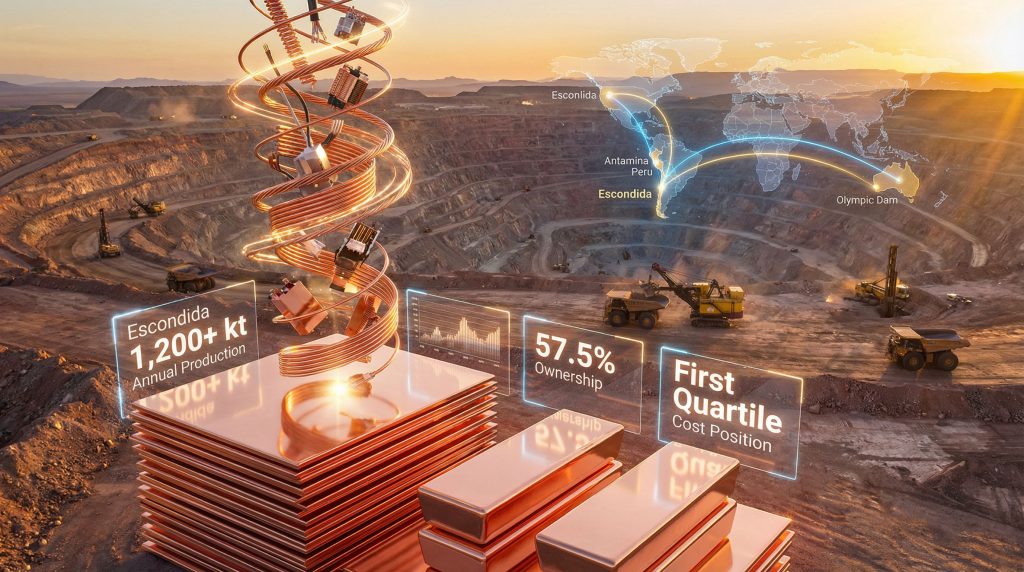
- Chilean Operations: Escondida facility maintains 57.5% ownership stake, producing over 1,200 kilotonnes annually
- Australian Assets: Olympic Dam integrated operation combines copper, uranium, and gold extraction
- Peruvian Holdings: Antamina partnership delivers 33.75% ownership in world-class deposit
- North American Development: Resolution Copper project represents 45% stake in Arizona's largest undeveloped deposit
Production Capabilities and Cost Structure Analysis
Table: BHP Copper Asset Performance Metrics
| Asset | Annual Output (kt) | Cash Cost Position | Reserve Grade | Operating Life |
|---|---|---|---|---|
| Escondida | 1,200+ | First quartile | 0.6% Cu | 30+ years |
| Olympic Dam | 190 | Second quartile | 1.8% Cu | 75+ years |
| Antamina | 420 | First quartile | 0.8% Cu | 15+ years |
| Spence | 185 | Second quartile | 0.7% Cu | 20+ years |
The cost positioning across these assets provides significant margin protection during commodity downturns while maximising cash generation during favourable pricing environments. Olympic Dam's exceptional reserve life of over 75 years offers unparalleled resource longevity in an industry where new discoveries face increasingly challenging development timelines.
How Electrification Infrastructure Creates Sustained Copper Demand
The global transition toward electrified systems fundamentally alters copper consumption patterns, creating demand categories that didn't exist during previous commodity cycles. Furthermore, these structural changes suggest copper requirements will grow at accelerating rates as technology adoption reaches mainstream implementation.
Electric Vehicle Revolution and Copper Intensity
Electric vehicle manufacturing requires dramatically higher copper content compared to conventional automotive production:
- Battery Electric Vehicles: Average copper content reaches 83 kilograms per vehicle
- Conventional Vehicles: Traditional internal combustion engines contain approximately 23 kilograms copper
- Charging Infrastructure: DC fast-charging stations require 8-10 kilograms copper wiring per unit
- Grid Connection: Supporting electrical infrastructure adds additional copper requirements
Current electric vehicle adoption rates suggest this demand category alone could consume an additional 2-3 million tonnes of copper annually by 2030, representing approximately 8-12% of current global production. In addition, copper prices record highs have emerged as a key consideration for manufacturers planning long-term supply agreements.
Data Center and Artificial Intelligence Infrastructure Expansion
The artificial intelligence revolution creates entirely new copper demand categories as computational requirements scale exponentially:
Each hyperscale data center requires 3-5 tonnes of copper per megawatt of installed capacity, with AI-specific facilities demanding even higher copper intensity due to advanced cooling systems and power distribution requirements. As global AI workloads expand, this represents a completely unprecedented demand source that traditional supply forecasts hadn't anticipated.
Major technology companies plan to deploy hundreds of new data centers globally, each requiring substantial copper infrastructure for power distribution, cooling systems, and server connectivity. This demand source operates independently of traditional industrial cycles, creating sustained consumption growth.
Renewable Energy Grid Integration Requirements
Wind and solar power generation systems require significantly more copper per unit of energy output compared to conventional power sources:
- Wind Turbines: Onshore installations use 3-5 tonnes copper per megawatt capacity
- Solar Arrays: Photovoltaic systems require 4-6 tonnes copper per megawatt installed
- Grid Modernisation: Smart grid infrastructure demands 3-5 times more copper than traditional systems
- Energy Storage: Battery storage systems add additional copper requirements for inverters and connections
Consequently, copper investment strategies are evolving to account for these infrastructure-driven demand patterns.
What Operational Advantages Distinguish BHP's Copper Assets?
BHP's copper operations demonstrate industry-leading performance metrics across operational efficiency, cost management, and technological implementation. These advantages translate into superior cash generation capabilities and competitive resilience during challenging market conditions.
Technology Integration and Automation Excellence
Advanced technology deployment across BHP's copper operations creates significant operational advantages:
- Autonomous Mining Systems: Escondida achieved full autonomy in 2024, improving productivity 15-20%
- Predictive Maintenance Programmes: AI-driven equipment monitoring reduces unplanned downtime by 30%
- Digital Twin Technology: Real-time mine optimisation increases processing throughput efficiency
- Remote Operations Centres: Centralised monitoring reduces operational costs while enhancing safety protocols
These technological implementations provide sustainable competitive advantages that smaller operators cannot easily replicate due to capital requirements and technical expertise demands.
Cost Leadership and Margin Protection
Table: Copper Production Cost Comparison Analysis
| Cost Component | BHP Average | Industry Median | Competitive Advantage |
|---|---|---|---|
| Mining costs ($/tonne ore) | $13-16 | $19-23 | 25-30% lower |
| Processing costs ($/lb Cu) | $0.90-1.15 | $1.25-1.55 | 20-25% lower |
| Transportation costs ($/lb Cu) | $0.16-0.21 | $0.26-0.36 | 30-40% lower |
| All-in sustaining costs | $2.30-2.70 | $2.90-3.30 | 15-20% lower |
This cost leadership provides substantial margin protection during commodity downturns while maximising profitability during favourable pricing periods. The company's position in the first and second quartiles of global cost curves ensures sustained cash generation across market cycles.
Which Growth Catalysts Could Accelerate Production Capacity?
BHP's copper expansion strategy emphasises brownfield developments and operational optimisation rather than greenfield exploration, reducing execution risk while maximising returns on invested capital. This approach leverages existing infrastructure and operational expertise to achieve growth targets.
Near-Term Capacity Enhancement Projects
Several expansion initiatives target production increases over the next three years:
- Escondida Optimisation: Phase 2 concentrator enhancements targeting 10% throughput improvement
- Olympic Dam Enhancement: Processing facility upgrades to improve copper recovery rates from 86% to 90%+
- Spence Life Extension: Production optimisation and mine life extension to 2045
- Antamina Expansion: Partnership discussions for additional processing capacity installation
These projects utilise existing infrastructure and proven ore bodies, reducing development risk compared to new mine construction while delivering meaningful production growth.
Strategic Development Pipeline Through 2035
Medium-term growth opportunities focus on leveraging existing asset bases:
- Resolution Copper Development: Potential to supply 25% of US copper demand once environmental permits finalise
- Chilean Satellite Deposits: Multiple exploration targets near Escondida infrastructure
- Olympic Dam Regional Expansion: Additional copper-gold deposits within existing mining lease
- Advanced Processing Technology: Lower-grade ore extraction techniques expanding economic reserves
The Resolution Copper project alone represents potential production of 180,000-200,000 tonnes annually for 40+ years, significantly expanding BHP's North American presence. Furthermore, development opportunities in the argentina copper system provide additional regional expansion potential.
How Do Global Economic Trends Support Long-Term Copper Demand?
Macroeconomic forces beyond electrification create additional copper demand drivers that reinforce the structural growth thesis. These trends suggest sustained consumption increases across multiple geographic regions and economic sectors.
Emerging Market Infrastructure Development
Developing economies plan massive infrastructure investments that require substantial copper consumption:
- India Infrastructure Initiative: $1.4 trillion infrastructure spending planned through 2030
- Southeast Asian Electrification: ASEAN countries targeting 40% renewable energy capacity by 2035
- African Grid Expansion: 600 million people gaining electrical grid access requires extensive copper infrastructure
- Latin American Industrialisation: Regional copper production supporting domestic manufacturing growth
These infrastructure programmes operate on decades-long timelines, creating sustained demand growth independent of developed market consumption patterns. However, recent developments in asx copper stocks impact demonstrate how geopolitical factors influence market dynamics.
Supply Chain Security and Geopolitical Diversification
Scenario Analysis: Geopolitical Supply Disruption Impact
| Risk Scenario | Probability Estimate | Price Impact Potential | BHP Strategic Advantage |
|---|---|---|---|
| China supply disruption | 25% | +$1,500/tonne | High (geographic diversification) |
| South American political instability | 15% | +$800/tonne | Medium (Chilean exposure) |
| Trade war escalation | 35% | +$1,200/tonne | High (Western-aligned assets) |
| Green transition acceleration | 60% | +$2,000/tonne | Very high (quality asset portfolio) |
Western governments increasingly prioritise supply chain security for critical minerals, creating premium valuations for politically stable copper sources. BHP's asset portfolio primarily operates in established mining jurisdictions with strong regulatory frameworks.
The next major ASX story will hit our subscribers first
What Risk Factors Could Impact Copper Investment Returns?
While long-term copper fundamentals appear robust, several risk categories require careful consideration when evaluating investment positioning. Understanding these challenges allows for more informed decision-making regarding copper exposure in BHP shares.
Operational and Technical Challenges
Mining operations face increasing complexity as ore quality declines globally:
- Grade Deterioration: Maintaining production levels as average ore grades decrease 1-2% annually
- Water Resource Constraints: Desert operations face increasing water scarcity in Chile and Australia
- Environmental Compliance: Stricter regulations increasing operational costs 3-5% annually
- Skilled Labour Shortages: Technical expertise gaps in key mining jurisdictions
These operational challenges require continuous capital investment and technological innovation to maintain production efficiency and cost competitiveness.
Market Structure and Demand Risks
Several factors could potentially disrupt copper demand growth trajectories:
- Chinese Economic Deceleration: 50% of global copper consumption concentrated in single market
- Technology Substitution: Alternative materials potentially reducing copper intensity in applications
- Carbon Pricing Implementation: Emissions costs affecting mining economics and competitiveness
- Resource Nationalism: Host government policy changes impacting operational agreements
China's economic performance remains crucial for global copper markets, with policy changes potentially creating significant demand volatility.
How Does BHP's Integrated Model Compare to Pure-Play Copper Miners?
BHP's diversified mining portfolio creates both advantages and trade-offs compared to companies focused exclusively on copper production. Understanding these differences helps evaluate the investment proposition within broader portfolio contexts.
Diversification Benefits and Constraints
Comparative Framework: Integrated vs. Specialist Mining Companies
| Evaluation Factor | BHP (Integrated Model) | Pure-Play Copper Miners | Investor Implications |
|---|---|---|---|
| Commodity exposure | Diversified across 5+ metals | 80%+ copper concentration | Lower volatility, reduced sector upside |
| Capital allocation | Competing investment priorities | Copper-focused spending | Balanced growth, steady returns |
| Operational expertise | Cross-commodity knowledge transfer | Deep copper specialisation | Efficiency gains, technology sharing |
| Market valuation | Conglomerate discount potential | Pure-play premium pricing | Potentially undervalued copper assets |
The integrated model provides natural hedging against commodity-specific downturns while potentially limiting upside exposure during copper bull markets.
Strategic Positioning for Energy Transition
BHP's diversified portfolio offers unique advantages during the global energy transition:
- Cross-Commodity Synergies: Iron ore cash flows funding copper growth investments
- Technology Innovation: Mining expertise transferable across multiple commodities
- Financial Flexibility: Diversified revenue streams supporting counter-cyclical investment
- ESG Leadership: Integrated sustainability approach across all operational segments
This positioning allows the company to invest in copper expansion during commodity downturns when acquisition costs remain attractive. For instance, evaluating copper‑uranium investment opportunities demonstrates the benefits of diversified commodity exposure.
What Investment Scenarios Support Different Copper Market Outcomes?
Multiple economic scenarios create varying investment outcomes for copper-focused strategies, allowing portfolio managers to evaluate potential returns across different macroeconomic environments.
Accelerated Electrification Scenario Analysis
Bull Case: Rapid Technology Adoption
- Demand Growth: 4-6% annual copper consumption increase through 2035
- Supply Constraints: Limited new mine development constraining supply response to demand
- Price Trajectory: Sustained copper pricing above $12,000 per tonne
- BHP Advantage: Low-cost production generating exceptional cash flow margins
This scenario assumes faster-than-expected electric vehicle adoption, aggressive renewable energy deployment, and accelerated data center construction.
Steady Transition Baseline Scenario
Base Case: Gradual Technology Implementation
- Demand Growth: 2-3% annual copper consumption increase through 2035
- Supply Response: Measured new supply additions balancing market dynamics
- Price Trajectory: Copper prices cycling between $8,000-11,000 per tonne
- BHP Position: Consistent cash generation supporting steady dividend growth
The baseline scenario reflects current policy trajectories and technology adoption rates without significant acceleration or disruption.
Demand Disruption Scenario Considerations
Bear Case: Technology Substitution and Economic Slowdown
- Alternative Materials: Technological breakthroughs reducing copper requirements in key applications
- Economic Recession: Global economic contraction dampening industrial copper demand
- Supply Expansion: Multiple large-scale copper projects achieving production simultaneously
- BHP Resilience: Low-cost operations maintaining profitability through commodity cycles
Even under challenging scenarios, BHP's cost positioning provides defensive characteristics relative to higher-cost copper producers.
Investment Implications for Portfolio Construction
BHP's copper exposure in BHP shares represents a multifaceted investment proposition that combines current income generation with long-term growth potential aligned with global decarbonisation trends. The company's operational excellence, strategic asset positioning, and financial flexibility provide multiple value creation pathways across different market environments.
The investment thesis rests on three fundamental pillars: superior asset quality delivering consistent cash flows, strategic positioning within growing demand segments, and operational capabilities maintaining competitive advantage through commodity cycles. While risks exist around demand volatility and operational challenges, BHP's integrated business model provides natural hedges that pure-play copper miners cannot replicate.
For investors seeking copper market exposure through an established, financially robust vehicle with proven operational capabilities, BHP's copper portfolio offers an attractive combination of current yield and long-term growth potential. The company's position within the global energy transition creates multiple scenarios where copper assets could deliver superior returns over extended investment horizons.
Recent analysis from Intelligent Investor regarding BHP's copper positioning suggests that operational setbacks may create opportunities for strategic investors. Furthermore, BHP's future copper plans outline the company's commitment to expanding production capacity in line with global electrification trends.
Disclaimer: This analysis contains forward-looking statements and investment opinions that involve inherent risks and uncertainties. Commodity prices, mining operations, and global economic conditions can fluctuate significantly. Past performance does not guarantee future results. Investors should conduct their own research and consider their individual financial circumstances before making investment decisions.
Ready to Identify the Next Major Copper Discovery?
Discovery Alert instantly alerts investors to significant ASX mineral discoveries using its proprietary Discovery IQ model, turning complex mining data into actionable insights for both copper-focused opportunities and broader mineral exploration plays. Explore Discovery Alert's dedicated discoveries page to understand how historic mineral discoveries have generated exceptional market returns, then begin your 14-day free trial to position yourself ahead of the next major breakthrough.