July 8, 2026
The Hidden Architecture of Sudan's Gold Economy and Why Billions Cannot Buy Stability
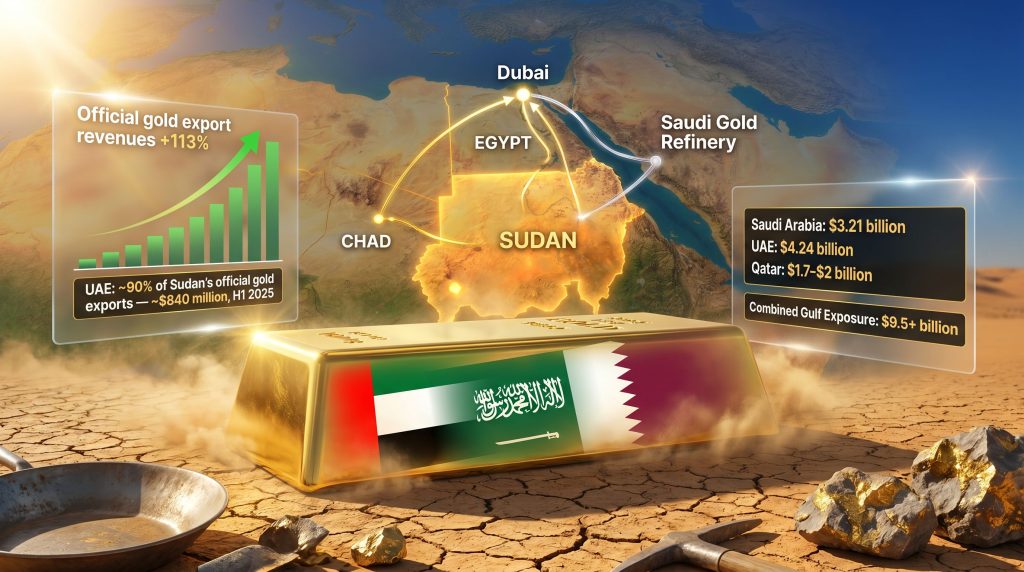
Conflict economics operates according to a logic that defies conventional development thinking. In most resource-rich nations, mineral wealth theoretically provides the raw material for fiscal capacity, infrastructure investment, and poverty reduction. Yet in practice, when armed factions control extraction, external actors control trade routes, and governance institutions collapse under the weight of war, natural resources become instruments of perpetuation rather than progress. Sudan presents perhaps the starkest contemporary illustration of this paradox, where gold deposits spanning its northern and eastern territories have attracted more than $9.5 billion in combined Gulf financial exposure without producing any measurable improvement in civilian welfare.
Understanding why requires moving beyond the surface-level narrative of aid and investment, and into the structural mechanics of how Gulf influence in Sudan gold trade actually operates, who benefits, and what would need to change for that calculus to shift.
When big ASX news breaks, our subscribers know first
Sudan's Gold Sector: Scale, Structure, and Fragmentation
The Dual Architecture of Production
Sudan ranks consistently among Africa's leading gold producers, but its mining sector is far less consolidated than peer producers on the continent. Production flows from two structurally distinct channels that operate largely in parallel rather than in coordination.
The first is the licensed, large-scale mining segment, which involves formal concession agreements, reported output, and at least nominal interaction with state tax and export frameworks. The second, and significantly larger, is the artisanal and small-scale mining sector, known within the industry as ASM. This segment accounts for the majority of Sudan's physical gold output and operates through informal networks that are extraordinarily difficult to regulate, monitor, or tax.
The ASM sector's dominance matters enormously for understanding the conflict economy. Because artisanal miners operate across dispersed geographic areas, often in zones controlled by armed factions rather than state authorities, their output flows directly into informal trade networks rather than official export channels. This is the foundational layer on which Sudan's gold smuggling architecture is built.
The 113% Revenue Paradox
One of the most counterintuitive data points in Sudan's wartime economy is the 113% surge in official gold export revenues recorded during the conflict period. For a country experiencing mass displacement, infrastructure destruction, and the collapse of most formal economic activity, a doubling of any revenue stream appears anomalous.
The explanation lies in the combination of increased extraction pressure as competing factions maximised revenue from controlled territories, and the partial formalisation of export flows that had previously moved through entirely unofficial channels. When formal banking and trade infrastructure deteriorated, some actors who previously operated informally shifted toward whatever official mechanisms remained functional, temporarily inflating recorded figures. This dynamic does not represent economic recovery; it represents intensified resource extraction under wartime conditions.
How Dubai Became the Default Destination for Sudanese Gold
The Infrastructure of Opacity
Dubai's dominance as a destination for Sudanese gold did not emerge from the 2023 conflict. It was built over decades through the deliberate development of precious metals trading infrastructure designed to process high volumes of gold from diverse, often opaque, origin sources. The city's refining capacity, combined with its historically permissive approach to origin documentation requirements, created a structural advantage that conflict-affected African producers have consistently exploited.
The mechanism is technically elegant and commercially rational. Gold arriving in Dubai from Sudan through informal routes, whether via Egypt's overland corridors or Chad's cross-border networks, is melted and recast in local refineries. This process physically destroys the origin characteristics of the metal and reintroduces it into international supply chains as LBMA and COMEX markets-compliant material eligible for Good Delivery status. Once recast, the gold is functionally indistinguishable from metal mined in compliant jurisdictions.
According to Reuters reporting, the UAE imported close to 90% of Sudan's official gold exports in the first half of 2025 alone, representing approximately $840 million in declared value. The volume moving through unofficial channels is, by definition, harder to quantify but widely assessed to dwarf the official figures.
The Egyptian Transit Corridor: An Underappreciated Node
One dimension of the Gulf influence in Sudan gold trade that receives insufficient analytical attention is Egypt's structural role as the primary overland transit corridor. Approximately 60% of gold from Sudan's northern states moves through Egypt before reaching Dubai's refining infrastructure. This makes Egypt simultaneously a transit facilitator, a regional power with its own interests in Sudan's political outcome, and a potential enforcement point for any future interdiction strategy.
Egypt's dual positioning creates a significant complication for international policy. Furthermore, diplomatic pressure on Cairo to close smuggling corridors risks disrupting a bilateral relationship with its own strategic dimensions, including water rights, border security, and regional influence dynamics in the Horn of Africa. The broader geopolitical mining landscape reinforces just how deeply these competing interests complicate resource governance across conflict-affected regions.
| Smuggling Route | Estimated Gold Share | Primary Destination |
|---|---|---|
| Egypt overland to Dubai | ~60% of northern Sudan output | UAE |
| Chad corridor (RSF-linked) | Significant but unquantified | UAE |
| Eritrea corridor | Smaller volume | UAE |
| Red Sea formalised channel | Emerging, post-2026 | Saudi Arabia |
The UAE's Diplomatic Rupture and What It Revealed
From Dominance to Disruption
The UAE's position in Sudan's gold economy was already politically sensitive before the formal diplomatic breakdown. International monitoring bodies, including United Nations mechanisms, had identified UAE-linked networks as significant facilitators of RSF financial flows, with evidence suggesting that gold revenues converted through Dubai-based trading entities were being used to fund procurement of arms, drones, fuel, and ammunition. The UAE has publicly denied all such allegations.
The rupture formalised in May 2025 when Sudan's army-affiliated defence council severed ties with Abu Dhabi, citing allegations of advanced weapons transfers to the RSF. The UAE subsequently barred Sudanese aircraft from its airports and, according to Financial Times reporting, suspended cargo movements to and from Port Sudan from early August 2025. This disruption extended beyond gold to include South Sudanese crude oil processed at Fujairah, demonstrating how deeply embedded UAE commercial infrastructure had become in Sudan's broader resource economy.
The practical consequence was immediate pressure on the Sudanese pound and a structural opening that Saudi Arabia moved deliberately to fill. The London vault market dynamics provide additional context for understanding how disruptions in one regional trading hub create ripple effects across the entire global gold supply chain.
Saudi Arabia's Strategic Entry: Formalisation as Foreign Policy
The Refinery Gambit
Saudi Arabia's approach to Sudan's gold sector reflects a more institutionally sophisticated strategy than the UAE's historically trader-driven model. Rather than working through informal networks and private intermediaries, Riyadh has pursued state-to-state mechanisms that simultaneously serve commercial and geopolitical objectives.
In January 2026, Saudi Arabia's state-run gold refinery publicly announced its readiness to purchase Sudanese bullion directly, positioning itself as a formal alternative to Dubai's long-standing dominance. A month later, in February 2026, Sudan's army-backed Ministry of Minerals formalised this relationship through a gold exploration agreement with Saudi Gold Refinery along the Red Sea coast. The geographic logic is significant: a Red Sea-based arrangement reduces dependence on overland smuggling corridors and positions both countries to benefit from direct maritime trade infrastructure.
Sudanese authorities indicated that the formalisation of gold exports through Saudi channels was expected to redirect substantial revenues into official treasury accounts, rather than the factional and informal networks that had previously captured most of the value.
The Vision 2030 Dimension
Saudi Arabia's interest in Sudanese gold is not purely transactional. It fits within the kingdom's broader Vision 2030 economic diversification programme, which explicitly targets expanded roles in global commodities processing, mining, and resource infrastructure. Securing preferential access to one of Africa's significant gold producers aligns directly with Riyadh's ambition to build industrial capacity in precious metals refining and reduce dependence on hydrocarbon revenues.
Simultaneously, the arrangement serves a competitive geopolitical function by reducing UAE influence over a country positioned along the Red Sea, one of the world's most strategically consequential maritime corridors for global trade.
The Weapons Deal That Exposed Saudi Leverage
In April 2026, a $1.5 billion weapons and jet sale from Pakistan to Sudan was placed on hold after Saudi Arabia withdrew its financial backing and requested termination of the agreement. The reversal, which occurred against the backdrop of broader U.S.-Iran regional tensions, illustrated that Saudi influence over Sudan extends well beyond resource trade agreements into the architecture of the country's security financing. The ability to veto a major arms deal by withdrawing financial sponsorship reveals a depth of leverage that pure trade relationships do not typically generate.
Qatar's Investment-Led Model: A Third Way
Copper, Capital, and Reconstruction Positioning
Qatar's engagement in Sudan operates on a structurally different logic from either the UAE's gold trade dominance or Saudi Arabia's state refinery strategy. Rather than focusing on gold extraction and export, Doha has pursued a diversified investment portfolio spanning real estate, banking, agriculture, and hard minerals.
The most significant current development is Qatar Mining's preparation to restart an $800 million copper project following war-related operational disruptions. Sudan's Ministry of Minerals granted authorisation for Qatari mining companies to resume operations, signalling that Khartoum's army-backed authorities view Qatari capital as a constructive rather than politically threatening form of external engagement.
Total Qatari investment exposure in Sudan is estimated at between $1.7 billion and $2 billion across approximately 60 projects. This breadth of sectoral coverage positions Qatar for influence over Sudan's long-term reconstruction trajectory rather than its immediate wartime resource flows, a strategically distinct posture that insulates Doha from the reputational risks associated directly with conflict gold.
Qatar's historically active mediation role in Sudanese political disputes gives it a diplomatic identity that neither the UAE nor Saudi Arabia can credibly claim in the current environment. This positions Doha as potentially the most durable external actor in Sudan's post-conflict reconstruction landscape, assuming a ceasefire eventually materialises.
The next major ASX story will hit our subscribers first
The Development Paradox: Why $9.5 Billion Has Not Moved the Needle
Mapping Gulf Financial Exposure
| Gulf Actor | Estimated Financial Commitment | Primary Channel |
|---|---|---|
| Saudi Arabia | $3.21 billion | Humanitarian aid across 359 projects |
| UAE | $4.24 billion (2015-2025) | Aid, investment, emergency packages |
| Qatar | $1.7 to $2 billion | Mining, real estate, banking, agriculture |
| Combined Gulf Exposure | $9.5+ billion | Mixed aid, investment, resource access |
The Structural Misallocation Problem
Despite the scale of Gulf financial exposure, IMF projections place Sudan's GDP per capita at approximately $864 in 2026, with real GDP growth of just 0.7%. These figures confirm that capital inflows of this magnitude have produced no meaningful improvement in broad economic conditions.
The explanation is structural rather than incidental. The overwhelming majority of Gulf capital in Sudan serves one of four purposes, none of which directly generates productive economic capacity:
- Humanitarian aid delivery addressing immediate survival needs without rebuilding productive infrastructure
- Resource access agreements that extract value and export it rather than processing it domestically
- Geopolitical leverage instruments designed to maintain influence over political outcomes rather than improve economic ones
- Emergency stabilisation packages that prevent acute crises without addressing underlying structural causes
Saudi Arabia's $3.21 billion in humanitarian support across 359 projects, while addressing genuine civilian needs across education, water, health, food security, and energy, does not rebuild the functioning financial systems, commercial infrastructure, and governance institutions that generate self-sustaining economic growth. The UAE's $30 million emergency package for civilians in El Obeid, North Kordofan, released even amid unresolved diplomatic tensions with Khartoum, similarly addresses symptoms rather than causes.
The February 2026 UAE pledge of $500 million to a UN humanitarian fund during a Washington donor event, made while Abu Dhabi simultaneously maintained political distance from Sudan's army-backed government, illustrates the contradictory nature of Gulf engagement particularly clearly. Humanitarian generosity and geopolitical competition operate in parallel rather than in service of a coherent development strategy.
The Self-Financing Conflict Cycle and the Case for Targeted Sanctions
How Gold Sustains Both Sides
The most structurally damaging dimension of Gulf influence in Sudan gold trade is its role in perpetuating armed conflict. Both the SAF and the RSF control distinct gold-producing territories and maintain separate extraction and export networks. As long as gold revenues continue flowing to both factions through their respective external channels, neither party faces meaningful financial pressure to negotiate a durable settlement.
The RSF's financial sustainability through UAE-linked gold networks and the SAF's emerging formalisation relationship with Saudi Arabia create a situation where external actors are simultaneously funding the continuation of the conflict while nominally supporting peace processes. This is not necessarily intentional; it is the emergent consequence of Gulf states prioritising their own economic and geopolitical positioning over conflict resolution outcomes. Analysts examining the strategic role of gold in global markets have noted how its unique properties make it particularly susceptible to becoming an instrument of conflict finance.
A Chatham House analysis of gold and war in Sudan confirms that the metal has become deeply embedded in the financing structures of both armed factions, reinforcing the view that disrupting trade flows is inseparable from any credible peace process.
Three Scenarios for Sudan's Gold Economy
| Scenario | Conditions Required | Likely Outcome |
|---|---|---|
| Saudi Formalisation Succeeds | Red Sea refinery channel scales; UAE influence declines sustainably | Partial revenue formalisation; limited civilian benefit without governance reform |
| Gulf Competition Intensifies | UAE re-engages politically; Saudi-UAE rivalry plays out in Sudan | Continued conflict financing; gold revenues remain fragmented across factional networks |
| International Sanctions Applied | Targeted measures on Gulf gold-trading entities; UN enforcement capacity | Disruption of smuggling networks; potential reduction in conflict financing capacity for both factions |
International policy analysts have consistently identified targeted sanctions on specific gold-trading and refining entities operating in Gulf jurisdictions as the most direct mechanism for interrupting the conflict finance cycle. The technical challenge is that Dubai's refining infrastructure effectively erases origin evidence, making commodity-level traceability extremely difficult to enforce without entity-level intervention.
The Widening Contest: Beyond the Gulf
The competition for influence over Sudan's resource wealth and political future is increasingly transcending its Gulf origins. Western governments, Turkey, and Egypt are all positioning themselves around Sudan's reconstruction prospects, mineral endowment, and strategic Red Sea geography.
Egypt's dual role as transit corridor facilitator and regional power with independent interests in Sudan's political trajectory makes it simultaneously a problem and a potential solution for any coordinated interdiction strategy. Turkey's engagement, while less financially significant than Gulf exposure, adds another layer of external competition to a country already struggling to maintain sovereign agency over its own resource base.
The internationalisation of Sudan's resource contest transforms what began as a domestic political and military conflict into a proxy arena for competing external economic agendas. In addition, the geopolitical impact on minerals more broadly demonstrates how resource-rich conflict zones consistently attract external actors whose interests diverge sharply from those of local populations. For Sudan's civilian population, this multiplication of external actors does not translate into improved outcomes; it introduces additional layers of interest that must be balanced before any coherent reconstruction programme can be assembled.
What Genuine Reform Would Actually Require
Translating Sudan's resource wealth into civilian benefit would demand a coordinated set of interventions that no single external actor currently has either the capacity or the incentive to deliver unilaterally:
- Internationally monitored gold export frameworks ensuring revenues flow to public accounts rather than factional treasuries, with independent verification
- Debt relief and reconstruction financing explicitly conditioned on verifiable civilian welfare metrics rather than diplomatic alignment
- Conflict resolution mechanisms that specifically address the financial incentives sustaining both armed factions, including agreed frameworks for demilitarising gold-producing territories
- Regional diplomatic coordination bringing Gulf states, Egypt, Turkey, and Western actors into a structured engagement model that prevents competitive undercutting of any individual reform initiative
- Sustained pressure on Dubai's refining sector to implement origin traceability standards equivalent to those applied to other commodity supply chains
None of these conditions currently exist. Furthermore, as GIS Reports analysis of Sudan's war economy makes clear, the structural entrenchment of gold within conflict financing means that reform efforts face formidable resistance from the very actors who benefit most from the current arrangement. Until the conditions for genuine reform are in place, the structural pattern of Gulf influence in Sudan gold trade will continue to serve external interests far more effectively than it serves the Sudanese people whose land produces the wealth being contested.
Disclaimer: This article contains forward-looking projections, including IMF economic forecasts, that are subject to revision. All financial figures, trade data, and investment estimates referenced are drawn from publicly available reporting and should not be interpreted as investment advice. The geopolitical and conflict dynamics described reflect conditions as reported through mid-2026 and are subject to change.
For additional context on Sudan's gold revenues and Gulf investment flows across African markets, visit africa.businessinsider.com.
Want To Track The Next Major Mineral Discovery Before The Market Does?
While Sudan's gold economy remains entangled in conflict financing and geopolitical rivalry, Discovery Alert's proprietary Discovery IQ model cuts through the complexity of ASX mineral announcements in real time — instantly identifying actionable opportunities across gold and 30+ other commodities. Explore historic discoveries and their extraordinary returns, then begin your 14-day free trial at Discovery Alert to position yourself ahead of the broader market.