
June 9, 2026
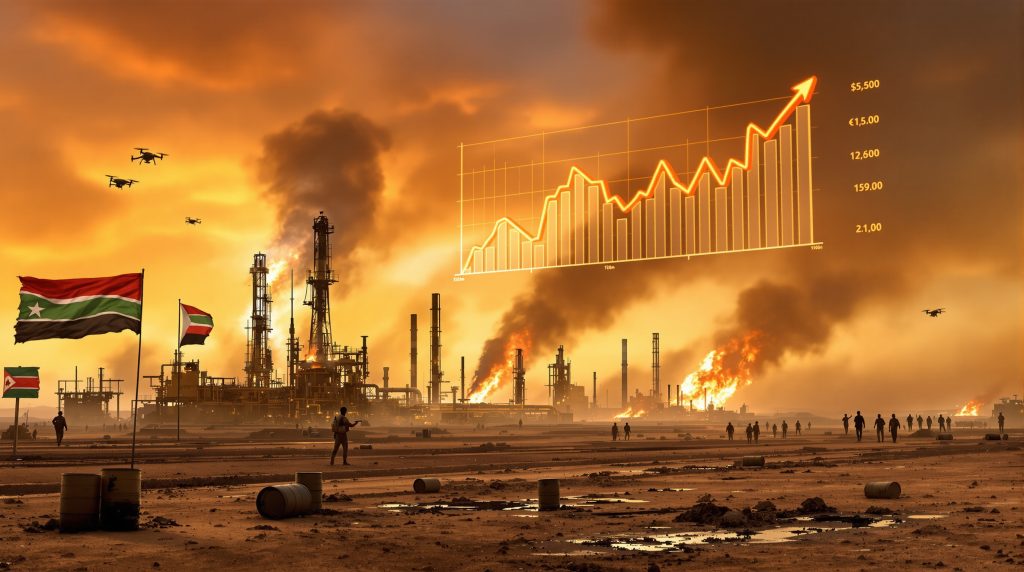
What's Happening to Sudan's Critical Oil Infrastructure?
Sudan's oil corridor, particularly the strategic Heglig oil fields near the South Sudan border, faces unprecedented danger as militia attacks intensify across the region. These vital facilities form the backbone of both Sudan's domestic energy security and South Sudan's economic lifeline, with recent violence threatening to disrupt one of East Africa's most crucial energy transit routes.
Government officials in Khartoum have issued urgent warnings that operations at the Heglig complex may require complete suspension following a series of coordinated assaults. The situation has deteriorated rapidly, with drone strikes and ground attacks forcing evacuations and creating a precarious security environment for remaining personnel.
When big ASX news breaks, our subscribers know first
Who Is Behind the Attacks on Sudan's Oil Corridor?
The paramilitary Rapid Support Forces (RSF) stand at the center of this escalating crisis. Since April 2023, the RSF has waged an increasingly destructive campaign against Sudan's military government, with the conflict evolving from urban battles to strategic targeting of energy infrastructure.
Recent intelligence reports indicate the RSF has established a parallel administration in territories under its control, effectively splitting governance across the country. This development has transformed what began as a power struggle into a full-blown civil war with devastating humanitarian consequences:
- At least 150,000 deaths attributed to the conflict
- Millions of civilians displaced from their homes
- Critical infrastructure systematically targeted
- Regional stability increasingly compromised
The RSF's tactical shift toward targeting oil facilities represents a significant escalation, directly threatening both Sudan's remaining energy production capacity and South Sudan's economic viability.
Why Does the Heglig Oil Complex Matter Regionally?
Strategic Importance of the Heglig Fields
The Heglig oil complex isn't merely another production facility—it represents a critical node in East Africa's energy infrastructure network. Its significance extends far beyond Sudan's borders for several key reasons:
| Aspect | Strategic Importance |
|---|---|
| Geographic Position | Straddles the contested border region between Sudan and South Sudan |
| Pipeline Connectivity | Forms a crucial segment of the export corridor carrying South Sudanese crude to Red Sea terminals |
| Production Capacity | Contributes significantly to Sudan's domestic energy supply |
| Economic Impact | Generates essential revenue for both Sudanese and South Sudanese governments |
| Regional Security | Stability of the complex directly impacts broader Horn of Africa security dynamics |
When South Sudan gained independence in 2011, it retained approximately 75% of the former unified Sudan's oil reserves. However, the landlocked nation depends entirely on Sudan's pipeline infrastructure to export its crude through Port Sudan on the Red Sea. This arrangement creates a complex interdependence that the current conflict threatens to unravel.
Timeline of Escalating Threats to Oil Infrastructure
The deterioration of security around Sudan's oil corridor has followed a concerning pattern:
-
April 2023: Initial outbreak of conflict between Sudanese military and RSF forces
-
Late 2023: First reported attacks on peripheral oil infrastructure
-
Early 2024: Expansion of conflict into oil-producing regions
-
Mid-2024: Targeted strikes against pipeline infrastructure
-
August 2025: Critical drone attacks on Heglig facilities forcing partial evacuation
-
September 2025: Government warnings of potential complete shutdown of operations
How Are These Attacks Impacting South Sudan's Economy?
South Sudan's Oil Dependency Crisis
South Sudan faces an existential economic threat from the deteriorating security situation in Sudan's oil corridor. The country's financial structure reveals an extreme vulnerability:
- Oil exports constitute approximately 90% of government revenue
- Nearly all crude production must transit through Sudan's pipeline network
- Alternative export routes remain years away from development
- Government services depend almost entirely on oil income
Recent UN-commissioned investigations have uncovered troubling patterns in South Sudan's oil sector governance. According to confidential reports, billions in oil revenue have been systematically diverted through opaque mechanisms including:
- "Oil-for-roads" programs with minimal infrastructure delivery
- Non-transparent service contracts with inflated costs
- Revenue diversion through parallel financial channels
- Limited oversight and accountability mechanisms
These governance challenges compound the physical threats to oil transit, creating a perfect storm for South Sudan's economy.
Political Complications Within South Sudan
The threat to oil exports comes at a particularly dangerous moment in South Sudan's political development. Long-delayed elections have intensified rivalries between key political figures:
- President Salva Kiir's faction has consolidated control over key institutions
- Vice President Riek Machar faces new legal challenges his supporters describe as politically motivated
- Accusations of murder and corruption have further polarized leadership
- Reform efforts have stalled amid deepening political divisions
This political instability directly impacts oil sector governance, with oversight mechanisms weakened by factional competition. The combination of physical threats to export infrastructure and political dysfunction creates a dangerous scenario for South Sudan's economic future.
What Are the Regional Security Implications?
The destabilization of Sudan's oil corridor extends beyond immediate economic impacts to create broader regional security challenges:
-
Humanitarian Crisis Amplification: Disruption of government revenues could worsen already severe humanitarian conditions
-
Cross-Border Tensions: Disputes over oil transit fees and security responsibilities may reignite historical conflicts between Sudan and South Sudan
-
Proxy Involvement: Regional powers may increase support to preferred factions, internationalizing the conflict
-
Migration Pressures: Economic collapse could trigger new displacement waves affecting neighboring countries
-
Terrorist Exploitation: Non-state armed groups may exploit security vacuums in oil-producing regions
The Horn of Africa's fragile stability faces a significant test as energy infrastructure increasingly becomes a target in Sudan's internal conflict.
How Are International Oil Companies Responding?
International energy companies with exposure to Sudan and South Sudan face difficult decisions as security deteriorates:
Risk Mitigation Strategies
Companies operating in the region have implemented various approaches to manage escalating risks:
- Personnel Reductions: Minimizing expatriate presence in high-risk areas
- Security Enhancements: Increasing protection measures for critical assets
- Operational Adjustments: Modifying production schedules and maintenance plans
- Contingency Planning: Developing scenarios for potential export disruptions
- Stakeholder Engagement: Intensifying dialogue with relevant governments
Several major operators have reportedly conducted emergency security reviews following the most recent attacks, with some implementing phased withdrawal plans for non-essential personnel.
Investment Implications
The investment landscape for Sudan's energy sector faces severe challenges:
- Capital Flight: Existing investors reassessing commitment to regional projects
- Development Delays: New field exploration and development largely suspended
- Valuation Impacts: Asset impairments likely as risk premiums increase
- Insurance Challenges: Coverage becoming prohibitively expensive or unavailable
- Alternative Destinations: Investment capital redirecting to more stable jurisdictions
These dynamics create a negative feedback loop where security concerns drive investment reductions, weakening economic conditions and potentially fueling further instability.
The next major ASX story will hit our subscribers first
What Could Stabilize the Situation?
Addressing the crisis in Sudan's oil corridor requires a multifaceted approach addressing both immediate security threats and underlying governance challenges:
Immediate Stabilization Measures
Several interventions could help stabilize the immediate security environment:
-
Negotiated Safe Zones: Establishing protected corridors for oil infrastructure
-
Third-Party Monitoring: Independent verification of security arrangements
-
Technical Workarounds: Engineering solutions to bypass vulnerable segments
-
Revenue Sharing Agreements: New arrangements incentivizing all parties to protect flows
-
International Guarantees: External security assurances for critical infrastructure
Longer-Term Solutions
Sustainable stability requires addressing deeper structural issues:
- Governance Reforms: Transparency and accountability mechanisms for oil revenue
- Diversification Initiatives: Reducing economic dependence on single export corridors
- Regional Cooperation Frameworks: Multilateral approaches to energy security
- Infrastructure Investment: Alternative export routes reducing vulnerability
- Political Reconciliation: Addressing root causes of conflict between competing factions
What's the Outlook for Regional Oil Flows?
The future of Sudan's oil corridor faces significant uncertainty, with several potential scenarios emerging:
Scenario 1: Continued Deterioration
If current trends continue without intervention:
- Periodic disruptions to oil flows becoming more frequent
- Production shutdowns extending from days to weeks
- Insurance and operational costs rising prohibitively
- Gradual abandonment of vulnerable infrastructure
- Severe fiscal impacts for both Sudan and South Sudan
The continuing oil price movements in global markets could further complicate recovery efforts.
Scenario 2: Stabilization Through Negotiation
If diplomatic efforts succeed:
- Security arrangements protecting key infrastructure
- Resumption of reliable export flows
- Gradual return of operational confidence
- New power-sharing arrangements incorporating oil governance
- Regional cooperation mechanisms strengthening
Analysts are increasingly concerned that failure to achieve stability could trigger an oil price crash with worldwide implications.
Scenario 3: Alternative Export Development
If long-term solutions are prioritized:
- Acceleration of alternative export route development
- Diversification of South Sudan's export options
- Reduced leverage of any single transit country
- New regional energy cooperation frameworks
- Resilience against localized security challenges
The global trade impact of disrupted African oil flows remains a significant concern for energy markets.
Conclusion: A Pivotal Moment for East African Energy Security
The escalating attacks on Sudan's oil corridor represent more than just another chapter in the country's internal conflict—they signal a fundamental threat to regional energy security and economic stability. With South Sudan's economic viability hanging in the balance and Sudan's own energy infrastructure under direct attack, the stakes extend far beyond immediate production disruptions.
The targeting of oil infrastructure reflects a dangerous evolution in conflict tactics, with economic warfare increasingly complementing traditional military operations. This development demands new approaches to infrastructure protection and regional cooperation to preserve the energy lifelines upon which multiple nations depend.
As militia attacks continue to escalate, the international community faces urgent questions about how to safeguard critical energy corridors in conflict zones. The answers developed in response to Sudan's crisis may well shape approaches to energy security challenges across Africa and beyond.
The oil futures outlook indicates continued volatility as markets respond to these geopolitical tensions. Additionally, experts are monitoring how ongoing US oil production decline might further complicate global supply chains already stressed by regional conflicts.
Readers interested in learning more about the geopolitical dimensions of oil infrastructure in conflict zones can also explore related educational content at OilPrice.com, which offers regular updates on energy security challenges in various regions including Sudan and South Sudan.
Want to Discover the Next Major ASX Mining Opportunity?
Don't miss potential market-moving mineral discoveries like those that transformed De Grey Mining and WA1 Resources. Get instant, real-time alerts on significant ASX mineral discoveries with Discovery Alert's proprietary Discovery IQ model at https://discoveryalert.com.au/discoveries/, turning complex mineral data into actionable investment insights.