June 19, 2026
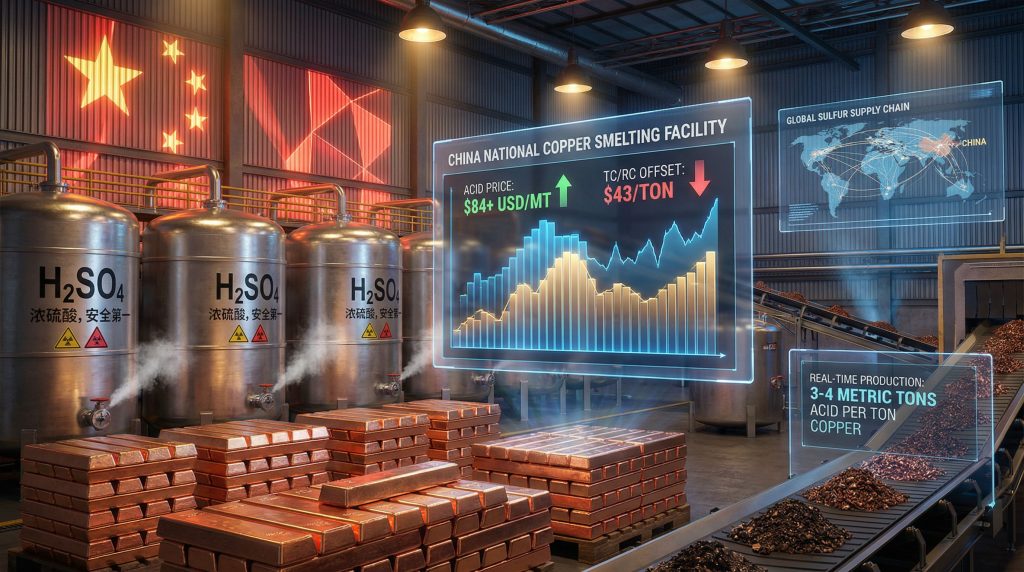
The impact of sulfuric acid prices on Chinese copper smelting exemplifies how secondary revenue streams transform from disposal challenges into critical profit drivers during periods of margin compression. This transformation reflects broader structural shifts occurring across metallurgical industries, where environmental compliance requirements and evolving demand patterns create new economic dependencies. Chinese copper smelters, controlling approximately 40% of global refined copper production capacity, now navigate dual commodity exposures that introduce previously unrecognized volatility sources into their operational frameworks. Furthermore, understanding these dynamics is essential for developing effective copper investment strategies across global markets.
Production Economics and Industrial Yield Optimisation
Chinese copper smelting operations generate approximately 3.0-3.5 metric tons of sulfuric acid per ton of refined copper output through pyrometallurgical processing of sulfidic concentrates. This stoichiometric relationship stems from the oxidation of sulfur compounds during roasting operations, where copper concentrates containing 25-35% sulfur content undergo thermal processing at temperatures exceeding 1,200°C.
The acid generation process involves three distinct phases:
- Roasting Stage: Copper concentrates release SO₂ gas during high-temperature oxidation
- Catalytic Conversion: SO₂ transforms to SO₃ through vanadium catalyst systems achieving 99%+ conversion efficiency
- Hydration Process: SO₃ combines with water to produce concentrated sulfuric acid at 98-99% purity levels
Modern environmental regulations mandate sulfuric acid recovery systems, transforming what historically represented a disposal challenge into mandatory revenue-generating infrastructure. Chinese smelters invested approximately $15-25 million per facility in acid plant installations to comply with the 2020 Air Pollution Prevention Law and associated SO₂ emission limits.
Revenue Contribution Analysis Framework
| Performance Metric | Historical Baseline | Current Environment | Margin Impact |
|---|---|---|---|
| Acid Price Levels (USD/MT) | $65-75 | $75-85 | 13-15% improvement |
| Annual Production Volume | 27.9-37.2M tons nationally | Capacity-dependent | Variable utilisation |
| Revenue Per Copper Ton | $195-262 | $225-297 | $30-35 enhancement |
| Profit Margin Contribution | 8-12% of total | 15-20% of total | Strategic materiality |
The economic framework demonstrates how sulfuric acid revenues have evolved from supplementary income to material profit contributors, particularly during periods when treatment charges (TC) and refining charges (RC) face downward pressure from global capacity oversupply conditions. This evolution directly affects global copper supply forecast projections.
When big ASX news breaks, our subscribers know first
Supply Chain Vulnerabilities and Import Dependencies
China's 40% reliance on imported sulfur creates direct transmission channels for international supply disruptions to impact domestic smelting economics. The sulfur supply ecosystem depends primarily on petroleum refining by-products from Middle Eastern facilities, Russian industrial operations, and Southeast Asian chemical production complexes.
Critical Supply Source Analysis
Primary Import Origins:
- Middle East Refineries: 45-50% of imports (Saudi Arabia, UAE, Kuwait)
- Russian Federation: 20-25% of imports (subject to geopolitical constraints)
- Southeast Asia: 15-20% of imports (Indonesia, Malaysia chemical by-products)
- North Africa: 10-15% of imports (Morocco, Tunisia mining operations)
Supply chain disruptions in any major source region create immediate price transmission effects due to limited substitution flexibility and transportation logistics constraints. When Middle Eastern refineries reduce crude processing capacity, sulfur co-production declines proportionally, tightening global markets within 4-6 week inventory cycles.
The sulfur-to-acid conversion economics reveal why price volatility amplifies through the value chain. At current production ratios, a $15/ton sulfur price increase translates to approximately $4-6/ton acid cost impact, assuming fixed processing and capital costs representing 60-70% of total production expenses.
Treatment Charge Dynamics and Economic Substitution Effects
Chinese smelters historically relied on treatment and refining charges as primary revenue sources, receiving $75-85 per ton of concentrate processed during favourable market conditions. However, global smelting capacity expansion combined with mine supply constraints compressed these charges to $40-50 per ton levels by 2023-2024.
Margin Compression Mechanics
Critical Economic Threshold: When TC/RC rates decline below $35-40 per ton equivalent while sulfuric acid prices simultaneously weaken, Chinese smelters approach negative operating cash flow territories, potentially triggering utilisation adjustments across 15-20% of national capacity.
The substitution effect operates through mathematical relationships where sulfuric acid revenue must compensate for TC/RC declines to maintain minimum profitability thresholds. At 3.5 tons acid per ton copper, each $10/ton acid price decline requires approximately $35/ton TC/RC improvement to maintain equivalent margin contribution.
Utilisation Rate Response Patterns:
- Optimal Operations: TC/RC above $60/ton + acid prices exceeding $80/MT
- Margin Stress: TC/RC between $30-60/ton + acid prices $60-80/MT range
- Utilisation Risk: TC/RC below $30/ton + acid prices under $60/MT
- Forced Adjustments: Negative TC/RC conditions regardless of acid pricing
These dynamics often correlate with broader ASX copper stocks impact patterns during volatile periods.
Demand Diversification and Industrial Applications Growth
Sulfuric acid consumption patterns have expanded beyond traditional fertiliser applications, creating new demand drivers that influence smelter economics through market tightening effects. The global sulfuric acid market, valued at approximately $12.5 billion annually, experiences 3.4% compound annual growth driven by emerging industrial applications.
Emerging Demand Sectors
Battery Manufacturing Expansion:
Lithium iron phosphate (LFP) battery production requires high-purity sulfuric acid for electrolyte preparation and cell manufacturing processes. Chinese battery manufacturers consume approximately 150,000-200,000 tons annually with projected growth to 350,000-400,000 tons by 2028.
Indonesian Nickel Processing:
Hydrometallurgical nickel operations in Indonesian industrial parks consume 2.5-3.0 tons of sulfuric acid per ton of nickel production. With Indonesia targeting 1.5 million tons annual nickel output, this represents 3.75-4.5 million tons of potential acid demand competing with traditional markets.
High-Purity Electronics Applications:
Semiconductor and electronics manufacturing requires ultra-pure sulfuric acid grades (99.999% purity) for wafer cleaning and etching processes, commanding premium pricing 40-60% above industrial grades.
Seasonal Demand Pattern Analysis
| Quarter | Fertiliser Demand | Industrial Consumption | Price Seasonality |
|---|---|---|---|
| Q1 | Spring preparation (high) | Steady baseline | +8-12% seasonal premium |
| Q2 | Peak agricultural season | Manufacturing ramp-up | +5-8% above baseline |
| Q3 | Post-harvest decline | Maintenance periods | -3-5% below baseline |
| Q4 | Winter dormancy (low) | Year-end production | -8-10% seasonal discount |
Regulatory Interventions and Market Stabilisation Mechanisms
Chinese authorities implemented price stabilisation policies during late 2025, prioritising domestic supply security while balancing smelter profitability concerns and downstream industrial requirements. These interventions reflect growing recognition of sulfuric acid's strategic importance across multiple industrial value chains.
Policy Response Framework
Strategic Reserve Management:
The government established 500,000-ton strategic acid reserves distributed across major industrial regions, providing buffer capacity during supply disruptions and enabling price intervention capabilities during extreme volatility periods.
Export Licensing Controls:
New regulations require export licences for sulfuric acid shipments exceeding 50,000 tons annually per company, allowing authorities to redirect domestic production toward internal markets during shortage conditions. According to Reuters, this policy shift represents a significant change in Chinese export strategy.
Environmental Credit Systems:
Smelters generating sulfuric acid from copper concentrate processing receive environmental compliance credits, providing regulatory advantages over standalone acid producers using imported sulfur feedstock.
Risk Management Strategies and Operational Adaptations
Progressive smelting operations deploy sophisticated risk management frameworks addressing dual commodity exposure through sulfuric acid and copper concentrate markets. These strategies recognise fundamental differences between traditional metals trading and chemical commodity dynamics. Consequently, effective market volatility hedging becomes crucial for maintaining operational stability.
Portfolio Diversification Approaches
Long-term Supply Agreements:
Forward contracting with fertiliser producers and industrial consumers provides revenue stability, typically involving 2-3 year agreements at fixed pricing with volume flexibility provisions.
Integrated Value Chain Development:
Strategic partnerships with downstream acid consumers, including direct investment in fertiliser facilities or battery material production, create captive demand channels reducing spot market exposure.
Geographic Market Expansion:
Southeast Asian industrial development creates export opportunities for Chinese smelter-produced acid, particularly supporting Indonesian nickel operations and Vietnamese manufacturing expansion.
Operational Flexibility Enhancement
Modular Production Capabilities:
Advanced smelters install modular acid plant configurations enabling rapid capacity adjustments based on margin conditions, with 20-30% flexibility in acid production independent of copper output levels.
Inventory Management Optimisation:
Strategic acid storage systems accommodate 30-45 days of production volume, enabling arbitrage opportunities during price volatility while maintaining customer supply commitments.
Maintenance Scheduling Coordination:
Synchronised maintenance programmes align smelter downtime with unfavourable acid market conditions, maximising operational efficiency during profitable periods.
The next major ASX story will hit our subscribers first
Market Structure Evolution and Competitive Dynamics
The sulfuric acid market demonstrates increasing sophistication through derivative instrument development, regional price benchmarking systems, and industrial demand forecasting capabilities that reduce information asymmetries between producers and consumers.
Financial Market Infrastructure
Price Discovery Mechanisms:
Regional benchmarks including the China Acid Price Index (CAPI) and Shanghai Chemical Exchange (SCE) quotations provide transparent pricing references for contract negotiations and risk management purposes.
Derivative Instruments:
Sulfuric acid futures contracts launched on domestic exchanges enable hedging strategies for both producers and consumers, with $2-3 billion annual trading volumes supporting price risk management.
Credit and Financing Integration:
Banks develop specialised financing products for acid inventory management and infrastructure investment, recognising sulfuric acid as acceptable collateral for commodity trading facilities. Market analysts at Fastmarkets note this trend extends beyond copper to other metal processing sectors.
Investment Evaluation Framework for Market Participants
Investors analysing Chinese copper smelter exposure to sulfuric acid price volatility require comprehensive assessment methodologies incorporating operational metrics, market positioning, and strategic risk management capabilities. In addition, copper-uranium investment opportunities present alternative diversification strategies.
Financial Performance Evaluation
Revenue Attribution Analysis:
- By-product Revenue Ratios: 15-25% of total smelter revenue derived from sulfuric acid sales
- Margin Sensitivity Coefficients: Each $10/ton acid price change impacts operating margins by 3-5%
- Operational Leverage Assessment: Fixed cost coverage ratios during margin compression periods
Strategic Positioning Metrics:
Companies with integrated acid utilisation capabilities demonstrate 20-30% lower earnings volatility compared to spot market participants, reflecting superior risk management and demand certainty.
Competitive Advantage Identification
Infrastructure Capabilities:
- Acid plant capacity relative to copper production volume
- Storage and logistics infrastructure supporting flexible sales timing
- Quality certification enabling premium market access
Market Access Quality:
- Long-term contract coverage percentages
- Customer relationship diversification across industrial sectors
- Geographic market reach and distribution capabilities
Future Market Scenarios and Strategic Implications
Multiple scenario pathways characterise potential sulfuric acid market evolution, each carrying distinct implications for Chinese copper smelting economics and global commodity market dynamics.
Growth Acceleration Scenario
Demand Drivers:
- Battery manufacturing expansion supporting 4.2% annual demand growth
- Indonesian nickel processing scaling to 2.5 million tons capacity
- Semiconductor industry recovery driving high-purity grade premiums
Price Implications:
Sustained acid prices in the $85-95/MT range with reduced volatility as supply-demand balances tighten and market maturity increases.
Supply Normalisation Scenario
Rebalancing Factors:
- Geopolitical tension resolution restoring traditional sulfur trade routes
- Middle Eastern refinery capacity expansion increasing by-product availability
- Alternative production technology deployment reducing import dependencies
Economic Consequences:
Acid prices stabilising in the $65-75/MT range with increased competition requiring smelters to emphasise operational efficiency and cost management.
Managed Volatility Environment
Market Characteristics:
Government intervention capabilities combined with industry risk management sophistication create higher volatility acceptance with improved shock absorption capacity across the value chain.
Operational Requirements:
Success requires advanced forecasting capabilities, flexible production systems, and diversified market access supporting profitability across various price environments.
Strategic Recommendations for Market Participants
The integration of sulfuric acid pricing dynamics into Chinese copper smelting economics represents a permanent structural shift requiring adaptive strategies across operational, financial, and strategic dimensions.
Operational Excellence:
Implementing modular production capabilities, advanced inventory management systems, and integrated quality control processes supporting premium market positioning while maintaining cost competitiveness.
Financial Risk Management:
Developing sophisticated hedging strategies, diversified revenue contracts, and scenario-based planning methodologies addressing dual commodity exposure across copper and sulfuric acid markets.
Strategic Positioning:
Building integrated value chain relationships, expanding geographic market access, and investing in technological capabilities supporting competitive advantages during volatile market conditions.
The impact of sulfuric acid prices on Chinese copper smelting extends beyond individual company performance to influence global refined copper supply availability, regional industrial development patterns, and commodity market interconnectedness. Understanding these relationships becomes increasingly critical as metallurgical industries navigate complex multi-commodity exposure environments requiring sophisticated risk management and strategic planning capabilities.
Looking to Capitalise on Copper Market Dynamics?
Discovery Alert's proprietary Discovery IQ model delivers real-time alerts on significant copper discoveries across the ASX, transforming complex mineral data into actionable investment insights. With Chinese smelting economics directly influencing global copper markets, subscribers gain immediate access to emerging opportunities that could benefit from these evolving market conditions. Begin your 14-day free trial today to position yourself ahead of market developments.