July 24, 2026
Understanding the Industrial Chemical Supply Crisis
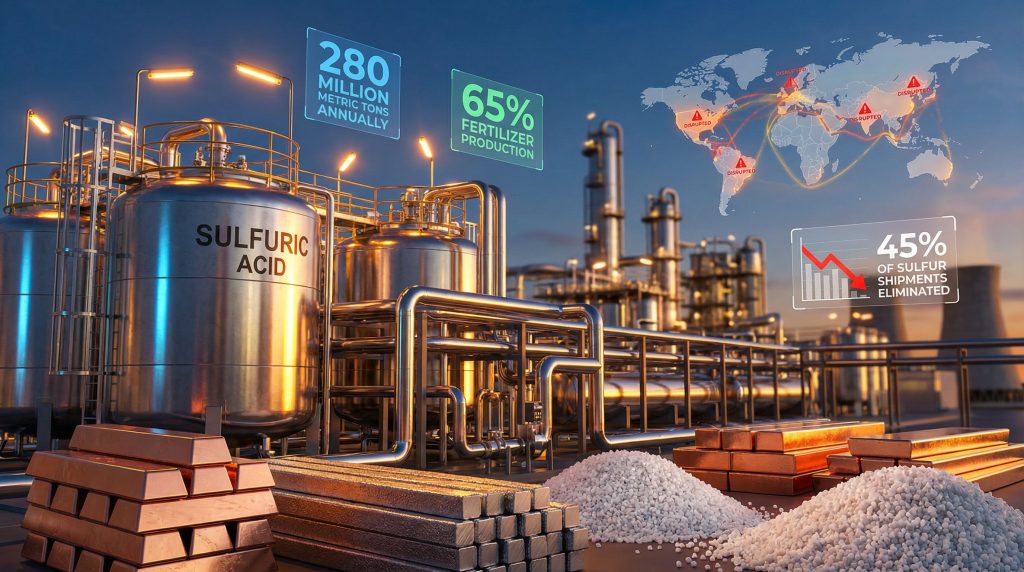
Industrial commodity markets face unprecedented disruption as supply chain vulnerabilities expose critical dependencies on geographically concentrated production sources. The global sulfuric acid shortage represents a particularly acute example of how geopolitical tensions can cascade through interconnected industrial processes, creating bottlenecks that affect everything from copper mining to agricultural fertiliser production.
When big ASX news breaks, our subscribers know first
Understanding the Sulfuric Acid Supply Chain Crisis
The current global sulfuric acid shortage stems from a complex web of supply chain disruptions that have fundamentally altered industrial chemical availability across multiple continents. Maritime trade routes carrying sulfur, the primary feedstock for acid production, have experienced severe restrictions due to geopolitical tensions in the Middle East.
Regional Supply Dependencies:
- African markets previously imported 48% of sulfur requirements from Middle Eastern sources
- Nearly half of Middle Eastern sulfur shipments to global markets have been eliminated
- Alternative supply routes lack sufficient capacity for rapid substitution
Furthermore, the shortage has created immediate operational challenges for industries dependent on steady acid supplies. Copper producers utilising hydrometallurgical extraction processes face particularly acute constraints, as these operations require substantial volumes of sulfuric acid for ore leaching activities.
Critical Supply Chain Metrics:
| Region | Historical Sulfur Dependency | Current Disruption Level |
|---|---|---|
| Africa | 48% from Middle East | Severe shortage |
| Asia | 35% from Middle East | Moderate constraints |
| Europe | 25% from Middle East | Supply tightening |
What Makes Sulfuric Acid So Essential to Modern Industry?
Sulfuric acid serves as a foundational chemical compound across numerous industrial applications, with global consumption patterns revealing deep structural dependencies. The compound's versatility extends from metal extraction processes to agricultural fertiliser manufacturing, creating interconnected vulnerabilities when supplies become constrained.
Primary Industrial Applications:
- Fertiliser Production: 65% of total consumption for phosphate rock dissolution
- Metal Processing: 20% for copper leaching operations and other metallurgical processes
- Chemical Manufacturing: 10% for intermediate compound synthesis
- Specialised Applications: 5% including battery production and petroleum refining
Hydrometallurgical copper extraction represents one of the most acid-intensive industrial processes, requiring approximately 2.5 tons of sulfuric acid per ton of copper produced. This dependency creates immediate production constraints when acid becomes unavailable, as oxide ore deposits cannot be economically processed through alternative methods.
Consequently, mining operations utilising oxide ore processing face immediate production constraints when sulfuric acid becomes unavailable. Unlike sulfide concentrates that can be processed through alternative smelting methods, oxide deposits require acid leaching for economically viable extraction.
The fertiliser industry demonstrates similarly critical dependencies, with sulfuric acid comprising 60-70% of production costs for diammonium phosphate (DAP) and monoammonium phosphate (MAP). Price volatility in acid markets immediately translates to agricultural input cost fluctuations.
Fertiliser Acid Requirements:
| Product Type | Acid Required (tons/ton) | Typical Production Volume |
|---|---|---|
| DAP | 0.4 | 45 million tons annually |
| MAP | 0.35 | 25 million tons annually |
| TSP | 0.3 | 15 million tons annually |
How Do Geopolitical Tensions Affect Chemical Supply Chains?
The concentration of sulfur production in politically volatile regions creates systemic vulnerabilities for global chemical supply chains. Maritime chokepoints, particularly the Strait of Hormuz, represent critical infrastructure whose disruption affects industrial operations thousands of miles away.
Current supply chain disruptions trace directly to geopolitical tensions that have effectively closed major shipping routes for sulfur exports. The near-closure of the Strait of Hormuz to sulfur traffic has eliminated crucial supply links between Middle Eastern producers and consuming regions.
Geographic Concentration Risks:
- Middle Eastern sulfur production serves global markets through limited maritime routes
- Alternative logistics infrastructure remains underdeveloped in competing regions
- Land-based transportation alternatives lack sufficient capacity for bulk chemical movements
- Port infrastructure in non-Middle Eastern regions cannot handle rapid volume increases
Multiple copper producers in the Democratic Republic of Congo have experienced order cancellations or supply withdrawals from chemical suppliers, demonstrating how regional conflicts affect industrial operations across continents. These disruptions force unusual supply chain reconfigurations as companies seek alternative sources.
However, the global sulfuric acid shortage illustrates how geopolitical risk extends beyond energy markets to affect fundamental industrial inputs. Companies previously focused on cost optimisation now prioritise supply security, fundamentally altering procurement strategies and supplier relationships.
Impact of US-China Trade Dynamics
In addition to Middle Eastern supply disruptions, the US-China trade war impact has further complicated global chemical supply chains. Trade restrictions and tariffs have forced companies to restructure sourcing networks, adding complexity to an already strained system.
Why Are Copper Mining Operations Particularly Vulnerable?
Copper extraction through hydrometallurgical leaching processes depends entirely on sulfuric acid availability, creating immediate operational bottlenecks when chemical supplies become constrained. Approximately 20% of global copper production relies on these acid-dependent extraction methods.
The vulnerability stems from the technical requirements of oxide ore processing, where sulfuric acid dissolves copper-bearing minerals to enable metal extraction. This process cannot be economically bypassed through alternative chemistry, unlike sulfide ores that can be processed through pyrometallurgical smelting.
Technical Process Dependencies:
- Oxide ore leaching requires 2.5 tons of acid per ton of copper produced
- Acid concentration and contact time directly affect recovery efficiency
- Process optimisation depends on consistent acid purity and availability
- Alternative extraction methods for oxide ores remain economically unviable
Copper producers have begun reducing chemical consumption to stretch existing stockpiles, a measure that directly affects production volumes. This inventory management strategy provides temporary relief but cannot sustain operations during extended supply disruptions.
Consequently, the Democratic Republic of Congo's copper industry faces particular exposure due to its reliance on oxide ore deposits and historical dependence on imported sulfuric acid supplies. Market demand in the DRC alone represents approximately 2 million metric tons annually.
DRC Copper Industry Impact:
| Factor | Current Status | Projected Impact |
|---|---|---|
| Annual acid demand | 2 million metric tons | Supply deficit emerging |
| Oxide ore dependency | 60% of production | High vulnerability |
| Import disruption | 48% reduction | Severe constraints |
What Alternative Supply Sources Are Emerging?
Integrated copper smelting operations are emerging as critical alternative sources for sulfuric acid during the current shortage. These facilities produce acid as a byproduct of copper concentrate processing, creating regional supply capacity independent of traditional import channels.
The Kamoa-Kakula copper mine in the Democratic Republic of Congo exemplifies this integrated production model. Its on-site smelter produced 117,871 metric tons of sulfuric acid during the first quarter of 2026, with annual capacity projected between 600,000-700,000 metric tons at full operation.
Integrated Production Advantages:
- Byproduct acid generation eliminates import dependencies
- On-site production reduces transportation costs and delivery delays
- Integrated operations maintain competitive positioning during supply shortages
- Customer proximity enables flexible delivery scheduling
Furthermore, Glencore and Eurasian Resources Group have emerged as customers for this integrated acid production, demonstrating how supply shortages create new commercial relationships between traditional competitors. These arrangements reflect fundamental shifts in industrial supply chain structure.
Regional Production Capacity Analysis:
| Facility Type | Annual Capacity | Market Coverage | Development Timeline |
|---|---|---|---|
| Integrated smelters | 600,000-700,000 tons | 30% of DRC demand | Operational |
| Standalone production | Limited expansion | Regional coverage | 18-24 months |
| Import recovery | Variable | Depends on geopolitics | Unknown |
However, even significant new capacity cannot fully address regional demand. The Congolese market's 2 million metric ton annual requirement exceeds what integrated producers can supply, leaving substantial gaps that require import restoration or additional capacity development.
The next major ASX story will hit our subscribers first
How Are Fertiliser Markets Responding to Acid Shortages?
Fertiliser manufacturers face severe operational constraints as sulfuric acid represents their primary input cost for phosphate-based products. The shortage has triggered dramatic price increases across agricultural input markets, with downstream effects on global food production economics.
Phosphate fertiliser production requires substantial acid volumes for rock dissolution processes, with typical consumption ranging from 0.3 to 0.4 tons of acid per ton of finished product. Supply constraints immediately translate to production limitations and cost escalation.
China's planned suspension of sulfuric acid exports beginning May 2026 adds additional pressure to already constrained global markets. Commonwealth Bank has warned that this policy aims to preserve domestic agricultural capacity during planting season, but eliminates a significant supply source for international markets.
Fertiliser Price Impact:
| Product | Acid Requirement | Price Increase | Market Response |
|---|---|---|---|
| DAP | 0.4 tons/ton | 45% increase | Production cuts |
| MAP | 0.35 tons/ton | 38% increase | Allocation systems |
| TSP | 0.3 tons/ton | 52% increase | Customer prioritisation |
Agricultural input suppliers are implementing allocation systems to manage limited acid supplies, prioritising high-value customers and products with the strongest demand fundamentals. This rationing approach helps maintain operations but reduces overall production capacity.
Consequently, the fertiliser industry's response demonstrates how chemical shortages propagate through interconnected supply chains, ultimately affecting agricultural productivity and food security in regions dependent on imported fertilisers.
What Long-Term Structural Changes Are Occurring?
The global sulfuric acid shortage accelerates industrial restructuring toward vertical integration and regional supply chain localisation. Companies are fundamentally reassessing global sourcing strategies, prioritising supply security over traditional cost optimisation approaches.
Mining companies are increasingly investing in captive acid production capacity, either through integrated smelting operations or standalone chemical facilities. This vertical integration reduces external dependencies while creating potential revenue streams from byproduct sales.
Strategic Industry Adaptations:
- Vertical integration through captive acid production facilities
- Regional clustering around existing production infrastructure
- Technology substitution research for acid-free processes
- Strategic stockpiling to buffer against future disruptions
Industrial facilities are co-locating near acid producers to reduce transportation risks and costs. This geographic clustering creates regional industrial ecosystems with reduced vulnerability to supply chain disruptions.
In addition, mining industry evolution has intensified research into alternative processing technologies, though breakthrough developments require substantial time and capital investment. Process optimisation efforts focus on reducing acid consumption rates while maintaining production efficiency.
Investment Trends:
| Strategy | Investment Level | Implementation Timeline | Risk Mitigation |
|---|---|---|---|
| Vertical integration | High | 2-3 years | Complete supply control |
| Regional clustering | Moderate | 1-2 years | Reduced logistics risk |
| Process alternatives | High | 3-5 years | Technology dependency |
| Strategic inventory | Low | 6-12 months | Short-term buffer |
How Do Semiconductor and Battery Industries Factor Into Demand?
High-purity sulfuric acid demand from electronics manufacturing adds significant pressure to already constrained global markets. Semiconductor fabrication and lithium battery production require ultra-pure grades that command premium pricing during shortage periods.
Electronics manufacturing consumes relatively small volumes compared to mining and fertiliser applications, but quality specifications require specialised production processes. These high-value applications often receive priority allocation during supply shortages.
Furthermore, the semiconductor industry's acid requirements focus on wafer cleaning and etching processes, where purity levels must exceed 99.999%. Battery manufacturing utilises acid in electrolyte preparation and metal purification steps, with similar quality demands.
High-Purity Applications:
- Semiconductor wafer processing requires 99.999% purity levels
- Battery manufacturing demands consistent electrolyte-grade quality
- Electronics applications typically pay 200-300% premiums over industrial grades
- Quality specifications limit supplier options during shortages
Competition between industrial and electronics applications intensifies during supply constraints, with price mechanisms directing available supplies toward highest-value uses. This market segmentation helps maintain critical technology production while constraining bulk industrial applications.
What Price Mechanisms Are Driving Market Behaviour?
Sulfuric acid pricing has shifted from traditional cost-plus models to scarcity-based mechanisms, with spot markets experiencing extreme volatility. Price discovery now reflects supply availability rather than production economics, creating unprecedented market dynamics.
Spot market volatility has reached 300-500% price swings within quarterly periods, making procurement planning extremely difficult for industrial consumers. Long-term contracts now command 40-60% premiums over historical pricing levels as buyers seek supply security.
Chilean acid prices increased 44% within a single month, demonstrating how regional supply constraints create rapid price movements. Similar volatility patterns emerge across global markets as buyers compete for limited supplies.
Price Mechanism Evolution:
| Market Segment | Historical Model | Current Model | Volatility Level |
|---|---|---|---|
| Spot purchases | Cost plus 10-15% | Scarcity pricing | 300-500% swings |
| Term contracts | Fixed annual pricing | Premium allocation | 40-60% increases |
| High-purity grades | Quality premiums | Extreme scarcity pricing | 200-400% premiums |
Regional price arbitrage opportunities have emerged as transportation costs become secondary to supply availability. Acid producers can command significantly different prices based on local market conditions and alternative supply access.
However, contract renegotiation becomes common as suppliers seek to capture scarcity premiums while buyers attempt to secure supply continuity. Traditional commercial relationships face strain as market dynamics override historical pricing arrangements.
Critical Minerals and Strategic Implications
The sulfuric acid crisis highlights broader concerns about critical minerals energy security and the vulnerabilities in essential industrial supply chains. This dependency on geographically concentrated sources creates strategic risks for nations relying on imported chemicals.
Which Regions Are Best Positioned for Supply Recovery?
Geographic proximity to sulfur sources and existing acid production infrastructure determines regional resilience during supply disruptions. Areas with integrated industrial complexes demonstrate greater supply stability compared to import-dependent regions.
Regions with domestic sulfur production or diversified import sources maintain operational advantages during geopolitical disruptions. North American markets benefit from domestic sulfur recovery from oil refining and natural gas processing operations.
Consequently, the Democratic Republic of Congo's position improves due to new integrated smelting capacity, though total demand exceeds local production capability. Regional cooperation arrangements help optimise available supplies across neighbouring markets.
Regional Supply Position Assessment:
| Region | Production Capacity | Import Dependency | Recovery Outlook |
|---|---|---|---|
| North America | High domestic production | Low import dependency | Strong recovery |
| Europe | Moderate capacity | Moderate imports | Variable by country |
| Sub-Saharan Africa | Emerging capacity | High dependency | Gradual improvement |
| Asia-Pacific | Mixed by country | Variable dependency | Depends on China policy |
Infrastructure development timelines vary significantly by region, with established industrial areas capable of faster capacity expansion. Greenfield development requires 18-24 months minimum for meaningful production increases.
How Are Companies Adapting Their Operational Strategies?
Industrial operators implement comprehensive demand management strategies including process optimisation, alternative chemistry research, and strategic inventory building. Priority allocation systems favour high-value applications over commodity uses during supply constraints.
Copper producers are reducing consumption rates through enhanced process efficiency and ore blending optimisation. These operational adjustments extend available supplies while maintaining production levels, though efficiency gains remain limited.
Operational Adaptation Strategies:
- Process optimisation to reduce acid consumption per unit of output
- Enhanced inventory management with strategic stockpiling
- Customer prioritisation based on contract terms and relationship value
- Alternative chemistry research for future supply diversification
Companies are restructuring supplier relationships to emphasise supply security over cost minimisation. Multiple sourcing strategies and regional diversification help reduce single-point-of-failure vulnerabilities.
Furthermore, mining consolidation trends have accelerated as companies seek strategic partnerships between acid producers and consumers. These create integrated supply chains that bypass traditional market mechanisms, providing supply certainty while generating stable revenue streams for producers.
Risk management protocols now incorporate supply chain resilience metrics alongside traditional financial and operational measures. Companies invest in scenario planning and contingency development to address future disruption possibilities.
What Does This Mean for Global Industrial Production?
The global sulfuric acid shortage represents a critical bottleneck affecting multiple industrial sectors simultaneously. Recovery timelines depend on geopolitical resolution and infrastructure development, with structural market changes likely persisting beyond immediate supply restoration.
Industrial production patterns are shifting toward regions with secure acid supplies, creating new competitive advantages based on input availability rather than traditional cost factors. This geographic rebalancing affects long-term industry development planning.
Supply chain resilience has emerged as a critical competitive differentiator, with companies investing heavily in vertical integration and alternative sourcing capabilities. These structural changes represent permanent shifts in industrial organisation rather than temporary crisis responses.
Long-term Industry Implications:
- Accelerated vertical integration across chemical-dependent industries
- Regional industrial clustering around secure supply sources
- Enhanced inventory management and strategic stockpiling practices
- Increased investment in alternative technology development
The shortage demonstrates how interconnected modern industrial systems create cascading vulnerabilities when critical inputs become constrained. Future supply chain design will likely prioritise redundancy and flexibility over pure cost efficiency.
However, recovery from the current shortage requires both geopolitical stabilisation and substantial infrastructure investment. Even with resolved tensions, rebuilding supply chain confidence and capacity will require extended time periods and significant capital commitment.
Disclaimer: This analysis is based on publicly available information and industry data current as of the publication date. Market conditions, pricing, and supply availability change rapidly during shortage periods. Readers should verify current market conditions and consult with industry experts before making operational or investment decisions based on this information.
Ready to Capitalise on Critical Commodity Supply Disruptions?
Discovery Alert's proprietary Discovery IQ model delivers real-time alerts on significant ASX mineral discoveries, empowering subscribers to identify actionable opportunities in critical supply chains before broader market recognition. Understand why historic discoveries can generate substantial returns by exploring major mineral finds that transformed supply dynamics, then begin your 14-day free trial to position yourself ahead of market-moving announcements.