June 17, 2026
How Sulphide Nickel Economics Are Reshaping Europe's Supply Chain Ambitions
The global nickel market has long operated in two distinct tiers: the high-volume, lower-purity laterite world dominated by Indonesian processing, and the smaller but strategically prized sulphide sector, where ore chemistry, carbon intensity, and concentrate quality command a premium from discerning industrial buyers. For most of the past decade, the laterite tier has ruled on price, flooding global markets with nickel units and making conventional sulphide mines economically marginal. That dynamic is now shifting in ways that are reopening conversations about assets once considered stranded.
Against this backdrop, the African Rainbow Nkomati nickel mine restart after off-take deal with Boliden represents more than a single corporate transaction. ARM's announcement of a conditional agreement with Sweden's Boliden Commercial AB for nickel concentrate from its Nkomati mine in South Africa's Mpumalanga province signals a structural recalibration in how European industrial buyers are thinking about where their critical mineral inputs come from, at what carbon cost, and under whose geopolitical orbit.
When big ASX news breaks, our subscribers know first
The Geology That Makes Nkomati Different From Most Nickel Deposits
Understanding why this deal matters requires first understanding what kind of nickel deposit Nkomati actually is, because not all nickel is created equal. The global nickel industry divides its primary ore sources into two fundamentally different geological categories:
-
Laterite deposits: Formed through intense tropical weathering of ultramafic rocks over millions of years, these surface and near-surface ores contain nickel in oxidised mineral forms. They are abundant, particularly across Indonesia, the Philippines, and New Caledonia, but processing them demands high-temperature, energy-intensive methods including rotary kiln electric furnace (RKEF) technology.
-
Sulphide deposits: Found in deeper geological settings associated with magmatic nickel deposits, these ores host nickel in chemically distinct sulphide mineral phases such as pentlandite. They process via conventional froth flotation into concentrates that can be fed directly into established smelting infrastructure.
Nkomati belongs to the sulphide category, classified as a class-one nickel sulphide orebody. This classification carries significant commercial weight. Sulphide concentrates are compatible with European smelting technology, produce lower volumes of processing waste per unit of nickel recovered, and carry a substantially lower carbon footprint per tonne of refined metal produced.
Research from the International Nickel Study Group (INSG) suggests that laterite-derived nickel processed through RKEF routes in coal-powered industrial zones can generate carbon intensities of roughly 8 to 12 tonnes of CO₂-equivalent per tonne of nickel, compared to approximately 3 to 6 tonnes for sulphide operations using conventional processing. For European manufacturers subject to growing supply chain carbon disclosure requirements under the EU's Corporate Sustainability Reporting Directive (CSRD) and the incoming Carbon Border Adjustment Mechanism (CBAM), that emissions gap is a genuine procurement differentiator.
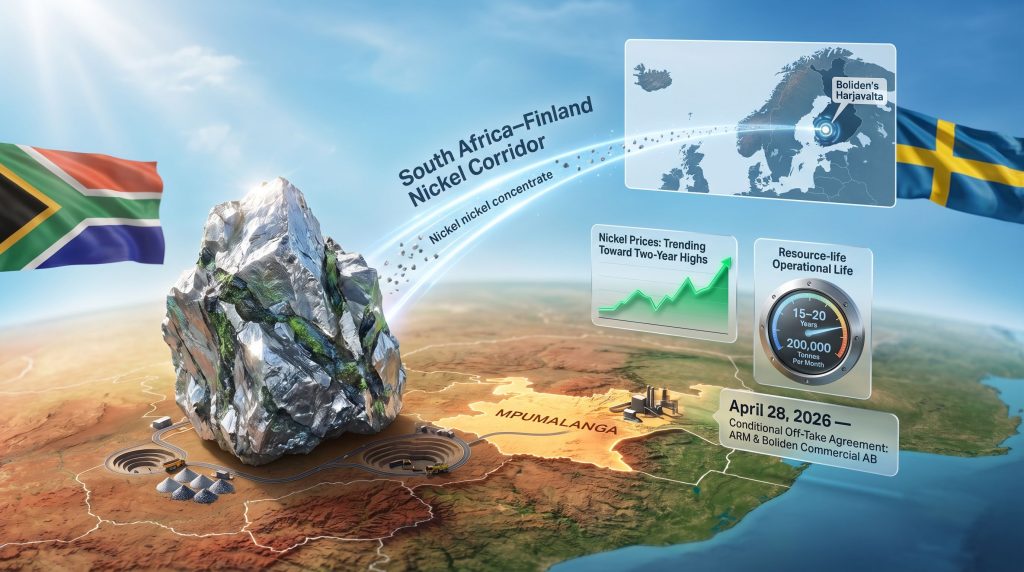
The deposit is estimated to support between 15 and 20 years of operations at a processing throughput of approximately 200,000 tonnes per month, providing a long-duration production profile that makes it credible as an anchor supply source for downstream industrial agreements.
From Joint Venture Complexity to Sole Ownership: What Changed at ARM
How Did ARM Gain Full Control?
The Nkomati mine's ownership history is itself an important part of the commercial story. For much of its operational life, the asset was structured as a 50/50 joint venture between ARM and Russia's Nornickel. That arrangement dissolved when Nornickel divested its 50% stake to ARM, with the transaction completing in July 2025.
The timing is strategically significant. By mid-2025, Russian-origin metals had become a procurement complication for European industrial buyers navigating sanctions frameworks, ESG screening requirements, and reputational considerations. ARM's acquisition of full ownership removed not just governance complexity but a geopolitical liability that would have made European off-take arrangements structurally harder to negotiate.
ARM's 100% ownership of Nkomati positions the company to make unilateral strategic decisions about the asset's future, removing the joint-venture governance friction that previously complicated restart discussions.
Why Nkomati Was Placed on Care and Maintenance in 2021
The 2021 care-and-maintenance decision reflected the collision of two unfavourable forces that, taken together, made continued production economically indefensible.
First, nickel price momentum had entered a structurally weak phase. The London Metal Exchange (LME) nickel price traded within a range of approximately $7,500 to $8,500 per tonne through much of 2021, compressed by the rapid expansion of Indonesian nickel supply that had been underway since the mid-2010s. Output growth, supported by Chinese-backed processing investment in nickel pig iron (NPI) and high-pressure acid leach (HPAL) facilities, effectively restructured the global nickel cost curve.
Second, Nkomati's operating costs were rising in real terms, driven by South African energy pricing pressures, labour cost inflation, and the deepening of underground infrastructure. The convergence of falling revenue per tonne and rising cost per tonne compressed margins below the threshold needed to justify continued operation.
However, care and maintenance status, rather than full closure, preserved the asset's physical integrity. Underground dewatering, ventilation, and surface infrastructure remained functional — a decision that proved consequential given that the restart capex requirement is now described as relatively modest compared to greenfield development.
The ARM–Boliden Agreement: What the Deal Actually Says
On 28 April 2026, ARM announced the conditional off-take agreement with Boliden Commercial AB, the commercial trading arm of Boliden AB, a Swedish mining and smelting company listed on Nasdaq Stockholm.
Under the proposed arrangement, ARM would supply nickel concentrate produced from Nkomati to Boliden's Harjavalta smelter in Finland. ARM has confirmed that Harjavalta is the only large-scale nickel smelter currently operating in Europe, making it a structurally irreplaceable processing node for any African sulphide producer seeking a direct European industrial supply route.
The agreement carries several conditions that must be satisfied before it moves to execution:
-
ARM board approval of the overall Nkomati restart business case, encompassing the full capital allocation decision.
-
Boliden's responsible sourcing due diligence, a formal verification process assessing the mine's environmental management, social licence to operate, governance structures, and sanctions compliance.
-
Undisclosed commercial terms covering pricing mechanisms, volume commitments, quality specifications, and contract duration.
ARM's own language around the deal is deliberately measured. The company has described it as strengthening the restart business case, not confirming a restart. The distinction matters for investors and analysts assessing the probability-weighted timeline for production recommencement.
| Condition | Status as of 28 April 2026 |
|---|---|
| ARM Board Restart Approval | Pending |
| Boliden ESG Due Diligence | In progress |
| Commercial Terms | Undisclosed |
| Restart Decision | Not confirmed |
Understanding the Boliden Harjavalta Connection
Why Is Harjavalta So Strategically Important?
Boliden's Harjavalta smelter in southwestern Finland is a purpose-built, large-scale nickel smelting operation capable of processing sulphide concentrates into refined nickel products for downstream industrial consumers, including stainless steel manufacturers and battery material producers across the European continent.
The facility's status as Europe's sole large-scale primary nickel smelter creates a bottleneck dynamic in European nickel supply chains. That structural scarcity elevates Harjavalta's strategic importance well beyond its physical capacity, making access to it a meaningful competitive advantage for upstream concentrate suppliers.
For ARM, securing a conditional supply relationship with Harjavalta achieves several things simultaneously. It establishes a processing and sales route, aligns Nkomati's output with European critical raw materials sourcing expectations, and creates a pathway to European end-users without routing material through Asian intermediary processors.
The next major ASX story will hit our subscribers first
What Is Driving the Nickel Price Recovery in 2026?
Nickel prices are trending toward two-year highs as of April 2026, driven primarily by production constraints in Indonesia, the world's dominant nickel-producing nation. Furthermore, Indonesian nickel trends show that authorities have implemented policy measures restricting production volumes, a reversal of the expansionary trajectory that had characterised Indonesian output since the mid-2010s.
The reasons behind Indonesian supply policy shifts are complex, encompassing resource nationalism, domestic value-add requirements, environmental pressure, and strategic calculations about long-term resource depletion rates. Regardless of the specific mechanisms, the market effect is a tightening of global nickel concentrate supply at a moment when demand for responsibly sourced, low-carbon nickel is accelerating.
| Factor | 2021 Conditions | 2026 Conditions |
|---|---|---|
| LME Nickel Price | Multi-year lows (~$7,500–$8,500/t) | Trending toward two-year highs |
| Indonesian Supply | Expansionary, price-depressive | Policy-constrained, tightening |
| ARM Ownership Structure | 50/50 JV with Nornickel | 100% ARM-owned |
| European Sourcing Pressure | Emerging | Mainstream procurement requirement |
| Carbon Disclosure Rules | Voluntary | Mandatory (CSRD, CBAM advancing) |
Nickel's Dual-Market Role and Why Sulphide Quality Matters
Nickel serves two structurally distinct demand pools that impose different quality requirements on upstream producers:
-
Stainless steel manufacturing absorbs roughly 70% of global nickel consumption and can utilise lower-purity nickel pig iron as well as refined Class 1 nickel. Price sensitivity is high in this segment.
-
Electric vehicle battery cathodes, particularly high-nickel chemistries such as NMC 811 and NCA, require Class 1 nickel with high purity specifications. This segment is growing rapidly and commands a quality premium.
Sulphide concentrates like those from Nkomati, when processed through a facility like Harjavalta, are capable of yielding Class 1 nickel suitable for both markets. This dual-market optionality gives the Nkomati-Harjavalta supply chain greater commercial flexibility than laterite-derived lower-purity products offer.
The accelerating adoption of high-nickel battery chemistries in European electric vehicle manufacturing is creating structural demand for exactly the kind of high-purity, low-carbon sulphide nickel that Nkomati could produce.
ARM's Strategic Pathways for the Restart
ARM has publicly outlined several distinct approaches it is evaluating for bringing Nkomati back into production, each carrying different capital, risk, and return characteristics.
Pathway 1: Fully Owned Restart Anchored by the Boliden Off-Take
ARM proceeds as sole operator, using the conditional Boliden agreement as the commercial foundation. This maximises ARM's upside exposure to nickel price appreciation but concentrates capital and operational risk on the company's balance sheet.
Pathway 2: Strategic Partnership with an Integrated End-User
ARM has flagged the possibility of partnering with a downstream industrial entity such as a battery manufacturer, steelmaker, or refiner. This model, increasingly common across the critical minerals sector, would reduce ARM's capital commitment in exchange for sharing production economics.
Pathway 3: Phased Restart Beginning with Open-Pit Operations
The initial restart focus is on open-pit mining, which carries lower capital requirements and shorter commissioning timelines than underground development. Critically, existing underground infrastructure, processing facilities, and tailings management systems are understood to be intact. Chrome concentrate shipments from the site commenced in January 2026, demonstrating that the asset is already partially productive and capable of generating revenue to offset ongoing care-and-maintenance expenditure.
The Broader Implication: An African-European Critical Mineral Corridor
The African Rainbow Nkomati nickel mine restart after off-take deal with Boliden, if it progresses through its conditions precedent to full execution, would represent a meaningful step toward the kind of African-European mineral supply corridors that have been discussed at a policy level but rarely operationalised at a commercial scale.
The EU's Critical Raw Materials Act has designated nickel as strategically important, with binding benchmarks for domestic processing capacity and diversified sourcing. A South Africa-to-Finland nickel supply chain, rooted in sulphide geology, low-carbon processing, and responsible sourcing verification, directly addresses the sourcing diversification objectives embedded in that regulatory framework.
For investors, the key variables to monitor are the completion of Boliden's ESG due diligence, ARM's board restart decision timeline, and the trajectory of LME nickel prices relative to Nkomati's anticipated operating cost structure. The asset's long resource life, existing infrastructure, and strategic market positioning create the conditions for a compelling commercial case. Consequently, however, the deal's conditional nature means that none of the potential upside should be treated as confirmed.
Disclaimer: This article is intended for informational purposes only and does not constitute financial advice. Forward-looking statements regarding nickel prices, production timelines, and commercial agreements involve inherent uncertainty. Readers should conduct independent research and seek professional advice before making investment decisions.
Want To Track The Next Major ASX Nickel Discovery Before The Market Does?
Discovery Alert's proprietary Discovery IQ model delivers real-time alerts on significant ASX mineral discoveries — including sulphide nickel opportunities — instantly cutting through complex geological and market data to surface actionable insights for investors at every level. Explore historic examples of major mineral discoveries and their market returns, then begin your 14-day free trial at Discovery Alert to position yourself ahead of the next significant find.