August 5, 2026
The Hidden Commodity at the Centre of a Global Supply Crisis
Every major geopolitical disruption eventually reveals which commodities the world forgot to worry about. Oil dominates headlines. Natural gas commands political attention. But quietly underpinning food production, battery manufacturing, semiconductor fabrication, and copper processing sits a substance most people have never considered as strategically important: sulphur.
The events unfolding across the Persian Gulf in 2026 have forced a rapid reassessment of this assumption. When the first sulphur shipment crosses the Strait of Hormuz after weeks of effective blockade, it does not just represent a cargo of industrial byproduct reaching its destination. It signals something far more consequential about the fragility of supply chains that the world's essential industries depend upon every single day.
When big ASX news breaks, our subscribers know first
Why the Strait of Hormuz Is the Fulcrum of Global Sulphur Trade
Understanding the significance of a sulphur shipment crossing the Strait of Hormuz requires first grasping an uncomfortable geographic reality. The Strait of Hormuz is the only maritime exit point from the Persian Gulf, a narrow passage connecting the region's ports to the Gulf of Oman and onward to global shipping lanes. There is no alternative route. No bypass. No second door.
For energy markets, this vulnerability is well-understood and extensively debated. What receives far less attention is how comprehensively this same chokepoint controls the flow of non-energy commodities, particularly sulphur, which is produced in enormous volumes across the Gulf as a byproduct of oil refining and natural gas processing. The geopolitical mining landscape has rarely faced such a stark illustration of geographic concentration risk.
The Middle East accounts for an estimated 50% of global seaborne sulphur trade, making the region the world's dominant price-setter for international markets. Global seaborne sulphur trade reached 30.3 million tonnes in 2024, easing marginally to 29.4 million tonnes in 2025, before the onset of the 2026 US-Iran conflict began accelerating that decline sharply.
When hostilities commenced at the end of February 2026, tanker transit volumes through the Strait fell by approximately 90%. This was not the result of a formal closure order. Instead, it reflected the practical mechanics of an effective closure: war risk insurance premiums made shipments commercially unviable, toll payments required for safe passage escalated rapidly, and shipowners were unwilling to risk vessels and crew in an active conflict zone.
The consequences rippled immediately and globally across agricultural, metallurgical, chemical, and technology supply chains. According to UNCTAD analysis of Hormuz disruptions, the broader trade implications extend well beyond energy commodities.
What Sulphur Actually Does and Why Its Absence Is Catastrophic
Sulphur is one of industrial civilisation's most versatile and indispensable raw materials, yet its role remains almost entirely invisible to anyone outside the commodities and chemicals sectors. Its primary commercial pathway is conversion into sulphuric acid, which then serves as a critical feedstock or processing agent across four foundational industries.
Sulphur's Four Critical Industrial Applications
-
Fertilizer production: Sulphuric acid is the essential reagent for processing phosphate rock into monoammonium phosphate (MAP), diammonium phosphate (DAP), single superphosphate (SSP), and triple superphosphate (TSP). Without sulphur, the global phosphate fertilizer supply chain cannot function.
-
Critical minerals extraction: High-Pressure Acid Leach (HPAL) processing of laterite nickel ores, the dominant industrial pathway to battery-grade nickel sulphate, consumes enormous quantities of sulphuric acid. Cobalt and copper extraction operations across Africa and Asia rely on the same reagent. Furthermore, the critical minerals and energy security agenda is now directly affected by sulphur supply constraints.
-
Semiconductor manufacturing: Ultra-pure sulphuric acid performs essential wafer cleaning, photoresist stripping, and surface preparation functions throughout chipmaking. It is a process-critical chemical with no straightforward substitute.
-
General chemical manufacturing: Sulphur derivatives underpin a vast range of chemical processes globally, from pharmaceutical synthesis to industrial cleaning agents.
Where the World's Sulphur Comes From
| Region | Estimated Share of Seaborne Trade | Key Producers |
|---|---|---|
| Middle East | ~50% | UAE (ADNOC/Ruwais), Kuwait (KPC), Qatar (QatarEnergy), Iran |
| Russia and Central Asia | Significant secondary share | Gazprom byproduct streams, Kazakhstan (Tengiz) |
| North America | Primarily domestic | US Gulf Coast refineries, Canadian oil sands |
| Other Regions | Marginal contributions | Venezuela (reduced output), others |
Global sulphur production reached approximately 83.87 million tonnes in 2025, but the critical factor is not total production volume. It is where that production is concentrated and the physical impossibility of rapidly sourcing it elsewhere when a disruption strikes.
Sulphur is a byproduct commodity. It is not mined as a primary resource but recovered as an inevitable output of desulphurisation processes at oil refineries and natural gas sweetening plants. This means production cannot be increased on demand in response to a price signal. It is entirely dependent on upstream hydrocarbon processing activity, and no equivalent emergency reserve mechanism exists for sulphur comparable to the strategic petroleum reserves maintained by oil-importing nations.
Anatomy of a Supply Crunch: The Scale of Stranded Cargo
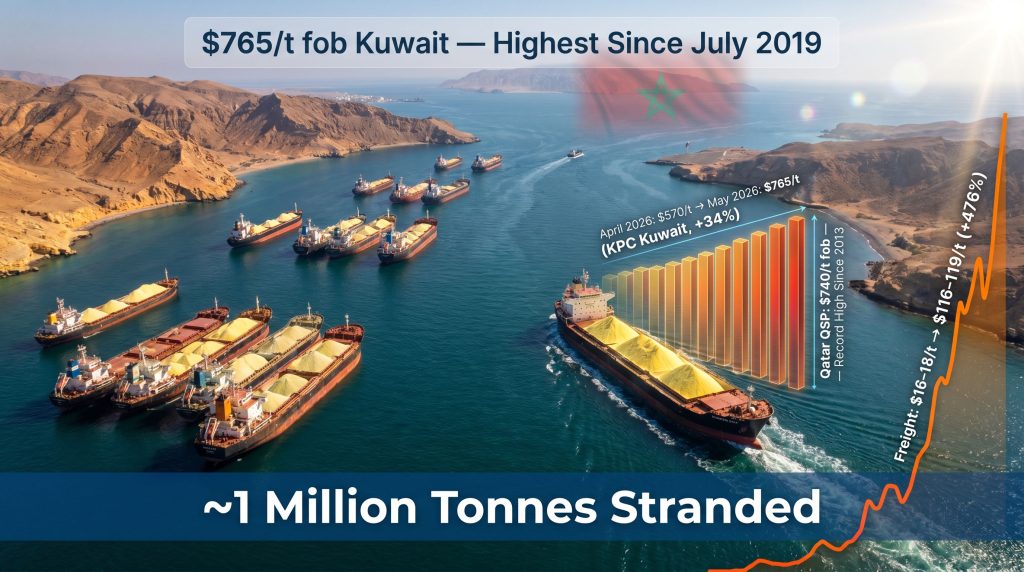
By early May 2026, the scale of the sulphur inventory problem in the Persian Gulf had become extraordinary. Market estimates indicated that close to 1 million tonnes of granular sulphur had been loaded onto vessels and was ready to sail, but remained unable to transit the Strait.
AIS vessel tracking data identified approximately 14 vessels carrying an estimated 600,000 tonnes of sulphur sitting visibly in the Middle East Gulf awaiting passage. Commodity market analysts assessed the true figure at potentially 25 vessels once ships operating with AIS transponders switched off were accounted for, a standard practice in high-risk shipping environments.
The composition of this stranded inventory matters enormously for understanding future price dynamics:
| Cargo Category | Estimated Share | Market Implication |
|---|---|---|
| Under existing quarterly contracts | 60-70% | Buyers face delay, not cancellation; pricing pre-agreed |
| Available for spot market sale | 30-40% | Price-dampening surge upon strait reopening |
The contract-versus-spot distinction creates an asymmetric market dynamic. Contracted volumes provide some commercial certainty but do nothing to restore physical supply to buyers in need. The spot-available portion, estimated at 300,000-400,000 tonnes, represents a potential price shock in reverse: when the strait reopens, these cargoes will enter markets simultaneously, creating a concentrated oversupply event that could trigger a sharp short-term correction before medium-term supply fundamentals reassert themselves.
Compounding the inventory problem is the reality that Middle East production itself has contracted. Damage to infrastructure, including Qatar's Ras Laffan gas plant where the majority of Qatari sulphur originates, has reduced output across the region. Storage facilities have reached capacity constraints as sulphur continues to be produced but cannot be exported, creating a feedback loop that forces refineries to reduce output to manage overflow. The result is a situation where both the available inventory and the forward production pipeline are simultaneously compromised.
The Richsing Lotu: What One Successful Transit Reveals
When the Richsing Lotu successfully navigated the Strait of Hormuz between 1 and 6 May 2026, it became one of the most closely watched commercial vessel movements in recent commodity market history. The facts of the transit illustrate both the extraordinary conditions shaping global sulphur trade and the cautious, incremental nature of the market's recovery.
The vessel had loaded approximately 50,000 tonnes of granular sulphur at UAE's Ruwais port on 27 March 2026. It then waited for several weeks, a commercial pause reflecting the meticulous risk calculation that shipowners face when operating in active conflict zones. Insurance premiums, passage costs, military threat assessments, and cargo owner instructions all factor into the decision calculus before a vessel commits to a transit attempt.
AIS tracking confirmed the vessel's passage through the Strait between 1 and 6 May, after which it appeared outside the US blockade line, carrying its cargo toward Jorf Lasfar, Morocco, one of the world's largest phosphate fertilizer production complexes. The delivery was made under standard quarterly contract terms, signalling that at least some commercial counterparties are honouring existing contractual obligations rather than invoking force majeure clauses despite dramatically elevated transit costs.
The Richsing Lotu was not the first vessel to attempt the crossing. The MV Valsamitis had transited the Strait on 16 April 2026, carrying 34,000 tonnes of granular sulphur also loaded at Ruwais. That vessel bunkered at Fujairah before proceeding toward Dar es Salaam, Tanzania, serving African copper producers dependent on sulphuric acid for ore processing. The MV Valsamitis transit established the initial precedent; the Richsing Lotu confirmed it was not an isolated incident but rather the beginning of cautious, incremental resumption.
The pattern of individual vessel transits, spaced weeks apart, reflects market behaviour consistent with risk testing rather than genuine commercial normalisation. Each successful crossing lowers the perceived probability of the worst-case outcome for the next vessel attempting passage, gradually rebuilding shipowner confidence in an environment of still-substantial uncertainty.
The Price Shock: Record Highs Across Every Gulf Producer Benchmark
The commercial consequences of the effective Strait closure have been extreme and historically unprecedented. Every major Middle Eastern sulphur producer has raised official selling prices to levels never previously recorded.
Official Selling Price Escalation Across Gulf Producers
| Producer | April 2026 OSP | May 2026 OSP | Month-on-Month Change |
|---|---|---|---|
| Kuwait (KPC) | $570/t fob Kuwait | $765/t fob Kuwait | +$195/t (+34%) |
| Abu Dhabi (ADNOC) | ~$600/t fob Ruwais | $760/t fob Ruwais | +$160/t (+27%) |
| Qatar (QatarEnergy) | ~$490/t fob | $740/t fob Ras Laffan/Mesaieed | Record high since Argus records began in 2013 |
The Kuwait Sulphur Price of $765/t is the highest the benchmark has reached since its launch in July 2019, representing the culmination of a rising price cycle that began in July 2025 and has now been dramatically accelerated by the conflict. The QatarEnergy May sulphur price of $740/t sits $250/t above the previous all-time high of $490/t recorded in August 2022, a figure that itself was considered exceptional at the time. The ADNOC official selling price of $760/t fob Ruwais is the highest level since June to August 2008, when prices briefly reached $800-820/t during the last major sulphur price spike before the global financial crisis collapsed commodity markets.
What These Prices Mean for Import Markets
Freight costs have amplified the price shock significantly. Rates for sulphur shipments from the Middle East have risen by approximately 476% since the onset of the US-Iran conflict, escalating from $16-18/t on 26 February 2026 to levels exceeding $116/t by late April 2026. War risk insurance premiums add further cost burden on top of elevated freight assessments. As reported by Splash247, the war has turned sulphur markets toxic with an acid supply shock of significant proportions.
| Destination Market | Assessed Freight Rate | Implied Delivered Cost |
|---|---|---|
| South China ports (30,000-35,000t) | $116-119/t (assessed 30 April 2026) | ~$856-884/t cfr |
| Chinese river ports (30,000-35,000t) | $120-122/t | ~$860-887/t cfr |
| East coast India (40,000-45,000t) | $95-99/t | ~$855-859/t cfr |
These delivered cost levels represent a fundamental repricing of sulphur-derived production economics for fertilizer manufacturers, nickel processors, and chemical producers across Asia and South Asia.
The next major ASX story will hit our subscribers first
Sector-by-Sector Exposure: Who Bears the Greatest Risk
Agricultural Supply Chains
The fertilizer sector faces the most immediate and time-critical consequences. Sulphur is the upstream feedstock for sulphuric acid used in phosphate fertilizer production, and the agricultural calendar creates hard procurement deadlines that cannot be deferred indefinitely. Fertilizer manufacturers typically hold limited sulphur inventory, meaning disruptions extending beyond their buffer stocks directly constrain production capacity.
The downstream impact is already visible in nitrogen markets. US urea prices at New Orleans have risen by $159 per short ton (24%) to $629/st since the conflict began, sitting $144/st above year-ago levels, according to Argus market data. This reflects the interconnected nature of the fertilizer complex: a sulphur supply shock affects phosphate production economics, which influences nutrient substitution decisions across the broader fertilizer market.
Egypt's producer NCIC, for example, issued a tender in late April 2026 offering 30,000 tonnes of DAP at up to $880/t fob, 10,000 tonnes of TSP at up to $695/t fob, and 25,000 tonnes of urea at up to $852/t fob Ain Sokhna, illustrating how phosphate and nitrogen prices across the Mediterranean are responding to the supply disruption.
China's Structural Dependency
China's industrial demand for sulphur occupies a uniquely vulnerable position in this disruption. With approximately 47% of its sulphur imports sourced from Gulf producers, Chinese buyers face both acute supply scarcity and extreme cost escalation simultaneously. The supply squeeze has forced procurement pauses and an unsuccessful search for alternative sources, given the Middle East's structural dominance of seaborne sulphur trade. Downstream effects cascade through China's domestic sulphuric acid, phosphate fertilizer, and chemical manufacturing sectors.
Critical Minerals and the Energy Transition Supply Chain
The HPAL processing pathway for battery-grade nickel is particularly exposed. HPAL operations are continuous, high-volume industrial processes that consume sulphuric acid in large quantities throughout every operating hour. Unlike semiconductor manufacturers, who may maintain strategic chemical inventories, HPAL facilities typically operate on a just-in-time procurement model given the logistics of storing concentrated acid at scale.
In addition, the battery raw materials market faces a genuine secondary constraint on supply chains supporting electric vehicle battery production. A multi-month disruption to sulphur availability creates cascading pressures across the broader critical raw materials transition agenda, as the chemical inputs underpinning green technology manufacturing are increasingly exposed to the same geopolitical chokepoints as fossil fuels.
Alternative Supply Sources: Why Substitution Is Harder Than It Appears
The instinctive market response to a regional supply disruption is to seek alternative sources. For sulphur, however, this option is far more constrained than for most commodities.
| Alternative Source | Key Constraint | Near-Term Viability |
|---|---|---|
| Russia / Central Asia | Sanctions exposure, logistics barriers, geopolitical risk | Very limited for Western buyers |
| North America | Primarily consumed domestically; minimal export surplus | Marginal supplementation only |
| Venezuela | Output significantly below historical capacity | Insufficient scale |
| Kazakhstan (Tengiz) | Landlocked logistics complexity | Medium-term potential, not immediate |
The fundamental obstacle is sulphur's byproduct nature. Because it is recovered from hydrocarbon processing rather than extracted as a primary commodity, increasing supply requires either expanding hydrocarbon production or improving sulphur recovery rates at existing facilities. There is no sulphur equivalent of calling upon swing producers or releasing strategic reserves.
This structural reality is what distinguishes the 2026 Strait of Hormuz disruption from a standard supply shock. It is not merely a logistics problem that can be solved through rerouting or price incentives. It represents a genuine reduction in the physical availability of a substance for which global industrial demand is largely inelastic in the short term.
Scenarios for Market Resolution and Price Trajectory
The following scenario analysis represents forward-looking projections based on current market conditions and is inherently speculative. It should not be interpreted as financial or investment advice.
Scenario 1: Gradual Incremental Reopening (Base Case)
The pattern established by the MV Valsamitis and Richsing Lotu transits continues, with individual vessels testing passage and progressively rebuilding shipowner confidence. Over a 4-8 week period, the 300,000-400,000 tonnes of spot-available stranded cargo enters global markets in a concentrated release, triggering a short-term price correction from current record highs. Freight rates normalise progressively as insurance risk premiums decline alongside reduced military activity.
Scenario 2: Prolonged Effective Closure (Bearish for Buyers)
Sustained military activity through mid-to-late 2026 maintains the effective closure of the Strait. Additional damage to Gulf production infrastructure, potentially including further deterioration of Qatar's Ras Laffan gas plant, reduces the forward production pipeline even as current stranded inventory is gradually released through individually negotiated transits. Global sulphur prices consequently sustain near or above current record levels, with cascading effects on phosphate fertilizer availability and critical minerals processing costs.
Scenario 3: Rapid Full Commercial Reopening (Bullish for Buyers)
A diplomatic resolution or ceasefire restores shipping confidence rapidly. A mass simultaneous exodus of stranded vessels creates an acute spot oversupply event, triggering a sharp correction well below pre-conflict pricing as buyers defer new purchases in anticipation of further declines. Freight rates collapse as war risk premiums disappear and shipowners return to normal routing.
The Deeper Strategic Lesson for Industrial Supply Chain Planning
The 2026 Strait of Hormuz disruption has exposed a fundamental gap in global industrial risk management. Sulphur has no internationally coordinated strategic reserve. No emergency release mechanism exists. No multilateral framework governs supply security for this commodity in the way that the International Energy Agency coordinates oil market responses.
The consequences of this gap are now visible in real time: fertilizer production constraints threatening agricultural seasons, mineral processing operations scrambling to secure acid supply, and chipmakers quietly drawing down strategic inventories accumulated precisely against scenarios they hoped would never materialise.
Several structural responses are likely to gain commercial traction regardless of how quickly the current disruption resolves:
-
Phosphate fertilizer producers may invest in expanded sulphur storage capacity to extend inventory buffer beyond current 4-8 week horizons
-
Accelerated commercial interest in alternative sulphuric acid production pathways, including recovery from pyrite and other sulphide mineral sources, which were previously uneconomic against cheap Middle Eastern sulphur
-
Geopolitical diversification strategies among the largest sulphur-consuming industrial operations, potentially including long-term offtake agreements with North American and Central Asian producers despite higher baseline costs
-
Closer attention from governments and industrial policy planners to sulphur as a critical industrial input warranting strategic consideration alongside more widely recognised critical materials
The moment a sulphur shipment crosses the Strait of Hormuz under conflict conditions, making global news for a commodity few investors or policymakers had previously tracked, represents a clear signal that the world's industrial supply chain assumptions need updating. The question is whether the lessons from 2026 generate durable structural changes, or fade from institutional memory as rapidly as the last crisis before it.
This article is based on commodity market data and reporting from Argus Media (published May-June 2026). Forward-looking statements, scenario projections, and price forecasts are speculative in nature and should not be construed as financial advice. Commodity markets are subject to rapid change and readers should consult qualified advisers before making investment or procurement decisions based on this analysis.
Want to Stay Ahead of the Next Major Commodity Discovery Before the Market Catches On?
While sulphur supply shocks ripple through fertiliser, battery, and semiconductor supply chains, savvy investors are already positioning themselves in the ASX-listed companies exposed to critical mineral discoveries — and Discovery Alert's proprietary Discovery IQ model delivers real-time alerts the moment significant ASX mineral announcements are made, turning complex data across 30+ commodities into clear, actionable insights. Explore historic discoveries and the returns they generated, then start your 14-day free trial to ensure you're never last to act on the next major find.