August 25, 2026
Modern oil extraction has evolved beyond the familiar landscape of open-pit mining operations, driven by technological advances that unlock previously inaccessible hydrocarbon reserves. The petroleum industry increasingly recognizes that production methods must adapt to geological realities, economic constraints, and operational efficiency demands. Steam-assisted gravity drainage (SAGD) and other thermal recovery techniques represent a fundamental shift in how energy companies approach resource extraction, particularly in unconventional deposits where traditional mining proves economically unviable. This Suncor in situ oil sands shift exemplifies how major energy companies are redefining their operational strategies.
This technological evolution reflects broader industry trends toward capital-efficient extraction methods that maximize cash flow generation per barrel produced. Companies are discovering that operational flexibility, lower surface impact, and enhanced reserve accessibility through in-situ techniques can deliver superior financial returns compared to capital-intensive mining infrastructure.
Understanding Suncor's Strategic Production Transformation
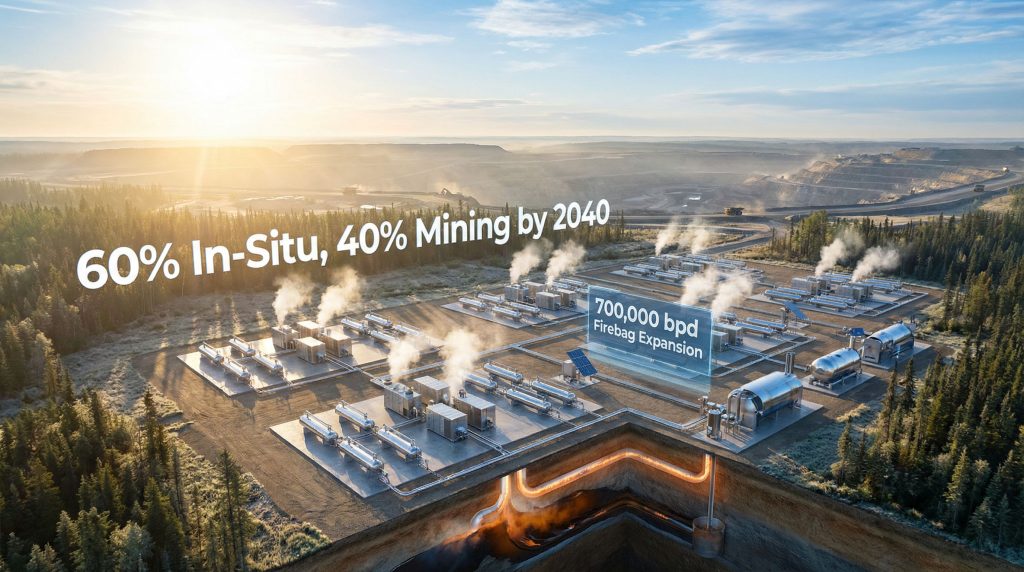
Suncor Energy's ambitious plan to transform its production portfolio by 2040 represents one of the most significant operational pivots in Canadian oil sands history. The company aims to shift from a predominantly mining-based operation to an in-situ focused strategy, with 60% of production coming from steam-assisted extraction methods by 2040, compared to the current 30% baseline.
This Suncor in situ oil sands shift reflects fundamental economic advantages that extend beyond simple operational preferences. According to company leadership, in-situ operations deliver double the relative cash flow per barrel compared to traditional mining methods, making this transformation a financially driven strategic imperative rather than merely a technological preference.
Furthermore, industry analysts have noted how this transformation aligns with broader oil price rally analysis trends that favour lower-cost production methods during volatile market conditions.
Economic Drivers Behind Production Method Selection
The financial mathematics behind Suncor's strategic pivot become apparent when examining cash flow generation metrics. While mining operations require substantial upfront capital for heavy machinery, tailings infrastructure, and seasonal weather adaptation systems, in-situ methods operate with modular development approaches that enable phased capacity expansion.
Key Financial Metrics:
- Cash flow advantage: 2x relative cash flow per barrel for in-situ operations
- WTI breakeven target: $38 per barrel by 2028
- Production growth target: 100,000 barrels per day upstream growth by 2028
- Current production mix: 70% mining, 30% in-situ (shifting to 40% mining, 60% in-situ by 2040)
The company's Firebag asset exemplifies this economic advantage, operating as Suncor's most profitable facility while producing 245,000 barrels per day through steam-assisted extraction. This operational success has prompted regulatory applications to expand Firebag's permitted capacity from 368,000 barrels per day to 700,000 barrels per day, representing a 182% increase from current permitted levels.
Capital Efficiency and Infrastructure Requirements
Steam-assisted gravity drainage operations require fundamentally different infrastructure compared to surface mining, creating opportunities for enhanced capital efficiency. SAGD facilities utilize twin horizontal wells positioned in carefully calculated configurations within bitumen-bearing formations, with the upper well injecting steam at 200-250°C while the lower well collects mobilized bitumen as gravity draws it downward.
This infrastructure approach offers several capital advantages:
- Modular installation: Facilities can be built in phases, reducing initial capital requirements
- Smaller surface footprint: Lower environmental compliance costs and regulatory complexity
- Reduced machinery intensity: Eliminates need for massive haul trucks, shovels, and mining infrastructure
- Geographic flexibility: Can access reserves in areas unsuitable for surface mining
The operational scalability becomes evident in Suncor's near-term optimization plans, where debottlenecking and enhancement projects will increase Firebag production to 275,000 barrels per day by 2028 without major capital expenditure, representing a 12% production increase through technical refinement rather than infrastructure expansion.
When big ASX news breaks, our subscribers know first
Technical Mechanisms of Steam-Assisted Extraction
The engineering principles underlying SAGD technology reveal why in-situ methods can access reserves beyond the reach of conventional mining. Steam injection creates thermal mobilization of bitumen deposits, reducing viscosity from thousands of centiPoise to levels that enable gravity-assisted flow toward production wells.
Modern extraction companies are increasingly utilising advanced reservoir modeling techniques to optimise these thermal recovery processes and maximise production efficiency.
SAGD Process Engineering
Steam-assisted extraction operates through precisely controlled thermal recovery mechanisms that work within specific geological parameters. The process involves:
Well Configuration:
- Horizontal well pairs positioned 5-10 meters apart vertically
- Typical horizontal length of 500-1,500 meters per well
- Steam injection at elevated pressure to maintain formation contact
Thermal Recovery Phases:
- Circulation phase (0-3 months): Steam circulation establishes thermal communication
- Production ramp-up (3-24 months): Steam chamber development and bitumen mobilization
- Plateau production (24+ months): Steady-state operations with optimized steam-oil ratios
This technical approach enables access to bitumen deposits at depths of 100-400 meters, well beyond the practical limits of surface mining operations. The thermal recovery process can handle bitumen viscosity ranges from 300-3,000 centiPoise, adapting steam injection parameters to geological conditions.
Production Curve Characteristics and Reserve Access
In-situ operations exhibit distinct production profiles that differ significantly from mining extraction. SAGD wells typically demonstrate:
- Extended field life: 20-40 year production periods per well pair
- Predictable decline curves: Steam-oil ratio optimization maintains production efficiency
- Reserve factor flexibility: Can access multiple geological zones through vertical well spacing
Suncor's recent reserve revision, adding 11 billion barrels to bring total bitumen reserves to 30 billion barrels, reflects the company's enhanced understanding of deeper deposit accessibility through in-situ methods. This 58% increase in reserve estimates indicates that thermal extraction technologies unlock resources previously considered marginal or uneconomic.
Asset-Specific Development Strategy
Suncor's production transformation centers on two primary in-situ assets: the existing Firebag facility and the proposed Lewis development. These projects demonstrate how the Suncor in situ oil sands shift will unfold through coordinated capacity expansion and new project development.
Firebag Expansion Timeline
The Firebag asset serves as Suncor's in-situ flagship, with expansion plans that illustrate the scalability advantages of steam-assisted extraction:
Current Operations (2026):
- Production: 245,000 barrels per day
- Permitted capacity: 368,000 barrels per day
- Profitability ranking: Most profitable Suncor asset
Near-term Optimization (2028):
- Target production: 275,000 barrels per day
- Growth method: Debottlenecking and technical optimization
- Capital requirement: Minimal infrastructure investment
Long-term Expansion (2030s):
- Regulatory application: 700,000 barrels per day permitted capacity
- Capacity increase: 455,000 barrels per day additional production
- Development approach: Phased expansion coordinated with Base Plant depletion
Lewis Project Development
The proposed Lewis in-situ development represents greenfield resource access, targeting 160,000 barrels per day production capacity through phased implementation. This project's development sequence will coordinate with the gradual depletion of Suncor's Base Plant mine, expected to reach substantial depletion by the mid-2030s.
Lewis project characteristics include:
- Reserve type: Previously inaccessible through mining methods
- Development strategy: Phased implementation reducing capital intensity
- Timeline coordination: Sequenced to offset Base Plant production decline
- Geographic advantage: Located in areas unsuitable for surface mining
Financial Implications and Cost Structure Evolution
The Suncor in situ oil sands shift creates fundamental changes in the company's cost structure and financial profile. Steam-assisted operations demonstrate superior cash flow generation through reduced operating expenses, enhanced capital efficiency, and improved production sustainability.
Breakeven Optimization and Margin Enhancement
Suncor's target of achieving $38 per barrel WTI breakeven by 2028 reflects the cost advantages inherent in thermal extraction methods. This breakeven improvement results from several operational factors:
Reduced Operating Costs:
- Elimination of heavy equipment maintenance and replacement
- Lower transportation costs within production facilities
- Reduced seasonal weather impact on operations
- Streamlined processing requirements
Enhanced Production Efficiency:
- Consistent production profiles less subject to weather interruption
- Predictable decline curves enabling better production planning
- Optimization opportunities through steam injection refinement
However, the broader energy sector faces challenges from evolving natural gas price trends that could impact steam generation costs for SAGD operations.
Capital Allocation and Investment Returns
The production method transformation enables more efficient capital allocation across Suncor's asset portfolio. In-situ developments require lower upfront capital per barrel of production capacity while offering superior return on invested capital through:
Investment Efficiency Factors
- Modular development reducing initial capital requirements
- Phased expansion enabling capital discipline and market timing flexibility
- Higher cash flow generation per dollar invested
- Extended asset life providing longer investment payback periods
Consequently, energy companies are increasingly focusing on capital allocation strategies that prioritise projects with lower initial capital requirements and enhanced operational flexibility.
Industry Context and Competitive Positioning
Suncor's strategic pivot reflects broader Canadian oil sands industry trends toward thermal recovery methods. The sector increasingly recognizes that in-situ technologies offer competitive advantages in cost structure, environmental impact, and operational flexibility compared to traditional mining approaches.
Technology Adoption Patterns Across the Sector
The Canadian oil sands industry has witnessed accelerating adoption of steam-assisted extraction technologies, driven by several convergent factors:
Economic Drivers:
- Improved steam generation efficiency reducing energy costs
- Enhanced reservoir modeling enabling better well placement
- Digital optimization systems improving steam-oil ratios
- Reduced regulatory complexity for smaller surface footprints
Reserve Access Requirements:
- Depletion of easily accessible surface deposits
- Discovery of deeper bitumen resources requiring thermal extraction
- Enhanced geological understanding of in-situ suitable formations
Environmental and Regulatory Considerations
Steam-assisted extraction methods offer several environmental advantages that influence regulatory approval processes and public acceptance:
- Surface disturbance reduction: Smaller land footprint compared to open-pit mining
- Water management: Closed-loop systems reducing freshwater consumption
- Tailings elimination: No tailings ponds required for in-situ operations
- Habitat preservation: Minimal impact on surface ecosystems
These environmental benefits translate to regulatory advantages, with in-situ projects typically experiencing streamlined permitting processes compared to new mining developments. However, steam generation requirements create different environmental challenges, particularly related to natural gas consumption and greenhouse gas emissions.
Risk Factors and Implementation Challenges
Despite the economic and technical advantages driving the Suncor in situ oil sands shift, several risk factors could impact the successful execution of this production transformation.
Technical and Operational Risks
Steam-assisted extraction faces distinct technical challenges that differ from mining operations:
Reservoir Performance Variability:
- Geological heterogeneity affecting steam chamber development
- Pressure maintenance requirements over extended production periods
- Steam breakthrough risks in poorly characterized formations
- Recovery factor uncertainty in untested geological zones
Energy Input Dependencies:
- Natural gas price sensitivity for steam generation
- Energy infrastructure requirements in remote locations
- Steam generation efficiency optimization challenges
- Power supply reliability for continuous operations
Market and Economic Factors
The transformation timeline extends through 2040, exposing Suncor to various market risks. Moreover, potential oil market trade war impact scenarios could influence long-term demand patterns and commodity price volatility.
Commodity Price Sensitivity:
- WTI crude oil price volatility affecting project economics
- Natural gas price correlation with operating costs
- Currency exchange rate impacts on capital expenditure
- Long-term energy demand uncertainty
Capital Market Access:
- Funding requirements for major expansion projects
- ESG (Environmental, Social, and Governance) investor preferences
- Regulatory approval timelines for capacity expansions
- Competition for capital within Suncor's portfolio
The next major ASX story will hit our subscribers first
Long-term Strategic Implications for Canadian Oil Sands
Suncor's production method transformation signals broader changes within Canada's oil sands sector, with implications extending beyond individual company strategy to influence industry structure, investment patterns, and technological development.
Supply Chain and Infrastructure Evolution
The Suncor in situ oil sands shift requires adaptation across the energy services sector:
Service Provider Adaptation:
- Drilling contractors specializing in horizontal well technology
- Steam generation equipment suppliers
- Reservoir simulation and optimization service companies
- Enhanced oil recovery technology developers
Infrastructure Requirements:
- Natural gas pipeline capacity for steam generation
- Electrical grid enhancement for remote operations
- Transportation infrastructure adapted to in-situ production
- Water treatment and recycling facility development
Investment Flow Patterns and Capital Reallocation
The industry shift toward in-situ methods creates new patterns of capital investment within Canadian oil sands:
| Investment Category | Mining Operations | In-Situ Operations |
|---|---|---|
| Initial Capital Intensity | High ($15-20B for major projects) | Moderate ($3-8B for major developments) |
| Capacity Scalability | Limited (fixed processing capacity) | High (modular well additions) |
| Environmental Approval Complexity | High (tailings, surface disturbance) | Moderate (steam emissions, water use) |
| Production Lifespan | 25-40 years | 20-40 years per well area |
| Operating Cost Structure | Equipment-intensive | Energy-intensive |
This capital reallocation pattern influences investor preferences, with institutional investors increasingly favoring projects with lower initial capital requirements and enhanced operational flexibility.
Technology Innovation and Development Trajectories
The emphasis on steam-assisted extraction drives technological innovation across several domains:
Enhanced Recovery Techniques:
- Solvent-assisted SAGD reducing steam requirements
- Electromagnetic heating methods for heavy bitumen
- Advanced reservoir simulation and artificial intelligence optimization
- Carbon capture integration with steam generation
Digital Optimization Systems:
- Real-time reservoir monitoring and production optimization
- Predictive maintenance for steam generation equipment
- Automated steam injection control systems
- Machine learning applications for well performance optimization
Future Market Positioning and Competitive Dynamics
As the Suncor in situ oil sands shift progresses toward 2040, the company's strategic positioning within global crude oil markets will evolve significantly. The transformation creates competitive advantages in cost structure, production flexibility, and environmental profile that influence market share and profitability.
Global Crude Oil Market Integration
Suncor's enhanced cost competitiveness through in-situ production enables better integration with global crude oil markets. According to Suncor Energy's strategic analysis, this transformation positions the company favourably against international competitors.
Cost Competitiveness Factors:
- $38/barrel WTI breakeven positioning competitive with international producers
- Reduced volatility in production costs compared to mining operations
- Enhanced ability to respond to commodity price cycles through production optimization
- Improved margins during low-price environments
Market Access Advantages:
- Consistent production profiles enabling long-term supply contracts
- Reduced weather-related production interruptions
- Enhanced ability to match production to market demand
- Improved crude quality through optimized extraction processes
The strategic transformation positions Suncor within the competitive cost structure of international oil producers while maintaining the geographic and political stability advantages of Canadian operations. Furthermore, industry experts anticipate that this shift will solidify Suncor's position as a leading energy producer in North America.
Disclaimer: This analysis is based on publicly available information and company presentations. Oil and gas investments involve substantial risks, including commodity price volatility, regulatory changes, and operational challenges. Projected production figures, financial targets, and timeline estimates represent company guidance and may not be achieved due to various factors beyond company control. Readers should conduct independent research and consult qualified financial advisors before making investment decisions. Reserve estimates and production forecasts involve geological uncertainty and may differ materially from actual results.
Ready to Position Yourself Ahead of the Next Energy Market Shift?
Discovery Alert's proprietary Discovery IQ model delivers real-time alerts on significant ASX mineral discoveries, instantly empowering subscribers to identify actionable opportunities ahead of the broader market. Understand why major mineral discoveries can lead to significant market returns by exploring Discovery Alert's dedicated discoveries page, showcasing historic examples of exceptional outcomes, and begin your 14-day free trial today to secure your market-leading advantage.