May 16, 2026
Understanding the Strategic Revolution in Extraction Economics
Market dynamics rarely shift overnight, yet certain inflection points reshape entire industries within a decade. The global oil sands sector stands at precisely such a crossroads, where established production methodologies face economic realities that demand fundamental strategic recalibration. Traditional surface mining operations, long the backbone of Canadian bitumen extraction, increasingly compete against steam-assisted technologies that promise superior returns on invested capital. The Suncor in situ oil sands shift represents a pivotal transformation reflecting broader energy sector trends toward operational efficiency, environmental optimisation, and long-term resource sustainability. Understanding these underlying forces provides critical context for analysing how major operators navigate the transition from conventional extraction toward technologically sophisticated alternatives.
When big ASX news breaks, our subscribers know first
Production Technology Evolution in Canadian Oil Sands
Steam-Assisted Gravity Drainage vs. Surface Mining Methods
The fundamental distinction between surface mining and in situ extraction lies in their approach to accessing bitumen deposits. Surface mining operations utilise conventional truck-and-shovel methodologies to extract heavy bitumen from shallow deposits, typically positioned within 75 metres of the surface. This approach requires extensive overburden removal and creates large-scale open pits that can extend several kilometres in diameter.
Steam-assisted gravity drainage (SAGD) technology operates through entirely different principles. Paired horizontal wells are drilled into deeper bitumen formations, with steam injected through upper wellbores to heat the viscous bitumen to approximately 200 degrees Celsius. This thermal treatment reduces bitumen viscosity by orders of magnitude, enabling gravity-driven drainage toward lower production wells positioned three to five metres below the injection interval.
The capital intensity comparison reveals stark differences between methodologies. Surface mining requires massive infrastructure investments including mining fleets, conveyor systems, upgrading facilities, and tailings management infrastructure. In situ operations demand substantial upfront investments in steam generation equipment, well drilling programmes, and specialised completion technologies, but typically achieve faster project payback periods due to lower ongoing operational costs.
Economic Drivers Behind Extraction Method Transitions
Current market conditions favour in situ production through multiple economic mechanisms. Operating expense structures for SAGD facilities typically range between $15-25 per barrel, while surface mining operations often exceed $25-35 per barrel when including upgrading, transportation, and environmental compliance costs. This cost differential becomes more pronounced as commodity prices fluctuate, providing in situ operations with greater resilience during market downturns.
Cash flow analysis demonstrates that in situ operations deliver approximately twice the relative cash flow per barrel compared to mining operations under prevailing market conditions. This superior economic performance stems from several factors:
• Lower labour intensity per barrel produced
• Reduced environmental compliance costs
• Minimal overburden handling requirements
• Shorter project development timelines
• Enhanced production controllability and optimisation potential
Environmental footprint considerations increasingly influence production method selection as regulatory frameworks evolve toward stricter emissions standards and land use restrictions. Furthermore, industry evolution trends indicate that SAGD operations typically disturb 80-90% less surface area compared to equivalent mining projects, while generating lower absolute emissions per barrel through improved energy efficiency in steam generation and bitumen processing.
Economic Transformation Through Production Mix Optimisation
Cash Flow Superiority of In Situ Operations
The economics of Suncor's in situ oil sands shift become apparent when examining detailed financial performance metrics between extraction methodologies. Current production data indicates that in situ facilities generate substantially higher returns on invested capital compared to traditional mining operations, even after accounting for the thermal energy requirements inherent to steam injection processes.
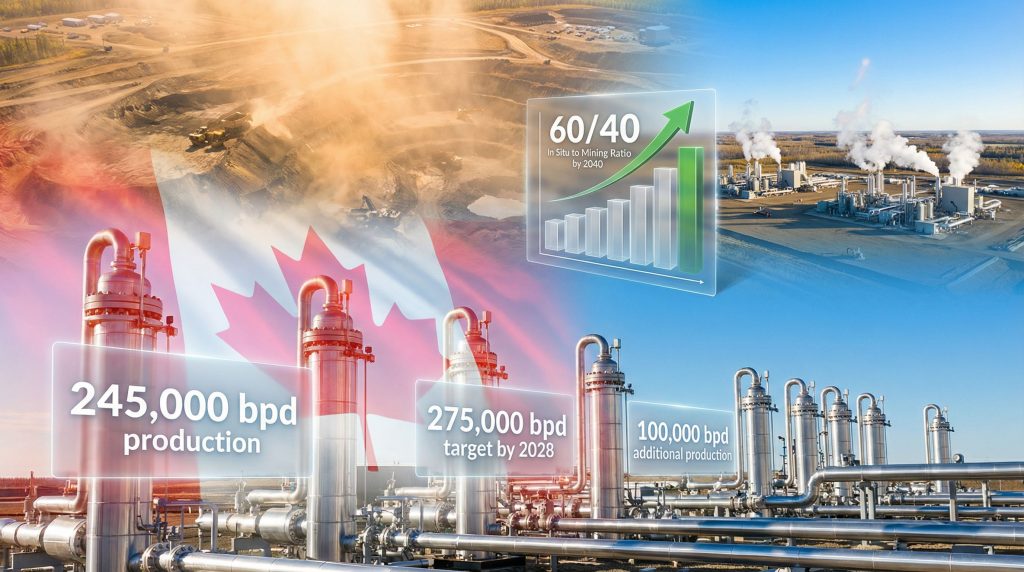
Firebag, recognised as the company's most profitable asset, currently produces 245,000 barrels per day using SAGD technology within existing permitted capacity of 368,000 barrels per day. The facility's pathway to 275,000 barrels per day by 2028 through optimisation projects demonstrates how existing in situ infrastructure can achieve meaningful production increases without requiring major capital expenditures.
In addition, the broader Canada energy transition context reveals how operators must balance immediate economic benefits with long-term sustainability requirements.
"Critical Economic Insight: In situ operations deliver twice the relative cash flow per barrel compared to mining operations, establishing a fundamental economic advantage that drives strategic reorientation across the oil sands sector."
Reserve Utilisation and Asset Life Cycle Management
The strategic transition reflects both resource depletion dynamics and optimised capital allocation strategies. Surface-mineable reserves represent finite resources concentrated in specific geological formations, while in situ-accessible deposits extend across vastly larger geographical areas at varying depths and concentrations.
Base Plant mine operations face gradual depletion by the mid-2030s, creating a natural transition point for production method rebalancing. Rather than developing new mining operations, operators increasingly favour in situ projects that can access deeper formations previously considered uneconomical using conventional extraction techniques.
The 11 billion barrel reserve addition through updated resource assessments brings total bitumen reserves to 30 billion barrels, with the majority of new reserves accessible exclusively through in situ methodologies. This resource base expansion fundamentally alters long-term production planning and capital allocation priorities.
Operational Flexibility in SAGD Development
In situ operations provide superior operational flexibility compared to surface mining projects. SAGD facilities can be developed in modular phases, allowing operators to optimise production rates, steam efficiency, and facility utilisation based on real-time market conditions and commodity price environments.
Decarbonisation benefits become increasingly apparent as operators implement advanced monitoring and control systems. The progression from current 245,000 barrels per day toward 275,000 barrels per day by 2028 exemplifies how operational excellence and facility optimisation can drive meaningful production growth without requiring major infrastructure expansion.
Production ramp-up timelines for in situ projects typically span 18-24 months from steam circulation initiation to commercial production rates, compared to 5-7 years for equivalent mining project development. This accelerated timeline provides greater responsiveness to market opportunities and reduced exposure to construction cost inflation.
Flagship Project Development Framework
Firebag Expansion: The Strategic Centrepiece
Firebag represents the cornerstone of the Suncor in situ oil sands shift, demonstrating both current operational excellence and future expansion potential. The facility's capacity expansion application from 368,000 barrels per day to 700,000 barrels per day represents a 90% increase in permitted production volume, establishing Firebag as potentially the largest SAGD operation globally.
| Performance Metric | Current Status | 2028 Target | Expansion Application |
|---|---|---|---|
| Daily Production | 245,000 bpd | 275,000 bpd | Up to 700,000 bpd |
| Capacity Utilisation | 67% of permitted | 75% of permitted | Expanded permit pending |
| Optimisation Pathway | Baseline | Debottlenecking | Major expansion phases |
| Timeline | Operational | 2028 | Regulatory approval required |
The optimisation pathway to 275,000 barrels per day by 2028 focuses on removing production bottlenecks within existing steam generation, bitumen separation, and pipeline transportation systems. This incremental approach preserves capital efficiency while maximising utilisation of existing infrastructure investments.
Lewis Project Integration Strategy
The Lewis project exemplifies strategic asset sequencing aligned with overall production transition timing. Targeting 160,000 barrels per day production capacity, Lewis development phases will coincide with Base Plant mine depletion, ensuring seamless production transition without creating temporary capacity shortfalls.
Phased development approaches enable risk management through staged capital deployment and operational learning integration. Mining permitting insights reveal that early production phases provide operational data that inform subsequent development phases, optimising facility design and production strategies based on real performance metrics rather than theoretical projections.
The integration framework ensures workforce transition planning as mining operations wind down and in situ projects ramp up. This coordinated approach minimises employment disruption while leveraging existing operational expertise across different extraction methodologies.
Comparative Analysis Against Industry Transformation Trends
Canadian Oil Sands Sector Evolution
The Suncor in situ oil sands shift reflects broader industry trends toward lower-cost production methodologies across Canadian oil sands operations. Major operators including Canadian Natural Resources, Imperial Oil, and Cenovus Energy have similarly prioritised in situ development over new mining projects, recognising superior economic returns and operational flexibility.
Industry-wide technology adoption accelerates as operators share learnings around steam optimisation, digital production monitoring, and facility automation. Data-driven operations enable real-time production optimisation, predictive maintenance scheduling, and enhanced recovery factor improvements across SAGD operations.
Investment Implications for Energy Markets
Capital allocation efficiency becomes increasingly critical as energy companies face investor pressure for improved returns and disciplined spending. In situ projects typically require $20,000-40,000 per barrel of daily capacity compared to $80,000-120,000 per barrel for equivalent mining developments, representing a significant capital efficiency advantage.
Production cost competitiveness analysis positions Canadian in situ operations favourably against international heavy oil competitors. SAGD facilities achieve operating costs competitive with offshore oil developments while providing greater supply security and operational controllability.
Long-term supply security considerations favour in situ development as surface-mineable reserves become increasingly constrained. The vast geographical extent of in situ-accessible resources ensures decades of development potential, supporting long-term planning horizons and sustained production growth.
Financial Projections and Strategic Timeline
Production Growth Targets Through 2040
The transformation toward a 60% in situ, 40% mining production composition by 2040 represents a complete inversion of current production emphasis. This strategic reorientation requires 100,000 barrels per day of additional production by 2028, with the majority of expansion occurring after 2032 as major in situ projects reach commercial production.
Key Financial Performance Metrics:
• 30 billion barrels total bitumen reserves following reserve additions
• 2x cash flow generation from in situ vs. mining operations
• 275,000 barrels per day Firebag production target by 2028
• 160,000 barrels per day Lewis project production capacity
• Mid-2030s Base Plant mine depletion timeline
Reserve Base Enhancement and Resource Optimisation
The 11 billion barrel reserve addition fundamentally alters long-term production planning and resource allocation strategies. These additional reserves, primarily accessible through in situ methodologies, extend operational timelines and support sustained production growth well beyond 2040.
Resource conversion from probable to proven categories requires successful demonstration of commercial production rates and sustained operational performance. Early optimisation projects at Firebag provide critical performance data supporting reserve reclassification and expanded development programmes.
Economic recovery rate improvements through advanced completion techniques, enhanced steam distribution, and optimised production strategies increase the recoverable portion of in-place bitumen resources. Industry-leading recovery factors of 60-70% for SAGD operations compare favourably to 80-90% mining recovery but access vastly larger resource bases.
The next major ASX story will hit our subscribers first
Implementation Challenges and Risk Assessment
Technical and Operational Risk Factors
Steam generation requirements for large-scale SAGD operations present significant technical challenges, particularly regarding natural gas supply security and emissions management. However, Suncor plans major shift in focus to in-situ oil sands output by 2040, requiring facility-scale steam generators with reliable gas supply contracts and efficient combustion systems to maintain steam quality and injection pressure specifications.
Water usage and recycling considerations become increasingly critical as in situ operations expand. SAGD facilities typically generate 2-4 barrels of produced water per barrel of bitumen, requiring sophisticated treatment and recycling systems to minimise freshwater consumption and meet environmental discharge standards.
Production optimisation in mature fields requires advanced reservoir management techniques including horizontal well refracturing, steam distribution rebalancing, and enhanced recovery chemical injection. These technologies extend field life and increase ultimate recovery but require specialised expertise and ongoing capital investment.
Market and Regulatory Uncertainties
Commodity price volatility impacts in situ operations differently than mining projects due to distinct cost structures and operational flexibility. While SAGD facilities demonstrate greater resilience during price downturns, steam generation costs correlate with natural gas prices, creating exposure to energy commodity price relationships.
Environmental policy evolution regarding carbon pricing, emissions standards, and water usage regulations could significantly impact long-term project economics. Regulatory frameworks continue developing around in situ operations, creating uncertainty regarding future compliance requirements and associated costs.
The regulatory approval timeline for Firebag expansion to 700,000 barrels per day capacity remains uncertain, with environmental assessment processes typically requiring 2-3 years for major capacity increases. Nevertheless, Suncor raises 2026 buyback plan to $2.87 billion, indicating strong financial confidence in the strategic transition.
Global Competitiveness and Market Positioning
International Heavy Oil Market Context
Canadian in situ operations compete globally against heavy oil producers in Venezuela, Mexico, and other international markets. Cost curve positioning analysis indicates that optimised SAGD operations rank in the second quartile of global heavy oil production costs, providing competitive advantages over higher-cost offshore and enhanced recovery projects.
Transportation infrastructure requirements for Canadian oil sands products influence market access and pricing differentials. Pipeline capacity constraints historically limited market reach, but recent infrastructure developments including Trans Mountain expansion improve access to international markets and support pricing optimisation.
Refining capacity considerations affect product placement and pricing, as heavy oil requires specialised refining configurations. The concentration of heavy oil refining capacity along the U.S. Gulf Coast creates both opportunities and vulnerabilities regarding market access and pricing dynamics.
Technology Innovation and Efficiency Improvements
Digital optimisation technologies increasingly drive operational efficiency improvements across in situ operations. Advanced process control systems, predictive analytics, and automated monitoring reduce operational costs while improving production consistency and facility reliability.
Artificial intelligence applications in production management enable real-time optimisation of steam injection rates, production well performance, and facility utilisation. Machine learning algorithms analyse vast datasets to identify optimisation opportunities and predict equipment maintenance requirements.
Sustainability improvements through technology focus on reducing greenhouse gas emissions per barrel, minimising water usage, and enhancing energy efficiency. Carbon capture and storage integration with steam generation facilities represents a potential pathway for emissions reduction, though commercial viability requires supportive policy frameworks and carbon pricing mechanisms.
The Suncor in situ oil sands shift exemplifies how technological innovation, economic optimisation, and strategic asset management drive fundamental industry transformation. As operators prioritise capital efficiency and operational excellence, in situ technologies provide compelling advantages that reshape production strategies and long-term planning horizons across Canada's oil sands sector.
What's Driving the Shift Toward High-Value Resource Projects?
The strategic transformation in extraction economics mirrors broader trends across resource sectors, where companies increasingly prioritise high-margin, technology-driven operations. Discovery Alert's proprietary Discovery IQ model delivers real-time alerts on significant ASX mineral discoveries, instantly empowering investors to identify actionable opportunities ahead of the broader market whilst companies navigate similar strategic transitions. Begin your 14-day free trial today and understand why major mineral discoveries can generate substantial returns by exploring Discovery Alert's dedicated discoveries page.