August 13, 2026
Supply Chain Dependencies Reshape Global Risk Assessment
Modern commodity markets have evolved into intricate networks where regional disruptions create cascading effects across continents. The US and Israel attack on Iran demonstrates how energy infrastructure, particularly in hydrocarbon-rich regions, represents critical nodes in this global system where military actions can trigger immediate price volatility and longer-term structural adjustments.
The interconnected nature of today's energy markets means that conflicts in one region force rapid recalibration of supply chains, insurance premiums, and strategic reserves worldwide. This dynamic creates investment opportunities and risks that extend far beyond the immediate conflict zone.
When big ASX news breaks, our subscribers know first
Economic Foundations of Resource-Based Military Strategy
Strategic Resource Control Mechanisms
Military interventions in energy-producing regions follow predictable economic patterns driven by resource scarcity and strategic positioning. Iran's position as holder of 157.8 billion barrels of proven crude oil reserves, representing approximately 9.5% of global proven reserves, makes it the world's fourth-largest oil reserve holder after Venezuela, Saudi Arabia, and Canada.
The country's natural gas reserves are equally significant, with 33.6 trillion cubic meters of proven reserves representing 15-17% of global proven reserves, ranking second globally after Russia. These massive energy endowments create what economists term "geographic leverage" over global supply chains.
Historical precedents demonstrate clear correlation patterns between military actions and energy price volatility. Furthermore, our OPEC meeting analysis reveals how geopolitical events reshape production strategies:
• Gulf War (1990-1991): Oil prices surged from $15/barrel to peak at $40/barrel, representing a 167% increase within six months
• Iraq Invasion (2003): Brent crude elevated from $25/barrel to $40/barrel within six months, maintaining elevated pricing through 2008
• Arab Spring Libya Crisis (2011): Libyan production losses of approximately 1.6 million barrels per day drove Brent crude from $107/barrel to peaks near $127/barrel
Military Cost-Benefit Analysis Framework
The economic calculus behind resource-based interventions incorporates multiple cost categories that decision-makers must evaluate. Moreover, understanding oil price rally drivers helps contextualise these strategic considerations.
Direct Military Expenditure Components:
• Combat operations and personnel deployment costs
• Ordnance expenditure and equipment maintenance
• Logistics and supply chain support infrastructure
• Intelligence gathering and surveillance operations
Indirect Economic Impact Assessment:
• Trade disruption across multiple commodity sectors
• Insurance premium increases for regional operations
• Supply chain delays affecting downstream industries
• Currency volatility in affected and allied nations
Strategic planners justify these expenditures through energy security calculations, where controlling or protecting energy supplies becomes framed as national security imperatives. However, empirical analysis often reveals that military interventions create greater short-term supply disruptions than the scenarios they aim to prevent.
Market Psychology and Risk Premium Mechanisms
Fear-Driven Pricing Dynamics
Commodity futures markets incorporate geopolitical uncertainty through sophisticated probability-weighted pricing models. When traders assess potential supply disruptions, they embed premiums into forward contracts that reflect both likelihood and severity of various outcomes.
The "fear factor multiplier" manifests when initial geopolitical developments trigger price movements 2-3 times larger than actual supply-loss fundamentals would justify. This amplification occurs through several behavioural mechanisms:
• Portfolio rebalancing: Risk managers simultaneously reduce energy exposure, creating cascade selling pressure
• Margin call liquidation: Leveraged traders face forced position exits during volatility spikes
• Options market gamma effects: Delta hedging activity by derivatives dealers destabilises underlying prices further
Historical Risk Premium Analysis
| Conflict Event | Timeframe | Brent Crude Movement | Premium Duration |
|---|---|---|---|
| Gulf War I | August 1990 | $15→$40/bl (+167%) | 6 months |
| Iraq Invasion | March 2003 | $25→$40/bl (+60%) | 12+ months |
| Arab Spring Libya | February 2011 | $107→$127/bl (+19%) | 3-4 months |
| Russia-Ukraine | February 2022 | $90→$120/bl (+33%) | 6+ months |
Market participants apply availability heuristic bias, where recent conflicts influence risk assessment disproportionately to their actual probability of recurrence. The 2022 Russia-Ukraine invasion demonstrated this pattern when Brent crude spiked from $90/barrel to $120/barrel within 14 days, despite actual supply losses remaining below projected levels.
Immediate Supply Chain Vulnerability Assessment
Critical Chokepoint Analysis
The Strait of Hormuz represents the most critical energy transit route globally, with 21 million barrels per day transiting this narrow waterway, representing 20-21% of global petroleum supply. At its narrowest point, the shipping channel spans only 33 nautical miles, with 2 miles falling within Iranian territorial waters.
Persian Gulf Production Concentration:
• Regional OPEC producers generate approximately 28-30 million barrels per day
• Represents 28-30% of global oil output from a single geographic region
• LNG component includes 21% of globally traded liquefied natural gas
Iran's specific production capacity includes 4 million barrels per day of crude oil production capability, though sanctions have reduced operational output to 3.2-3.4 million barrels per day as of February 2026. Consequently, the country's export capacity reaches 2.5 million barrels per day when unrestricted, alongside annual natural gas production of 232 billion cubic metres.
Alternative Route Economics
Supply chain disruption forces costly rerouting through alternative pathways with significant economic implications:
Saudi Arabia's Yanbu Pipeline:
• Capacity: 5 million barrels per day to Red Sea terminals
• Cannot fully absorb Persian Gulf production volumes
• Requires existing spare capacity availability
Cape of Good Hope Route:
• Adds 10-14 days transit time to Asian destinations
• Increases fuel costs by approximately 20% per voyage
• War risk insurance premiums add $2-5 per barrel in costs
Emergency stockpiling by buyers incurs monthly carrying costs of 0.5-1.5% including storage, financing, and insurance components. Refineries face additional complications as they cannot instantly substitute crude slate specifications locked into existing supply contracts.
Sectoral Economic Disruption Patterns
Transportation Industry Impact Analysis
Aviation, maritime, and ground transportation sectors face immediate cost pressures when energy prices spike during geopolitical crises. Aviation fuel cost escalation directly impacts airline profitability, with carriers typically unable to hedge against sudden geopolitical risk premiums.
Maritime shipping experiences dual pressures from higher fuel costs and route diversification requirements. War risk insurance for Persian Gulf routes historically increases to 1-2% of cargo value during active conflicts, compared to normal rates of 0.1-0.5%.
Manufacturing and Industrial Response
Petrochemical feedstock availability constraints create ripple effects throughout manufacturing supply chains. Iran produces approximately 2% of global urea fertiliser output, making agricultural sectors vulnerable to production disruptions.
Energy-Intensive Industries Most Affected:
• Steel industry energy input cost pressures
• Aluminium smelting operations facing energy intensity challenges
• Chemical manufacturing dependent on natural gas feedstocks
• Glass and cement production requiring consistent energy inputs
Financial Market Risk Repricing
Currency Market Safe-Haven Flows
Military escalation triggers predictable currency market patterns as investors seek stability during uncertainty periods. The US dollar typically strengthens as safe-haven demand increases, while oil-exporting nation currencies experience volatility based on their production exposure and geopolitical alignment.
Euro Weakness Factors:
• European energy security concerns amplified by recent Ukraine experience
• Import dependency on Middle Eastern suppliers
• Limited strategic petroleum reserve capacity relative to consumption
Emerging market currencies face stress indicators as capital flows reverse toward developed market safety, creating additional economic pressure on import-dependent economies. Furthermore, the US–China trade war outlook adds complexity to these currency dynamics.
Equity Sector Rotation Analysis
Defence contractor stocks typically experience 15-25% performance improvements during active conflicts as military expenditure expectations increase. Energy company valuations receive premiums during supply disruption periods, though actual production companies may face operational challenges in conflict zones.
Renewable Energy Investment Acceleration:
• Solar and wind project internal rates of return improve relative to fossil fuel alternatives
• Battery storage deployment urgency increases for grid stability requirements
• Green hydrogen production scaling economics become more attractive
• Nuclear power renaissance economic drivers strengthen
In addition, understanding green transition dynamics becomes crucial for evaluating these market shifts.
The next major ASX story will hit our subscribers first
Macroeconomic Modelling Scenarios
Inflation Transmission Mechanisms
Energy price shocks transmit to core inflation through multiple channels, creating central bank policy dilemmas during supply-side inflation periods. Consumer spending patterns adjust as energy costs consume larger budget shares, reducing discretionary spending across other sectors.
GDP Growth Impact Calculations:
• Oil-importing nations face economic drag proportional to import dependency
• Multiplier effects compound as energy costs increase across all economic sectors
• Regional economic bloc vulnerability rankings shift based on energy exposure
• Recession probability calculations adjust upward with sustained energy price elevation
Central Bank Policy Framework Challenges
Supply-side inflation presents monetary authorities with conflicting objectives between price stability and employment mandates. Traditional inflation-fighting tools like interest rate increases may worsen economic slowdowns without addressing underlying supply constraints.
Central banks must balance immediate inflation concerns against longer-term economic stability, as aggressive monetary tightening during supply shocks can amplify recession risks whilst providing limited inflation relief.
Long-Term Structural Energy Transformation
Energy Independence Strategic Calculations
Domestic production capacity expansion receives renewed economic justification as energy security concerns override pure cost efficiency considerations. Nuclear power renaissance economics improve as utilities reassess baseload generation portfolio risks.
Strategic Mineral Reserve Economics:
• Battery material stockpiling costs versus supply security benefits
• Rare earth element diversification away from concentrated suppliers
• Critical metal processing capability development requirements
• Energy efficiency investment payback periods improve under higher energy costs
However, the broader renewable energy shift context suggests these developments are part of fundamental structural changes.
Global Trade Architecture Evolution
Energy trade bloc formation scenarios gain momentum as traditional suppliers face geopolitical restrictions. Regional energy hub development creates competitive dynamics between established and emerging supply routes.
Supply Chain Resilience Recalibration:
• Efficiency versus security trade-offs in supplier selection
• Regional production diversification strategies
• Emergency response protocol development costs
• International energy cooperation framework strengthening
Market Response to Operation Epic Fury
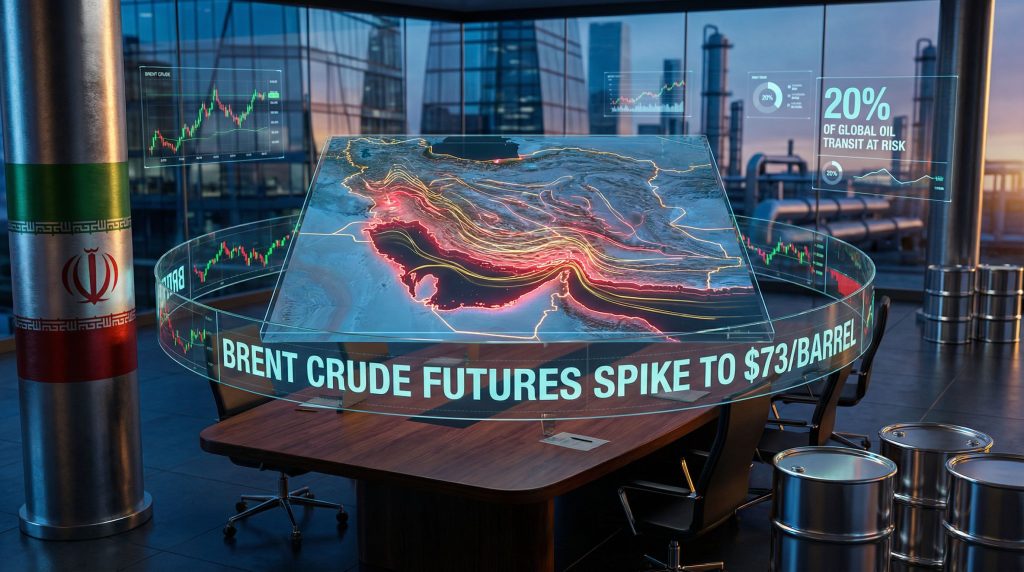
Current market conditions reflect immediate trader response to the escalating situation, with Brent crude reaching $73 per barrel on February 27, 2026, representing the highest level since July 2025. This pricing occurred before full military escalation, indicating markets were already incorporating geopolitical risk premiums.
Immediate Market Reactions:
• Front-month contracts experiencing sharp price spikes as immediate supply fear dominates
• Forward contracts showing modest increases, reflecting expectations of eventual conflict resolution
• Contango pattern strengthening as near-term risk premiums increase relative to longer-dated contracts
The OPEC+ emergency meeting scheduled for Sunday introduces additional uncertainty as the cartel weighs production policy adjustments against market instability. Delegates previously considered modest supply increases from April, but military escalation fundamentally alters supply-demand balance calculations.
According to BBC News live coverage, market participants are closely monitoring diplomatic channels for potential de-escalation signals whilst positioning for various conflict duration scenarios.
Risk Assessment and Investment Implications
Portfolio Protection Strategies
Investors must evaluate multiple scenario outcomes when positioning for extended Middle Eastern conflict. Historical patterns suggest energy price premiums average 3-6 months duration, with peak impacts occurring within the first 30 days of conflict initiation.
Vulnerability Rankings by Economy:
• Japan: 90% oil import dependency creates maximum exposure
• South Korea: 85% import dependency with limited strategic reserves
• India: 87% import dependency with growing consumption base
• United States: Domestic shale production provides relative buffer capacity
Strategic Petroleum Reserve Utilisation
Emergency reserve releases historically moderate price spikes but require careful calibration to avoid depleting strategic stockpiles during extended conflicts. The effectiveness of reserve releases depends on coordination among allied nations and actual versus perceived supply shortfalls.
Risk Scenario Planning:
• 30-day disruption: War risk premiums manageable through emergency measures
• 90-day conflict: Alternative supply route activation becomes critical
• 180+ day duration: Fundamental supply chain restructuring required
• Strait closure: Global recession probability exceeds 60%
Future Energy Security Architecture
The current crisis accelerates discussions about resilient energy infrastructure development and diversified supply chains. Investment in renewable energy receives additional justification as a hedge against fossil fuel volatility, whilst traditional energy companies reassess geographic exposure risks.
Long-term economic modelling must incorporate higher baseline geopolitical risk premiums into energy project valuations, fundamentally altering the economics of both conventional and alternative energy investments. For instance, detailed analysis from the Arms Control Association suggests these structural changes may persist beyond immediate conflict resolution.
The US and Israel attack on Iran represents a watershed moment that could reshape global energy markets for years to come, forcing accelerated transitions toward more resilient and diversified energy systems whilst highlighting the economic vulnerabilities inherent in geographically concentrated resource dependencies.
Disclaimer: This analysis is based on historical patterns and current market conditions. Actual outcomes may vary significantly based on conflict duration, international responses, and unforeseen developments. Readers should consult qualified financial advisors before making investment decisions based on geopolitical scenarios.
Ready to Navigate Geopolitical Market Volatility?
Discovery Alert's proprietary Discovery IQ model delivers real-time alerts on significant ASX mineral discoveries, helping investors identify actionable opportunities when global uncertainty creates market dislocations. Explore how historic discoveries have generated substantial returns during volatile periods, and begin your 14-day free trial today to position yourself ahead of shifting market dynamics.