August 14, 2026
Supply Chain Vulnerabilities Threaten European Energy Independence
Market concentration in critical mineral supply chains has reached unprecedented levels across the global mining sector. While renewable energy deployment accelerates worldwide, the materials required to construct wind turbines, solar panels, and battery storage systems remain dominated by a handful of suppliers. This concentration creates systemic risks for regions pursuing aggressive decarbonisation targets, particularly as Europe falling behind in critical minerals race becomes increasingly evident through geopolitical tensions reshaping international trade relationships.
The energy transition depends on reliable access to lithium, cobalt, nickel, rare earth elements, and other specialised materials. Yet current supply chain architecture reveals dangerous dependencies that could undermine clean energy ambitions across entire continents. Understanding these vulnerabilities requires examining not just production volumes, but processing capacity, technological expertise, and the strategic positioning of dominant players in this evolving landscape.
When big ASX news breaks, our subscribers know first
Critical Mineral Dependencies Expose European Vulnerabilities
Concentration Risk Analysis Reveals Severe Imbalances
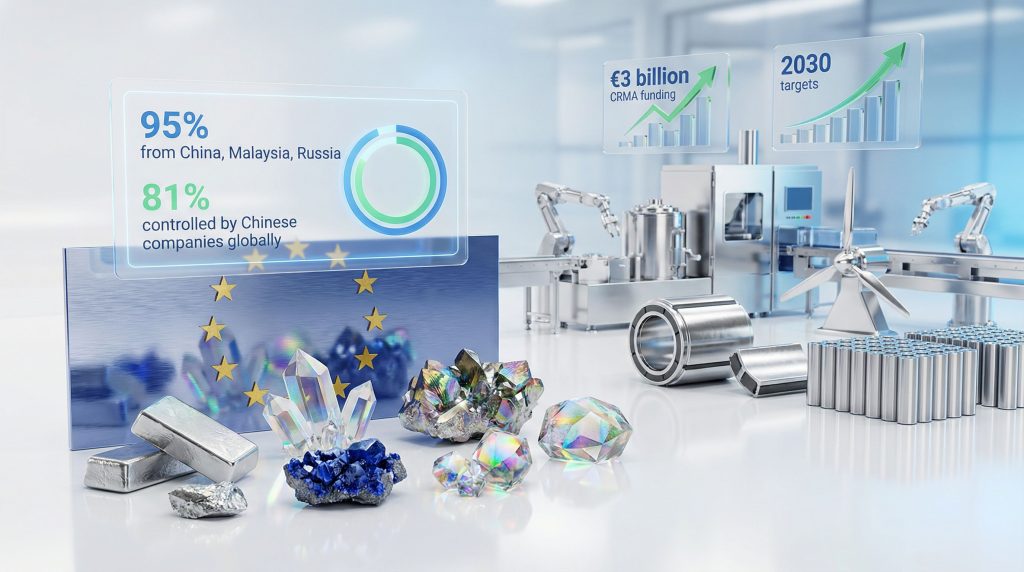
European Union import statistics demonstrate the extent of supply chain concentration across critical minerals essential for clean energy infrastructure. Recent data analysis shows that 95% of EU rare earth element imports originate from just three countries: China, Malaysia, and Russia. This dependency creates multiple single points of failure within European supply chains.
The concentration extends beyond rare earths to encompass the broader spectrum of energy transition materials. China controls 81% of global processing capacity for critical minerals, while Chinese companies directly manage 32% of global lithium production and control an additional 18% through overseas operations. Furthermore, notable examples include Zijin's Tres Quebradas project in Argentina and Gangfeng Lithium's Sonara operation in Mexico.
| Material Category | Primary Source | EU Dependency Level | Processing Concentration |
|---|---|---|---|
| Rare Earth Elements | China, Malaysia, Russia | 95% | China: 90%+ |
| Lithium Processing | China-controlled facilities | 81% globally | China: 81% |
| Permanent Magnets | China | 93% | China: 93% |
| Nickel Supply Growth | Indonesia | Single supplier dominance | Indonesia: 70%+ |
Supply Disruption Modelling Reveals Economic Exposure
Supply interruption scenarios demonstrate the potential economic impact of critical mineral dependencies. Market share concentration increased from 82% in 2020 to 86% in 2024 across copper, lithium, nickel, cobalt, graphite, and rare earth elements, with virtually all supply growth originating from single dominant suppliers.
The International Energy Agency's 2025 analysis reveals that Indonesia dominates nickel supply expansion, while China leads growth in all other critical minerals. Consequently, this pattern creates cascading risk exposures throughout European manufacturing and energy sectors.
Economic Impact Assessment:
- 30-day supply disruption: Estimated €2-4 billion impact on renewable energy project timelines
- 90-day interruption: Potential manufacturing shutdowns across wind turbine and solar panel production
- 180-day scenario: Complete restructuring of European clean energy deployment schedules
Geopolitical Risk Factors Compound Supply Vulnerabilities
Export control mechanisms represent a significant threat vector for European critical mineral security. The China export controls demonstrate how resource dependencies can become geopolitical weapons, whilst Malaysia and Russia, as secondary suppliers, introduce additional political risk variables that European policymakers must consider in long-term planning scenarios.
The vertical integration strategy employed by Chinese companies creates particularly concerning dependency patterns. By controlling mining operations, processing facilities, and manufacturing capacity simultaneously, these entities can influence pricing, availability, and technological development across entire value chains.
US Policy Framework Outpaces European Strategic Response
Comparative Investment Mechanisms Reveal Scale Disparities
The United States has implemented comprehensive support structures that dwarf European critical mineral initiatives in both scope and financial backing. The Inflation Reduction Act of 2022, combined with the Trump critical minerals order through the 2025 One Big Beautiful Bill, provides private companies with tax credits, loans, price floors, grants, and offtake guarantees designed to accelerate domestic supply chain development.
In contrast, the EU Critical Raw Materials Act allocates €3 billion from existing financing sources through the December 2025 ResourceEU action plan. Industry analysts characterise this funding as insufficient for comprehensive industrial strategy implementation, particularly when compared to the scale of investment required for meaningful supply chain restructuring.
Policy Instrument Comparison:
United States Approach:
- Defence Production Act supplier guarantees
- Tax credit mechanisms for mine-to-magnet integration
- Price floor protections reducing market risk
- Government-backed offtake agreements
- Direct loan programmes for critical projects
European Union Framework:
- Permitting acceleration provisions
- Recycling mandate implementation
- Export restrictions on critical material waste
- Strategic project designation systems
- Partnership agreement facilitation
De-risking Mechanisms Create Competitive Advantages
The Defence Production Act provides US companies with supplier guarantee frameworks that fundamentally alter project economics and financing accessibility. These guarantees reduce lender risk perceptions and lower equity return requirements, making previously marginal projects commercially viable.
European projects face significantly higher financing costs due to regulatory uncertainty and limited public de-risking tools. However, industry experts note that many European strategic minerals projects are abandoned before reaching final investment decision stages, primarily due to insufficient risk mitigation mechanisms compared to US and Chinese alternatives.
Analysis of project development patterns shows that US companies benefit from integrated policy support spanning exploration through production phases, while European initiatives rely heavily on market-driven approaches that have proven inadequate for competing against state-supported international competitors.
Investment Flow Analysis (2023-2025):
| Region | Venture Capital Investment | Government Support | Project Success Rate |
|---|---|---|---|
| United States | $2.3 billion | High (DPA + IRA) | 67% to FID |
| European Union | $890 million | Medium (CRMA) | 34% to FID |
| China | $4.1 billion | Very High (State-directed) | 78% to FID |
European 2030 Targets Face Implementation Challenges
Domestic Extraction Goals Encounter Structural Obstacles
The EU Critical Raw Materials Act establishes ambitious benchmarks for reducing import dependencies by 2030. The framework targets 10% domestic extraction, 40% processing capacity, and 15% recycling minimums across critical mineral categories. Nevertheless, implementation progress reveals significant gaps between policy objectives and operational realities.
Sweden's LKAB represents one of the few major European processing initiatives, with an €800 million demonstration plant scheduled for 2026 operational status. The facility will process phosphorous and rare earth elements, scaling to full capacity during the 2030s. While promising, this single project illustrates the limited scope of current European domestic production efforts.
Permitting bottlenecks continue to delay critical projects across the EU. The Chvaletice manganese project in the Czech Republic exemplifies these challenges, experiencing extended permitting delays and grid connection issues despite Strategic Project designation from the European Commission. Furthermore, mining permitting insights reveal that fast-track permitting provisions have not yet been incorporated into Czech national law, highlighting implementation coordination problems.
Processing Capacity Development Requires Technology Transfer
Achieving 40% processing capacity on EU soil by 2030 demands significant technological expertise acquisition from Chinese-dominated processing sectors. Current European processing capabilities remain minimal compared to established Chinese infrastructure and technical knowledge bases.
Processing Capacity Gap Analysis:
- Current EU capacity: Less than 5% for most critical minerals
- 2030 target requirement: 40% processing capacity
- Investment needed: Estimated €15-25 billion across all mineral categories
- Technology transfer barriers: Limited access to proprietary Chinese processing methods
- Timeline constraints: 6-year implementation window for complex industrial development
Recycling Infrastructure Demands Coordinated Development
The 15% recycling minimum threshold requires comprehensive circular economy infrastructure that currently exists only in fragmented form across EU member states. The battery recycling breakthrough demonstrates potential, whilst permanent magnet recovery and solar panel material recapture represent the primary opportunities for meeting recycling targets.
Industry groups advocate for single market frameworks enabling recycling business scaling across national borders. This approach would consolidate waste streams and improve economic viability for specialised recycling operations. However, regulatory harmonisation across 27 member states presents significant coordination challenges.
Recycling Sector Development Requirements:
- Standardised quality certifications across member states
- Cross-border waste transport facilitation
- Technology development for complex material separation
- Economic incentive structures supporting recycling investment
- Consumer return systems for end-of-life products
International Partnerships Reshape Resource Diplomacy
Strategic Alliance Development Expands Supply Options
The European Union has established 15 active critical mineral partnerships spanning South Africa, Namibia, Argentina, Chile, and Canada. These agreements represent a fundamental shift from historical market-reliance approaches toward strategic resource diplomacy designed to reduce Chinese supply chain dominance.
Partnership frameworks incorporate value-added development requirements, mandating local processing capabilities and environmental compliance standards rather than simple raw material extraction arrangements. Consequently, this approach aims to create mutually beneficial relationships while developing alternative supply chains outside Chinese influence.
Partnership Portfolio Analysis:
| Region | Partner Countries | Primary Resources | Processing Requirements |
|---|---|---|---|
| South America | Argentina, Chile | Lithium, Copper | Local refinement mandatory |
| Africa | South Africa, Namibia | Rare earths, Platinum | Environmental compliance |
| North America | Canada | Nickel, Cobalt | Technology sharing |
Competitive Resource Acquisition Creates Market Tensions
US-EU competition for critical mineral partnerships has intensified as both regions pursue supply diversification strategies. Argentina's lithium resources, Chilean copper deposits, and Canadian nickel projects represent contested opportunities where American and European entities compete for preferential access terms.
China's Belt and Road mineral investments continue expanding despite Western partnership efforts. Chinese companies maintain significant presence in partnership target countries, often offering more attractive financing terms and fewer environmental restrictions than European alternatives.
Resource Nationalism Trends:
- Argentina: Increased state control over lithium extraction
- Chile: New mining royalty structures favouring domestic processing
- Namibia: Local content requirements for mining operations
- South Africa: Black Economic Empowerment compliance for resource projects
Partnership Effectiveness Requires Long-term Commitment
Successful critical mineral partnerships demand sustained political and financial commitment extending beyond electoral cycles. Host countries increasingly demand technology transfer, infrastructure development, and local economic benefit sharing as conditions for resource access agreements.
European partnership negotiations must balance competitive commercial terms with development assistance commitments. This dual approach requires coordination between trade, development, and foreign policy institutions across multiple EU member states.
Investment Risk Assessment Reveals Project Vulnerabilities
Financial De-risking Challenges Limit Project Viability
European critical mineral projects face significantly higher abandonment rates compared to global benchmarks, with many projects shelved before final investment decision stages. Limited public de-risking tools create financing gaps that prevent commercially marginal projects from advancing through development phases.
Capital cost escalation represents a persistent risk factor across European projects. Permitting delays, regulatory compliance additions, and grid connection requirements frequently increase project costs by 15-35% above initial estimates. These escalations often render projects economically unviable under current market conditions.
Project Development Risk Matrix:
| Development Stage | Primary Risk Factors | Failure Rate | Cost Escalation |
|---|---|---|---|
| Pre-Feasibility | Regulatory uncertainty | 45% | 10-20% |
| Feasibility Study | Environmental compliance | 32% | 20-35% |
| Permitting Phase | Grid connection delays | 28% | 25-40% |
| Construction | Supply chain disruption | 15% | 30-50% |
Market Price Volatility Undermines Project Economics
The 2024-2025 lithium price collapse illustrates how commodity price volatility can devastate project economics across entire sectors. Lithium prices declined from peak levels above $80,000 per tonne to below $15,000, forcing numerous European lithium projects into suspension or abandonment.
Investment momentum has weakened globally due to sustained low prices across multiple critical mineral categories. This price environment particularly impacts European projects that require premium pricing to offset higher operational costs and regulatory compliance expenses.
Price Impact Analysis:
- Lithium projects affected: 12 European initiatives suspended
- Investment reduction: 60% decline in new project financing
- Timeline extensions: Average 18-month delays for active projects
- Economic threshold: Many projects require 40%+ price increases for viability
Operational Barriers Compound Investment Risks
Grid connection delays represent a critical infrastructure bottleneck for processing facility development. European electrical grid systems often lack capacity to support energy-intensive mineral processing operations, creating additional timeline uncertainty and capital requirements.
Environmental Impact Assessment processes introduce substantial scheduling unpredictability, extending permitting timelines by 12-24 months beyond initial projections. These delays increase holding costs and reduce project net present values, making financing more difficult to secure.
Social licence considerations have become increasingly important for European mineral projects. Community engagement requirements, stakeholder consultation processes, and local benefit-sharing agreements add complexity and cost to project development timelines.
The next major ASX story will hit our subscribers first
Economic Impact Analysis Reveals Clean Energy Cost Implications
Supply-Demand Imbalances Drive Price Volatility
European clean energy deployment plans require massive increases in critical mineral consumption through 2030. Wind turbine installations, solar panel manufacturing, and battery storage systems demand materials in quantities that significantly exceed current supply projections.
2030 Demand Projections:
- Lithium requirements: 300% increase from 2024 levels
- Rare earth elements: 250% growth for permanent magnet production
- Cobalt demand: 400% expansion for battery applications
- Nickel consumption: 200% increase across all clean energy sectors
Supply gap quantification reveals significant shortfalls between domestic European production capabilities and consumption requirements. Even with successful implementation of CRMA targets, Europe falling behind in critical minerals race remains evident as the continent will remain heavily dependent on imports for most critical minerals through 2030 and beyond.
Competitive Disadvantage Assessment Shows Industrial Impact
Manufacturing cost implications for European renewable technology producers could reach 20-35% increases compared to Chinese competitors with secured supply chains. This cost differential threatens European industrial competitiveness across wind, solar, and battery storage sectors.
Energy transition timeline risks compound these competitive challenges. Material constraints could delay European decarbonisation schedules by 3-7 years compared to original targets, with corresponding impacts on climate objectives and economic transformation plans. According to recent analysis, this delay could significantly impact the EU's renewable energy targets.
Sector-Specific Economic Impact:
| Clean Energy Sector | Cost Increase Estimate | Timeline Risk | Employment Impact |
|---|---|---|---|
| Wind Power | 25-40% | 2-4 year delays | -15% manufacturing jobs |
| Solar Energy | 30-45% | 3-5 year delays | -25% panel production |
| Battery Storage | 35-50% | 4-6 year delays | -30% cell manufacturing |
| Electric Vehicles | 20-35% | 2-3 year delays | -20% assembly capacity |
Industrial Migration Threats Require Policy Response
Clean technology sector migration to lower-cost regions represents a significant risk for European industrial policy objectives. Companies facing sustained material cost disadvantages may relocate manufacturing operations to regions with better supply chain access or government support structures.
GDP impact estimates suggest that critical mineral supply constraints could reduce EU economic growth by 0.3-0.7% annually through 2030, with concentrated impacts on industrial regions dependent on clean energy manufacturing.
Alternative Strategies Could Accelerate Mineral Security
Technology Development Priorities Focus on Substitution
Material substitution research represents the most promising long-term strategy for reducing critical mineral dependencies. European research institutions are developing alternatives to rare earth permanent magnets, lithium-ion battery chemistries, and cobalt-based cathode materials.
Substitution Research Priorities:
- Permanent magnet alternatives: Ferrite and aluminium-nickel-cobalt technologies
- Battery chemistry evolution: Sodium-ion and solid-state electrolyte systems
- Catalyst substitution: Non-platinum group metal alternatives for fuel cells
- Lightweight materials: Advanced composites reducing metal requirements
Urban mining opportunities offer significant potential for material recovery from existing infrastructure. Electronic waste streams, industrial byproducts, and end-of-life renewable energy equipment contain substantial quantities of recoverable critical minerals.
Strategic Reserve Management Requires Optimisation
Emergency stockpile development could provide supply security during disruption scenarios. The development of an EU supply chain facility demonstrates progress in this area, whilst optimal reserve sizing balances storage costs against economic impact mitigation, with preliminary analysis suggesting 90-180 day inventory levels for most critical applications.
Strategic Reserve Framework:
- Inventory rotation systems: Preventing material degradation
- Storage facility security: Physical and cyber protection measures
- Release trigger mechanisms: Automated response to supply disruptions
- Cost-benefit optimisation: Balancing storage expenses against risk mitigation
Circular Design Requirements Support Resource Efficiency
Product longevity and recyclability mandates could significantly reduce new material demand across clean energy sectors. Extended product lifespans, modular design architectures, and end-of-life material recovery systems offer substantial resource conservation potential.
Implementation Timeline for Alternative Strategies:
| Strategy Category | Short-term (1-3 years) | Medium-term (3-7 years) | Long-term (7+ years) |
|---|---|---|---|
| Technology Substitution | Research acceleration | Pilot demonstrations | Commercial deployment |
| Urban Mining | Infrastructure development | Capacity scaling | Full integration |
| Strategic Reserves | Inventory building | Management optimisation | Crisis response testing |
| Circular Design | Regulation implementation | Industry adoption | Market transformation |
Strategic Implementation Roadmap for 2026-2030
European critical mineral security requires coordinated action across multiple policy domains, technological development areas, and international cooperation frameworks. Success depends on accelerating domestic capacity building while simultaneously diversifying international partnerships and advancing technological solutions.
Near-term Implementation Priorities (2026-2027):
- CRMA permitting reform implementation across all member states
- Strategic reserve inventory development for highest-risk materials
- Partnership activation with South American and African suppliers
- Research funding acceleration for substitution technologies
Medium-term Capacity Building (2027-2029):
- Domestic processing infrastructure development
- Recycling network expansion and standardisation
- Technology transfer arrangements with partnership countries
- Circular economy framework implementation
Long-term Resilience Development (2029-2030+):
- Supply chain independence achievement for critical applications
- Competitive positioning in advanced material technologies
- Crisis response capability testing and optimisation
- Global leadership in sustainable mineral development practices
The European Union faces a critical window for addressing structural vulnerabilities in critical mineral supply chains. Current dependencies create significant risks for clean energy transition objectives and industrial competitiveness. As highlighted in European analysis, coordinated implementation of domestic capacity building, international partnership development, and technological innovation strategies could establish a more resilient and secure foundation for sustainable economic growth.
Success requires political commitment extending beyond electoral cycles, substantial public and private investment coordination, and recognition that Europe falling behind in critical minerals race represents both immediate economic risks and long-term strategic challenges requiring comprehensive policy responses.
Ready to Stay Ahead of Critical Minerals Investment Opportunities?
Discovery Alert's proprietary Discovery IQ model delivers real-time notifications on significant ASX mineral discoveries, empowering investors to identify actionable opportunities in critical minerals before broader market recognition. Begin your 30-day free trial today and position yourself to capitalise on the next major discovery whilst historic mineral discoveries demonstrate the substantial returns possible from strategic early positioning.