June 7, 2026
The collapse of authoritarian regimes across the Middle East often triggers seismic shifts in energy market dynamics, but few transformations carry the strategic significance of Syria's current hydrocarbon sector consolidation. After more than a decade of fragmented control, territorial disputes, and international sanctions, Syria's energy landscape is undergoing a fundamental restructuring that could reshape regional power balances and global investment flows. The convergence of unified territorial control, sanctions relief, and early international re-engagement creates conditions for what energy analysts describe as the most significant Mediterranean energy opportunity since Libya's post-2011 discoveries. This oil and gas revival in Syria demonstrates potential impacts similar to those seen in current oil price rally analysis.
What Does Syria's Energy Consolidation Mean for Regional Markets?
Unified Control Creates Investment Pathway
The transformation from fractured energy governance to centralised control represents more than administrative reorganisation – it fundamentally alters the risk-return calculus for international energy investors. The December 2024 regime change, combined with the Syrian Democratic Forces withdrawal agreement encompassing Al-Raqqah, Deir ez-Zor, and Al-Hasakah provinces, consolidated approximately 75-80 percent of Syria's remaining hydrocarbon production capacity under unified government authority.
This consolidation eliminates previous coordination costs that plagued international operators, reducing operational approval timeframes from an estimated 90-180 days under multi-jurisdictional control to 30-45 days under centralised governance. The Omar oil field, Syria's largest producing asset, along with the strategically important Tabiyeh gas field, returned to unified control under these arrangements.
SWIFT system restoration in mid-2025 created quantifiable improvements in transaction velocity, eliminating previous delays averaging 45-60 days for contractor compensation. This financial system normalisation represents a 3-5 percent operational cost reduction for international operators, making Syrian projects more competitive within regional investment portfolios.
Post-conflict energy sector recoveries provide instructive precedents. Iraq's transition from disputed-jurisdiction production averaging 1.8-2.2 million barrels per day across competing authorities to unified coordination enabled production recovery to 2.8-3.0 million barrels per day by 2012. Libya's National Oil Corporation initially accelerated production from 0.3 million barrels per day to 1.2 million barrels per day within 24 months following 2011 consolidation, though subsequent political fragmentation reversed these gains.
Supply Chain Implications for Mediterranean Energy Hub
Syria's strategic positioning between European and Asian energy markets creates unique opportunities for supply chain optimisation that extend far beyond domestic production recovery. The country's location provides alternative routing for regional energy flows, potentially reducing European dependence on traditional supply corridors while creating new transit revenues.
Pipeline infrastructure rehabilitation represents the critical bottleneck for export capacity restoration. Syria's pre-2011 pipeline network handled 380,000-400,000 barrels per day of oil throughput and 900 million cubic feet per day of gas transmission. Current infrastructure assessment indicates 60-70 percent of pipeline capacity requires major rehabilitation or replacement, representing capital requirements of $2.8-4.2 billion for full export capability restoration.
The Mediterranean positioning offers particular advantages for gas exports to European markets experiencing supply diversification pressures. Syria's offshore concessions encompass approximately 54,000 square kilometres of Mediterranean shelf seabed with zero exploration wells drilled to date, representing entirely unexplored territory adjacent to proven regional gas provinces. Furthermore, the broader context of natural gas trends 2025 indicates growing market opportunities for new suppliers.
Strategic Infrastructure Priority Matrix:
- Export pipeline rehabilitation: $2.8-4.2 billion capital requirement
- Offshore exploration potential: 54,000 sq km unexplored seabed
- Regional transit capacity: Alternative to existing supply corridors
- Power grid integration: Domestic stability prerequisite for export capacity
When big ASX news breaks, our subscribers know first
How Will Production Recovery Transform Syria's Economic Landscape?
Baseline Production Metrics and Recovery Projections
| Production Category | Pre-2011 Peak | 2021 Low Point | 2026 Target | Recovery Timeline |
|---|---|---|---|---|
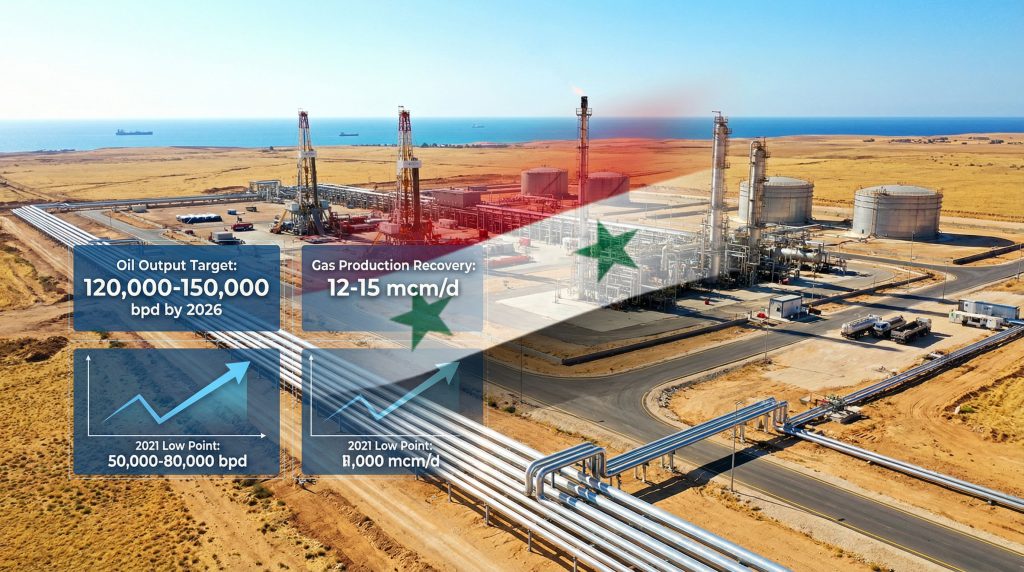
| Oil Output (bpd) | 380,000-400,000 | 50,000-80,000 | 120,000-150,000 | 2-4 years |
| Gas Production (mcm/d) | 25-30 | 7-7.6 | 12-15 | 18-24 months |
| Active Fields | 100+ | 78 | 85-90 | Ongoing |
| Revenue Potential ($B) | 8.5-12.0 | 1.2-2.0 | 2.8-4.1 | 2026-2027 |
The 87-88 percent decline in oil output and 75-76 percent reduction in gas production during the conflict period represents the most severe energy sector contraction experienced by any regional producer. Recovery modelling anticipates sequential field commencement prioritising the Omar field targeting 40,000-50,000 barrels per day capacity for 2026-2027, followed by Tayyem, Ruwaidha, and Arak field development.
Gas sector recovery prioritises Palmyride Basin field clusters including Hani, Jihar, and Qara fields for 2025-2026 production commencement. The Hani field alone offers estimated production capacity of 100-150 million cubic metres per day, requiring compression infrastructure installation valued at $200-350 million and pipeline extensions costing $80-120 million per field interconnection.
Syria's documented discovered but undeveloped resources total 1.3 billion barrels of oil equivalent across proved, probable, and possible classifications. This excludes undiscovered resources estimated at 2.0-3.5 billion barrels of oil equivalent based on volumetric basin modelling, indicating substantial exploration upside beyond current production targets.
Revenue Diversification Beyond Hydrocarbon Dependence
Energy sector recovery economics demonstrate direct correlation with domestic power generation stability and broader economic reconstruction. Syria's power deficit, estimated at 8,000-12,000 megawatts of daily capacity shortage during 2021-2024, created electricity rationing cycles limiting industrial capacity to 4-6 hours daily availability.
Natural gas production recovery of 12-15 million cubic metres per day enables gas-fired power generation expansion equivalent to 2,500-3,500 megawatts of installed capacity through combined-cycle thermal efficiency conversion. This domestic power supply restoration represents prerequisite infrastructure for economic reconstruction across manufacturing, water treatment, and desalination sectors.
At baseline Brent crude pricing of $65-75 per barrel, production of 120,000-150,000 barrels per day generates $2.8-4.1 billion in annual revenue at full capacity. This revenue stream creates sustainable financing for capital expenditure in non-hydrocarbon sectors when combined with multilateral reconstruction financing mechanisms.
Import substitution through domestic refining expansion offers additional economic benefits. Syria's three operational refineries maintain 376,000 barrels per day nameplate capacity but operated at 30-40 percent utilisation during conflict periods due to feedstock constraints. Recovery to 50-60 percent utilisation would eliminate petroleum product import requirements estimated at $2.0-2.5 billion annually, representing significant foreign exchange preservation.
Which International Players Are Positioning for Syria's Energy Renaissance?
Gulf State Investment Strategies
Dana Gas, the UAE-based independent producer, executed a comprehensive Memorandum of Understanding in Q4 2025 for Syrian gas field redevelopment, with committed capital ranging from $500 million to $1.2 billion across 2025-2032 implementation phases. The agreement encompasses exploration, development, and production sharing arrangements across defined concession blocks, leveraging Dana Gas's historical operational presence in Syrian gas fields during pre-2011 periods.
The technical scope includes development of the Hani field with 100-150 million cubic metres per day production capacity, Jihar field targeting 60-90 million cubic metres per day, and Jafra field with 40-60 million cubic metres per day potential. Development timelines model 18-month infrastructure deployment from regulatory approval to initial production commencement.
Four Saudi entities committed to technical support provision through documented agreements: TAQA (Saudi Aramco subsidiary), ADES (Arabian Drilling Services), Arabian Drilling Company, and Arabian Geophysical and Surveying Services. TAQA deployment encompasses field optimisation consulting, asset integrity services, and production enhancement technical packages valued at $180-250 million across 2025-2028 engagement periods.
This distributed technical service model reduces individual exposure while maintaining collective sectoral engagement, reflecting Saudi Arabia's strategic approach to regional energy security considerations and upstream asset portfolio diversification. In addition, similar regional considerations influence decisions regarding OPEC production impact on global markets.
Western Major Oil Company Re-entry Analysis
ConocoPhillips executed an MoU for Syrian gas sector engagement focused on Palmyride Basin development and expanded onshore acreage access. Historical ConocoPhillips deployment patterns in similar post-sanctions environments suggest initial $150-300 million phased exploration and development investment, concentrating on lower-risk gas sector operations preceding oil production expansion.
Gas development presents strategic advantages through domestic power generation utilisation, eliminating export logistics requirements and associated sanctions compliance complexity during initial operational phases. ConocoPhillips engagement encompasses reprocessing of existing 3D seismic data covering 8,000-12,000 square kilometres of survey coverage, requiring $15-25 million investment across 12-18 month interpretation phases.
Gulfsands Petroleum, historically active in Syria pre-2011, initiated discussions regarding Block 26 resumption. Historical production from Block 26 operations achieved 50,000-80,000 barrels per day pre-conflict, with resumption representing potential for 30,000-40,000 barrels per day production recovery within 18-24 month operational commencement timeframes.
Novaterra executed parallel engagement agreements addressing block concessions in underexplored Syrian territories, with historical operational scale suggesting $50-100 million commitment thresholds for similar-scale operations in comparable emerging market environments. The changing regional dynamics, particularly regarding Venezuela policy shift, influence investment strategies across the sector.
Technology Transfer and Operational Partnerships
Production recovery requires deployment of four technical work categories: well workover operations, artificial lift system deployment, surface facility repairs, and enhanced recovery methodology implementation. Well workover costs average $0.8-1.2 million per well for standard interventions in Syrian formations, based on comparable regional operations in Iraqi and Kuwaiti fields.
The Omar field workover programme targeting 35-50 wells requires capital deployment of $28-60 million across 2025-2027 implementation timelines. Artificial lift systems including progressive cavity pumps, electric submersible pumps, and jet pump installations require $1.5-3.0 million per well installation including surface collection and treatment facilities.
Baseline production recovery models prioritise 25-40 well artificial lift installations across primary producing fields, requiring $37.5-120 million capital deployment contingent upon technological supply chain access and international financing arrangements. However, evolving conditions in Syria's energy sector indicate significant potential for recovery.
What Are the Geopolitical Implications of Syria's Energy Unification?
Sanctions Relief Timeline and Economic Integration
The systematic removal of economic sanctions represents a fundamental shift in Syria's integration with international financial systems and energy markets. The US and EU sanctions relief process, initiated following the December 2024 regime change, created measurable improvements in operational conditions for international energy companies.
SWIFT system restoration enables standardised international payment processing, eliminating previous workarounds that added 15-20 percent transaction costs to international contractor payments. This financial normalisation reduces operational overhead for international operators while enabling transparent revenue sharing and tax payment mechanisms required for sustained government partnership agreements.
Syria's gradual reintegration with international banking systems creates opportunities for project financing through traditional mechanisms rather than complex barter arrangements that characterised energy sector financing during sanctions periods. Standard commercial lending rates replace previous financing costs that often exceeded 12-15 percent annually due to sanctions compliance complexity.
The timeline for complete sanctions removal correlates with demonstrated governance stability and operational transparency within the energy sector. Progressive sanctions relief tied to operational milestones creates incentive structures for sustained governance improvements while reducing geopolitical risks for international investors.
Regional Energy Balance Shifts
Syria's energy sector recovery creates strategic implications for regional energy supply chains and geopolitical relationships across the Eastern Mediterranean and Levantine regions. Domestic production recovery reduces dependency on costly energy imports that strained government budgets during conflict periods while creating new supply options for regional partners.
Reduced Syrian dependence on Russian and Iranian energy imports alters regional influence dynamics. During peak conflict periods, Syria imported 80-90 percent of refined petroleum products and 60-70 percent of natural gas requirements through Russian and Iranian supply arrangements. Domestic production recovery to 120,000-150,000 barrels per day oil output eliminates $1.8-2.4 billion annually in import dependencies.
Turkish energy transit arrangements face recalibration as Syrian production recovery creates alternative supply routes for regional energy flows. Syria's pre-2011 role as energy transit corridor for Iraqi and regional production to European markets could resume with infrastructure rehabilitation, potentially reducing Turkish transit leverage over regional energy security.
Lebanese electricity supply arrangements represent immediate opportunities for Syrian gas exports. Lebanon's power generation deficit and reliance on expensive fuel oil imports create demand for 2-4 million cubic metres per day of Syrian gas supply, generating $200-400 million annually in export revenues while supporting regional stability through improved Lebanese power supply reliability. Consequently, these developments are influenced by broader patterns in trade war oil markets.
How Do Infrastructure Challenges Shape Recovery Scenarios?
Critical Asset Rehabilitation Priorities
Infrastructure rehabilitation represents the primary constraint on production recovery timelines and sustainable growth trajectories. Current assessment indicates that 78 documented producing fields require varying degrees of infrastructure restoration, with 60-70 percent of pipeline capacity needing major rehabilitation or replacement.
Key Infrastructure Focus Areas:
- Omar field production optimisation targeting 40,000-50,000 bpd recovery requiring $28-60 million workover investment
- Palmyride Basin gas development for domestic power generation with compression infrastructure costs of $200-350 million per field
- Export pipeline network restoration requiring $2.8-4.2 billion capital deployment
- Refinery capacity enhancement at Baniyas and Homs facilities targeting 50-60 percent utilisation recovery
The Omar field, representing Syria's largest producing asset, requires comprehensive well workover programmes across 35-50 wells to restore production capacity. Each well intervention averages $0.8-1.2 million in costs for standard mechanical interventions, with additional artificial lift system deployment requiring $1.5-3.0 million per well including surface facilities.
Gas sector infrastructure prioritises compression and processing facilities enabling domestic power generation applications. The Palmyride Basin development requires 18-month infrastructure deployment timelines from regulatory approval to initial production, with each major field requiring dedicated compression infrastructure installation and pipeline extensions to existing power generation facilities.
Export infrastructure rehabilitation creates the most significant capital requirements but offers the greatest revenue generation potential. Pipeline restoration for 380,000-400,000 barrels per day oil export capacity requires systematic replacement of corroded sections, pump station rehabilitation, and terminal facility restoration across multiple export routes.
Security Risk Mitigation for Energy Operations
Operational security considerations shape infrastructure development sequencing and international partnership structures. Energy operations in previously contested regions require comprehensive security protocols that balance operational efficiency with personnel safety and asset protection requirements.
The gas sector presents lower security risk profiles compared to oil operations due to domestic market focus and reduced export infrastructure requirements. Gas field development in the Palmyride Basin benefits from proximity to government-controlled territories and existing power generation infrastructure, minimising transportation security challenges.
International security cooperation frameworks provide risk mitigation mechanisms for foreign operators. Joint security arrangements between Syrian government forces and international contractors create operational continuity protocols while international arbitration frameworks provide dispute resolution mechanisms for contract stability.
Insurance and risk management structures for foreign investors require specialised approaches adapted to post-conflict operational environments. Political risk insurance providers offer coverage for contract stability, regulatory changes, and operational disruptions, though premium costs typically range 8-15 percent above standard commercial rates for comparable operations in stable jurisdictions.
What Does Syria's Untapped Potential Mean for Global Energy Markets?
Exploration Upside Beyond Current Reserves
Syria's exploration potential extends significantly beyond current production and discovered resource assessments. The country's onshore exploration acreage encompasses approximately 186,000 square kilometres under Syrian government concession, with offshore Mediterranean concessions covering 54,000 square kilometres of entirely unexplored seabed.
Basin-scale resource assessment indicates 2.0-3.5 billion barrels of oil equivalent in undiscovered resources beyond the 1.3 billion barrels in documented discovered but undeveloped reserves. This exploration upside represents one of the largest underexplored hydrocarbon provinces in the Eastern Mediterranean region.
Offshore potential assessment reveals unprecedented exploration opportunities. Syria's Mediterranean shelf has zero exploration wells drilled to date, contrasting sharply with adjacent offshore discoveries in Israeli, Cypriot, and Egyptian waters. Regional geological continuity suggests significant natural gas potential in Syrian offshore blocks, with reservoir characteristics potentially comparable to the giant Zohr and Leviathan fields in neighbouring jurisdictions.
Onshore underexplored basin opportunities focus on deeper stratigraphic intervals and frontier exploration areas. Advanced seismic reprocessing of existing 3D survey coverage identifies multiple prospects requiring drilling confirmation across established production areas, while entirely undrilled structural trends offer exploration potential in frontier regions. For instance, developments in Syria's oil and gas revival demonstrate the sector's recovery potential.
Long-term Market Integration Scenarios
Mediterranean gas hub development represents Syria's most significant long-term opportunity for integration with global energy markets. The country's strategic location enables gas supply aggregation from multiple regional producers for delivery to European markets experiencing ongoing supply diversification requirements.
Regional pipeline connectivity projects under development could position Syria as a central node in Eastern Mediterranean gas distribution networks. Connection to planned Israeli-European gas pipelines, potential Cypriot gas exports, and Egyptian gas surplus creates opportunities for Syrian infrastructure to serve as regional transmission hub generating substantial transit revenues.
Export capacity building targets European market access through multiple route options. Northern routes through Turkey provide direct access to European gas networks, while southern routes through Lebanon and potential offshore pipeline development offer alternative pathways reducing single-point-of-failure risks in regional gas supply chains.
The timeline for full market integration extends across 2026-2035 periods, contingent upon sustained political stability, infrastructure development completion, and international partnership agreements. Progressive integration phases prioritise domestic market stabilisation, regional export development, and eventual global market participation.
The next major ASX story will hit our subscribers first
Strategic Investment Framework: Risk vs. Opportunity Analysis
Early-Stage Entry Advantages
First-mover positioning in Syrian energy sector rehabilitation offers significant strategic advantages for international operators willing to accept higher initial risk profiles. Early-stage entry enables preferential asset access, government partnership establishment, and operational infrastructure development before broader international competition intensifies.
Government partnership benefits include priority access to high-quality acreage, favourable fiscal terms reflecting higher risk acceptance, and operational flexibility during initial development phases. Syrian government incentive structures for early-stage investors typically include enhanced profit-sharing arrangements, extended exploration periods, and preferential treatment in future licensing rounds.
Technology deployment advantages emerge from greenfield-equivalent conditions requiring comprehensive infrastructure development. International operators can implement state-of-the-art production technologies, optimise field development plans without legacy constraint limitations, and establish operational standards aligned with international best practices from project inception.
The competitive landscape during early recovery phases offers reduced competition for prime assets compared to established producing regions. Asset acquisition costs remain below regional benchmarks while resource quality often exceeds average characteristics due to previous underinvestment and limited development optimisation.
Phased Development Strategy Recommendations
Risk-optimised development sequencing prioritises gas sector operations preceding oil production expansion to minimise export infrastructure dependencies and political risk exposure during initial phases. Gas development focuses on domestic power generation markets with established demand and simplified regulatory approval processes.
Phase 1 (2025-2027): Gas Sector Foundation
- Palmyride Basin field development targeting 12-15 million cubic metres per day capacity
- Domestic power generation infrastructure connections
- Workforce development and institutional capacity building
- Initial capital deployment: $800 million – $1.2 billion
Phase 2 (2027-2030): Oil Production Scaling
- Omar field production optimisation targeting 40,000-50,000 barrels per day
- Export infrastructure rehabilitation and route diversification
- Enhanced recovery methodology implementation
- Capital deployment: $1.5 billion – $2.4 billion
Phase 3 (2030-2035): Integrated Energy Complex Development
- Offshore exploration programme initiation
- Regional energy hub infrastructure development
- Advanced technology deployment and optimisation
- Capital deployment: $3.0 billion – $4.8 billion
This phased approach balances risk management with growth potential while enabling operational learning and partnership development across progressively complex operational phases.
Syria's Energy Sector as Regional Transformation Catalyst
Five-Year Outlook for Production and Investment
The convergence of unified territorial control, sanctions relief, and international re-engagement creates conditions for sustained energy sector recovery across 2026-2030 periods. Realistic production targets based on current rehabilitation pace indicate 120,000-150,000 barrels per day oil production and 12-15 million cubic metres per day gas output achievable within 2026-2027 timeframes.
Foreign investment threshold requirements for sustained growth indicate $2.5-4.0 billion in international capital deployment necessary for comprehensive infrastructure rehabilitation and production optimisation. This investment level enables restoration of 60-70 percent of pre-2011 production capacity while establishing foundation infrastructure for long-term expansion phases.
Regional energy security implications extend beyond Syrian domestic production to broader Eastern Mediterranean supply stability. Syrian production recovery reduces regional dependence on volatile supply sources while creating alternative energy pathways supporting overall regional energy security enhancement.
Success Metrics for Sustainable Recovery
Energy self-sufficiency benchmarks provide measurable indicators of recovery progress and sustainability. Domestic energy security requires 15-18 million cubic metres per day of gas production for power generation and industrial applications, achievable through current development programmes within 2027-2028 timeframes.
Export revenue contribution to reconstruction financing creates economic sustainability metrics beyond energy sector performance. Target export revenues of $2.8-4.1 billion annually from oil production and $400-600 million annually from gas exports enable substantial government revenue generation for broader economic reconstruction priorities.
International energy market integration milestones include SWIFT system normalisation (completed 2025), international contract standardisation (2026-2027 target), and regional pipeline connectivity establishment (2028-2030 timeline). These integration phases enable progressive expansion from domestic-focused operations to regional and global market participation.
The transformation of Syria's energy landscape from conflict-disrupted operations to integrated regional production represents more than sectoral recovery. This oil and gas revival in Syria creates precedents for post-conflict energy sector rehabilitation while demonstrating the strategic importance of unified governance, international partnership, and systematic infrastructure development in enabling sustainable energy sector renaissance across challenging geopolitical environments.
Disclaimer: This analysis involves forecasts, speculation, and financial projections based on current available information. Energy sector investments in post-conflict regions carry significant political, operational, and financial risks. Investment decisions should be made based on independent due diligence and professional financial advice. Production targets, revenue projections, and timeline estimates are subject to change based on operational developments, regulatory changes, and geopolitical factors.
Want to Capitalise on Major Energy Sector Discoveries?
Discovery Alert's proprietary Discovery IQ model delivers instant notifications on significant ASX mineral discoveries, turning complex geological data into actionable investment opportunities for energy and commodities sectors. Explore why historic mineral discoveries have generated substantial returns for early investors by visiting Discovery Alert's discoveries page and begin your 30-day free trial to position yourself ahead of the market.