August 6, 2026
The Strategic Context Behind Syria's Maritime Energy Push
Syria's offshore oil and gas development has emerged as a cornerstone of the nation's post-conflict energy strategy, positioning the country to capitalise on Mediterranean hydrocarbon resources while addressing critical reconstruction funding needs. Mediterranean energy markets face unprecedented transformation as regional powers scramble to secure alternative supply routes following Europe's dramatic shift away from Russian energy sources. This strategic realignment has created opportunities for previously marginalised players to re-enter international hydrocarbon markets, particularly in the Eastern Mediterranean basin where geological surveys continue to reveal substantial untapped reserves.
Syria's emergence as a potential offshore energy producer represents more than economic recovery following nearly 15 years of conflict. The recent trilateral partnership between Syrian Petroleum Company, Chevron, and Power International Holding signals a fundamental recalibration of Mediterranean energy dynamics, where post-conflict reconstruction intersects with European energy security imperatives.
The timing proves particularly significant given Europe's accelerated diversification strategy, as analysed in our recent oil price rally analysis. With traditional supply chains disrupted, Mediterranean gas routes have gained strategic importance as alternatives to pipeline dependencies. Syria's territorial waters, situated within the prolific Levantine Basin, offer geographic positioning that could enable direct pipeline connections to Turkish distribution networks and broader European markets.
This development occurs against complex geopolitical considerations influenced by broader trade war impact analysis. The involvement of US-based Chevron suggests potential evolution in sanctions frameworks, while Qatar-based Power International Holding brings regional capital and expertise to the partnership structure. The arrangement reflects Syria's careful balancing of international engagement with national resource control priorities.
When big ASX news breaks, our subscribers know first
How Significant Are Syria's Offshore Hydrocarbon Reserves?
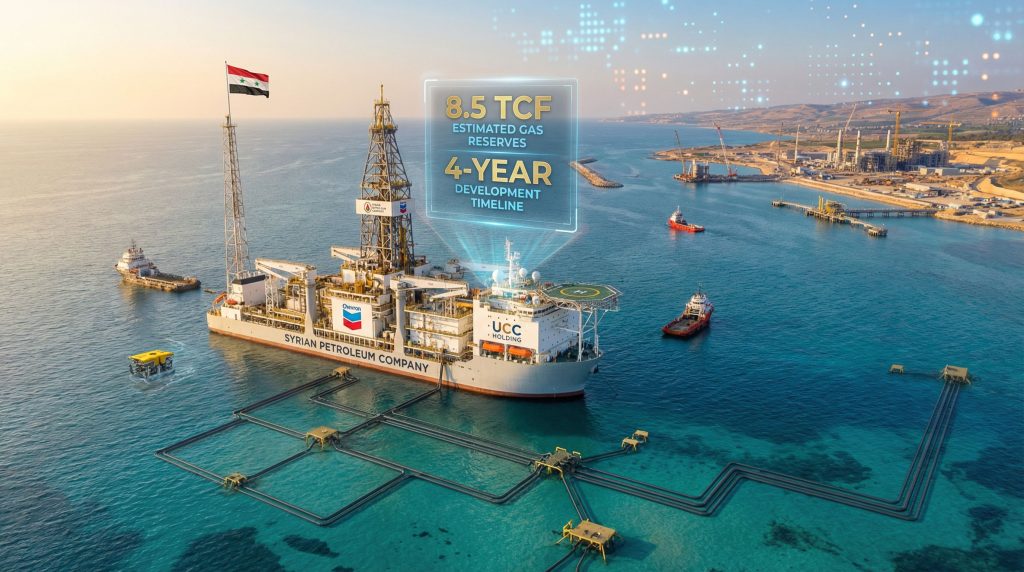
Syria's offshore potential centres on its portion of the Levantine Basin, where geological assessments indicate substantial hydrocarbon accumulations beneath Mediterranean waters. According to 2015 Oil & Gas Journal estimates, Syria's proven oil reserves total 2.5 billion barrels, while natural gas reserves reach 8.5 trillion cubic feet. These figures, predating significant regional discoveries and technological advances, likely represent conservative assessments of actual resource potential.
The broader Levantine Basin context provides crucial perspective on Syria's reserves. Industry assessments suggest the basin contains approximately 122 trillion cubic feet of natural gas and 1.7 billion barrels of oil equivalent, positioning Syria's territorial waters within a significant regional hydrocarbon province. This geological setting has already enabled major discoveries in Israeli and Cypriot waters, establishing the Eastern Mediterranean as a legitimate energy supply corridor.
Comparative Reserve Analysis
Regional reserve comparisons reveal Syria's potential position within Mediterranean energy markets:
| Country | Offshore Gas (TCF) | Development Status | Primary Partners |
|---|---|---|---|
| Syria | 8.5 (2015 estimate) | Pre-development | Chevron, Power International |
| Lebanon | 25+ (estimated) | Exploration delays | TotalEnergies, Eni |
| Cyprus | 4-6 (Aphrodite field) | Development challenges | ExxonMobil, Shell |
| Israel | 35+ (Leviathan/Tamar) | Production phase | Noble Energy, Delek |
The comparative analysis highlights Syria's substantial resource base relative to active regional developments. While Israeli fields currently dominate Eastern Mediterranean production, Syrian reserves represent significant additional supply potential that could reshape regional market dynamics once operational, particularly considering ongoing natural gas trends.
Geological Characteristics and Basin Potential
The Levantine Basin's geological structure suggests favourable conditions for Syria offshore oil and gas development. Relatively shallow to medium-depth water scenarios reduce technical complexity compared to ultra-deepwater developments, while established regional expertise in Mediterranean operations provides operational precedents.
Subsea infrastructure requirements appear moderate based on regional analogies, with potential connections to existing pipeline corridors reducing capital requirements for export infrastructure. The basin's proven hydrocarbon systems, demonstrated through successful Israeli and Cypriot discoveries, validate the geological model underlying Syrian territorial assessments.
However, specific reservoir characteristics, including hydrocarbon types, depths below seabed, and geological formation details, await detailed exploration programmes. The four-year timeline to gas production, as outlined by Syrian Petroleum Company leadership, suggests recognition of substantial technical development requirements.
What Are the Technical and Operational Challenges?
Syria offshore oil and gas development faces multifaceted technical challenges that distinguish offshore operations from traditional onshore production. The planned four-year timeline to reach offshore gas reserves, as indicated by Syrian Petroleum Company CEO Youssef Qablawi, reflects the complexity of subsea infrastructure development, specialised equipment requirements, and integration with onshore processing facilities.
Offshore Development Infrastructure Requirements
The technical scope for Syrian offshore development encompasses several critical infrastructure components:
• Subsea wellhead systems: Specialised equipment designed for Mediterranean marine conditions
• Flowline networks: Pipeline systems connecting subsea wells to processing facilities
• Control and monitoring systems: Umbilicals providing hydraulic, electrical, and communication links
• Processing infrastructure: Onshore facilities for separation, treatment, and conditioning
• Export terminal development: Loading and shipping facilities for processed hydrocarbons
Each infrastructure element requires specialised engineering adapted to Mediterranean environmental conditions, including seasonal weather patterns, seismic considerations, and marine environmental protection requirements. The integration of these systems demands sustained technical execution over multiple development phases.
Risk Assessment Framework
Syrian offshore development faces elevated risk factors across political, technical, and commercial dimensions:
Political and Regulatory Risks:
• Institutional capacity: Limited post-conflict regulatory frameworks for offshore development
• International recognition: Variable governmental recognition affecting commercial partnerships
• Sanctions compliance: Complex navigation of international sanctions regimes
• Regional security: Ongoing Mediterranean geopolitical tensions
Technical and Environmental Risks:
• Seismic activity: Eastern Mediterranean moderate earthquake activity requiring infrastructure resilience
• Marine environment: Mediterranean seasonal conditions and environmental protection standards
• Subsea complexity: Deepwater well design and pressure management challenges
• Supply chain access: Availability of specialised offshore equipment and services
The involvement of Chevron brings established deepwater expertise from Gulf of Mexico, West Africa, and Southeast Asia operations. However, Syrian-specific conditions require adapted technical solutions and risk mitigation strategies.
Development Timeline and Phase Structure
The anticipated development phases reflect typical offshore project progression:
Phase 1: Exploration and Appraisal (2026-2027)
• Initial drilling programmes to confirm reserve estimates
• Geological and reservoir characterisation studies
• Environmental baseline assessments
• Regulatory approval processes
Phase 2: Development Planning (2027-2028)
• Field development plan finalisation
• Infrastructure design and procurement
• Commercial framework establishment
• Financial investment decision
Phase 3: Infrastructure Construction (2028-2030)
• Subsea infrastructure installation
• Onshore processing facility construction
• Pipeline and export infrastructure development
• System integration and testing
The planned mobilisation before summer 2026 suggests accelerated initial phases, reflecting Syria's economic reconstruction priorities and partner urgency to establish commercial operations.
How Does This Development Reshape Regional Energy Dynamics?
Syrian offshore entry into Mediterranean energy markets creates strategic implications extending beyond national economic recovery. The development represents additional supply capacity entering regional markets at a critical period of European energy diversification, potentially affecting established export relationships and pricing dynamics across the Eastern Mediterranean energy corridor.
Strategic Positioning for European Markets
Syria's geographic positioning enables multiple export route possibilities for European natural gas markets. The most viable pathway involves pipeline connections through Turkish territory to established European distribution networks, including the Trans-Anatolian Pipeline system and existing Turkish gas infrastructure. This route offers advantages over alternative Mediterranean pipeline options due to established infrastructure and operational precedents.
Direct Mediterranean export routes present alternative possibilities but require substantial new infrastructure investments. Furthermore, Syria's coastal positioning could theoretically support pipeline connections to existing Mediterranean gas networks, though technical and commercial feasibility studies remain pending.
Liquefied natural gas export represents a third option, requiring significant processing infrastructure investments but offering flexibility in market access. Syria's potential LNG development could utilise existing Mediterranean shipping routes and terminal infrastructure in European markets.
Competitive Impact on Regional Producers
Syrian offshore production introduction creates competitive pressure on existing Mediterranean energy suppliers, particularly affecting patterns similar to those seen in the US oil production decline:
Israeli Export Strategy Implications:
• Current Israeli gas exports through Egypt's LNG facilities face potential competition for processing capacity
• Long-term European export contracts may encounter pricing pressure from additional supply sources
• Regional market share dynamics shift with increased Mediterranean production capacity
Egyptian LNG Market Position:
• Additional Syrian feedstock could enhance Egyptian liquefaction facility utilisation rates
• Competitive dynamics emerge between processing Syrian gas versus Israeli supply arrangements
• Egypt's position as Mediterranean gas hub faces both opportunities and challenges
Cypriot Development Economics:
• Aphrodite field development faces altered commercial environment with additional regional supply
• Investment decisions for Cypriot expansion encounter changed regional pricing assumptions
• Commercial partnerships may require restructuring based on evolved supply-demand balance
Turkish Energy Import Diversification:
• Syria offshore production offers Turkish energy security through supply source diversification
• Transit revenue opportunities emerge through Syrian gas pipeline routes to European markets
• Reduced Turkish dependence on concentrated supplier relationships
Market Timing and European Energy Security
The Syrian offshore development timeline aligns strategically with European energy transition requirements. First gas production anticipated by 2030 corresponds with European efforts to establish permanent alternatives to Russian energy supplies while maintaining natural gas as a transitional energy source supporting renewable energy integration.
European natural gas demand projections through 2035 indicate continued substantial consumption despite renewable energy expansion. Syrian offshore production could provide additional supply diversity supporting European energy security objectives while offering competitive pricing relative to global LNG markets.
Additionally, the development occurs alongside broader regional energy market shifts and OPEC production impact considerations that influence Mediterranean energy pricing dynamics.
What Investment and Partnership Models Are Emerging?
The trilateral partnership structure between Syrian Petroleum Company, Chevron, and Power International Holding represents an innovative approach to post-conflict energy development that balances state control objectives with international technical expertise and regional capital mobilisation.
Partnership Structure Analysis
The hybrid partnership model addresses multiple strategic objectives:
Syrian Petroleum Company Role:
• Maintains majority national interest in offshore resource development
• Ensures state participation in revenue streams and operational oversight
• Provides domestic regulatory interface and government relationship management
• Secures national control over strategic energy asset development
Chevron Corporation Contributions:
• Delivers proven deepwater development expertise from global operations
• Provides access to advanced offshore technologies and engineering capabilities
• Enables international market access and commercial relationships
• Supplies project management experience for complex offshore developments
Power International Holding Involvement:
• Contributes regional capital and Middle Eastern market knowledge
• Facilitates regional supply chain and contractor relationships
• Provides cultural and regional business practice expertise
• Enables risk sharing across political, technical, and commercial dimensions
Capital Requirements and Investment Phases
Syrian offshore development requires substantial capital commitments across multiple development phases:
Investment Timeline and Capital Allocation:
| Development Phase | Timeline | Estimated Investment Range |
|---|---|---|
| Exploration Phase | 2026-2027 | $200-400 million |
| Development Phase | 2028-2030 | $2-4 billion |
| Production Infrastructure | 2030-2032 | $1-2 billion |
| Export Facilities | 2031-2033 | $500 million-$1 billion |
Total project investment requirements potentially reach $4-7.5 billion depending on development scope, infrastructure complexity, and export route selection. These capital requirements necessitate sophisticated financing structures combining partner contributions, international project financing, and potential sovereign wealth fund participation.
Risk Sharing and Commercial Framework
The partnership structure enables risk distribution across complementary capabilities:
Technical Risk Mitigation:
• Chevron assumes primary responsibility for offshore development execution
• Power International Holding provides regional operational risk management
• Syrian Petroleum Company manages domestic regulatory and political risks
Commercial Risk Distribution:
• Market access risks shared between Chevron's international networks and regional relationships
• Currency and financial risks distributed across multiple partner jurisdictions
• Political risks balanced between international and regional partner presence
The commercial framework likely includes production sharing arrangements, cost recovery mechanisms, and profit distribution formulas balancing partner contributions with Syrian national interests. Specific commercial terms remain confidential pending final development agreements.
What Are the Broader Economic Implications?
Syria offshore oil and gas development represents potential transformation of national economic fundamentals, with hydrocarbon revenues offering crucial funding for post-conflict reconstruction while restoring Syria's position in regional energy markets.
Revenue Generation Scenarios
Pre-conflict Syrian hydrocarbon production peaked at 380,000 barrels of oil daily and 25 million cubic metres of gas daily, generating over $3 billion annually in 2010. Offshore development could potentially restore significant portions of this revenue stream while creating new export income sources through natural gas sales to European markets.
Conservative Development Scenario (2030-2035):
• Annual revenue potential: $1-2 billion
• Production assumptions: 50,000-100,000 barrels oil equivalent daily
• Market price assumptions: $70-80/barrel oil, $8-10/MCF gas
• Export market penetration: 25-40% of production
Moderate Development Scenario (2032-2037):
• Annual revenue potential: $3-5 billion
• Production assumptions: 150,000-200,000 barrels oil equivalent daily
• Market price assumptions: $75-90/barrel oil, $10-12/MCF gas
• Export market penetration: 50-65% of production
Optimistic Development Scenario (2034-2039):
• Annual revenue potential: $5-8 billion
• Production assumptions: 250,000-350,000 barrels oil equivalent daily
• Market price assumptions: $85-100/barrel oil, $12-15/MCF gas
• Export market penetration: 70-80% of production
Economic Reconstruction Impact
Offshore energy revenues provide potential funding mechanisms for comprehensive national reconstruction efforts:
Infrastructure Development Priorities:
• Transportation network reconstruction and modernisation
• Power generation and electrical grid restoration
• Water treatment and municipal infrastructure
• Healthcare and educational facility reconstruction
• Industrial capacity restoration and expansion
Economic Diversification Opportunities:
• Petrochemical industry development utilising gas feedstock
• Service sector expansion supporting energy operations
• Technical capacity building and human capital development
• Regional trade relationship restoration and expansion
Revenue management strategies prove crucial for maximising reconstruction benefits while avoiding resource curse dynamics that have affected other hydrocarbon-dependent economies. Consequently, transparent revenue allocation, diversified investment strategies, and institutional capacity building represent essential components of sustainable economic recovery.
Employment and Capacity Building
Syrian offshore development creates substantial employment opportunities across skill levels:
Direct Employment Creation:
• Technical positions in offshore operations and maintenance
• Engineering and project management roles
• Support services including logistics, catering, and transportation
• Onshore processing facility operations
Indirect Employment Benefits:
• Supply chain and contractor services expansion
• Regional service industry growth
• Construction and infrastructure development employment
• Professional services sector expansion
Knowledge transfer from international partners enables long-term domestic capacity building in offshore energy technologies, potentially positioning Syria as a regional centre for Mediterranean energy expertise.
The next major ASX story will hit our subscribers first
How Do Geopolitical Factors Influence Development Prospects?
Syrian offshore development occurs within complex regional and international political frameworks that significantly influence project viability, commercial relationships, and operational parameters.
Regional Power Dynamics
The Eastern Mediterranean energy landscape involves multiple competing interests and strategic relationships:
United States Policy Considerations:
• Chevron's participation suggests potential sanctions relief or exemption frameworks
• US energy security interests include diversified Mediterranean supply sources
• Regional stability objectives align with Syrian economic reconstruction
• Balance between Syrian engagement and alliance relationship maintenance
Russian Strategic Interests:
• Existing Russian presence in Syrian energy infrastructure
• Competition with US energy sector engagement
• Mediterranean naval and strategic positioning considerations
• Regional influence through energy sector relationships
Turkish Energy Security Priorities:
• Transit route opportunities for Syrian gas to European markets
• Energy import diversification reducing dependency on single suppliers
• Regional positioning as energy hub for Mediterranean-European connections
• Balance between NATO alliance obligations and regional energy interests
Israeli Regional Energy Competition:
• Concern about Syrian offshore development affecting Israeli gas export competitiveness
• Regional security implications of Syrian energy sector restoration
• Potential cooperation opportunities in Mediterranean energy infrastructure
• Commercial relationships through regional energy trading mechanisms
European Union Energy Policy Alignment
Syrian offshore development aligns with several European Union strategic energy objectives:
Energy Security Enhancement:
• Additional supply diversity supporting reduced Russian energy dependence
• Mediterranean supply corridor development strengthening energy resilience
• Regional stability promotion through economic reconstruction support
Commercial and Regulatory Considerations:
• EU sanctions frameworks affecting Syrian energy sector engagement
• Environmental standards and carbon emission regulations
• Supply chain due diligence and human rights compliance requirements
Sanctions and International Compliance
The participation of US-based Chevron indicates potential evolution in sanctions frameworks, though development success requires sustained international compliance. According to recent reports from NBC News, this landmark offshore oil field deal represents a significant shift in international engagement with Syrian energy sector development.
US Treasury and State Department Coordination:
• Specific licensing or exemption frameworks enabling Chevron participation
• Ongoing compliance monitoring and reporting requirements
• Alignment with broader US Middle East policy objectives
European Union Regulatory Environment:
• Current EU sanctions on Syrian petroleum sector
• Potential exemptions for energy infrastructure supporting European supply security
• Environmental and social governance compliance requirements
International Financial System Access:
• Banking and financial services availability for project financing
• Insurance and risk management coverage for offshore operations
• Export credit agency support for equipment and technology provision
Technology and Innovation Opportunities in Syrian Offshore Development
Syria offshore oil and gas development presents opportunities for advanced technology deployment and innovation in Mediterranean deepwater operations, potentially establishing Syria as a regional centre for offshore energy expertise.
Advanced Offshore Technologies
The partnership with Chevron enables access to cutting-edge offshore development technologies:
Subsea Production Systems:
• Enhanced subsea trees and manifolds adapted for Mediterranean conditions
• Advanced flow assurance technologies preventing hydrate formation
• Real-time monitoring systems enabling remote operations optimisation
• Subsea processing capabilities reducing topside infrastructure requirements
Digital Operations and Monitoring:
• Integrated asset management platforms providing comprehensive operational oversight
• Predictive maintenance technologies reducing operational downtime
• Digital twin modelling for production optimisation and safety enhancement
• Artificial intelligence applications for reservoir management and forecasting
Environmental Protection Technologies:
• Advanced blowout prevention systems ensuring operational safety
• Marine environmental monitoring systems protecting Mediterranean ecosystems
• Emission reduction technologies supporting climate objectives
• Waste minimisation and circular economy applications
Knowledge Transfer and Capacity Building
International partnership structures facilitate substantial technology transfer to Syrian technical teams. Moreover, detailed analysis from Petroleum Australia indicates that this collaboration represents Syria's first significant offshore development initiative since the conflict began.
Technical Training Programmes:
• Offshore operations training for Syrian engineers and technicians
• Project management capacity building for complex energy developments
• Safety and environmental management system implementation
• Maintenance and operations expertise development
Institutional Capacity Development:
• Regulatory framework modernisation supporting offshore energy development
• Technical standards and certification programmes
• Research and development capabilities in offshore technologies
• Regional technical expertise centre establishment
The knowledge transfer process potentially positions Syria as a Mediterranean centre for offshore energy expertise, supporting future regional development projects and creating sustainable technical capacity beyond individual project lifecycles.
Future Outlook: Strategic Scenarios for Syrian Offshore Energy Development
Syria offshore oil and gas development faces multiple potential pathways depending on political stability, international engagement, technical execution, and regional market dynamics. Strategic scenario modelling provides insight into possible development trajectories and associated implications.
Scenario 1: Accelerated Development Pathway (2026-2030)
Key Assumptions:
• Rapid political stabilisation and sustained international support
• Successful technical execution without major operational setbacks
• Favourable regional security environment enabling uninterrupted operations
• Strong European demand for Mediterranean gas supporting commercial viability
Development Timeline:
• 2026-2027: Successful exploration confirming reserve estimates
• 2028-2029: Infrastructure development and construction completion
• 2029-2030: First gas production and initial export sales
• 2031-2032: Full production capacity and sustained export revenues
Economic Outcomes:
• Annual revenues reaching $3-5 billion by 2032
• Significant contribution to national reconstruction funding
• Employment creation supporting broader economic recovery
• Regional energy market position establishment
Scenario 2: Measured Development Pathway (2026-2035)
Key Assumptions:
• Gradual political stabilisation with ongoing regional uncertainties
• Technical challenges requiring extended development timelines
• Variable international support affecting project financing
• Moderate European demand growth supporting long-term commercial viability
Development Timeline:
• 2026-2028: Extended exploration and appraisal phases
• 2029-2031: Gradual infrastructure development with potential delays
• 2032-2033: Initial production commencement
• 2034-2035: Production optimisation and export market development
Economic Outcomes:
• Annual revenues reaching $2-4 billion by 2035
• Steady contribution to reconstruction efforts over extended timeline
• Measured employment growth supporting economic stability
• Gradual regional market integration
Scenario 3: Delayed Development Pathway (2026-2040)
Key Assumptions:
• Continued political and security challenges affecting operations
• Technical complications requiring multiple development campaign adjustments
• Limited international engagement constraining financing and technical support
• Regional market saturation reducing commercial attractiveness
Development Timeline:
• 2026-2030: Prolonged exploration phase with limited progress
• 2031-2035: Gradual development progress subject to ongoing interruptions
• 2036-2038: Initial production at reduced capacity
• 2039-2040: Full development realisation under challenging conditions
Economic Outcomes:
• Annual revenues reaching $1-3 billion by 2040
• Limited near-term reconstruction funding contribution
• Constrained employment creation with delayed economic benefits
• Minimal regional market impact during development period
Critical Success Factors
Syrian offshore development success depends on multiple interdependent factors:
Political and Regulatory Stability:
• Sustained governance capacity for complex energy project oversight
• Predictable regulatory frameworks supporting long-term investment decisions
• International recognition enabling commercial relationship development
• Regional security environment supporting operational continuity
Technical Execution Excellence:
• Successful drilling and reservoir development campaigns
• Infrastructure construction completion within timeline and budget parameters
• Operational safety and environmental protection standard maintenance
• Integration of complex offshore and onshore systems
Commercial and Financial Viability:
• Sustained international partnership engagement and financial commitment
• Access to international financial markets for project financing
• Competitive market positioning supporting long-term export contracts
• Revenue management strategies maximising reconstruction benefits
International Engagement and Market Access:
• Continued sanctions relief or exemption frameworks enabling commercial operations
• European market access for Syrian gas exports
• Regional cooperation supporting pipeline infrastructure and transit arrangements
• Technology transfer and capacity building programme implementation
The intersection of these success factors determines not only project viability but also broader implications for Syrian economic recovery, regional energy dynamics, and Mediterranean supply security. Syrian offshore oil and gas development represents both significant opportunity and substantial risk, requiring sustained commitment and strategic coordination across multiple stakeholder groups.
Strategic monitoring of development progress provides crucial insights into post-conflict energy sector reconstruction models, international engagement frameworks, and regional energy market evolution in an era of accelerated energy transition and security prioritisation.
Could Syria's Offshore Energy Development Signal New Mediterranean Investment Opportunities?
Syria's ambitious offshore oil and gas development programme, backed by Chevron and Power International Holding, exemplifies how geopolitical shifts can create unexpected investment opportunities in Mediterranean energy markets. Discovery Alert's proprietary Discovery IQ model helps investors identify similar emerging opportunities across ASX-listed companies, delivering real-time alerts when significant mineral discoveries are announced that could reshape market dynamics. Explore historic examples of transformative discoveries and begin your 14-day free trial today to position yourself ahead of rapidly evolving resource markets.