May 21, 2026
The Governance Problem That Mining's Disclosure Revolution Has Yet to Solve
Every major industry that handles catastrophic risk eventually reaches a reckoning between the volume of information it produces and the real-world protection that information actually delivers. In nuclear energy, aviation, and chemical manufacturing, that reckoning produced not just reporting frameworks but enforceable accountability systems with genuine teeth. Mining's relationship with tailings storage facilities has followed a different trajectory: one in which disclosure requirements have expanded dramatically while the governance architecture needed to make those disclosures meaningful has lagged far behind.
That gap sits at the heart of tailings transparency in mining, and a new study from the University of São Paulo has put a precise academic lens on just how wide it has become.
When big ASX news breaks, our subscribers know first
What Tailings Storage Facilities Are and Why Their Failure Profile Is Unique
Tailings are the finely ground residual material produced after ore is processed to extract valuable metals. At most modern operations, this material is mixed with water to form a slurry and pumped into engineered impoundments known as tailings storage facilities, or TSFs. These structures are among the largest engineered landforms on Earth, and they accumulate over the full operational life of a mine, sometimes spanning decades.
The structural design of a TSF is defined by its embankment construction method:
- Upstream construction raises the embankment crest using previously deposited tailings as the foundation, making it the most economical but least structurally stable method
- Downstream construction advances the embankment progressively outward, providing greater stability but requiring significantly more fill material and cost
- Centreline construction is a hybrid approach that offers a balance between cost and geotechnical performance
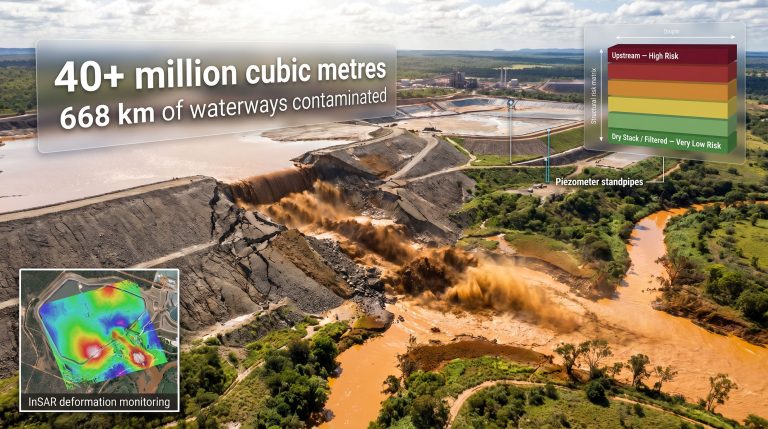
What makes TSF failures categorically different from most industrial accidents is their combination of scale, speed, and irreversibility. When a tailings dam loses structural integrity, the resulting flow can travel at speeds exceeding walking pace, carrying millions of cubic metres of toxic slurry across river systems, agricultural land, and populated areas. The contamination that follows can persist for decades, as heavy metals and processing chemicals bind to sediment and work their way through groundwater systems.
The catastrophic failures that occurred in Brazil during the mid-to-late 2010s became the defining reference point for a global governance response. Those events, which caused hundreds of deaths and widespread ecological destruction across river catchments, triggered the development of new international standards and the creation of publicly accessible international databases of tailings facilities. Yet despite this regulatory response, the frequency of significant TSF incidents globally has not declined in proportion to the regulatory attention directed at the sector.
Why the Energy Transition Is Making Tailings Transparency More Urgent, Not Less
The global shift toward renewable energy infrastructure is fundamentally reshaping the risk profile of tailings management. The energy transition minerals at the core of that transition — including copper for electrical systems, lithium for battery storage, cobalt and nickel for cathode chemistry — all generate substantial volumes of tailings per unit of extracted metal. As demand for these commodities accelerates, the aggregate volume of mine waste being produced globally is increasing.
The challenge is compounded by declining ore grades. As higher-quality near-surface deposits are progressively depleted, mining operations must process larger volumes of rock to recover the same quantity of metal. A copper operation working a 0.5% ore grade deposit must process twice the material of one operating at 1.0% grade to produce equivalent output, meaning tailings generation rates effectively double. This dynamic is well established across the copper and nickel sectors and is increasingly visible in lithium operations.
Simultaneously, new mining operations are moving into geographic areas that are more environmentally and socially sensitive than the remote locations that characterised earlier generations of large-scale mining. Proximity to waterways, agricultural systems, and communities is increasing. The consequences of inadequate tailings transparency in these contexts are correspondingly more severe, because the populations exposed to TSF risks are larger and the ecosystems at stake are more complex.
As researchers Rafaela Shinobe Massignan and Luis Enrique Sánchez of the University of São Paulo conclude in their 2026 systematic review, the energy transition is increasing both the volume of mine waste and the proximity of operations to sensitive environments and communities, creating conditions under which the cost of transparency failures escalates materially. (The Extractive Industries and Society, Volume 26, 2026)
How the Global Regulatory Framework for Tailings Transparency Evolved
The governance architecture surrounding tailings management has developed unevenly across different eras, with each phase responding to the limitations of what preceded it.
| Era | Key Development | Governance Mechanism | Core Limitation |
|---|---|---|---|
| Pre-2000s | Industry self-regulation | Internal codes of practice | No public disclosure requirements |
| 2000-2015 | EITI and IRMA frameworks emerge | Standardised environmental and social metrics | Focused on financial flows, not physical risk |
| 2016-2019 | Post-disaster regulatory reviews | National inquiries and independent panels | Jurisdiction-specific, no global applicability |
| 2020 onwards | Global Industry Standard on Tailings Management (GISTM) | Public lifecycle disclosure with third-party assurance | Voluntary outside ICMM membership |
The GISTM: What It Requires and What It Misses
The Global Industry Standard on Tailings Management, developed in 2020 through a collaboration between the International Council on Mining and Metals (ICMM), the UN Environment Programme, and the Principles for Responsible Investment, represents the most comprehensive tailings governance framework ever developed. Its core requirements span the full lifecycle of a TSF and include:
- Public disclosure of facility design specifications and engineering parameters
- Operational risk classifications using a consequence-based tiering system
- Mandatory third-party assurance as a credibility mechanism
- Closure and post-closure planning requirements made publicly accessible
- Disclosure of water management practices and environmental monitoring data
ICMM members operating facilities classified as posing extreme or very high downstream consequences were required to conform within three years of adoption, with all other member facilities required to align within five years.
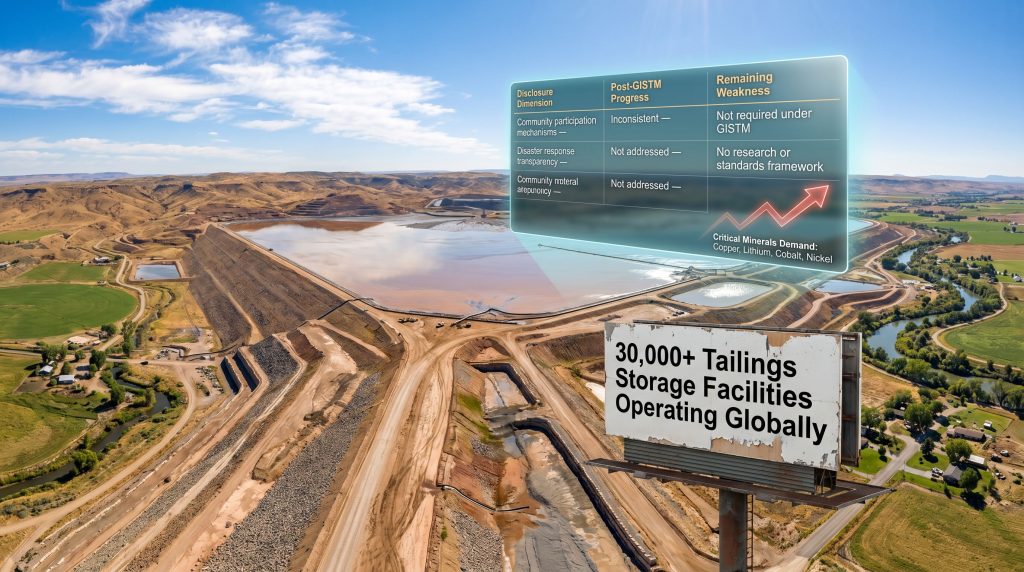
Critical Governance Gap: The GISTM applies to ICMM members, which include the six largest global mining companies. For the broader industry, it remains entirely voluntary. With more than 30,000 tailings storage facilities operating globally, this means the overwhelming majority of TSFs exist outside any equivalent disclosure obligation.
The Extractive Industries Transparency Initiative (EITI) and the Initiative for Responsible Mining Assurance (IRMA) provide complementary frameworks that address financial accountability and multi-stakeholder certification respectively. IRMA, in particular, incorporates physical risk and community engagement requirements that align with but extend beyond GISTM's focus. The gap that emerges when operators engage selectively with only one of these frameworks, rather than all three in combination, represents a structural weakness that the current governance architecture has not resolved.
What 945 Peer-Reviewed Studies Reveal About Research Priorities
A systematic review of 945 peer-reviewed articles on mining transparency, published in The Extractive Industries and Society (Volume 26, 2026) by Rafaela Shinobe Massignan and Luis Enrique Sánchez of the Department of Mining and Petroleum Engineering at the University of São Paulo, provides the most comprehensive mapping to date of what academia knows and does not know about tailings transparency in mining.
The study identified six primary research categories across the mining transparency literature:
- Environmental disclosure
- Financial accountability
- Community participation
- Corporate governance
- Regulatory compliance
- Social licence to operate
The central finding is striking in its implications: tailings does not emerge as a standalone research focus within this body of literature. Instead, it appears as a secondary theme nested primarily within environmental reporting, a positioning that systematically underestimates its governance, societal, and physical risk dimensions.
The authors found a demonstrable lag between the industry events that triggered governance reform and the academic scrutiny those events should have generated. The catastrophic failures in Brazil that catalysed the development of new international standards, including publicly accessible international TSF databases, are only partially reflected in the peer-reviewed literature that followed.
The Three Critical Knowledge Gaps
The research identifies three specific areas where academic investigation is most deficient, each representing a practical governance failure as much as a scholarly one.
Gap 1: Community Participation in Tailings Risk Management
Not a single peer-reviewed study was identified that examines how affected communities participate in tailings failure or disaster risk management. This is not a minor omission. Communities living in proximity to TSFs bear the greatest physical and economic consequences when failures occur, yet hold the least institutional power to challenge operators, access technical risk information, or influence management decisions.
The structural barriers that produce this exclusion are well understood in other governance contexts:
- The technical complexity of geotechnical risk data is inaccessible to most non-specialists
- Disclosures are rarely translated into the languages spoken by affected communities
- Geographic isolation reduces access to regulatory processes and legal remedies
- Power asymmetries between multinational operators and local populations are rarely addressed by disclosure frameworks
Gap 2: Transparency During Disaster Response and Recovery
The literature contains no substantive research examining how transparency functions, or fails to function, in the immediate aftermath of a TSF failure event. This gap has direct operational consequences. Post-disaster information environments are characteristically contested: operators, regulators, and affected communities routinely hold divergent accounts of what happened, what the ongoing risks are, and what remediation is being undertaken.
Without a research base in this area, there is no evidence foundation for designing disclosure systems specifically calibrated to crisis and recovery contexts.
Gap 3: Governance Architecture for Disclosure Systems
The existing literature concentrates heavily on technical monitoring tools — sensor networks, geotechnical instrumentation, and remote sensing — at the expense of examining how disclosure systems should be structured, verified, and enforced. The authors note that research has produced substantial analysis of what should be disclosed but very little on how disclosure mechanisms should function within regulatory accountability systems. This asymmetry means governance design remains underdeveloped relative to monitoring technology.
Are Current Tailings Disclosures Producing Accountability?
The gap between information availability and information utility is one of the least examined dimensions of tailings transparency in mining, yet it may be the most consequential. Risk data that exists in public repositories but cannot be meaningfully engaged with by communities, regulators, or civil society performs the appearance of transparency without delivering its substance.
Massignan and Sánchez identify a specific concern in this regard: company-led disclosures face persistent credibility issues because information may be incomplete, presented with significant time lags, or framed in technical language that is inaccessible to non-specialist audiences. In tailings contexts, this creates a condition where risk information is technically available but practically unusable, particularly where stakeholders lack the institutional capacity to challenge operators or enforce disclosed standards.
Three structural conditions consistently undermine disclosure effectiveness:
- Institutional capacity deficits in communities and regulatory bodies, particularly in jurisdictions where mining governance frameworks are less mature
- Selective and delayed reporting by operators whose incentive structures do not penalise incomplete or technically inaccessible disclosures
- Absence of enforcement mechanisms that would create genuine consequences for misleading, incomplete, or untimely disclosure
The following table illustrates where post-GISTM progress has been most and least evident:
| Disclosure Dimension | Post-GISTM Progress | Remaining Weakness |
|---|---|---|
| TSF location and inventory | Meaningful improvement among ICMM members | Inconsistent across non-ICMM operators |
| Geotechnical risk classification | Standardised within ICMM membership | Limited independent verification in practice |
| Water and emissions metrics | Improved quantitative reporting | Baseline comparability issues persist |
| Social and community impacts | Minimal documented improvement | No standardised framework exists |
| Disaster response transparency | Not addressed by GISTM | No research or standards framework exists |
| Community participation mechanisms | Inconsistent across operators | Not required under GISTM |
The next major ASX story will hit our subscribers first
Technologies Reshaping What Tailings Monitoring Can Deliver
The past decade has seen meaningful advances in the technical toolkit available for TSF monitoring, even as the governance frameworks needed to translate that monitoring into accountability have lagged. Broader mining sustainability transformation efforts have, however, helped elevate the profile of these monitoring investments across the sector.
Real-Time Monitoring and Remote Verification
Modern TSF monitoring increasingly integrates multiple sensor modalities to provide continuous structural surveillance:
- Piezometer networks measure pore water pressure within embankments, providing early warning of the saturation conditions associated with liquefaction risk
- In-place inclinometers and settlement monitors detect structural displacement in embankment materials
- Seismic sensors identify ground vibration signatures that can precede or accompany structural distress
- Satellite-based InSAR (Interferometric Synthetic Aperture Radar) enables independent verification of surface deformation across TSF embankments, including in locations where physical access is limited
The satellite dimension is particularly significant for transparency purposes because it enables monitoring by parties other than the operator, including regulators, researchers, and civil society organisations, using publicly available imagery sources.
Dry Stacking and Paste Backfilling: Addressing Risk at the Source
Two alternative tailings management approaches are gaining traction as the industry confronts the limitations of conventional slurry impoundments. Responsible mining waste management strategies increasingly consider both of these alternatives as part of a broader effort to reduce physical risk at the source.
Dry stacking involves dewatering tailings before placement, producing a compacted, stackable material with substantially reduced liquefaction risk compared to wet impoundments. The technique eliminates the water storage component that makes conventional TSFs prone to catastrophic failure, though it requires significant additional energy for filtration and dewatering infrastructure.
Paste backfilling involves mixing processed tailings with cement and pumping the resulting paste underground to fill excavated voids. This approach simultaneously addresses ground stability in underground operations and eliminates surface storage requirements for the portion of tailings used as backfill. Its applicability is limited to underground operations and depends on the geochemical compatibility of the tailings with the underground environment.
Both methods carry cost and energy penalties that constrain their universal adoption, particularly at the scale of large open-pit operations generating hundreds of millions of tonnes of tailings over their operational lives. From a transparency standpoint, operations employing these alternative approaches should be required to disclose their waste management methodology and its associated risk profile with the same rigour applied to conventional TSF disclosures.
Blockchain Verification: Potential and Current Limits
Blockchain-based traceability architectures offer a technically credible mechanism for addressing the credibility deficit in company-led disclosures. By creating immutable, timestamped records of monitoring data, a blockchain-anchored TSF disclosure system would make it computationally infeasible to alter historical records retrospectively — a significant improvement over conventional document-based reporting.
The selective disclosure capability of certain blockchain architectures is particularly relevant to the mining context: commercially sensitive operational data could be protected while safety-critical information is made publicly verifiable. However, these tools remain in pilot stages, primarily applied to supply chain traceability rather than physical risk governance. Their application to TSF transparency is speculative at this stage and would require substantial investment in data standards, integration infrastructure, and regulatory recognition before delivering accountability benefits at scale.
Disclaimer: References to emerging technologies such as blockchain in TSF governance contexts represent forward-looking analysis based on current technological trajectories and should not be interpreted as established practice or confirmed capability.
What Genuine Tailings Transparency Actually Requires
The distinction between a transparency framework and a transparency system is not semantic. A framework defines what must be disclosed. A system determines whether those disclosures produce accountability. The mining industry currently has the beginnings of a framework, through GISTM and its predecessor standards, but a transparency system with genuine accountability architecture remains largely absent.
An effective tailings transparency system requires four functional components operating simultaneously:
- Accessible disclosure: Information published in formats, languages, and media channels that affected communities can realistically engage with, not merely made available in technical repositories accessible to specialists
- Participatory governance: Structured, legally recognised mechanisms through which communities can provide input into TSF risk management decisions before those decisions are made
- Independent verification: Third-party assurance that assesses operational risk rather than simply auditing whether disclosure checklists have been completed
- Enforceable accountability: Regulatory penalties for non-disclosure, misleading disclosure, or failure to act on risks that have been disclosed
Implementing this framework uniformly across the diversity of jurisdictions in which TSFs operate is genuinely difficult. Levels of institutional capacity, regulatory independence, socioeconomic inequality between operators and communities, and the political influence of mining companies relative to local government vary enormously across the countries where significant TSF concentrations exist. These variations are not arguments for lower standards but for adaptive implementation mechanisms that recognise contextual realities while maintaining accountability outcomes.
The Research Agenda That Needs to Follow
The Massignan and Sánchez review's identification of three knowledge gaps points directly toward a structured research agenda. Each gap corresponds to a practical governance failure that better research could help address.
Community participation models require comparative analysis across different regulatory contexts to identify which institutional conditions enable meaningful community oversight of TSF risk management. Accessible risk communication frameworks for non-technical audiences represent a specific research and design priority that has received almost no attention.
Disaster transparency protocols need empirical investigation of how information governance functions during and after TSF failure events. The development of standardised disclosure frameworks for crisis contexts — balancing transparency with operational response requirements — represents a significant gap that the absence of research has left entirely unfilled.
Disclosure system architecture demands evaluation not of whether disclosures are complete but of whether they drive accountability. Assessment of technology-enabled tools, including real-time monitoring portals and blockchain-anchored verification systems, in improving transparency outcomes represents a productive research direction, provided it is evaluated against governance effectiveness rather than technical sophistication alone.
Furthermore, questions around mine closure and reclamation deserve closer integration with disclosure system design, as post-operational transparency obligations remain among the least developed areas of current governance frameworks.
Frequently Asked Questions About Tailings Transparency in Mining
What is tailings transparency in mining?
Tailings transparency in mining refers to the comprehensive public disclosure of information about tailings storage facilities, covering their physical locations, structural risk classifications, management practices, environmental monitoring data, and compliance with applicable standards. Genuine transparency encompasses not only data publication but the mechanisms through which communities, regulators, and investors can meaningfully engage with and act on that information.
What is the GISTM and who does it apply to?
The Global Industry Standard on Tailings Management is a governance framework developed in 2020 by the ICMM, UN Environment Programme, and Principles for Responsible Investment. It mandates public disclosure of TSF design, operational parameters, risk levels, and closure plans with third-party assurance for ICMM member companies. Outside ICMM membership, it remains voluntary, meaning most of the world's 30,000-plus TSFs operate without equivalent disclosure obligations.
Why does tailings transparency matter for communities near TSFs?
Communities in proximity to TSFs face direct physical risks from potential failures, including toxic flooding, groundwater contamination, and destruction of agricultural land. Transparency enables communities to understand those risks and participate in management decisions — but only when information is accessible, timely, and supported by participatory governance mechanisms that give communities genuine institutional power.
What are the three biggest gaps in current tailings disclosure practice?
Research published in The Extractive Industries and Society (Volume 26, 2026) identifies the absence of meaningful community participation in TSF risk management, the lack of transparency frameworks for disaster response and recovery, and the scarcity of practical proposals for improving disclosure architecture beyond technical monitoring tools as the three primary research and governance deficiencies. A detailed analysis of disclosure hesitancy further illustrates how these gaps translate into real-world disaster risk.
How does the energy transition affect tailings transparency risks?
Surging demand for copper, lithium, cobalt, and nickel to support renewable energy infrastructure is increasing both the volume of tailings generated globally and the geographic sensitivity of new mining locations. Declining ore grades compound this by requiring more material to be processed per unit of metal recovered, amplifying waste generation rates and the consequences of inadequate transparency.
From Reporting Frameworks to Accountability Systems
Tailings transparency in mining has advanced at the framework level in ways that would have been difficult to anticipate a decade ago. The GISTM established disclosure expectations of unprecedented scope. International TSF databases have made facility locations visible in ways they never previously were. Third-party assurance requirements have introduced a credibility check that self-reported data alone cannot provide.
Yet the systematic review of 945 peer-reviewed studies conducted by Massignan and Sánchez exposes the degree to which these advances remain incomplete. Not a single study was identified examining community participation in tailings disaster risk management. No research base exists for designing transparent governance during and after failure events. Furthermore, the literature concentrates on monitoring technology rather than the governance architecture needed to convert monitoring data into accountability.
The measure of progress in tailings transparency should not be the sophistication of the frameworks that have been adopted but whether those frameworks are producing different outcomes for the communities most exposed to TSF risks. As the energy transition expands both the volume of mine waste and the proximity of operations to vulnerable populations, the cost of treating tailings transparency as a reporting exercise rather than a governance system will become increasingly measurable in human and ecological terms. Consequently, the path toward trust in tailings accountability runs not through more sophisticated disclosure checklists but through enforceable systems that place communities at the centre of risk governance.
The fundamental shift required is from asking what operators must disclose to asking whether that disclosure is accessible, verifiable, enforceable, and capable of driving accountability for the communities bearing the greatest risk.
Further reading: The primary study referenced throughout this article, A systematic literature review on transparency in the mining industry reveals many under-researched topics, by Rafaela Shinobe Massignan and Luis Enrique Sánchez, is published in The Extractive Industries and Society, Volume 26, 2026. Additional context on tailings governance and the evolution of mining transparency standards is available through Mining Technology at mining-technology.com.
Want to Invest in the Mining Companies Getting Governance Right?
Discovery Alert's proprietary Discovery IQ model delivers real-time alerts on significant ASX mineral discoveries across copper, lithium, nickel, and beyond — the very commodities driving the energy transition and its expanding tailings footprint — instantly cutting through complex data to surface actionable investment opportunities ahead of the broader market. Explore Discovery Alert's discoveries page to understand how major mineral discoveries have historically generated substantial returns, and begin your 14-day free trial to position yourself at the forefront of the next significant find.