August 9, 2026
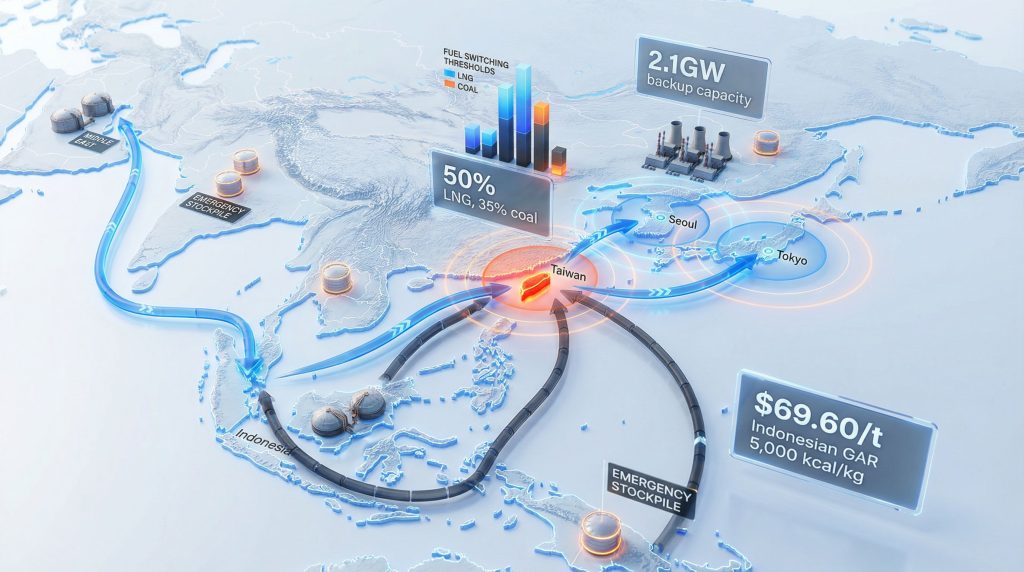
Taiwan builds coal stocks to buffer LNG shortfall as Asia's energy landscape reveals complex vulnerability matrices where import-dependent economies balance cost optimisation against supply security imperatives. Regional utilities increasingly prioritise strategic reserves over short-term economic efficiency, particularly during periods of geopolitical volatility. Energy security frameworks now employ sophisticated buffer mechanisms spanning primary supplier diversification, secondary fuel switching capabilities, and tertiary emergency stockpile protocols.
Supply Chain Vulnerability Assessment in Northeast Asia
Modern energy security calculations require multi-dimensional risk modelling beyond traditional market dynamics. Taiwan's current energy portfolio demonstrates these challenges, with approximately 50 percent LNG dependency creating acute vulnerability windows during supply disruptions. Furthermore, the island's thermal coal imports reached 52 million tonnes in 2025, representing a 9.4 percent decline from 2024 levels, while coal consumption hit a 24-year low during the same period.
This structural shift toward gas-based generation has created operational dependencies that become problematic during crisis scenarios. In addition, Taiwan maintains sufficient secure LNG supplies only through the end of March 2026, according to Ministry of Economic Affairs assessments conducted in early March. However, understanding the broader LNG supply implications helps contextualise how these narrow supply windows demonstrate how optimisation strategies can create systemic vulnerabilities when geopolitical events disrupt preferred fuel sources.
Emergency Protocol Architecture
Strategic reserve mechanisms require maintaining decommissioned generation assets in operational readiness rather than permanent retirement. For instance, Taiwan's Hsinta coal-fired power plant exemplifies this approach, with four units totalling 2.1 gigawatts of capacity available for crisis activation. These facilities were retired between 2023-2025 but remain configured for emergency dispatch when operating reserve margins fall below 8 percent.
The emergency generation framework operates on explicit threshold triggers:
- Primary activation: Operating reserve margins below 8 percent
- Fuel prioritisation: Gas-fired output prioritised before coal restart
- Inventory management: Strategic stockpiling initiated during threat assessment
- Procurement acceleration: Emergency tender processes for alternative supplies
Consequently, Taipower's procurement strategy demonstrates anticipatory planning, with tenders seeking 960,000 tonnes for January-March delivery and 1.52 million tonnes for March-August delivery issued since October 2025. This represents proactive inventory building rather than reactive crisis response.
When big ASX news breaks, our subscribers know first
Fuel Switching Economics During Crisis Scenarios
LNG spot price volatility creates fundamental shifts in generation economics across Asia-Pacific markets. Indian buyers faced March 2026 delivery offers exceeding $25 per million BTU at west coast terminals, while Indonesian thermal coal prices reached $69.60 per tonne for GAR 5,000 kcal/kg specifications by February 27, 2026. These price differentials fundamentally alter utility dispatch decisions regardless of environmental policy commitments, particularly when considering the US natural gas forecast trends.
Regional Fuel Cost Comparison (March 2026)
| Market | LNG Price Range | Coal Alternative | Economic Advantage |
|---|---|---|---|
| Taiwan | $23-25/MMBtu | $69.60/tonne | Coal competitive at high LNG prices |
| India | $25+/MMBtu | $54.31/tonne (lower grade) | Significant coal advantage |
| South Korea | Market-dependent | Regional pricing | Moderate switching economics |
Supply Disruption Magnitude Analysis
The Strait of Hormuz carries approximately 20 percent of global LNG supply, with Qatar's 77 million tonnes per year Ras Laffan facility and UAE's 6 million tonnes per year Das Island terminal representing the primary affected export capacity. This disruption scale creates immediate arbitrage opportunities between Atlantic and Pacific basin pricing.
European LNG delivery prices reached $19.33 per million BTU for April delivery by March 3, 2026, representing more than double the $9.98 per million BTU level recorded on February 27. Northeast Asia May delivery prices increased to $16.87 per million BTU, a 66 percent gain from $10.14 per million BTU over the same period.
Henry Hub prices demonstrated relative stability, rising modestly from $2.86 per million BTU to $3.05 per million BTU over the same timeframe, creating $12.82 per million BTU arbitrage premiums for European LNG delivery over indicative long-term contract pricing.
Indonesian Policy Volatility Impact on Regional Coal Markets
Indonesia's position as the world's largest thermal coal exporter creates systemic supply security concerns when policy frameworks undergo rapid modification. Recent regulatory changes demonstrate how producer-country decisions cascade through regional energy security calculations across multiple importing nations, similar to how oil price movements affect broader market dynamics.
Policy Framework Modifications
Jakarta implemented several structural changes affecting export market stability:
- RKAB quota validity: Reduced from three-year to one-year periods in October 2025
- Output target uncertainty: Initial 2026 projections of 600 million tonnes versus 790 million tonnes produced in 2025
- Export proceeds management: Requirements for onshore bank account withholding
- Domestic pricing adjustments: HBA coal reference price modifications
- Export taxation considerations: Announced but unimplemented tax measures
These policy modifications created supply tightness independent of demand fundamentals, pushing Indonesian GAR 4,200 kcal/kg Supramax specifications to $54.31 per tonne by February 27, 2026, representing the highest level since June 2024.
Coal Quality Specifications and Strategic Dependencies
Taiwan's power generation infrastructure depends specifically on Indonesian coal for its low sulfur and ash content suitable for blending applications. This creates strategic dependency beyond simple volume requirements, as alternative suppliers may not provide equivalent specifications without significant infrastructure modifications.
Australian NAR 5,500 kcal/kg coal prices reached $85.97 per tonne FOB Newcastle, elevated from $70.62 per tonne at the start of 2026, demonstrating price transmission effects across the Asia-Pacific thermal coal complex. The quality differential between Indonesian GAR 5,000 kcal/kg ($69.60 per tonne) and lower-grade GAR 4,200 kcal/kg ($54.31 per tonne) specifications indicates approximately 22 percent pricing premiums for higher-grade materials.
Seasonal Demand Patterns and Strategic Timing
Northeast Asia's spring shoulder season provides critical timing advantages for emergency response protocols and fuel transition management. Reduced baseline electricity demand creates operational flexibility for infrastructure adjustments without immediate supply stress conditions, particularly relevant when examining the crude oil market analysis for comparative market behaviour.
Regional Market Response Variations
Different markets exhibit varying resilience characteristics during supply disruption scenarios:
Japan: Maintains 2.19 million tonnes of LNG inventory as of March 1, 2026, representing approximately 20 days of consumption and 9.5 percent weekly increase from prior reporting periods.
South Korea: Coal-fired output averaged 20.7 gigawatts on March 3, 2026, representing a 4.8 gigawatt increase from year-earlier levels, demonstrating anticipatory generation portfolio adjustments.
India: Implemented severe industrial supply rationing, with Gujarat Gas reducing customer volumes by 50 percent for March 2026 and Gujarat State Petroleum Corporation cutting industrial supply by 70 percent.
Infrastructure Utilisation Optimisation
Taiwan's thermal power output typically weakens during spring periods before rising during summer demand seasons, creating natural windows for emergency preparation and fuel switching evaluations. This seasonal demand profile enables strategic inventory building and infrastructure maintenance without compromising grid reliability.
The shoulder season advantage extends beyond demand reduction to include maintenance scheduling, alternative supply sourcing, and emergency protocol testing without operational stress conditions.
Investment Implications for Energy Security Infrastructure
Regional energy security strategies create structural investment opportunities across multiple infrastructure categories. The premium placed on supply diversification over cost optimisation reshapes capital allocation priorities throughout the Asia-Pacific energy sector, reflecting broader energy export challenges across the region.
Strategic Reserve Asset Classes
Energy security planning requires investment in specialised infrastructure configurations:
- Dual-fuel generation capacity: Plants capable of rapid coal-gas switching
- Strategic storage expansion: LNG tanks and coal stockpile facilities
- Supply chain diversification: Alternative sourcing and transportation infrastructure
- Emergency response systems: Rapid deployment and restart capabilities
- Warm reserve maintenance: Decommissioned but operational-ready assets
Arbitrage Opportunities During Disruption Periods
Supply constraints create temporary but significant arbitrage opportunities between regional markets. US LNG terminals operated at 94 percent utilisation rates by early March 2026, equivalent to 130.8 million tonnes per year production pace, with minimal marginal capacity available for additional demand response.
The only near-term capacity additions include Cheniere's 11.45 million tonnes per year Corpus Christi Stage 3 expansion and QatarEnergy-ExxonMobil's 18.1 million tonnes per year Golden Pass LNG first train, both undergoing commissioning procedures.
The next major ASX story will hit our subscribers first
Long-Term Strategic Scenario Planning
Asia's energy security framework continues evolving toward supply diversification priorities over pure cost optimisation, potentially reshaping global energy trade flows through the remainder of the 2020s. Multiple scenario pathways demonstrate varying implications for regional energy planning, with Taiwan's energy security concerns highlighting the complexity of these strategic decisions.
Extended Middle East Disruption Scenario
Prolonged disruption affecting 20 percent of global LNG supply would likely accelerate several structural adjustments:
- US LNG export capacity utilisation maximisation
- Enhanced coal competitiveness across Asia-Pacific generation portfolios
- Accelerated investment in alternative supply route infrastructure
- Strengthened strategic storage requirements across importing nations
- Modified environmental transition timeline considerations
Indonesian Export Policy Tightening Scenario
Further restrictions on thermal coal exports could fundamentally alter regional supply patterns:
- Increased Australian coal market share across Asia-Pacific
- Enhanced South African and Colombian import volumes to Asian markets
- Strengthened renewable energy investment justification
- Expanded opportunities for coal trading intermediation services
- Modified long-term fuel mix planning across utilities
Regional Market Integration Evolution
The current crisis demonstrates how individual market vulnerabilities create system-wide consequences across the Asia-Pacific energy complex. Taiwan builds coal stocks to buffer LNG shortfall scenarios illustrate broader regional trends toward defensive energy planning, where security considerations increasingly outweigh short-term economic optimisation.
Furthermore, the strategic shift toward Taiwan builds coal stocks to buffer LNG shortfall frameworks reflects broader Asia-Pacific energy security recalibrations that may define regional energy planning for years to come. Consequently, these developments demonstrate the increasing importance of strategic flexibility in energy planning.
Investment Disclaimer: Energy market analysis involves significant uncertainty regarding geopolitical developments, policy changes, and commodity price volatility. This analysis is for informational purposes and should not be considered investment advice. Readers should consult qualified financial advisors and conduct independent research before making investment decisions related to energy sector assets or commodities.
Interested in Energy Infrastructure Investment Opportunities?
Discovery Alert's proprietary Discovery IQ model identifies immediate opportunities across ASX-listed resource companies, including those positioned to benefit from Asia-Pacific energy security trends and infrastructure developments. Stay ahead of significant mineral discoveries and energy sector developments by starting your 14-day free trial today to gain actionable insights before the broader market responds.