August 6, 2026
Africa's New Investment Architecture: Why the Race for Capital Is Rewriting the Rules
The idea that African governments must choose between East and West when seeking development capital is rapidly becoming obsolete. Across the continent, a new generation of economic planners is operating from a fundamentally different premise: that geopolitical competition between major powers creates structural leverage for fast-growing economies willing to engage all comers on their own terms. Tanzania's decision to pursue Tanzania Russia $2 billion investment deals through the St. Petersburg International Economic Forum in June 2026 is the most visible recent expression of this logic, but it is far from an isolated case.
Understanding what this partnership framework actually represents, what it could deliver, and where its risks lie requires moving beyond the headlines and examining the economic architecture being constructed beneath them. Furthermore, the shifting geopolitical mining landscape adds another layer of complexity that investors cannot afford to ignore.
When big ASX news breaks, our subscribers know first
Tanzania's Economic Position: Why the Numbers Create Leverage
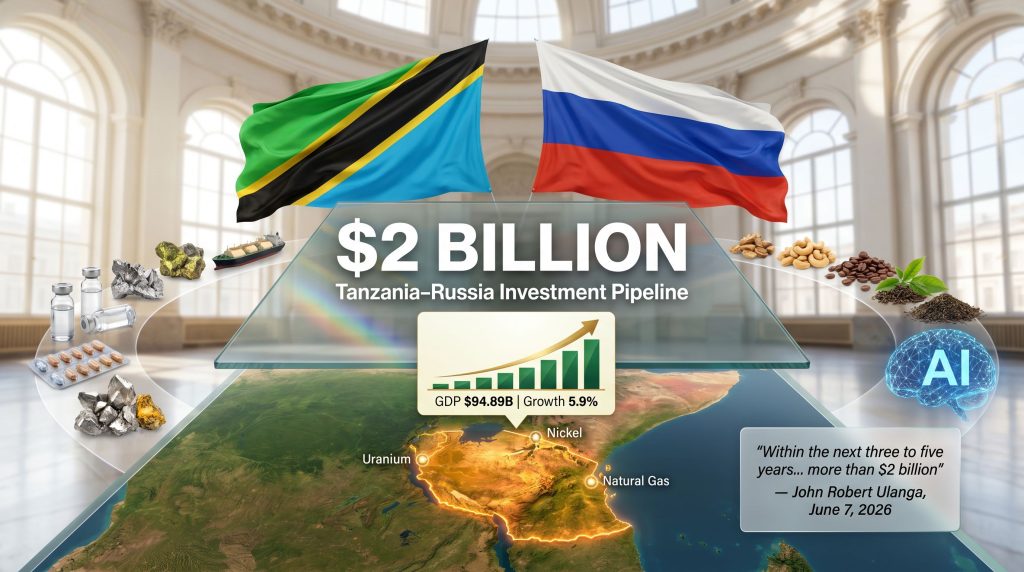
Tanzania is East Africa's second-largest economy by nominal GDP, and its macroeconomic trajectory gives it genuine bargaining power that conventional narratives often understate. The IMF projects Tanzania's nominal GDP at $94.89 billion in 2026, compared to Kenya's $147.26 billion. While the size gap is real, the growth differential is telling: Tanzania is forecast to expand at a real GDP rate of 5.9% in 2026, outpacing Kenya's projected 4.5%.
This combination of scale, momentum, and untapped resource endowment positions Tanzania as a destination that competing global powers have strong incentives to court. When an economy is growing at this pace, the question for policymakers is not whether external capital will come, but on what terms it arrives and from whom.
The projected Russian investment pipeline, valued at approximately Sh5.2 trillion in local currency terms, spans a three-to-five-year horizon across five strategic sectors. Tanzania's Director of Economic Diplomacy at the Ministry of Foreign Affairs and East African Cooperation, John Robert Ulanga, confirmed the figure during a June 7, 2026 briefing following President Samia Suluhu Hassan's state visit to Russia, the first such visit by a Tanzanian head of state in 57 years.
Investor note: The $2 billion figure represents projected deal flow and business activity over a multi-year period, not committed or contracted capital. Investors and analysts should apply standard pipeline discounting when assessing likely economic impact timelines.
The Diplomatic Rupture That Accelerated the Pivot
To understand Tanzania's deepening engagement with Moscow, it is necessary to examine what happened to its relationships with traditional Western partners in the period following the October 29, 2025 general election. President Hassan was declared the winner by a substantial margin, but opposition groups and international observers raised serious concerns about the conduct of the process.
The post-election environment deteriorated significantly, with documented reports of a security crackdown, casualties, an internet shutdown, and restrictions on political assembly. The African Union's election observation mission concluded that the vote did not comply with AU principles and international democratic standards.
Western responses were pointed and consequential:
- The US Department of State communicated that the Tanzanian government's conduct had raised serious concerns about the reliability of the bilateral relationship and Tanzania's status as a partner.
- The European Union formally expressed concern over the violence, internet disruption, and reported election irregularities.
- The foreign ministers of the United Kingdom, Canada, and Norway issued a joint statement citing deaths and injuries linked to the security response to protests.
This pattern is not without historical precedent. Western aid conditionality and diplomatic censure have previously accelerated governments in Zimbabwe, Ethiopia, and Mali toward alternative partnership frameworks. Tanzania's trajectory is consistent with a well-documented response dynamic, though the speed and scale of the Russian engagement is notable.
Comparing Western and Russian Diplomatic Postures Toward Tanzania
| Dimension | Western Partners (US, EU, UK, Canada, Norway) | Russia |
|---|---|---|
| Post-election stance | Formally critical; raised governance concerns | Non-interventionist; no public criticism |
| Investment conditionality | Typically linked to governance benchmarks | Generally unconditional |
| Primary engagement forum | Bilateral diplomatic channels | St. Petersburg International Economic Forum |
| Investment vehicle | Development finance and ODA | State-backed commercial arrangements |
| Strategic interest | Democracy promotion, rule of law | Resource access, geopolitical influence |
The St. Petersburg Forum as a Geopolitical Deal Room
President Hassan's attendance at the St. Petersburg International Economic Forum (SPIEF) in June 2026 was symbolically and practically significant. SPIEF functions as Russia's primary instrument for projecting economic influence globally, and Tanzania's participation at the highest level, alongside Russian President Vladimir Putin, Uzbek President Shavkat Mirziyoyev, and Chinese Vice President Han Zheng, marked a clear signal of intent.
The forum provided the institutional setting within which Russian companies across multiple sectors engaged Tanzanian counterparts. Tanzania's Minister of State for Planning and Investment, Kitila Mkumbo, framed the visit explicitly within the country's long-term development framework, noting that Vision 2050 requires actively pursuing investment across the full spectrum of potential international partners.
Foreign Affairs Minister Mahmoud Thabit Kombo described the visit as positioning Tanzania within Russia's broader strategy of deepening trade and investment ties across the African continent. Critically, both ministers emphasised that Moscow's expanded role does not represent an abandonment of existing Western partnerships. The government's stated posture is one of strategic diversification rather than geopolitical realignment.
Sector-by-Sector: What the $2 Billion Pipeline Actually Covers
The Tanzania Russia $2 billion investment deals framework spans five distinct sectors, each with its own timeline, strategic rationale, and risk profile.
Healthcare and Vaccine Manufacturing
Russian companies indicated interest in partnering on pharmaceutical manufacturing infrastructure, with a projected capacity of up to 20 million vaccine doses annually within five years, serving both Tanzania's domestic market and neighbouring countries. This is strategically significant in a broader African context: the continent currently imports the overwhelming majority of its vaccines, and building local production capacity has been a stated continental priority under frameworks including the Africa CDC's Partnerships for African Vaccine Manufacturing initiative. A regional vaccine supply hub in Tanzania would reduce import dependency while creating long-term export revenue.
Critical Minerals: Uranium, Nickel, and Strategic Competition
Russian interest in Tanzania's uranium and nickel deposits reflects the intensifying global competition for African strategic minerals. The broader critical minerals demand surge is reshaping investment priorities across the continent, and Tanzania's endowments place it squarely at the centre of this competition. Uranium underpins nuclear energy systems and is experiencing renewed demand as countries revisit civil nuclear power programs, making the uranium market dynamics particularly relevant to this discussion.
In addition, the nickel market importance is increasingly recognised as a critical input for electric vehicle battery chemistry and stainless steel manufacturing, placing it at the intersection of the clean energy transition and industrial production.
Tanzania holds significant untapped mineral endowments across multiple categories. What is less commonly understood is that uranium mineralisation in East Africa frequently occurs in geological formations associated with other value-added minerals, meaning that exploration programmes targeting uranium can unlock multi-commodity resource potential. The strategic calculus for Russia is clear: securing resource relationships in Africa simultaneously advances commercial and geopolitical objectives.
Oil and Gas: Gazprom and the LNG Question
Gazprom is among the Russian energy companies reported to have expressed interest in Tanzania's oil and gas sector. Tanzania holds substantial offshore natural gas reserves in the Indian Ocean, but development has been constrained by the capital intensity of LNG infrastructure and the complexity of structuring offtake agreements. Russian involvement could accelerate development timelines, though it would also embed Tanzania more deeply within Moscow's global energy network, a consideration with long-term strategic implications.
Agriculture and Value-Added Processing
Agro-processing discussions focused on modernising farming technology and, crucially, moving Tanzania's key export commodities further up the value chain. Tanzania is a significant producer of cashews, coffee, and tea, all of which are currently exported primarily in raw or minimally processed form. Value addition at the source captures a substantially larger share of the commodity's final market price, a structural shift that could materially improve export earnings over time.
Technology, AI, and Digital Partnerships
Cooperation in artificial intelligence, machine learning, and data science was flagged during discussions, including potential institutional partnerships with bodies such as the Dar es Salaam Institute of Technology. Russian companies also expressed interest in collaborating with Tanzanian technology startups. A critical distinction worth noting: technology transfer agreements and capital investment operate on fundamentally different terms. Tanzania will need robust intellectual property and knowledge transfer provisions to ensure genuine capability development rather than creating a new form of technological dependency.
Sector Investment Summary
| Sector | Russian Interest | Tanzania's Core Need | Likely Impact Horizon |
|---|---|---|---|
| Healthcare / Pharma | Vaccine manufacturing | Reduce import reliance, build regional supply | 3 to 5 years |
| Critical Minerals | Uranium, nickel extraction | Monetise untapped deposits | 5 to 10 years |
| Oil and Gas | Exploration, LNG infrastructure | Capital and technical capacity | 5 to 15 years |
| Agriculture | Agro-processing, modern inputs | Value-add to cashews, coffee, tea | 2 to 5 years |
| Technology | AI, machine learning, startups | Digital economy growth, skills transfer | 2 to 7 years |
Russia's Africa Strategy: What Moscow Actually Gains
Russia's engagement with Tanzania does not exist in isolation. Since the 2019 Russia-Africa Summit and the follow-up gathering in St. Petersburg in 2023, Moscow has been systematically expanding economic, security, and diplomatic relationships across the continent using a set of well-defined instruments: state-backed energy companies, grain diplomacy, arms transfers, and private military arrangements.
East Africa has historically been a region where Russia's economic footprint was limited relative to its presence in North and West Africa. Tanzania represents a strategically valuable entry point into a sub-region with growing middle classes, substantial mineral endowments, and increasing infrastructure investment flows from multiple directions. The African mining finance trends further illustrate how capital is being redirected across the continent as new partnerships emerge.
Russia's non-conditionality approach, the absence of governance requirements attached to investment proposals, is a deliberate strategic differentiator that appeals to governments experiencing friction with Western development finance models. However, this does not make Russian capital risk-free from Tanzania's perspective: state-backed investment relationships carry their own structural dependencies, and the experience of other African nations with opaque debt arrangements and resource-backed financing warrants careful attention to deal terms as the pipeline matures.
The next major ASX story will hit our subscribers first
Three Scenarios for Tanzania's Partnership Mix
The Tanzania Russia $2 billion investment deals framework will evolve across a range of possible trajectories. Three scenarios warrant serious consideration.
Scenario 1: Calibrated Diversification (Most Probable)
Tanzania successfully deepens Russian economic engagement while maintaining functional Western relationships. Governance tensions with the West gradually stabilise, and investment flows from multiple directions simultaneously. Tanzania achieves genuine multi-partner capital access without becoming structurally dependent on any single source.
Scenario 2: Accelerated Eastern Pivot
Western diplomatic pressure intensifies or escalates to formal sanctions, prompting Tanzania to deepen Russian and Chinese ties more aggressively. Western development finance is partially displaced by state-backed Eastern capital, creating a different dependency structure with potentially higher long-term governance and debt-management risks.
Scenario 3: Western Re-engagement
Domestic political reforms or credible electoral process improvements lead to a normalisation of Western relationships. Russian investment proceeds in parallel, and Tanzania achieves the most favourable multi-partner architecture, combining non-conditional Eastern capital with Western governance-linked development finance and technology partnerships.
Analytical perspective: The most frequently overlooked variable in these scenarios is Tanzania's own institutional capacity to manage multiple large-scale investment relationships simultaneously. Deal negotiation skill and contract management capability will be as important as diplomatic positioning in determining actual outcomes.
What Investors and Analysts Should Watch
For those tracking East African investment dynamics, several indicators will signal which scenario is materialising:
- Whether letters of intent and memoranda of understanding signed at SPIEF convert into binding investment contracts within the projected three-to-five-year window.
- Tanzania's governance trajectory and the evolution of its relationships with the US and EU as leading indicators of Western re-engagement probability.
- The specific deal structures emerging in the minerals sector, particularly whether uranium and nickel arrangements follow standard commercial terms or incorporate the kind of resource-backed financing that has created debt and sovereignty concerns elsewhere on the continent.
- Progress on the vaccine manufacturing partnership, which has a clearer near-term timeline and more measurable deliverables than the longer-horizon energy and minerals investments.
- Tanzania's participation in future Russia-Africa forums and whether the country maintains visible engagement with Western multilateral institutions in parallel.
Tanzania's 5.9% real GDP growth rate, strong underlying macroeconomic fundamentals, and significant untapped resource base give it more negotiating leverage than the current diplomatic narrative suggests. As reported by Eurasia Review, the Russia-Tanzania bilateral relationship is being deliberately structured to extend well beyond a single summit, reinforcing the view that this is a strategic partnership rather than an opportunistic arrangement. The Tanzania Russia $2 billion investment deals framework is best understood not as a defection from one camp to another, but as a calculated attempt by a fast-growing economy to maximise its access to capital, technology, and industrial expertise from the full spectrum of available global partners.
Whether that strategy delivers its projected returns will depend on deal execution, institutional capacity, and the choices made by all parties as the geopolitical competition for Africa's resources and markets continues to intensify.
This article contains forward-looking projections and scenario analysis based on publicly available information as of June 2026. Investment figures cited represent pipeline estimates and projected deal flows, not confirmed or contracted capital. Readers should conduct independent assessment before drawing conclusions about economic or investment outcomes.
Want to Stay Ahead of the Next Major African Mineral Discovery?
As geopolitical competition reshapes Africa's resource landscape and strategic minerals like uranium and nickel attract growing international interest, Discovery Alert's proprietary Discovery IQ model delivers real-time alerts on significant ASX mineral discoveries — instantly translating complex geological data into actionable investment insights. Explore historic discoveries and the substantial returns they have generated, then begin your 14-day free trial at Discovery Alert to position yourself ahead of the market.