June 18, 2026
Australia's energy landscape faces unprecedented challenges as global supply chains strain under geopolitical tensions and domestic fuel reserves dwindle to critically low levels. The Taroom Trough Australia energy crisis has emerged as a focal point for potential solutions, representing both opportunity and challenge in addressing the nation's vulnerability. This dependency on imported petroleum products has reached alarming proportions, with strategic reserves falling well below international security standards. This vulnerability exposes Australia to price volatility, supply disruptions, and potential national security risks that could cripple essential services and economic activity.
While renewable energy transitions dominate policy discussions, the immediate reality remains that Australia requires reliable liquid fuel supplies for transportation, aviation, and industrial processes that cannot yet be electrified. The search for domestic solutions has intensified as international markets become increasingly unpredictable and costly, particularly as an oil price rally continues to impact global energy markets.
Geographic Foundation and Strategic Location
The Taroom Trough represents a geological formation within Queensland's broader Bowen Basin framework, positioned approximately 200 kilometers northwest of Brisbane. This location places potential development within reasonable proximity to existing infrastructure networks, including road systems, power transmission lines, and established industrial corridors that could support extraction operations.
The geological significance extends beyond simple geographic positioning. The Taroom Trough sits within sedimentary rock formations that have historically been associated with hydrocarbon deposits throughout southeastern Queensland. These geological characteristics mirror formations found in other successful Australian oil provinces, though each location presents unique extraction challenges and opportunities.
The strategic value of this positioning becomes apparent when considering Australia's fuel distribution networks. Queensland's existing refinery infrastructure and port facilities could potentially integrate new domestic production sources, reducing transportation costs and supply chain complexity compared to more remote extraction sites.
Historical Context of Domestic Production Decline
Australia's oil production capacity has experienced dramatic deterioration since peak extraction periods in the 1970s and 1980s. The nation once maintained eight operational refineries across multiple states, providing substantial domestic processing capabilities that supported energy independence objectives.
Current domestic refining capacity has contracted to just two major facilities, creating bottlenecks in processing imported crude oil and increasing vulnerability to international supply disruptions. This industrial decline occurred simultaneously with the depletion of major offshore oil fields, particularly those in Bass Strait, which historically provided significant portions of Australia's domestic fuel requirements.
The economic implications of this production decline extend beyond simple import costs. Furthermore, oil price movements in international markets demonstrate how Australia now depends on complex international supply chains for essential fuel products, creating exposure to shipping delays, regional conflicts, and currency fluctuations that directly impact domestic fuel prices and availability.
When big ASX news breaks, our subscribers know first
Critical Vulnerability Metrics
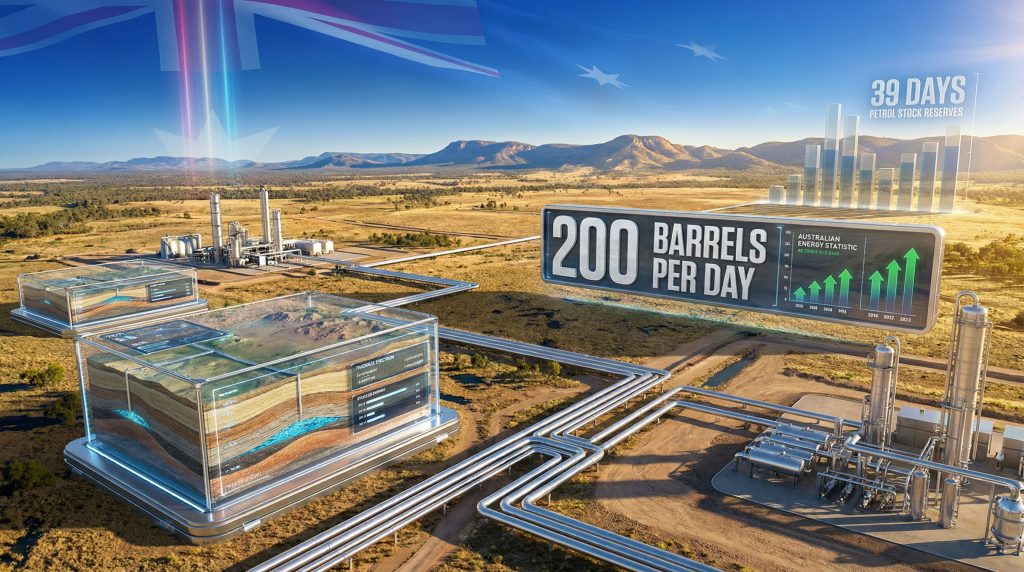
Australia's energy security challenges manifest through multiple concerning indicators that highlight the urgency of domestic production initiatives. Strategic petroleum reserves currently maintain approximately 39 days of supply, falling significantly below the International Energy Agency's recommended 90-day minimum standard.
| Vulnerability Indicator | Current Status | Recommended Level |
|---|---|---|
| Strategic fuel reserves | 39 days supply | 90+ days (IEA standard) |
| Domestic refining capacity | 2 active facilities | Historical: 8+ facilities |
| Import dependency ratio | 85%+ reliance | Target: <50% dependency |
| Regional supply disruption risk | High exposure | Moderate exposure |
The concentration of remaining refining capacity creates additional systemic risks. Equipment failures, maintenance shutdowns, or supply disruptions affecting either facility could severely impact national fuel availability within weeks rather than months.
Economic Impact of Supply Chain Vulnerabilities
Price volatility in international oil markets translates directly into Australian fuel costs, with limited domestic buffer capacity to absorb sudden price spikes. Regional fuel station closures have become increasingly common in remote areas where supply chain costs make operations economically challenging.
Transport-dependent industries face particular vulnerability during supply disruptions. Agricultural operations, mining companies, and freight networks require reliable fuel access to maintain productivity, yet current supply arrangements provide minimal redundancy during crisis periods. In addition, the oil futures outlook suggests continued uncertainty ahead.
The economic multiplier effects extend throughout regional economies where fuel availability supports essential services, emergency response capabilities, and basic commercial activities. Communities located far from major distribution hubs face disproportionate impacts during supply constraints.
National Security Considerations
Military fuel requirements demand reliable domestic sources for operational security and strategic autonomy. Defense capabilities depend on secure fuel supplies that cannot be easily disrupted by international conflicts or trade disputes affecting civilian supply chains.
Emergency response services, including firefighting, medical evacuation, and disaster relief operations, require guaranteed fuel access during crisis periods when commercial supply chains may be compromised. Current strategic reserves provide limited buffer capacity for extended emergency operations.
International comparisons reveal Australia's vulnerability relative to other developed nations with similar geographic challenges. Countries like Canada and Norway maintain substantially higher domestic production ratios and strategic reserve capacities despite comparable geographic dispersal and infrastructure challenges.
Technical Production Specifications
Based on available information from Queensland Government-backed exploration activities, the Taroom Trough development could potentially achieve initial production levels around 200 barrels per day. While modest by international standards, this baseline production represents significant progress toward domestic fuel security objectives.
The quality specifications of extracted crude oil will determine processing requirements and integration opportunities with existing refinery infrastructure. Light crude varieties require less complex processing than heavy crude alternatives, potentially reducing development costs and timeline requirements.
Processing through existing refinery networks offers advantages in infrastructure utilisation and distribution integration, though capacity constraints may limit expansion possibilities without substantial facility upgrades.
Reserve Assessment and Viability Projections
Geological assessments suggest the Taroom Trough formation contains characteristics consistent with commercial hydrocarbon deposits, though comprehensive resource evaluation continues through ongoing exploration activities.
Long-term viability depends on multiple factors including extraction costs, reserve size confirmation, and oil quality characteristics that influence processing requirements. Successful development requires sustained production levels that justify infrastructure investment and operational expenses over extended periods.
Reserve estimation methodologies continue evolving as exploration activities provide additional geological data. Initial assessments provide foundation information, but commercial viability requires confirmation through extended testing and production trials.
Infrastructure Development Requirements
Road network upgrades may be necessary to support heavy equipment transportation and ongoing operational logistics. Current regional infrastructure was designed for agricultural and general commercial use rather than intensive industrial operations.
Pipeline connectivity to existing distribution systems could reduce transportation costs and improve supply chain efficiency. However, pipeline construction requires substantial capital investment and regulatory approval processes that may extend development timelines.
Environmental monitoring frameworks must address potential impacts on groundwater, soil quality, and local ecosystems. Compliance requirements include ongoing assessment protocols and remediation capabilities throughout operational phases.
Policy Framework and Development Support
Queensland Government backing for Taroom Trough exploration reflects state-level recognition of energy security priorities and economic development opportunities. According to reporting by the Australian Mining Review, several explorers supported by the Queensland Government are leveraging current global fuel security concerns to advance development proposals.
State government advocacy includes support for streamlined approval processes and infrastructure development coordination. This political alignment creates favourable conditions for project advancement, though federal assessment processes maintain independent evaluation criteria.
The current global fuel security crisis provides additional political context supporting domestic energy development initiatives. International supply disruptions and price volatility strengthen arguments for reduced import dependency and strategic production capacity.
Federal Assessment Process Framework
National interest evaluation criteria consider multiple factors including economic impact, strategic value, and environmental considerations. Fast-track pathways exist for projects meeting specific criteria related to national security, economic significance, and environmental compliance.
Environmental impact assessment requirements balance development objectives with ecological protection standards. Assessment processes evaluate potential impacts on water resources, wildlife habitats, and atmospheric emissions throughout project lifecycles.
Climate policy integration requires consideration of emission reduction objectives alongside energy security priorities. Development proposals must demonstrate alignment with broader environmental targets while addressing immediate fuel supply challenges.
International Development Model Comparisons
Canadian oil sands development provides relevant precedents for domestic resource extraction under challenging economic and environmental conditions. Canadian policies balanced energy security objectives with environmental stewardship through comprehensive regulatory frameworks.
Norwegian offshore development strategies demonstrate successful government-industry collaboration models that maximise domestic benefits while attracting international investment and expertise. Norway's approach emphasises long-term resource management and revenue optimisation.
United States strategic petroleum reserve policies illustrate government intervention strategies for maintaining fuel security during supply disruptions. US models provide insights into reserve management and emergency response protocols applicable to Australian conditions.
Economic Development Implications
Capital investment requirements for comprehensive Taroom Trough development could range from hundreds of millions to several billion dollars across exploration, production, and infrastructure phases. Initial exploration investments represent relatively modest commitments compared to full-scale development costs.
| Development Phase | Estimated Investment Range | Projected Timeline |
|---|---|---|
| Exploration and assessment | $50-100 million | 2026-2027 |
| Production infrastructure | $500 million – $1.5 billion | 2027-2029 |
| Refinery capacity expansion | $5-15 billion | 2028-2032 |
Financial modelling depends on multiple variables including reserve size confirmation, extraction costs, oil quality characteristics, and market pricing assumptions. Economic viability requires sustained production levels that generate sufficient revenue to justify infrastructure investments and operational expenses.
Employment and Regional Economic Benefits
Direct employment opportunities in extraction operations could support hundreds of specialised positions including geological technicians, drilling operators, environmental monitors, and maintenance personnel. These positions typically offer wages above regional averages and require specialised skills that support career development.
Indirect job creation extends throughout supporting industries including:
- Equipment manufacturing and maintenance services
- Transportation and logistics operations
- Environmental consulting and monitoring services
- Construction and infrastructure development
- Regional accommodation and service providers
Regional economic multiplier effects benefit Queensland communities through increased spending, tax revenue, and business development opportunities. Local suppliers, contractors, and service providers gain access to new revenue streams that support economic diversification beyond traditional agricultural activities.
Revenue and Fiscal Implications
Royalty income potential for Queensland government depends on production levels, oil pricing, and applicable tax structures. Sustained production could generate ongoing revenue streams supporting state infrastructure investments and public services.
Federal tax revenue implications include corporate income tax, petroleum resource rent tax, and goods and services tax collections from operational activities. These revenue streams contribute to broader fiscal objectives while supporting domestic economic activity.
Export potential could improve Australia's balance of payments position by reducing import requirements and potentially generating foreign currency earnings. However, domestic market supply priorities may limit export opportunities during initial production phases.
Development Risk Assessment
Technical and geological risk factors present ongoing challenges throughout development phases. Reserve uncertainty requires confirmation through extended testing and production trials before commercial viability can be definitively established.
Extraction complexity may exceed initial projections as operational experience reveals site-specific challenges. Unconventional extraction techniques often require adaptation periods and additional investment to optimise production efficiency.
Quality variations in extracted crude oil could affect processing requirements and refinery compatibility. Unexpected quality characteristics may necessitate facility modifications or alternative processing arrangements that increase operational costs.
Environmental and Regulatory Challenges
Climate policy alignment presents ongoing challenges as environmental objectives may conflict with fossil fuel development priorities. Project proponents must demonstrate compatibility with emission reduction targets and environmental protection standards.
Environmental impact assessment duration can extend project timelines significantly, particularly when comprehensive studies reveal unexpected ecological sensitivities or require additional mitigation measures.
Community consultation processes require extensive stakeholder engagement and may identify concerns that necessitate project modifications or additional compensation arrangements. Local opposition can create regulatory complications and operational challenges.
Economic Viability Uncertainties
Industry analysis has raised questions regarding long-term economic sustainability, particularly considering high development costs relative to current reserve estimates and volatile global oil pricing conditions.
Global oil price volatility creates financial planning challenges for long-term development projects. Consequently, price fluctuations can significantly impact project economics and return on investment calculations throughout extended development periods, especially when considering patterns of stagnant oil prices that have affected market stability.
High development costs relative to proven reserves create financial risk exposure that may discourage investor participation. Economic returns depend on sustained production levels and favourable pricing conditions that cannot be guaranteed throughout project lifecycles.
The next major ASX story will hit our subscribers first
International Energy Independence Models
Norway's North Sea development strategy provides valuable insights into successful domestic resource utilisation under challenging conditions. Norwegian policies emphasised government participation, environmental stewardship, and long-term revenue management through sovereign wealth fund mechanisms.
Canada's oil sands development demonstrates large-scale domestic production capabilities despite high extraction costs and environmental challenges. Canadian approaches balanced economic development with environmental regulation through comprehensive policy frameworks.
Brazil's pre-salt offshore development showcased technological innovation and strategic government intervention to maximise domestic benefits from challenging extraction projects. Brazilian models illustrate successful government-industry collaboration in complex development environments.
Technology Integration and Innovation Opportunities
Enhanced oil recovery techniques could improve extraction efficiency and extend productive life of developed reserves. Advanced technologies including horizontal drilling, hydraulic fracturing, and chemical injection methods may optimise production from challenging geological formations.
Digital monitoring and automation integration can reduce operational costs while improving safety and environmental compliance. Real-time monitoring systems enable proactive maintenance and optimisation that extend equipment life and maximise production efficiency.
Carbon capture and storage potential offers opportunities to address environmental concerns while maintaining production capabilities. CCS technologies could reduce emission impacts and support climate policy alignment objectives.
Strategic Partnership Models
International oil company collaboration provides access to specialised expertise, advanced technologies, and financial resources that domestic operators may lack. Partnership arrangements can accelerate development timelines while sharing risk exposure.
Government-private sector risk sharing mechanisms can facilitate development projects that might otherwise be economically marginal. Public sector participation can provide stability and long-term commitment that encourages private investment.
Technology licensing and knowledge transfer agreements enable access to proven extraction techniques and operational expertise. International partnerships can provide training, technical support, and best practice implementation that improves project success probability.
Strategic Energy Future Scenarios
Optimistic development scenarios envision full-scale production capacity achievement by 2030, contributing meaningfully to Australia's energy independence objectives. Successful development could support regional economic growth while reducing import dependency and supply chain vulnerability.
Integration with renewable energy transition planning requires coordination between fossil fuel development and clean energy expansion initiatives. Complementary development strategies can provide energy security during transition periods while supporting long-term sustainability objectives.
Export market development for premium crude products could generate foreign currency earnings and support broader economic benefits beyond domestic consumption requirements. However, domestic supply priorities may limit export opportunities during initial production phases.
Moderate Success Projections
Limited production supporting regional fuel security represents a more conservative but potentially realistic outcome. Modest production levels could contribute to strategic reserves and regional supply stability without achieving complete import independence.
Complementary role alongside renewable energy expansion allows fossil fuel production to support transition period requirements while clean energy capacity develops. This balanced approach addresses immediate security needs while supporting long-term environmental objectives.
Strategic reserve contribution rather than comprehensive independence provides valuable supply chain resilience without requiring massive infrastructure investment. Reserve capacity can buffer supply disruptions and price volatility even with continued import dependency.
Contingency Planning and Risk Mitigation
Alternative energy security strategies may be necessary if Taroom Trough Australia energy crisis solutions encounter insurmountable challenges. Diversification of supply sources, strategic partnerships, and alternative domestic production sites could provide backup options.
Emergency response protocols for future supply disruptions require advance planning and resource allocation regardless of domestic production success. Crisis management capabilities must address potential supply chain failures, price spikes, and regional shortage scenarios, including scenarios involving an oil price crash analysis.
International cooperation frameworks can provide mutual assistance during energy crisis periods while supporting collective energy security objectives among allied nations. Collaborative approaches may offer more resilient solutions than purely domestic strategies.
Frequently Asked Questions
How quickly could Taroom Trough production scale up to meaningful levels?
Production scaling depends on successful completion of exploration phases, infrastructure development, and regulatory approval processes. Optimistic timelines suggest initial commercial production by 2027-2028, with substantial capacity development requiring additional years of investment and construction.
What environmental safeguards are being implemented to protect regional ecosystems?
Environmental protection measures include comprehensive impact assessments, ongoing monitoring protocols, and remediation capabilities throughout operational phases. Regulatory frameworks require compliance with water quality, soil protection, and atmospheric emission standards designed to minimise ecological impacts.
How will Taroom Trough development affect Australian fuel prices for consumers?
Domestic production could provide price stability benefits by reducing exposure to international market volatility, though initial production levels may be insufficient to significantly impact national fuel pricing. Regional areas may experience more direct benefits through reduced transportation costs and improved supply reliability.
What role do international investors play in Taroom Trough development?
International partnerships can provide essential expertise, advanced technologies, and financial resources necessary for successful development. Foreign investment participation enables access to global best practices and risk sharing arrangements that improve project viability and success probability.
Long-term Energy Security Integration
Coordination with national energy transition planning requires balancing immediate fuel security needs with long-term environmental objectives. Domestic oil production can provide strategic bridge capacity during renewable energy infrastructure development while maintaining essential liquid fuel supplies.
The role of fossil fuel production during transition periods involves supporting transportation sectors, industrial processes, and emergency services that cannot immediately transition to alternative energy sources. Strategic production capacity provides flexibility and security during extended transition timelines.
Long-term energy portfolio diversification benefits from multiple supply sources and production capabilities that reduce vulnerability to any single point of failure. Domestic production, renewable generation, and international partnerships combine to create resilient energy systems.
Learning Opportunities for Future Development
Early warning systems for supply chain vulnerabilities can identify potential disruptions before they become critical shortages. Monitoring international markets, geopolitical developments, and infrastructure conditions enables proactive response strategies.
Domestic production capacity maintenance strategies preserve essential capabilities even during periods when international supplies remain adequate. Maintaining operational knowledge, infrastructure, and technical expertise ensures rapid response capabilities when circumstances change.
International cooperation frameworks support collective energy security objectives while sharing costs and risks associated with strategic production capacity. Collaborative approaches may prove more sustainable and effective than purely national strategies.
The Taroom Trough Australia energy crisis presents both significant opportunities and substantial challenges for Australia's energy independence aspirations. While the development faces considerable technical, financial, and regulatory hurdles, the potential benefits for national energy security warrant continued exploration and strategic investment consideration.
This analysis is based on available public information and should not be considered investment advice. Energy sector developments involve substantial technical, financial, and regulatory uncertainties that could significantly affect project outcomes and investment returns.
Ready to Position Yourself for the Next Major Discovery?
Discovery Alert's proprietary Discovery IQ model delivers instant notifications on significant ASX mineral discoveries, including energy-related opportunities that could transform market positions. As Australia's energy security challenges intensify and domestic resource development gains political momentum, subscribers gain rapid insights into actionable trading and investment opportunities across all commodities, ensuring informed decisions ahead of broader market recognition. Begin your 14-day free trial today to secure your market-leading advantage.