May 17, 2026
Understanding Technical Complexity in Deep Resource Extraction
Modern mineral extraction from significant underground depths represents one of the most technically demanding engineering challenges in industrial operations. The complexity stems from multiple interconnected factors: geological uncertainty at depth, massive scale requirements for economic viability, and the specialised expertise required to safely manage operations processing tens of thousands of tonnes daily.
The intersection of renewable energy infrastructure development and electric vehicle manufacturing has created unprecedented demand for specific metals, particularly copper. This demand surge occurs precisely when the mining industry faces acute workforce development challenges, creating a critical bottleneck in global supply chain security. Understanding these dynamics requires examining both the technical realities of large-scale underground operations and the innovative educational approaches emerging to address skills gaps.
When big ASX news breaks, our subscribers know first
Underground Mass Mining Operations: Scale and Technical Requirements
Cave Mining Methodologies and Production Volumes
Underground mass mining encompasses several extraction methodologies, with block caving and panel caving representing the most technically sophisticated approaches. These methods involve creating controlled subsidence of ore bodies, allowing gravity-assisted material flow through engineered draw point systems. The technical precision required for successful cave mining operations cannot be overstated.
Operational Scale Comparisons:
| Mining Method | Daily Production Range | Typical Ore Grade | Infrastructure Depth |
|---|---|---|---|
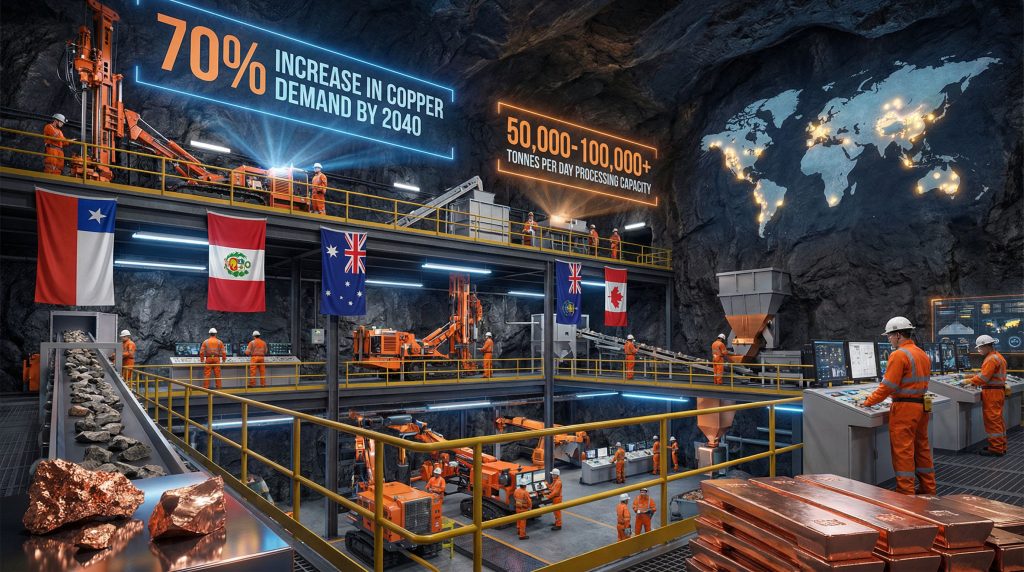
| Block Caving | 50,000-100,000+ tonnes | 0.3-0.8% copper | 500-1,500+ meters |
| Panel Caving | 40,000-80,000 tonnes | 0.4-0.9% copper | 400-1,200 meters |
| Open Stoping | 10,000-30,000 tonnes | 0.6-1.2% copper | 200-800 meters |
The Oyu Tolgoi operation in Mongolia's South Gobi region exemplifies modern cave mining scale, processing approximately 50,000 tonnes per day with ore grades averaging 0.5% copper. Furthermore, these industry evolution trends demonstrate how technological advancement drives productivity improvements. This production volume equals moving between 2,000-4,000 standard shipping containers daily, illustrating the massive logistical coordination required.
Operations exceeding 100,000 tonnes per day represent the upper threshold of current mining technology, requiring sophisticated material handling systems, precise geotechnical monitoring, and coordinated workforce deployment across multiple operational areas. Moreover, modern operations increasingly rely on 3D geological modelling to optimise extraction planning.
Geotechnical Engineering Requirements
Underground mass mining demands comprehensive rock mass characterisation using multiple classification systems:
- Q-system parameters for tunnel stability assessment
- Rock Mass Rating (RMR) evaluations for structural design
- Geological Strength Index (GSI) applications for cave design
- Induced seismic monitoring protocols for operational safety
- Numerical modelling techniques for predictive stability analysis
The technical complexity requires professionals capable of integrating geological data, stress analysis results, and operational parameters to optimise extraction while maintaining safety standards. In addition, effective drill results interpretation becomes crucial for operational success. This interdisciplinary requirement creates specific educational challenges that traditional academic programmes often cannot address effectively.
Addressing Critical Workforce Development Challenges
Declining Academic Enrolment and Industry Perception
Mining education has experienced significant enrolment declines over the past decade, driven by multiple interconnected factors affecting career choice decisions among younger professionals. These challenges extend beyond simple perception issues to fundamental structural problems in how mining expertise is developed and transferred.
Enrolment Challenge Factors:
- Environmental sustainability concerns regarding extractive industries
- Limited remote work opportunities compared to technology sectors
- Geographic isolation requirements for most mining operations
- Industry commodity price volatility affecting career stability
- Physical demands and safety perceptions
- Insufficient practical training in traditional academic programmes
The academic-industry gap manifests most clearly in practical operational knowledge. Many university mining programmes lack hands-on equipment experience, underground exposure, and mentorship from experienced practitioners. Consequently, this creates graduates with theoretical knowledge but limited capability to contribute effectively in operational environments.
Innovative Training Approaches: The South Gobi Underground Mass Mining Institute Model
The south gobi underground mass mining institute (SGUMMI), launched in 2025 through a partnership between Rio Tinto and The University of Queensland, represents a transformative approach to mining workforce development. Operating from the active Oyu Tolgoi copper mine site, SGUMMI delivers practical training directly within operational mining environments.
SGUMMI Training Framework:
- 10 expert-designed modules focused on underground mass mining
- Cave mining methodology emphasis with practical application
- On-site instruction by experienced industry professionals
- Real equipment exposure and operational system familiarity
- Integrated discipline approach covering geotechnical, ventilation, drilling, and blasting expertise
The institute addresses skills gaps by providing hands-on experience that traditional academic programmes cannot replicate. Led by Professor Andre van As, who brings over 30 years of underground geotechnical engineering experience and 22 years with Rio Tinto, the programme ensures curriculum relevance to actual operational challenges. Furthermore, the Rio Tinto launches South Gobi Underground Mass Mining Institute initiative represents a significant investment in workforce development.
Professional Development Impact: Case Studies from SGUMMI Graduates
Suvdaa Erdenebayar: Tactical Integration Scheduler at Oyu Tolgoi
As a tactical integration scheduler, Suvdaa manages daily coordination of multiple underground operations:
- Undercut drilling operations
- Controlled blasting sequences
- Material mucking coordination
- Drawbell construction scheduling
- Construction and development team deployment
Her role requires precise coordination across disciplines, demonstrating the operational complexity of modern cave mining. SGUMMI training enhanced her technical understanding and provided tools for continued independent learning in cave mining science, representing a new field in Mongolia's mining sector.
Rob Tobin: Operations and Maintenance Manager at Resolution Copper
Rob Tobin's background in electrical, operations, and maintenance provided foundational knowledge, but SGUMMI training delivered specialised understanding of block caving and geosciences essential for the Resolution Copper project in the United States. This demonstrates SGUMMI's global applicability beyond the Mongolian operational context.
The Resolution Copper project, owned by Rio Tinto and BHP, represents another major underground copper development requiring specialised workforce capabilities that traditional training approaches struggle to provide. Additionally, these developments often require substantial junior mining investments to support exploration and development activities.
Economic Context and Global Resource Security
Mongolia's Mining Sector and Economic Impact
Oyu Tolgoi contributes approximately 30% of Mongolia's GDP, illustrating the critical importance of mining expertise to national economic development. This economic significance extends beyond immediate production value to encompass:
- Technology transfer capabilities
- Local workforce skill development
- Supply chain integration opportunities
- Infrastructure development catalysis
- Regional economic diversification potential
The mine produces copper essential for electric vehicle manufacturing, renewable energy grid infrastructure, and energy storage systems. This positions Mongolia's mining sector within global decarbonisation supply chains, adding strategic importance beyond traditional commodity economics.
Copper Demand Drivers and Supply Chain Security
Global copper demand growth stems from multiple technological transitions occurring simultaneously. Furthermore, the integration of AI transforming mining operations creates new efficiency opportunities whilst maintaining operational complexity.
Primary Demand Drivers:
- Electric vehicle adoption requiring 2-4 times more copper per vehicle than conventional automobiles
- Renewable energy infrastructure expansion needing extensive copper wiring and components
- Grid modernisation projects requiring upgraded transmission capabilities
- Energy storage system deployment utilising copper-intensive technologies
- Industrial electrification processes replacing fossil fuel-powered equipment
The low-grade nature of copper deposits (typically 0.5% copper content) necessitates processing enormous volumes to achieve economic viability. This scale requirement drives demand for specialised underground mining expertise capable of managing complex, high-volume operations safely and efficiently.
International Development and Knowledge Transfer
Government Partnership Models
The Australian Government's development partnership with Mongolia supports human resource development in the extractives sector, recognising mining expertise as essential for sustainable economic growth. This partnership aligns with broader international development objectives whilst addressing practical skills shortages.
Such government-to-government collaborations facilitate:
- Technical expertise sharing between developed and developing mining regions
- Educational infrastructure development
- Regulatory framework strengthening
- Environmental management capability building
- Local workforce capacity enhancement
Technology Transfer and Capacity Building
The University of Queensland's involvement through its technology transfer company JKTech demonstrates how academic institutions can bridge theoretical knowledge and operational application. This model provides:
- Curriculum development based on operational requirements
- Research capability integration with practical training
- International expertise access for emerging mining regions
- Sustainable knowledge transfer mechanisms
- Quality assurance through established academic standards
However, the south gobi underground mass mining institute continues to evolve its approach, incorporating feedback from industry partners and academic collaborators to refine training methodologies.
Future Workforce Development Strategies
Expanding Access and Global Implementation
SGUMMI's expansion to serve all mining professionals in 2026 represents a scalable model for addressing global skills shortages. This expansion enables:
- Cross-regional knowledge transfer
- Standardised competency development
- Enhanced professional mobility
- Accelerated technology adoption
- Improved operational safety standards
The institute's emphasis on fundamental knowledge applicable across all underground mining methods creates versatile professionals capable of adapting to different operational contexts and geological conditions. In addition, insights from the new mining institute at Oyu Tolgoi demonstrate growing recognition of specialised training needs.
Integration of Advanced Technologies
Modern mining workforce development must incorporate emerging technologies reshaping operational practices:
Technology Integration Areas:
- Autonomous equipment operation and maintenance
- Advanced data analytics for operational optimisation
- Remote monitoring and control systems
- Predictive maintenance using machine learning
- Digital twin modelling for operational planning
- Environmental impact assessment technologies
Addressing Administrative and Structural Barriers
Successful workforce development requires streamlined administrative processes that prioritise educational outcomes over bureaucratic compliance. Universities adopting the SGUMMI model must focus on:
- Reducing unnecessary administrative barriers
- Ensuring industry-relevant curriculum development
- Maintaining financial accessibility for participants
- Emphasising practical competency over theoretical assessment
- Creating sustainable industry-academia partnerships
The next major ASX story will hit our subscribers first
Measuring Training Programme Effectiveness
Competency Assessment and Professional Outcomes
Training Success Metrics:
| Assessment Category | Success Indicators | Industry Benefits |
|---|---|---|
| Technical Proficiency | Equipment certification rates | Reduced training time |
| Operational Safety | Incident reduction metrics | Lower insurance costs |
| Production Efficiency | Optimisation improvements | Enhanced profitability |
| Career Development | Professional advancement | Improved retention |
| Knowledge Transfer | Mentorship effectiveness | Sustainable capability |
Long-Term Industry Impact
Successful training programmes demonstrate measurable benefits including:
- Reduced recruitment costs for mining companies
- Accelerated project development timelines
- Enhanced operational safety performance
- Improved production efficiency metrics
- Strengthened local technical capabilities
The first SGUMMI cohort included 26 mining professionals representing diverse disciplines: geology, geotechnical engineering, mine planning, mining operations, drill and blast, ventilation systems, and open pit operations. This diversity demonstrates the comprehensive nature of modern mining expertise requirements.
Investment in Sustainable Mining Education
Economic Justification for Training Investment
The economic case for specialised mining education extends beyond immediate training costs to encompass broader economic development benefits:
Investment Return Categories:
- Reduced dependence on imported technical expertise
- Enhanced local supply chain capabilities
- Accelerated technology adoption rates
- Improved regulatory compliance standards
- Strengthened environmental management practices
Creating Sustainable Knowledge Transfer Mechanisms
Effective mining education requires sustainable mechanisms for knowledge preservation and transfer. The south gobi underground mass mining institute addresses this through:
- Expert-led instruction from experienced practitioners
- Documentation of best practices and lessons learned
- Mentorship programmes connecting experienced and emerging professionals
- Continuous curriculum updates reflecting technological advances
- Alumni networks facilitating ongoing knowledge sharing
Global Implications and Strategic Considerations
The development of specialised underground mass mining training institutes represents more than workforce development; it constitutes strategic investment in global resource security. As demand for critical minerals continues growing driven by renewable energy and electric vehicle adoption, nations possessing both mineral resources and technical expertise will maintain competitive advantages.
The south gobi underground mass mining institute demonstrates how innovative partnerships between industry, academia, and government can address complex skills shortages whilst supporting broader economic development objectives. By providing practical, hands-on training within operational mining environments, such programmes create competent professionals capable of safely and efficiently managing large-scale underground operations.
The success of this model depends on continued collaboration between stakeholders, ensuring training programmes remain relevant to evolving technological and operational requirements. As the mining industry faces growing pressure to operate sustainably whilst meeting increasing demand for critical minerals, investment in specialised workforce development becomes essential for long-term success.
Disclaimer: This analysis is based on available information about mining workforce development and should not be considered as investment advice. Readers should conduct independent research and consult qualified professionals before making any career or investment decisions related to the mining sector.
Looking to Capitalise on Tomorrow's Major Copper Discoveries?
Discovery Alert's proprietary Discovery IQ model delivers real-time alerts on significant ASX mineral discoveries, instantly empowering subscribers to identify actionable opportunities ahead of the broader market. Understand why historic discoveries can generate substantial returns by exploring Discovery Alert's dedicated discoveries page, showcasing exceptional outcomes, then begin your 14-day free trial today to position yourself ahead of the market.