July 30, 2026
Technical Evolution in Mount Isa Inlier Copper Systems
Modern copper exploration across Queensland's Mount Isa Inlier demonstrates how systematic geological analysis, combined with strategic infrastructure positioning, creates compelling development pathways. True North Copper Cloncurry exploration exemplifies this approach through comprehensive resource development and strategic positioning within established mining infrastructure. Understanding the technical foundations that drive successful copper discovery requires examining both the geological frameworks that control mineralisation and the operational methodologies that convert geological potential into defined resources.
When big ASX news breaks, our subscribers know first
What Makes True North Copper's Cloncurry Project a Strategic Exploration Hub?
JORC Resource Classification Framework at Great Australia
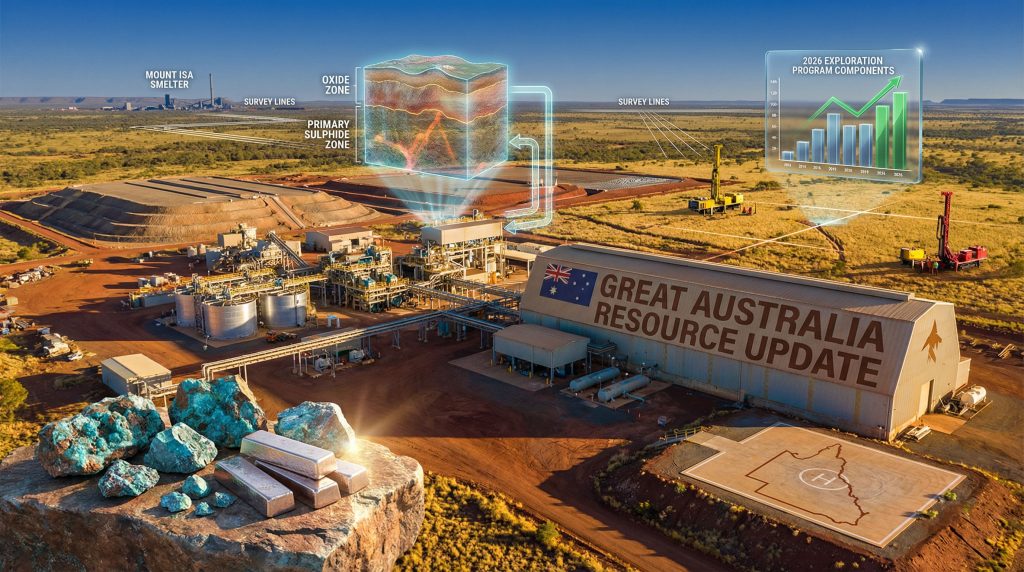
The Great Australia deposit exemplifies how comprehensive resource classification transforms exploration prospects into definable mineral assets. Furthermore, mineral exploration insights demonstrate the critical importance of systematic geological analysis in modern copper discovery programs. The updated JORC-compliant resource framework incorporates both oxide and primary sulphide mineralisation domains, providing critical geological continuity data that supports strategic development planning.
Resource classification systems rely on drill hole spacing, geological continuity assessment, and grade distribution analysis to establish confidence categories. The integration of oxide and sulphide domains at Great Australia demonstrates the complexity of Mount Isa Inlier copper systems. In addition, weathering processes create distinct metallurgical characteristics that require differentiated processing approaches.
Key Resource Domain Characteristics:
• Oxide Domain: Near-surface weathered zones suitable for heap leach processing
• Primary Sulphide Domain: Deeper fresh rock requiring flotation concentration
• Transitional Zones: Mixed oxidation states requiring specialised metallurgical testing
• Structural Controls: Fault and fracture systems influencing mineralisation continuity
Infrastructure Advantage in Northwest Queensland Mining
Strategic positioning within established mining infrastructure networks provides immediate operational advantages for exploration projects. The Cloncurry region benefits from proximity to existing transportation corridors, power transmission lines, and skilled workforce centres that reduce development capital requirements.
Infrastructure assessment considers multiple operational factors including processing facility availability, logistics networks, and regulatory frameworks. Moreover, projects positioned within established mining districts leverage existing environmental baseline studies, community consultation frameworks, and proven supply chains that accelerate development timelines.
"The Mount Isa corridor represents Australia's most established base metals mining region, with over century-long operational history providing comprehensive geological, environmental, and social frameworks for new project development."
Geological Setting Within the Mount Isa Inlier
The Mount Isa Inlier hosts world-class base metal deposits within Proterozoic rock sequences that demonstrate exceptional metal endowment. Structural architecture, alteration systems, and intrusive relationships create exploration targeting criteria that guide modern discovery programmes.
Iron Oxide Copper-Gold (IOCG) deposit models provide exploration frameworks for understanding mineralisation controls within the Mount Isa Inlier. 3D geological modelling enhances interpretation accuracy and supports comprehensive resource assessment. These systems typically feature:
• Structural preparation: Major fault systems providing fluid pathways
• Alteration halos: Extensive potassic, sodic, and iron oxide alteration zones
• Metal associations: Copper-gold-silver-uranium elemental signatures
• Deposit clustering: Regional-scale mineralised corridors hosting multiple deposits
How Does the Great Australia Resource Update Transform Development Planning?
Oxide vs Primary Sulphide Domain Analysis
Understanding metallurgical domain characteristics drives processing route selection and economic modelling for copper projects. Oxide and primary sulphide domains require fundamentally different extraction methodologies, creating distinct development pathways with varying capital requirements and production timelines.
Resource Domain Comparison
| Domain Type | Processing Method | Development Timeline | Capital Requirements | Recovery Rates |
|---|---|---|---|---|
| Oxide | Heap Leach/SX-EW | 18-24 months | Lower ($50-100M) | 70-85% |
| Primary Sulphide | Flotation/Smelting | 36-48 months | Higher ($200-500M) | 85-95% |
| Transitional | Blend Processing | 24-36 months | Moderate ($100-250M) | 75-90% |
Oxide domains typically support near-term cashflow generation through simpler processing technologies. Consequently, primary sulphide zones require conventional flotation and smelting infrastructure. The presence of both domain types at Great Australia provides operational flexibility for sequential development approaches.
Resource Confidence Enhancement Methodology
Resource confidence improvement follows systematic drilling programmes designed to upgrade resource categories from inferred to indicated and measured classifications. Drill spacing optimisation, geological modelling refinement, and metallurgical testwork integration support resource category advancement.
JORC Resource Category Requirements:
• Measured Resources: Drill spacing 25-50m, detailed metallurgy, mine planning confidence
• Indicated Resources: Drill spacing 50-100m, representative metallurgy, preliminary economics
• Inferred Resources: Drill spacing >100m, limited metallurgy, conceptual viability
Strategic Drilling Target Prioritisation
Systematic target ranking methodologies integrate geological, geophysical, and geochemical datasets to prioritise exploration investment. High-value targets combine geological favourability indicators with infrastructure accessibility and development timeline considerations.
Target prioritisation matrices evaluate multiple criteria including geological confidence, exploration accessibility, infrastructure proximity, and potential resource scale. This systematic approach optimises exploration capital allocation across district-scale tenure holdings.
Which Exploration Technologies Drive Target Generation at Cloncurry?
Geophysical Anomaly Interpretation Techniques
Modern exploration programmes integrate multiple geophysical techniques to define drill targets beneath surface cover and within complex geological terranes. Furthermore, AI drilling innovations are revolutionising target identification accuracy and drilling efficiency across the mining industry. Magnetic, gravity, induced polarisation, and electromagnetic surveys provide complementary datasets for geological interpretation.
Geophysical Survey Applications:
• Magnetic Surveys: Structural mapping, intrusive body definition
• Gravity Surveys: Density contrast mapping, basement structure interpretation
• Induced Polarisation: Sulphide mineralisation detection, alteration mapping
• Electromagnetic Surveys: Conductive body identification, groundwater mapping
Integration of geophysical datasets with geological mapping creates three-dimensional subsurface models that guide drill target selection. Advanced processing techniques, including constrained inversion and machine learning algorithms, enhance target definition accuracy.
Structural Controls on Copper-Silver Mineralisation
Structural geology interpretation provides fundamental frameworks for understanding mineralisation controls within Mount Isa Inlier copper systems. Fault networks, fold structures, and intrusive contacts create fluid flow pathways that concentrate metal-bearing solutions.
Kinematic analysis of fault systems reveals stress orientations and deformation timing relationships that influence mineralisation emplacement. For instance, structural preparation events often precede mineralisation, creating permeability networks essential for hydrothermal fluid circulation.
Integration of Historical Data with Modern Methods
Historical exploration datasets provide valuable regional context for modern exploration programmes, particularly within well-explored districts like the Mount Isa Inlier. Data integration techniques combine legacy drill hole databases, geophysical surveys, and geological mapping with contemporary analytical methods.
Modern analytical techniques, including portable X-ray fluorescence spectrometry, hyperspectral imaging, and automated mineralogy, enhance historical datasets with improved precision and expanded element suites. This integration approach maximises return on historical exploration investment.
What Role Does Existing Infrastructure Play in Exploration Economics?
Solvent Extraction Plant Readiness Assessment
Processing infrastructure availability significantly influences project development economics and timeline projections. Existing facilities, even in care and maintenance status, provide substantial capital cost advantages compared to greenfield development.
Solvent extraction-electrowinning (SX-EW) technology suits oxide copper processing, offering relatively simple operational requirements and moderate capital investment. Plant readiness assessment considers mechanical condition, technological currency, and regulatory compliance status.
SX-EW Processing Advantages:
• Lower capital intensity compared to flotation circuits
• Simplified operational requirements and staffing
• Direct cathode copper production for premium markets
• Modular design enabling staged capacity expansion
Transportation and Logistics Advantages
Strategic positioning within established transportation networks reduces operational costs and supports flexible marketing strategies. Road, rail, and port access options influence concentrate transport costs and smelter negotiations.
The Mount Isa region benefits from established road transport corridors connecting to rail networks and deepwater ports. This infrastructure maturity supports both exploration logistics and future production marketing requirements.
Proximity to Mount Isa Smelter Benefits
Geographic proximity to existing smelting capacity provides potential treatment options for concentrate production scenarios. The Mount Isa Smelter represents established copper processing capacity within the regional infrastructure network.
Smelter proximity considerations include transport costs, treatment charges, penalty elements, and contract terms that influence project economics. However, alternative smelting options, including international facilities, provide marketing flexibility for large-scale production scenarios.
How Do Regional Exploration Targets Expand District Potential?
Aquila and Acanthis Trend Integration
Regional exploration programmes identify mineralised trends that extend district-scale potential beyond individual deposit boundaries. The Aquila and Acanthis trends represent geological extensions of the broader Cloncurry mineralising system.
Trend analysis integrates structural geology, alteration mapping, and geochemical signatures to define exploration corridors. These regional frameworks guide systematic exploration programmes designed to test mineralisation continuity along favourable geological horizons.
Wallace North Deep Extension Opportunities
Deep extension drilling tests mineralisation continuity below historically explored depths, potentially expanding resource inventories within existing infrastructure footprints. Modern drilling technology enables cost-effective testing of deeper targets that were previously inaccessible.
Extension drilling programmes require geological modelling to predict mineralisation continuity at depth. Structural controls, alteration intensity, and grade distribution patterns guide target selection for deep exploration programmes.
Systematic Target Ranking Methodology
Quantitative target ranking systems evaluate exploration prospects across multiple criteria to optimise drilling investment allocation. Scoring matrices consider geological favourability, infrastructure access, development potential, and exploration risk factors.
Target Evaluation Criteria:
• Geological Confidence: Structural controls, alteration signatures, geochemical anomalies
• Infrastructure Access: Transportation, power, water, workforce availability
• Development Potential: Resource scale estimates, metallurgical suitability, environmental factors
• Exploration Risk: Drilling depth, geological complexity, permitting requirements
The next major ASX story will hit our subscribers first
What Exploration Methodologies Optimise Resource Conversion?
Drill Spacing Optimisation for Resource Confidence
Resource category advancement requires systematic drilling programmes designed to achieve specific geological confidence levels for different deposit zones. Optimal drill spacing balances resource definition costs against resource category improvement benefits.
Statistical analysis of grade distribution, geological continuity, and structural complexity guides drill spacing decisions for different parts of the deposit. Higher confidence zones typically require closer spacing to achieve measured resource classification.
2026 Exploration Programme Components
| Activity Type | Objective | Expected Outcome | Timeline | Investment Level |
|---|---|---|---|---|
| Infill Drilling | Resource Upgrade | Measured Category | Q2-Q3 | High Priority |
| Extensional Drilling | Resource Growth | Inferred Expansion | Q3-Q4 | Medium Priority |
| Geophysics | Target Generation | New Prospects | Q1-Q2 | Foundation Work |
| Metallurgical Testing | Recovery Optimisation | Processing Parameters | Q1-Q4 | Critical Path |
Metallurgical Testwork Integration
Metallurgical characterisation runs parallel to resource definition drilling to ensure processing parameters align with geological domains. Representative sampling programmes test recovery rates, concentrate grades, and processing conditions across different mineralisation zones.
Testwork programmes evaluate multiple processing routes to optimise recovery efficiency and product quality. Oxide zones typically require acid leaching studies, while sulphide zones need flotation optimisation and concentrate characterisation.
Environmental and Social Baseline Studies
Environmental baseline establishment provides foundation data for impact assessment and permitting processes. These studies typically require 12-24 months of data collection across seasonal cycles to establish comprehensive baseline conditions.
Social baseline studies engage local communities and stakeholders to understand existing land use patterns, cultural values, and economic dependencies. Early engagement supports development planning and regulatory approval processes.
How Does True North's Three-Stage Development Strategy Optimise Value?
Near-term Cashflow Generation Planning
Staged development approaches prioritise early cashflow generation from higher-confidence, lower-cost mineralisation zones. True North Copper Cloncurry exploration demonstrates this methodology through systematic resource development and strategic infrastructure utilisation. Oxide domain development typically provides faster payback periods and lower technical risk compared to primary sulphide processing.
Early production scenarios focus on simple processing technologies and established infrastructure to minimise development risk. This approach generates operating cashflow to fund subsequent development phases while proving operational capability.
Mount Oxide Growth Integration
Regional development strategies leverage existing operations and infrastructure to support expansion projects. Australia copper investment opportunities increasingly focus on strategic infrastructure integration and regional development synergies. Integration with established mining operations provides operational synergies, shared infrastructure costs, and proven development frameworks.
Growth integration considers processing capacity sharing, workforce development, and supply chain optimisation across regional operations. This approach reduces individual project risk while maximising infrastructure utilisation.
Regional Exploration Scaling Approach
Systematic exploration scaling expands from proven deposit areas toward regional target testing as operational cashflow supports expanded exploration investment. This risk-managed approach balances resource definition with exploration upside potential.
Scaling methodologies prioritise high-confidence targets within infrastructure range while maintaining exploration optionality across broader tenure holdings. Success-based expansion supports sustainable growth strategies.
What Technical Studies Support Pre-Feasibility Development?
Metallurgical Recovery Optimisation
Comprehensive metallurgical studies determine optimal processing routes for different mineral domains while establishing recovery rate assumptions for economic modelling. These studies typically progress from bench-scale testing through pilot plant trials.
Recovery optimisation considers multiple processing variables including grinding parameters, reagent selection, concentrate quality targets, and tailings management requirements. Environmental considerations increasingly influence process selection decisions.
Mining Method Selection Criteria
Mining method selection integrates geological characteristics, resource distribution, and economic parameters to determine optimal extraction approaches. Open pit mining typically suits near-surface oxide zones, whilst underground methods may be required for deeper sulphide resources.
Mining Method Evaluation Factors:
• Geological Conditions: Rock strength, structural stability, groundwater conditions
• Economic Parameters: Strip ratios, extraction costs, production rates
• Environmental Considerations: Surface disturbance, waste management, rehabilitation requirements
• Social Factors: Community impact, workforce requirements, infrastructure demands
Environmental Impact Assessment Requirements
Environmental impact assessment provides regulatory foundation for project approval whilst identifying mitigation measures for potential environmental effects. Assessment scope typically includes air quality, water resources, biodiversity, and social impacts.
Modern environmental assessment incorporates climate change considerations, including greenhouse gas emissions, water security, and ecosystem resilience factors. These assessments increasingly influence project design and operational planning.
Why Does the Mount Isa Inlier Geology Favour Copper Discovery?
IOCG Deposit Model Applications
Iron Oxide Copper-Gold deposit models provide exploration frameworks specific to Mount Isa Inlier geological conditions. These models integrate structural preparation, hydrothermal alteration, and metal precipitation processes that create large-scale mineralised systems.
IOCG systems typically feature extensive alteration halos that provide exploration vectors toward mineralised centres. Alteration mapping using hyperspectral techniques and portable analytical instruments enhances target definition accuracy.
Structural Architecture Analysis
Regional structural analysis reveals fundamental controls on mineralisation distribution within the Mount Isa Inlier. Major fault systems, fold structures, and intrusive relationships create exploration frameworks for systematic target testing.
Three-dimensional geological modelling integrates structural interpretation with mineralisation data to predict favourable target areas. These models guide exploration drilling programmes and support resource estimation procedures.
Alteration Zoning Interpretation
Hydrothermal alteration zoning provides systematic exploration criteria for IOCG deposit targeting. Alteration intensity and mineral assemblage mapping create vectors toward mineralised centres and support grade estimation procedures.
Alteration Zone Characteristics:
• Potassic Alteration: K-feldspar and biotite assemblages indicating high-temperature conditions
• Sodic Alteration: Albite and scapolite suggesting deep hydrothermal circulation
• Iron Oxide Zones: Magnetite and hematite concentrations marking fluid circulation pathways
• Sericitic Alteration: Low-temperature overprinting indicating cooling hydrothermal systems
How Do Market Dynamics Influence Exploration Timing?
Copper Demand Growth Projections
Global copper demand growth driven by electrification, renewable energy infrastructure, and urbanisation trends creates favourable market conditions for new copper discovery. Global copper supply analysis indicates significant investment opportunities for strategic copper projects positioned within established infrastructure networks. Energy transition requirements particularly support long-term demand growth projections.
Demand Growth Drivers:
• Electric Vehicle Production: Battery systems and charging infrastructure expansion
• Renewable Energy Systems: Wind turbines, solar installations, grid infrastructure
• Grid Modernisation: Smart grid technology and energy storage integration
• Industrial Electrification: Heat pump adoption, electric heating systems
Energy Transition Metal Requirements
The global energy transition requires substantial copper investment in electrical infrastructure, renewable energy systems, and energy storage technologies. Copper intensity in renewable energy systems significantly exceeds traditional power generation requirements.
Energy transition copper demand creates long-term market support for new discovery programmes. This demand growth occurs alongside traditional construction and industrial applications, supporting sustained market development.
Australian Copper Supply Gap Analysis
Australian copper production faces resource depletion challenges at several major operations, creating opportunities for new discovery and development projects. Brownfield exploration at existing operations provides near-term supply extension, whilst greenfield discovery supports long-term supply security.
Supply gap analysis considers production decline curves at existing operations against demand growth projections to identify investment opportunities. New discovery projects with established infrastructure access provide competitive development advantages.
What Risk Mitigation Strategies Guide Exploration Investment?
Technical Risk Assessment Frameworks
Systematic technical risk assessment evaluates geological uncertainty, metallurgical complexity, and infrastructure requirements to guide exploration investment decisions. Risk assessment frameworks typically consider multiple scenarios for resource estimation and development planning.
Technical Risk Categories:
• Geological Risk: Resource continuity, grade distribution, structural complexity
• Metallurgical Risk: Recovery rates, processing costs, concentrate quality
• Infrastructure Risk: Facility availability, transport access, utility connections
• Regulatory Risk: Permitting timelines, approval requirements, compliance costs
Regulatory Approval Pathways
Understanding regulatory frameworks enables realistic timeline and cost projections for project development. Environmental approvals, mining leases, and operational permits require systematic planning to avoid development delays.
Queensland mining regulation provides established frameworks for copper project development, with clear approval pathways and consultation requirements. Early engagement with regulatory authorities supports timeline optimisation and requirement clarification. True North Copper demonstrates effective stakeholder engagement through their comprehensive development approach and community consultation frameworks.
Market Risk Hedging Considerations
Commodity price volatility creates development risk for long-timeline projects requiring substantial capital investment. Risk management strategies include contract pricing, financial hedging, and operational flexibility to manage price exposure.
Development timing considerations balance commodity price cycles against resource readiness and market positioning. Mining sector analysis indicates that flexible development approaches enable optimisation of market entry timing while managing development costs.
True North Copper Cloncurry exploration exemplifies systematic risk management through staged development planning, comprehensive technical studies, and strategic infrastructure positioning. The project's geological framework, combined with established infrastructure access, provides a robust foundation for sustainable copper development within Australia's premier base metals district.
Disclaimer: This analysis contains forward-looking statements regarding copper exploration and market conditions. Actual results may vary significantly from projections due to geological uncertainty, market volatility, regulatory changes, and other factors beyond corporate control. Exploration success rates in the mining industry are inherently low, and investment in exploration projects carries substantial risk of total loss.
Ready to Discover the Next Major Copper Opportunity?
Discovery Alert's proprietary Discovery IQ model provides real-time alerts on significant ASX mineral discoveries, instantly identifying actionable copper and base metals opportunities across Australia's premier mining regions like the Mount Isa Inlier. Visit Discovery Alert's dedicated discoveries page to explore how major mineral discoveries have generated substantial returns, then begin your 14-day free trial today to position yourself ahead of the market in the rapidly evolving copper exploration sector.