
May 14, 2026
Technical Infrastructure Failures Create Systemic Bottlenecks
Mexico's downstream energy sector faces persistent operational challenges that extend far beyond individual facility performance. The modern refining landscape demands integrated electrical systems, sophisticated process controls, and resilient supply chain coordination to achieve consistent capacity utilisation. When these foundational elements fail to function harmoniously, even the most substantial infrastructure investments struggle to deliver projected returns.
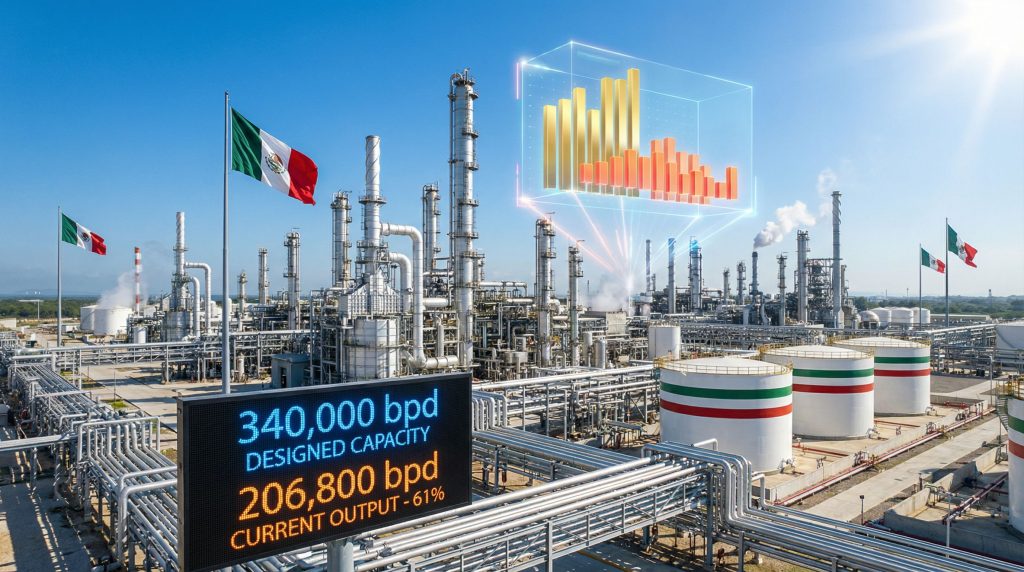
The Dos Bocas refinery capacity issues exemplify how technical bottlenecks can undermine strategic energy transition security. This $18 billion facility continues operating at approximately 60% of its designed capacity, processing roughly 207,000 barrels per day against a target of 340,000 barrels per day. These performance gaps reveal deeper structural vulnerabilities within Mexico's energy infrastructure ecosystem.
When big ASX news breaks, our subscribers know first
Operational Performance Patterns Reveal Systemic Weaknesses
Recent operational data demonstrates the complexity of achieving consistent refinery performance in Mexico's challenging infrastructure environment. During November 2025, the newest and most expensive refinery in the national system processed 206.808 million barrels per day of crude oil while producing only 180.609 million barrels per day of petroleum products.
This represents 60.8% of processing capacity and merely 53.1% of production capacity, significantly below the facility's August 2024 operational targets. The discrepancy between crude processing and product output indicates internal efficiency losses that compound the fundamental capacity constraints.
Furthermore, these operational challenges highlight the broader implications of insufficient infrastructure investment affecting multiple aspects of Mexico's energy security framework.
Power Infrastructure Vulnerabilities
Electrical grid instability creates cascading operational failures throughout the facility's processing units. Unlike international refining operations with redundant power systems, the Tabasco facility experiences complete shutdowns from single-point electrical failures. These vulnerabilities manifest in several critical areas:
Weather-Related Power Disruptions:
- Complete facility shutdowns during seasonal storms
- Monthly outages affecting processing continuity
- Recovery periods extending 3-7 days per incident
- Cumulative annual capacity loss exceeding 15%
Grid Stability Challenges:
- Weekly voltage fluctuations reducing processing rates
- Transformer failures requiring unit-specific shutdowns
- Compressor damage halting gas processing operations
- Inadequate backup power capacity for essential systems
The coastal location in Tabasco exposes the facility to both weather-related disruptions and transmission infrastructure limitations affecting industrial operations throughout the region. In addition, these power issues demonstrate how traditional energy infrastructure struggles to support renewable energy solutions in industrial applications.
Crude Oil Quality and Supply Chain Coordination
Feedstock compatibility issues create additional operational constraints beyond electrical infrastructure problems. The facility's design specifications assume consistent crude oil quality parameters that frequently exceed actual delivery conditions.
Feedstock Processing Challenges:
- Heavy crude contamination requiring extensive pre-processing
- Sulphur content variations exceeding equipment design limits
- Inconsistent delivery schedules disrupting production planning
- Quality control gaps between upstream production and refinery intake
These supply chain coordination problems reflect institutional separation between PEMEX's upstream and downstream operations, limiting integrated planning and optimisation opportunities.
Process Integration Bottlenecks:
- Subcontractor-managed sections operating with limited coordination
- Communication gaps between coking, distillation, and finishing units
- Scheduling conflicts during planned maintenance windows
- Inventory management constraints between processing stages
Comparative Analysis of National Refining System Performance
The broader Mexican refining system provides important context for evaluating individual facility performance. While the Dos Bocas refinery capacity issues persist, other facilities demonstrate varying levels of operational success within the same infrastructure environment.
| Facility | Designed Capacity (bpd) | Current Utilisation | Primary Products | Performance Trajectory |
|---|---|---|---|---|
| Dos Bocas | 340,000 | 61% | Petrol, Diesel, Heavy Fuel | Inconsistent |
| Tula | 315,000 | 68% | Petrol, Jet Fuel | Improving |
| Salina Cruz | 330,000 | 72% | Diesel, Heavy Products | Stable |
| Cadereyta | 275,000 | 65% | Petrol, Petrochemicals | Moderate |
| Minatitlán | 285,000 | 58% | Heavy Fuel, Asphalt | Declining |
| Madero | 190,000 | 70% | Petrol, LPG | Consistent |
National System Recovery Trends
Despite individual facility challenges, Mexico's overall refining performance showed marked improvement during 2025. National petrol production reached 413.503 million barrels per day in November 2025, representing a 75.4% increase compared to November 2024 and the highest November level since 2009.
Diesel production similarly improved to 280.705 million barrels per day, marking the strongest performance since December 2015. This system-wide recovery occurred while the newest facility continued operating below expectations, highlighting operational inconsistencies across the national refining network.
However, these improvements must be viewed alongside the significant oil production impact affecting global energy markets and Mexico's strategic positioning within international supply chains.
Key System Metrics:
- Total national capacity: 1.98 million barrels per day
- Current utilisation: 1.14 million barrels per day (57.6%)
- Import dependency: 700-750,000 barrels per day refined products
- Crude export capacity: 503,000 barrels per day (December 2025)
Strategic Infrastructure Enhancement Opportunities
Addressing the Dos Bocas refinery capacity issues requires systematic improvements across multiple operational domains. Short-term interventions can stabilise performance while longer-term investments build resilient operational capabilities.
Immediate Power Infrastructure Hardening
Electrical System Resilience:
- Industrial-grade uninterruptible power systems for critical operations
- Redundant transformer capacity preventing single-point failures
- Weather-resistant electrical infrastructure and surge protection systems
- Emergency generator capacity maintaining essential processing during outages
Process Control Enhancement:
- Advanced monitoring systems providing real-time operational visibility
- Predictive maintenance programmes reducing unplanned shutdowns
- Integrated control systems coordinating subcontractor-managed units
- Automated response protocols for common failure scenarios
Modern facilities increasingly rely on data-driven operations to optimise performance and prevent costly downtime events that plague traditional industrial facilities.
Medium-Term Supply Chain Integration
Feedstock Quality Management:
- Enhanced crude oil testing protocols at facility intake points
- Blending capabilities normalising heavy crude characteristics
- Strategic inventory buffers maintaining consistent processing schedules
- Direct pipeline connections reducing transportation variables
Operational Coordination:
- Centralised planning systems integrating upstream and downstream operations
- Long-term supply contracts specifying quality parameters
- Cross-training programmes improving operational flexibility
- Performance monitoring systems tracking efficiency metrics
Economic Impact Assessment of Continued Underperformance
The persistent Dos Bocas refinery capacity issues generate substantial economic opportunity costs affecting Mexico's energy security objectives and fiscal position.
| Performance Metric | Current Level | Full Capacity Target | Economic Gap |
|---|---|---|---|
| Daily processing | 207,000 bpd | 340,000 bpd | 133,000 bpd |
| Annual processing | 75.6 million barrels | 124.1 million barrels | 48.5 million barrels |
| Import substitution value | $4.2 billion annually | $6.9 billion annually | $2.7 billion opportunity cost |
| Foreign exchange impact | Limited export capacity | Enhanced trade balance | Reduced fiscal flexibility |
Broader Economic Implications
Energy Security Consequences:
- Continued refined product import dependency limiting sovereign energy objectives
- Reduced crude oil export capacity constraining foreign exchange earnings
- Higher domestic fuel costs affecting transportation and manufacturing competitiveness
- Limited progress toward downstream value addition goals
Strategic Positioning Impact:
At designed capacity, the facility could position Mexico as a refined product exporter to Central American markets, generating foreign exchange while supporting regional energy security. Consequently, current performance levels constrain this strategic opportunity while maintaining import dependency.
For instance, global oil price movements continue to affect Mexico's fiscal planning and strategic positioning within international energy markets.
Future Performance Scenarios and Timeline Projections
Realistic capacity optimisation scenarios depend on sustained investment in infrastructure resilience and operational coordination improvements. Multiple factors influence potential performance trajectories over the next three years.
Conservative Performance Projection (End-2026)
Target Metrics:
- 80% capacity utilisation (272,000 barrels per day)
- Petrol production: 130,000 barrels per day
- Diesel production: 110,000 barrels per day
- Stable secondary unit operations with reduced downtime
This scenario assumes gradual resolution of power infrastructure vulnerabilities and improved coordination between processing units without major additional capital investment.
Optimistic Scenario (2027-2028)
Performance Targets:
- 90% capacity utilisation (306,000 barrels per day)
- Full integration of contractor-managed processing sections
- Import dependency reduction by 400,000 barrels per day
- Positive refining margin achievement
The optimistic scenario requires comprehensive infrastructure hardening, enhanced supply chain integration, and sustained operational excellence across all facility systems.
Risk Factors Affecting Projections
Primary Performance Constraints:
- Persistent power infrastructure vulnerabilities in the Tabasco region
- PEMEX financial limitations constraining maintenance investment capacity
- Political pressure for rapid capacity increases versus sustainable operational practices
- Global refining margin pressures affecting economic viability thresholds
External Dependencies:
- National electrical grid reliability improvements
- Institutional coordination between PEMEX divisions
- Sustained government commitment to downstream infrastructure investment
- International crude oil price stability supporting operational economics
The next major ASX story will hit our subscribers first
Regional Energy Infrastructure Context
The Dos Bocas refinery capacity issues reflect broader challenges affecting industrial operations throughout Mexico's coastal regions. Electrical grid reliability consistently falls below international standards for heavy industrial applications, while extreme weather events increasingly disrupt critical infrastructure systems.
Institutional Coordination Challenges
The separation between PEMEX's upstream production and downstream refining operations creates coordination gaps affecting feedstock quality and delivery reliability. Unlike integrated international oil companies with unified operational control, PEMEX's divisional structure complicates facility-level optimisation efforts.
Organisational Impact:
- Limited communication between production and refining planning systems
- Inconsistent quality specifications between crude production and processing requirements
- Scheduling conflicts between upstream delivery and downstream processing capacity
- Divided accountability for end-to-end operational performance
Furthermore, these institutional challenges become more complex when considering Pemex's operational difficulties across multiple facilities and divisions.
Investment Prioritisation Implications
Mexico's energy sector faces competing demands between constructing new facilities and maintaining existing infrastructure. The focus on downstream capacity expansion has sometimes occurred at the expense of supporting infrastructure resilience, creating operational vulnerabilities affecting multiple facilities.
Strategic Balance Requirements:
- Power infrastructure investment supporting industrial operations
- Process technology upgrades improving operational efficiency
- Supply chain integration reducing coordination friction
- Human capital development enhancing operational capabilities
Additionally, industry analysis shows that refining capacity challenges are not unique to Mexico, with similar issues affecting new facilities globally.
Long-Term Strategic Implications for Mexican Energy Security
The resolution of Dos Bocas refinery capacity issues directly affects Mexico's timeline for achieving energy sovereignty objectives and reducing refined product import dependency. Each month of continued underperformance delays progress toward domestic fuel price stability and strategic petroleum reserve enhancement.
Energy Security Metrics
Current Performance Indicators:
- Refined product self-sufficiency: 42% (target: 75% by 2030)
- Crude oil export dependency: 65% of total production
- Strategic petroleum reserve capacity: 45 days domestic consumption
- Refining sector employment: 28,000 direct positions
Strategic Timeline Impact:
Consistent full-capacity operations could accelerate Mexico's energy security timeline by 18-24 months while generating additional fiscal resources for infrastructure modernisation programmes.
Regional Market Positioning Opportunities
Beyond domestic energy security, optimised facility performance could establish Mexico as a refined product hub for Central American markets, generating foreign exchange while supporting regional energy stability. Current capacity constraints limit these strategic opportunities while maintaining dependence on international product markets.
The path forward requires balancing political expectations for rapid capacity increases with technical realities of complex industrial operations, emphasising sustainable operational improvements over short-term production targets. Success depends on sustained investment in supporting infrastructure, enhanced institutional coordination, and comprehensive operational excellence programmes addressing root causes rather than symptomatic performance gaps.
"The facility's performance challenges reflect broader systemic issues affecting Mexico's energy infrastructure resilience and operational coordination capabilities."
Disclaimer: This analysis is based on publicly available data and should not be considered investment advice. Refinery performance projections involve significant uncertainty, and actual results may vary substantially from scenarios presented. Readers should consult qualified professionals before making investment or business decisions related to Mexico's energy sector.
Ready to Capitalise on Mexico's Energy Infrastructure Transformation?
Discovery Alert's proprietary Discovery IQ model delivers real-time alerts on significant ASX mineral discoveries, helping subscribers identify actionable opportunities in energy transition critical minerals ahead of the broader market. Begin your 30-day free trial today and understand why major mineral discoveries can lead to substantial market returns by exploring Discovery Alert's dedicated discoveries page.