June 21, 2026
The mining industry stands at a pivotal moment as technology for low carbon steel production transforms operations worldwide. Traditional blast furnace technologies, which have dominated steel manufacturing for over a century, now face unprecedented pressure to evolve amid tightening environmental regulations and expanding carbon pricing mechanisms across major steel-consuming regions.
Understanding the Carbon Challenge in Steel Manufacturing
The Scale of Steel Industry Emissions
Steel production accounts for approximately 7-9% of global carbon dioxide emissions, making it one of the most carbon-intensive industrial processes. Traditional blast furnace-basic oxygen furnace (BF-BOF) methods generate roughly 2.3 tons of CO2 per ton of steel produced, primarily due to their reliance on coking coal as both a fuel source and reducing agent. Furthermore, with annual steel demand projected to reach 2.6 billion tons by 2050, the industry faces unprecedented pressure to develop alternative production routes.
The implementation of carbon pricing mechanisms in Europe, North America, and parts of Asia has created economic incentives for steel producers to reduce their emissions intensity. However, the European Union's Emissions Trading System (ETS) and the upcoming Carbon Border Adjustment Mechanism (CBAM) are driving significant changes in production economics, making low-carbon steel technologies increasingly competitive.
Why Traditional Methods Fall Short
Traditional blast furnace operations require temperatures exceeding 1,500°C to reduce iron ore using coke-derived carbon monoxide. This process is inherently carbon-intensive, as the chemical reaction (Fe2O3 + 3CO → 2Fe + 3CO2) produces carbon dioxide as a direct byproduct. In addition, the infrastructure requirements for blast furnaces, including coke ovens and supporting facilities, represent billions of dollars in capital investments that create long-term technological lock-in effects.
Limited recycling capacity further constrains the circular economy potential of traditional steel production. While scrap steel can be melted in electric arc furnaces, the availability of high-quality scrap remains insufficient to meet global steel demand, particularly in developing economies with rapidly expanding infrastructure needs.
When big ASX news breaks, our subscribers know first
What Are the Leading Low-Carbon Steel Technologies?
Electric Arc Furnace Systems
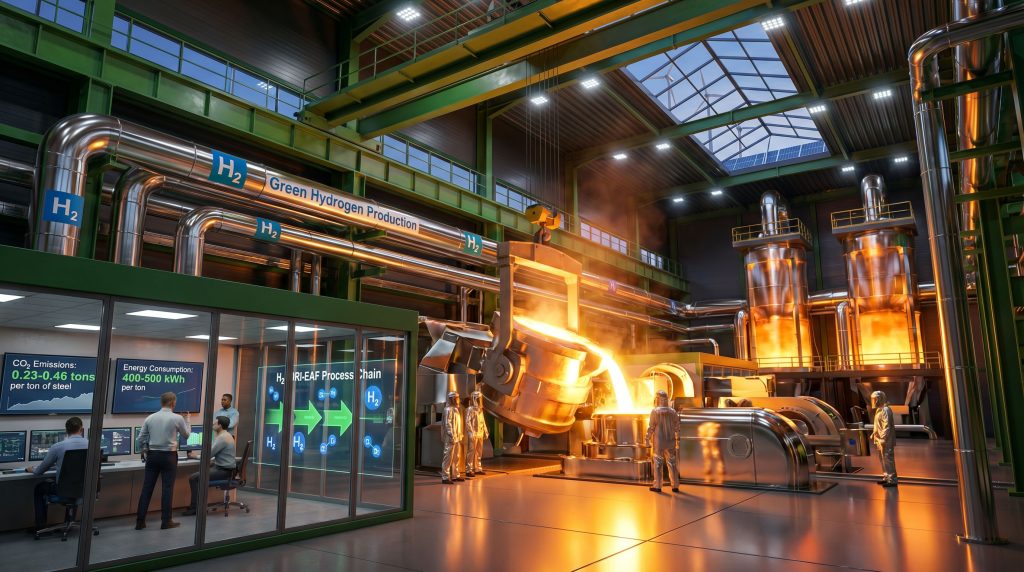
Electric arc furnace (EAF) technology represents the most commercially mature pathway for low-carbon steel technologies. These systems use electrical energy to generate temperatures of approximately 1,800°C through graphite electrodes, enabling the melting of both scrap steel and direct reduced iron (DRI). Energy consumption typically ranges from 400-500 kWh per ton of liquid steel, with emissions reduced to 0.23-0.46 tons of CO2 per ton of steel when powered by renewable electricity.
| Technology Component | Traditional BF-BOF | Electric Arc Furnace |
|---|---|---|
| Primary Energy Source | Coking Coal | Electricity |
| CO2 Emissions (t/ton steel) | 2.3 | 0.23-0.46 |
| Global Production Share | 76% | 24% |
| Feedstock Flexibility | Limited | High (scrap + DRI) |
The flexibility of EAF systems allows for varied feedstock compositions, including combinations of scrap steel, direct reduced iron, and hot briquetted iron (HBI). Consequently, this adaptability enables steel producers to optimise their raw material mix based on availability and cost considerations while maintaining product quality specifications.
Hydrogen-Based Direct Reduction Innovation
Hydrogen-based direct reduction represents a breakthrough technology for low carbon steel production, utilising hydrogen gas as a reducing agent at temperatures around 1,200°C. The chemical reaction (Fe2O3 + 3H2 → 2Fe + 3H2O) produces only water vapour as a byproduct, eliminating direct carbon emissions from the reduction process.
This process produces direct reduced iron (DRI) or hot briquetted iron (HBI), which serves as premium feedstock for electric arc furnaces. Moreover, the integration of hydrogen-based reduction with electric steelmaking creates a complete low-carbon production route when powered by renewable energy sources.
How Do Integrated Low-Carbon Steel Production Systems Work?
The H2-DRI-EAF Process Chain
Integrated low-carbon steel systems combine multiple technologies in a coordinated production chain. Green hydrogen production begins with renewable-powered electrolysis, splitting water molecules to generate hydrogen and oxygen. The hydrogen then feeds into direct reduction shaft furnaces, where iron ore pellets undergo reduction at controlled temperatures and gas compositions.
The resulting DRI transfers to electric arc furnaces for melting and refining into liquid steel. For instance, continuous casting systems convert the liquid steel into semi-finished products, which undergo rolling and finishing processes to produce final steel products meeting customer specifications.
Process Optimisation Strategies
Modern integrated systems incorporate sophisticated heat recovery mechanisms to maximise energy efficiency. Waste heat from direct reduction processes can preheat scrap steel or provide thermal energy for ancillary operations. Additionally, automated oxygen injection systems enhance melting efficiency in electric arc furnaces while reducing electrode consumption.
Digital control systems optimise power usage patterns, electrode positioning, and gas flow rates throughout the production process. These systems can adjust operations in real-time based on electricity pricing, raw material quality variations, and product specifications.
Raw Material Quality Requirements for Low-Carbon Production
Iron Ore Specifications for Direct Reduction
The shift toward hydrogen-based direct reduction creates stringent requirements for iron ore quality. High-grade iron ore with iron content exceeding 67-68% becomes essential for efficient reduction reactions. Lower impurity levels, particularly combined silica and alumina content below 2.2%, ensure optimal performance in direct reduction furnaces.
Pelletised feed offers superior performance compared to lump ore due to its consistent size distribution and porosity characteristics, which facilitate uniform gas flow and reduction kinetics. Furthermore, the improved reducibility of high-grade pellets reduces hydrogen consumption and increases productivity in direct reduction operations.
Brazilian Iron Ore Beneficiation Advances
Recent developments in Brazilian iron ore processing demonstrate the industry's commitment to producing premium-grade materials for sustainable iron production. Advanced beneficiation circuits combining comminution, high-intensity magnetic separation, and flotation achieve iron concentrations exceeding 68% while maintaining impurity levels below 2.2% for combined silica and alumina content.
These beneficiation processes utilise itabirite feedstocks, including both compact and friable varieties found in Minas Gerais deposits. The integrated approach maximises metallic recovery while producing pellet feed suitable for direct reduction applications. Production capacity targets of 5.5 million tons annually demonstrate the scale of investment required to support the transition to low-carbon steel production.
Scrap Steel Quality Considerations
Electric arc furnace operations require careful attention to scrap steel quality, particularly for high-grade steel applications. Prime scrap grades with minimal contamination become increasingly valuable as EAF capacity expands globally. However, copper content limitations of less than 0.15% are critical for automotive applications, where excessive copper can cause surface defects during forming operations.
Advanced sorting technologies, including sensor-based separation and artificial intelligence systems, improve the removal of non-metallic contaminants from scrap streams. Nevertheless, regional scrap availability constraints may limit the expansion potential of EAF-based production in rapidly industrialising economies where scrap generation lags behind steel consumption.
Economic Considerations for Low-Carbon Steel
Capital Investment Requirements
The development of integrated hydrogen-based steel production requires substantial capital investments across multiple technology components. H2-DRI plant construction costs typically range from $500-800 million for facilities with 2.5 million ton annual capacity. Green hydrogen electrolyser installations add $1,000-1,500 per kW of installed capacity, with large steel plants requiring hundreds of megawatts of electrolyser capacity.
Electric arc furnace upgrades for existing facilities can cost $100-200 million, depending on capacity and technological sophistication. In addition, grid infrastructure reinforcement becomes necessary to handle the increased electricity demand from electrified steel production, particularly in regions transitioning from coal-based systems.
Operating Cost Analysis
Green hydrogen production represents the largest variable cost component in H2-DRI systems, with current costs ranging from $3-6 per kilogram. Industry projections suggest these costs will decline to $2-3 per kilogram by 2030 as electrolyser technology improves and renewable electricity costs continue falling.
Electricity costs constitute 15-25% of electric arc furnace operating expenses, making renewable energy prices critical for economic competitiveness. Carbon pricing mechanisms provide offsetting benefits, with avoided CO2 emissions worth $50-100 per ton in regulated markets. Consequently, premium pricing for green steel products can command 10-30% price premiums above conventional steel in environmentally conscious markets.
Technical Challenges and Solutions
Hydrogen Infrastructure Development
Large-scale hydrogen-based steel production requires extensive infrastructure development beyond the production facilities themselves. Pipeline networks must distribute hydrogen from electrolysis sites to steel plants, potentially spanning hundreds of kilometres in some cases. Hydrogen's low volumetric energy density creates storage challenges, requiring either high-pressure compression or cryogenic liquefaction.
Safety protocols for hydrogen handling in industrial environments differ significantly from traditional steel plant operations. For instance, hydrogen's wide flammability range and invisible flame characteristics require specialised detection systems, ventilation designs, and emergency response procedures.
Grid Integration and Energy Management
The intermittent nature of renewable electricity generation creates operational challenges for energy-intensive steel production. Electric arc furnace operations can create significant power demand fluctuations, requiring grid operators to manage supply-demand balancing across wider regions.
Smart grid technologies enable steel plants to participate in demand response programmes, adjusting production schedules to optimise electricity costs and grid stability. Furthermore, energy storage solutions, including batteries and compressed air systems, can smooth consumption profiles and provide backup power during grid disruptions.
The next major ASX story will hit our subscribers first
Carbon Capture Technologies Supporting Steel Decarbonisation
Natural Gas DRI with CCS Integration
While hydrogen-based direct reduction represents the ultimate low-carbon solution, natural gas-based DRI with carbon capture and storage (CCS) provides an intermediate pathway. These systems can achieve carbon capture rates of 85-95% of process emissions using amine-based solvents or other capture technologies.
Post-combustion capture systems treat the flue gas from natural gas-fired direct reduction furnaces, separating CO2 for transportation and geological storage. This approach enables existing natural gas infrastructure utilisation while significantly reducing emissions intensity compared to traditional blast furnace operations.
Emerging Carbon Utilisation Pathways
Advanced carbon utilisation concepts explore converting captured CO2 into valuable products rather than simply storing it underground. Methane pyrolysis processes can produce hydrogen and solid carbon products, with the carbon finding applications in tyre manufacturing, construction materials, and other industrial applications.
Synthetic fuel production using captured carbon and renewable hydrogen creates potential revenue streams from waste CO2 while supporting transportation sector decarbonisation. These circular carbon economy approaches integrate steel production with chemical manufacturing and energy sectors, demonstrating the decarbonisation benefits in mining across multiple industries.
Future Outlook for Low-Carbon Steel Technology
Technology Roadmap to 2035
Commercial-scale H2-DRI facilities are expected to become operational between 2028-2030, with several projects currently under development in Europe, Asia, and North America. Green hydrogen cost parity with natural gas-based production should occur by the early 2030s, driven by continued renewable energy cost reductions and electrolyser technology improvements.
Electric arc furnace capacity is projected to expand from current levels of approximately 24% of global steel production to 40% by 2035. However, this expansion will require parallel development of high-quality scrap collection systems and DRI production capacity to supply EAF feedstock requirements.
Advanced materials research focuses on developing higher-temperature, more efficient process equipment. Improved refractory materials, advanced electrode designs, and next-generation electrolysis technologies will enhance productivity while reducing energy consumption across the production chain, supporting mining industry innovation efforts.
Policy and Market Drivers
The European Union's Carbon Border Adjustment Mechanism, implemented progressively from 2023-2026, creates competitive advantages for low-carbon steel producers while protecting domestic industry from carbon leakage. Government subsidies and loan guarantees support first-mover technology deployments, reducing financial risks for early adopters.
Corporate sustainability commitments from major steel consumers, including automotive manufacturers and construction companies, drive demand for green steel products. These procurement policies create market pull for low-carbon steel technologies even when production costs remain higher than conventional methods.
International technology transfer programmes accelerate global adoption of low-carbon steel technologies, with developed countries providing technical assistance and financing for developing economy transitions. Multilateral development banks increasingly focus lending on sustainable industrial transformation projects, connecting with broader critical minerals energy transition initiatives.
The integration of renewable energy solutions into steel production facilities represents another crucial development pathway. These comprehensive systems combine solar, wind, and energy storage technologies to provide reliable, low-carbon electricity for electric arc furnace operations and hydrogen production facilities.
Key Insight: Low-carbon steel production technologies, particularly hydrogen-based direct reduction combined with electric arc furnaces, offer pathways to reduce steel industry emissions by up to 95%. While current costs remain 10-30% higher than conventional methods, declining renewable energy prices and expanding carbon pricing mechanisms are rapidly improving economic viability. Success depends critically on coordinated development of hydrogen infrastructure, renewable electricity capacity, and high-grade iron ore supply chains optimised for direct reduction processes.
Frequently Asked Questions
How much can low-carbon steel technologies reduce emissions?
Electric arc furnaces using renewable electricity can reduce emissions to less than one-third of traditional blast furnace methods. Hydrogen-based direct reduction combined with electric arc furnaces can achieve near-zero emissions when powered by green hydrogen and renewable electricity, representing emission reductions of up to 95% compared to conventional BF-BOF production routes.
When will low-carbon steel become cost-competitive?
Industry projections indicate cost parity between green hydrogen steel and conventional steel by 2030-2035, driven by declining renewable energy costs, expanding carbon pricing mechanisms, and technology scaling effects. Regional variations will occur based on local electricity prices, carbon pricing levels, and raw material availability.
What raw materials are needed for technology for low carbon steel production?
High-grade iron ore with 67%+ iron content and combined silica-alumina impurities below 2.2% is preferred for direct reduction processes. Quality scrap steel remains essential for electric arc furnace operations, though supply constraints may limit expansion potential in rapidly developing economies. Pelletised feed offers superior performance compared to lump ore due to improved reducibility characteristics.
Further exploration: Readers interested in sustainable mining and steel production can explore related educational content covering mineral processing innovations and decarbonising steel production strategies from various industry publications and research institutions, as well as comprehensive reviews of steel industry transformation approaches.
Disclaimer: This article contains forward-looking projections and cost estimates based on current industry analysis. Actual technology for low carbon steel production development timelines, costs, and performance may vary based on technological breakthroughs, policy changes, and market conditions. Investment decisions should consider comprehensive due diligence and professional financial advice.
Ready to Capitalise on the Next Major Mineral Discovery?
Discovery Alert instantly alerts investors to significant ASX mineral discoveries using its proprietary Discovery IQ model, turning complex mineral data into actionable insights for the evolving resources sector. Understand why historic discoveries can generate substantial returns by visiting Discovery Alert's dedicated discoveries page, showcasing exceptional outcomes from major mineral finds, and begin your 14-day free trial today to position yourself ahead of the market.