August 5, 2026
Technology Supply Chain Evolution Through Strategic Partnerships
The global semiconductor and artificial intelligence landscape is experiencing a fundamental transformation as nations recognise that economic resilience requires coordinated responses to supply chain vulnerabilities. Traditional approaches to technology development, which relied heavily on concentrated manufacturing hubs and single-source dependencies, are giving way to distributed networks built on trust and shared strategic interests. This shift reflects growing awareness that technological sovereignty cannot be achieved in isolation, particularly when addressing the complex interdependencies spanning from raw material extraction to advanced AI deployment.
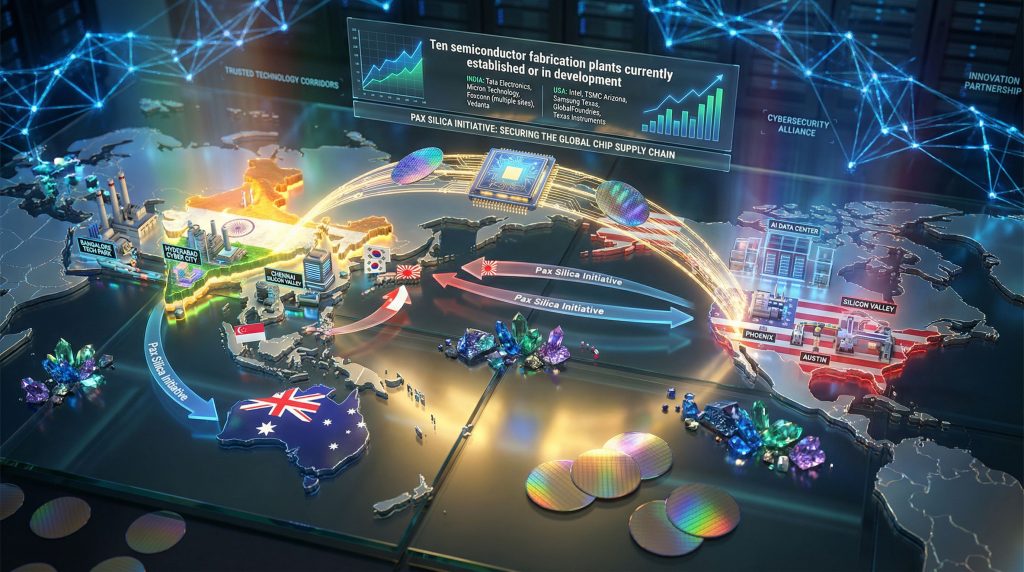
In February 2026, India's formal entry into the India US Pax Silica Initiative marked a significant milestone in this evolution. The initiative represents more than a bilateral agreement between two nations; it establishes a comprehensive framework for building resilient technology ecosystems that span the entire silicon value chain. This strategic partnership addresses critical vulnerabilities that have emerged from decades of concentrated production models while creating new pathways for innovation and economic security.
When big ASX news breaks, our subscribers know first
Understanding the Strategic Architecture of Pax Silica
The India US Pax Silica Initiative operates as a comprehensive trust-based network designed to address systemic vulnerabilities in global technology supply chains. This US Department of State initiative creates structured cooperation mechanisms that extend beyond traditional trade relationships to encompass strategic coordination across multiple technology domains.
The coalition currently includes diverse partners spanning multiple continents: Australia, Greece, Israel, Japan, Qatar, South Korea, Singapore, the United Arab Emirates, and the United Kingdom serve as formal signatories. Additionally, Canada, the Netherlands, the European Union, the OECD, and Taiwan participate through related engagement mechanisms, creating a broad network of aligned technological capabilities and strategic interests.
Key Coalition Capabilities:
• Advanced semiconductor design and manufacturing expertise across multiple technology nodes
• Critical mineral extraction and processing capabilities in geographically distributed locations
• Artificial intelligence research and development spanning both civilian and strategic applications
• Established supply chain networks with existing quality assurance and security protocols
• Regulatory frameworks that support technology transfer and intellectual property protection
The framework addresses what officials have identified as over-concentrated and vulnerable global supply chains through coordinated investment, shared technical standards, and distributed manufacturing capabilities. Rather than replacing existing commercial relationships, the India US Pax Silica Initiative creates additional pathways for critical technology flows while establishing security protocols for sensitive technologies.
This approach reflects recognition that supply chain resilience requires more than geographic diversification. Effective risk mitigation demands coordinated standards, interoperable systems, and shared security protocols that enable rapid response to disruptions while maintaining innovation momentum across the entire technology ecosystem.
India's Strategic Positioning Within the Global Technology Framework
India's participation in the India US Pax Silica Initiative leverages several unique advantages that strengthen the coalition's global reach and technical capabilities. The country's combination of engineering talent, manufacturing infrastructure, and strategic geographic positioning creates opportunities for significant contributions across multiple technology domains.
Engineering and Innovation Capabilities
India maintains established technology centres in Bangalore, Hyderabad, and Chennai that house significant concentrations of semiconductor design engineers, AI researchers, and systems integration specialists. These hubs support both domestic innovation initiatives and global technology development programs, creating pathways for knowledge transfer and collaborative research within the Pax Silica framework.
The country's educational institutions produce substantial numbers of engineers with expertise in semiconductor design, artificial intelligence, and advanced manufacturing processes. This talent pipeline supports both current technological capabilities and future expansion of domestic production capacity across critical technology sectors.
Manufacturing Infrastructure Development
Recent investments in semiconductor fabrication facilities position India to contribute meaningfully to distributed manufacturing networks. Government incentive programmes support domestic chip production while creating frameworks for international technology transfer and joint venture development with coalition partners.
Current Manufacturing Focus Areas:
• Semiconductor assembly and testing facilities with expanding capability profiles
• Critical mineral processing infrastructure targeting rare earth elements and lithium compounds
• AI hardware integration and systems manufacturing for both domestic and export markets
• Research and development facilities supporting next-generation technology development
These capabilities align with the initiative's emphasis on creating redundant production pathways that reduce systemic risks associated with geographic concentration in critical technology manufacturing. Furthermore, India's growing expertise in lithium industry innovations strengthens the coalition's access to essential battery materials for technology applications.
Strategic Geographic Advantages
India's location provides strategic access to critical mineral deposits across South and Southeast Asia while maintaining proximity to major technology manufacturing centres. This positioning enables efficient supply chain coordination with other coalition members while reducing transportation costs and logistics complexities.
The country's participation also strengthens Indo-Pacific technology cooperation by linking established manufacturing hubs in Japan, South Korea, and Singapore with emerging capabilities in Australia and the broader South Asian region. This geographic distribution creates multiple pathways for technology flows while reducing vulnerability to regional disruptions.
Supply Chain Risk Mitigation Through Distributed Networks
Modern technology supply chains face multiple categories of risk that traditional commercial arrangements cannot adequately address. The India US Pax Silica Initiative tackles these challenges through coordinated responses that combine geographic diversification with enhanced security protocols and shared technical standards.
Geographic Concentration Vulnerabilities
Current semiconductor manufacturing concentrates heavily in East Asia, with Taiwan and South Korea accounting for substantial percentages of global advanced chip production. Similarly, rare earth mineral processing remains concentrated in specific regions, creating systemic vulnerabilities when political instability or natural disasters disrupt production.
The Pax Silica approach creates alternative manufacturing pathways through coordinated investment in distributed facilities. Rather than competing with existing production centres, these facilities provide backup capabilities and specialised production for security-sensitive applications.
Distribution Strategy Components:
| Risk Category | Traditional Approach | Pax Silica Response |
|---|---|---|
| Single-point failures | Market-driven concentration | Coordinated distributed investment |
| Political disruptions | Commercial insurance mechanisms | Strategic reserve agreements |
| Technology dependencies | Arms-length supplier relationships | Integrated trust-based partnerships |
| Quality assurance | Individual company standards | Shared certification frameworks |
Economic Coercion Resistance
Supply chain weaponisation has emerged as a significant concern for nations dependent on imports of critical technologies. The ability to restrict access to semiconductors, rare earth minerals, or AI systems creates leverage that can be exploited for political or economic advantage.
The coalition addresses this vulnerability by creating alternative supply pathways that reduce dependence on potentially unreliable sources. Coalition members coordinate investment in backup capabilities while establishing protocols for rapid capacity scaling during supply disruptions.
This approach requires substantial upfront investment in redundant capabilities, but provides insurance against supply interruptions that could paralyse entire economic sectors. The framework balances economic efficiency with strategic security by maintaining distributed capabilities that can be activated when needed. Moreover, the focus on critical minerals energy security ensures that coalition members maintain access to essential materials for technology manufacturing.
Technology Security Integration
Advanced semiconductors and AI systems require sophisticated security protocols to prevent intellectual property theft, unauthorised technology transfer, and supply chain infiltration. Traditional commercial relationships often lack adequate security frameworks for sensitive technologies.
The coalition establishes shared security standards for technology development, manufacturing, and deployment. These protocols enable secure collaboration between coalition members while restricting access for non-aligned entities that may pose security risks.
Regional Security Implications for Indo-Pacific Stability
India's integration into the Pax Silica framework creates significant implications for regional economic security and strategic balance in the Indo-Pacific. The partnership builds upon recent bilateral agreements between India and the United States while extending cooperation to broader regional networks.
Enhanced Bilateral Technology Cooperation
The Pax Silica declaration builds upon an interim trade agreement signed between India and the United States in early 2026, which addressed longstanding friction points and established foundations for deeper economic integration. This progression from trade facilitation to strategic technology cooperation demonstrates the evolution of the bilateral relationship beyond traditional commercial arrangements.
Key areas of enhanced cooperation include joint research initiatives in artificial intelligence, coordinated semiconductor manufacturing investment, and shared protocols for critical mineral supply chain management. These initiatives create institutional frameworks for sustained technology collaboration that extend beyond individual commercial transactions.
Regional Alliance Integration
The framework connects India with existing Pax Silica members throughout the Indo-Pacific, creating networked relationships that strengthen regional economic security. Japan and South Korea bring advanced semiconductor manufacturing capabilities, while Australia contributes critical mineral resources and Singapore provides financial and logistics infrastructure.
This regional integration creates multiple pathways for technology flows while reducing dependence on supply chains that transit potentially contested areas. Distributed manufacturing and processing capabilities provide alternatives to traditional chokepoints that could be disrupted during regional tensions.
Regional Capability Distribution:
• Northeast Asia: Advanced semiconductor fabrication and AI system development
• Southeast Asia: Assembly, testing, and regional distribution capabilities
• South Asia: Critical mineral processing and emerging manufacturing capacity
• Oceania: Raw material extraction and specialised manufacturing components
Alternative Technology Corridors
The framework establishes secure technology corridors that bypass potentially unreliable supply routes while maintaining high security standards for sensitive technologies. These corridors integrate transportation, logistics, and security protocols to ensure continuous flow of critical components.
Coalition members coordinate investment in infrastructure that supports these alternative pathways, including secure data transmission networks, specialised transportation capabilities, and distributed storage facilities for critical components.
Sectoral Benefits and Industry Transformation
The India US Pax Silica Initiative creates specific opportunities across multiple industry sectors that form the foundation of modern technology ecosystems. Each sector benefits from enhanced cooperation while contributing unique capabilities to the broader coalition framework.
Artificial Intelligence Development and Deployment
AI technology development requires substantial computational resources, specialised expertise, and secure deployment frameworks. The Pax Silica coalition enables coordinated investment in AI infrastructure while establishing shared standards for ethical development and deployment.
India's participation brings significant AI research capabilities and a large domestic market for AI application testing. Coalition coordination enables access to advanced computing infrastructure while providing pathways for secure technology transfer between member nations.
AI Cooperation Framework:
• Joint research initiatives spanning both fundamental AI research and applied development programmes
• Shared AI safety standards and ethical frameworks for responsible technology deployment
• Collaborative infrastructure development including specialised computing facilities and data centres
• Coordinated AI deployment programmes in critical sectors including healthcare, education, and infrastructure management
The framework positions AI as a transformative force for long-term global prosperity while ensuring that development occurs within secure, values-aligned partnerships rather than competitive isolation.
Semiconductor Manufacturing and Design
Semiconductor technology requires coordinated capabilities spanning design, fabrication, assembly, and testing. The coalition enables technology transfer between advanced manufacturing centres and emerging production facilities while maintaining security protocols for sensitive technologies.
India's growing semiconductor infrastructure benefits from technology transfer agreements with established coalition partners while contributing manufacturing capacity for specific applications. This distributed approach reduces systemic risks while enabling specialisation based on comparative advantages.
Coalition coordination enables sharing of expensive fabrication equipment, joint development of next-generation manufacturing processes, and coordinated investment in supply chain infrastructure. These collaborative approaches reduce individual nation costs while building collective capabilities. Additionally, the ongoing mining industry evolution provides essential raw materials that support semiconductor manufacturing processes.
Critical Mineral Processing and Supply Chain Integration
Rare earth minerals, lithium compounds, and other critical materials require sophisticated processing capabilities and secure supply chain management. Geographic concentration of processing facilities creates vulnerabilities that the coalition addresses through distributed investment and shared technical expertise.
India's strategic positioning enables access to mineral deposits across South and Southeast Asia while developing domestic processing capabilities. Coalition coordination provides access to advanced processing technologies while creating alternative supply pathways for coalition partners.
Critical Mineral Strategy Components:
• Diversified sourcing agreements that reduce dependence on single suppliers or regions
• Processing facility development with shared technology transfer and quality standards
• Strategic stockpiling coordination to ensure supply security during disruptions
• Joint investment in next-generation extraction and processing technologies
The next major ASX story will hit our subscribers first
Global Technology Competition and Strategic Positioning
The India US Pax Silica Initiative fundamentally alters competitive dynamics in global technology markets by creating coordinated capabilities among aligned nations. This approach contrasts with traditional commercial competition by emphasising collective security and shared strategic advantages.
Collective Bargaining Power Enhancement
Coalition members coordinate technology development investment and market access decisions, creating enhanced negotiating positions in global technology markets. Shared standards and coordinated procurement enable coalition members to influence technology development directions while reducing individual nation vulnerability to economic pressure.
This collective approach enables smaller coalition members to access advanced technologies and market opportunities that would be difficult to achieve independently. Larger members benefit from distributed manufacturing capabilities and expanded market access through coalition partnerships.
Alternative Technology Development Pathways
The framework creates alternative pathways for technology development that reduce dependence on non-aligned suppliers while maintaining innovation momentum. Coalition coordination enables sharing of research and development costs while ensuring that breakthrough technologies benefit aligned partners.
Joint investment in emerging technologies enables coalition members to compete effectively with nations that might otherwise dominate specific technology sectors through concentrated investment or economic coercion. This approach balances competitive market dynamics with strategic security considerations.
Strategic Technology Access Controls
Coalition coordination enables implementation of technology access controls that prevent sensitive technologies from reaching potentially hostile entities while maintaining open innovation within the trusted partner network. These controls balance security requirements with commercial innovation incentives. Furthermore, industry events such as the global resources innovation expo provide platforms for coalition members to showcase collaborative technology developments.
"Technology export controls and access restrictions involve complex regulatory frameworks that continue to evolve. Organisations considering technology transfer or export activities should consult current regulations and obtain appropriate legal guidance."
Economic Impact Projections and Investment Opportunities
The India US Pax Silica Initiative creates multiple pathways for economic development and investment flows that extend beyond traditional bilateral trade relationships. These opportunities span both public sector coordination and private sector commercial development within the coalition framework.
Foreign Direct Investment Acceleration
Coalition membership reduces regulatory barriers and creates preferential frameworks for technology investment between partner nations. Indian semiconductor facilities gain access to advanced manufacturing technologies while US and other coalition investors benefit from reduced political risks and streamlined regulatory approval processes.
Investment flows are likely to accelerate in sectors where coalition coordination reduces traditional barriers to technology transfer. Joint venture opportunities expand as security protocols enable sharing of sensitive technologies within the trusted partner network.
Investment Priority Sectors:
• Semiconductor fabrication facilities with advanced process capabilities
• AI infrastructure development including specialised computing and data centres
• Critical mineral processing facilities with enhanced security protocols
• Research and development centres focusing on next-generation technologies
Trade Relationship Expansion
Bilateral trade in high-technology goods benefits from reduced regulatory friction and enhanced security protocols that enable commerce in sensitive technologies. Coalition coordination creates pathways for expanded trade while maintaining appropriate security standards.
Streamlined export controls for coalition partners reduce transaction costs and regulatory uncertainty for technology trade. These improvements particularly benefit small and medium enterprises that lack resources to navigate complex export control regimes independently.
Innovation Ecosystem Development
Joint research and development programmes create opportunities for enhanced innovation through coordinated investment and shared expertise. University partnerships and collaborative research centres enable knowledge transfer while building long-term relationships between coalition member institutions.
Shared intellectual property frameworks enable collaborative development while ensuring appropriate protection for sensitive technologies. These arrangements balance open innovation with security requirements through structured partnership agreements.
Implementation Challenges and Risk Management
While the initiative creates significant opportunities, successful implementation requires addressing multiple challenges related to technology transfer, regulatory coordination, and geopolitical considerations.
Technology Transfer and Intellectual Property Protection
Advanced technology cooperation requires sophisticated intellectual property protection mechanisms that balance sharing with security. Coalition members must coordinate patent protection, trade secret management, and technology access controls while enabling productive collaboration.
Existing export control frameworks require adaptation to accommodate enhanced cooperation between coalition partners while maintaining restrictions on non-aligned entities. These regulatory adjustments require careful coordination between multiple government agencies and international organisations.
Industrial Capacity Development
Expanding domestic manufacturing capabilities requires substantial investment in both physical infrastructure and workforce development. Indian facilities must achieve quality standards and security protocols that enable integration with advanced coalition supply chains.
Training programmes for advanced manufacturing processes require coordination between industry, educational institutions, and government agencies. These programmes must balance immediate operational needs with long-term capability development across multiple technology domains.
Geopolitical Risk Navigation
Coalition formation creates potential tensions with non-aligned trading partners that may respond through economic pressure or alternative partnership development. India must balance strategic technology cooperation with existing commercial relationships across diverse international markets.
Managing these relationships requires sophisticated diplomatic coordination and careful sequencing of policy implementation. Economic integration with coalition partners must avoid unnecessarily antagonistic approaches toward non-members while maintaining coalition security objectives.
Risk Mitigation Strategies:
• Graduated implementation that allows adjustment based on changing geopolitical conditions
• Diversified trade relationships that reduce dependence on any single market or supplier
• Flexible partnership agreements that accommodate changing strategic priorities over time
• Coordinated diplomatic engagement to minimise negative reactions from non-coalition partners
Future Development Scenarios and Strategic Outcomes
The initiative establishes foundations for long-term technology cooperation that could evolve across multiple scenarios depending on global political and economic developments over the next decade.
Near-Term Implementation Priorities (2026-2027)
Initial implementation focuses on establishing operational frameworks for enhanced cooperation while beginning concrete collaborative projects. Priority areas include semiconductor manufacturing technology transfer, joint AI research initiative launches, and secure supply chain protocol development.
Early success in these areas creates momentum for expanded cooperation while demonstrating the practical benefits of coalition coordination. Successful initial projects provide templates for scaling collaboration across additional technology domains and partner nations.
Medium-Term Integration Goals (2027-2030)
Full integration of Indian facilities into trusted supply networks enables comprehensive technology sharing while establishing India as a significant hub in coalition supply chains. Critical mineral processing capabilities expand to reduce coalition dependence on non-aligned suppliers.
Next-generation technology standards development becomes a coalition priority as members coordinate investment in emerging technologies including quantum computing, advanced AI systems, and novel manufacturing processes. This coordination enables collective leadership in technology standard-setting.
Long-Term Vision and Regional Leadership (2030+)
Successful implementation positions India as a central node in Indo-Pacific technology networks while creating sustainable competitive advantages in emerging technology markets. Regional leadership in technology cooperation extends beyond coalition membership to influence broader international technology governance.
The framework potentially expands to include additional aligned partners while deepening integration among existing members. Long-term success creates alternative models for international technology cooperation that balance security with innovation and economic development.
Strategic Success Metrics:
• Technology self-sufficiency levels across critical sectors for coalition members
• Supply chain resilience demonstrated through successful navigation of disruptions
• Innovation acceleration measured through joint research outputs and technology breakthroughs
• Economic integration depth reflected in bilateral trade and investment flows
• Regional stability contribution through enhanced economic interdependence among democratic partners
Transformative Implications for Global Technology Governance
The India US Pax Silica Initiative represents a fundamental shift toward trust-based technology partnerships that prioritise economic security alongside innovation advancement. This approach challenges traditional models of technology competition by demonstrating that strategic cooperation can enhance rather than constrain innovation while building more resilient supply chains.
The framework's success will depend on effective implementation of collaborative mechanisms, sustained investment in distributed capabilities, and careful navigation of complex international relationships. However, the strategic foundations established through Pax Silica create unprecedented opportunities for aligned nations to strengthen their positions in global technology leadership while building more secure and resilient economic foundations.
Coalition coordination enables sharing of both opportunities and risks across multiple technology domains, creating collective capabilities that exceed what individual nations could achieve independently. This collaborative approach provides a model for addressing technology competition challenges while maintaining democratic values and open innovation principles.
The initiative's long-term impact extends beyond bilateral India-US cooperation to influence broader patterns of international technology collaboration. Success in creating trusted technology partnerships could establish frameworks for addressing similar challenges in other critical sectors while demonstrating alternatives to purely competitive approaches to technology development.
According to recent reports, the formal signing ceremony represents a significant milestone in strengthening global supply chain security through international cooperation.
"This analysis involves forward-looking assessments based on currently available information. Technology cooperation initiatives involve multiple variables including changing geopolitical conditions, regulatory developments, and market dynamics that may influence actual outcomes. Readers should consider multiple perspectives and consult current developments when evaluating strategic implications."
Looking to Capitalise on Critical Minerals and Technology Supply Chain Opportunities?
Discovery Alert delivers instant notifications on significant ASX mineral discoveries, including critical minerals essential for semiconductor manufacturing and AI infrastructure, powered by its proprietary Discovery IQ model. Explore Discovery Alert's discoveries page to understand how major mineral discoveries have historically generated substantial returns, then begin your 14-day free trial to position yourself ahead of the market in this rapidly evolving technology landscape.