May 17, 2026
The Framework for Technology Transfer Between Mining and Energy Sectors
Innovation in mining technology has accelerated rapidly as operators recognise the potential for adapting proven solutions from adjacent industries. The oil and gas sector, with its decades of experience in remote operations, hazardous environments, and complex subsurface projects, offers a rich source of technological frameworks that mining companies can leverage without reinventing fundamental approaches.
The convergence between these sectors stems from shared operational challenges: both industries manage high-risk environments, require substantial capital investments in specialised equipment, and operate in geographically isolated locations where equipment failure can result in significant financial and safety consequences. This operational similarity creates natural pathways for technology transfer, particularly in areas such as predictive maintenance, autonomous systems, and digital process optimisation.
Operational Similarities Drive Cross-Sector Learning
Mining and oil and gas operations share several fundamental characteristics that make technology transfer not only possible but highly effective. Both sectors operate sophisticated machinery in harsh environments where downtime costs can exceed $50,000 per hour for major operations. Furthermore, remote monitoring capabilities, originally developed for offshore drilling platforms, translate directly to mining applications where equipment operates in isolated locations hundreds of kilometres from major service centres.
Risk assessment methodologies represent another area of successful transfer. The oil and gas industry's systematic approach to hazard identification and operational risk management has proven adaptable to underground mining environments. These frameworks include:
- Hazard and Operability Studies (HAZOP) protocols adapted for mining equipment
- Failure Modes and Effects Analysis (FMEA) for critical mining systems
- Real-time risk monitoring systems using sensor networks
- Emergency response coordination models for remote operations
Legacy System Integration Challenges
One of the most significant barriers to innovation in mining technology involves integrating new digital systems with existing infrastructure. Many mining operations rely on equipment with 20-30 year operational lifespans, creating substantial technical debt that must be addressed during modernisation efforts.
The oil and gas sector faced similar challenges during the digital transformation of refineries and offshore platforms in the 2000s and 2010s. Solutions developed during this period provide blueprints for mining operations:
Phased Integration Strategies:
- Pilot Testing Phase – Deploy new technologies on non-critical systems to validate performance
- Parallel Operations – Run new systems alongside legacy equipment to ensure continuity
- Gradual Migration – Transfer operations in stages to minimise disruption
- Full Integration – Complete system replacement after validation of reliability
This approach has proven particularly effective for implementing predictive maintenance systems, where mining companies can begin with monitoring of auxiliary equipment before expanding to critical production machinery.
When big ASX news breaks, our subscribers know first
Digital Transformation Technologies Showing Measurable ROI
The adoption of digital technologies in mining has accelerated significantly, though the sector continues to lag behind oil and gas in several key areas. Understanding which technologies deliver the highest return on investment helps mining companies prioritise their modernisation efforts.
Predictive Analytics Implementation Frameworks
Machine learning applications in mining have shown substantial promise, particularly for equipment maintenance optimisation. Unlike reactive maintenance approaches that respond to equipment failures, predictive analytics can identify potential issues 3-6 weeks before failure occurs, enabling planned maintenance during scheduled downtime.
Key Implementation Areas:
- Crusher Performance Optimisation – AI in drilling & blasting systems analyse vibration patterns, power consumption, and material flow to predict optimal operating parameters
- Conveyor Belt Monitoring – Computer vision systems detect wear patterns and potential failure points along belt systems extending several kilometres
- Haul Truck Fleet Management – Predictive models optimise routes, fuel consumption, and maintenance scheduling across fleets of 100+ vehicles
The integration of geological data with operational systems represents a significant advancement over traditional approaches. Real-time ore quality assessment enables immediate adjustments to processing parameters, improving recovery rates by 2-4% in copper and gold operations.
Autonomous Operations Scaling Methodologies
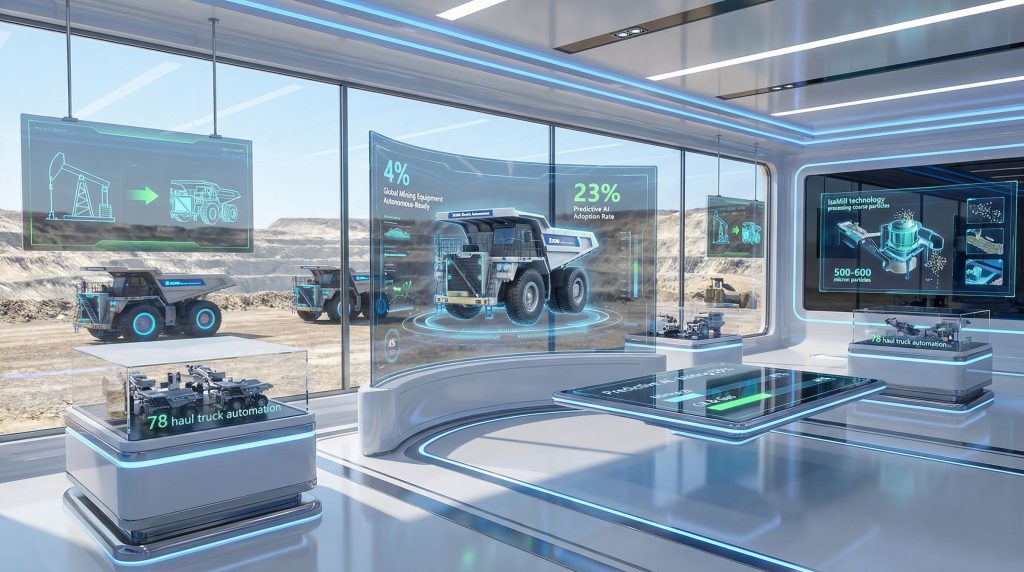
Autonomous equipment deployment in mining has progressed beyond pilot programmes to full-scale commercial operations. Rio Tinto's Pilbara iron ore operations currently utilise over 400 autonomous haul trucks, representing the largest autonomous mining fleet globally.
Current Deployment Statistics:
| Equipment Type | Global Units Deployed | Primary Regions | Average Implementation Time |
|---|---|---|---|
| Autonomous Haul Trucks | 600+ | Australia, Canada, Chile | 24-36 months |
| Autonomous Drill Rigs | 200+ | Australia, Sweden, Canada | 18-24 months |
| Underground Loaders | 150+ | Sweden, Finland, Australia | 12-18 months |
The technology transfer from oil and gas automation systems has accelerated this deployment. Remote operation centres, originally developed for offshore drilling platforms, now control mining equipment from thousands of kilometres away. These centres enable 24/7 operations with reduced on-site personnel requirements.
Critical Success Factors:
- Communications Infrastructure – Autonomous systems require low-latency, high-reliability networks typically based on private LTE or 5G implementations
- Regulatory Approval – Jurisdictions like Australia and Canada have developed specific frameworks for autonomous mining equipment
- Workforce Adaptation – Operators transition from equipment operation to fleet supervision roles
Electrification Strategies Adapted from Energy Sector Experience
The mining industry's approach to electrification draws heavily from oil and gas sector experience with electric drilling systems and offshore power management. However, mining applications face unique challenges related to mobile equipment and underground ventilation requirements.
Battery-Electric Vehicle Implementation
Mining companies are implementing electric vehicles in mining strategies across multiple operational contexts, with underground operations showing the strongest early adoption due to ventilation benefits. Electric equipment eliminates diesel exhaust, reducing ventilation requirements by 30-40% and cutting associated energy costs.
Regional Leadership Patterns:
Scandinavia: Sweden and Finland lead in underground electric equipment deployment, driven by strict environmental regulations and advanced electrical infrastructure. Komatsu's electric underground trucks operate in temperatures as low as -30°C, proving cold-weather viability.
Australia: Surface mining electrification focuses on haul truck conversions, with several operations piloting 300-tonne capacity electric trucks. The abundance of renewable energy sources provides favourable economics for large-scale electrification.
Chile: Lithium mining operations increasingly utilise electric equipment aligned with renewable energy development. This creates operational consistency between the product being mined and the energy systems used for extraction.
Infrastructure Development Requirements
Electrification of mining fleets requires substantial infrastructure investment beyond the vehicles themselves. Experience from electric drilling operations in oil and gas provides frameworks for power distribution and energy storage systems.
Critical Infrastructure Components:
- High-Capacity Charging Stations – Mining equipment requires 1-5 MW charging capacity for rapid turnaround times
- Energy Storage Systems – Battery storage provides grid stability and peak load management
- Power Distribution Networks – Underground operations require explosion-proof electrical systems
- Renewable Energy Integration – On-site solar and wind generation reduces grid dependency
The capital requirements for full fleet electrification can exceed $100 million for major mining operations, but operational savings through reduced fuel costs and maintenance requirements typically provide payback periods of 5-7 years.
Processing Innovations Transferred from Chemical Industries
Advanced processing technologies developed for chemical and petrochemical applications have found successful adaptation in mineral processing, particularly for fine particle recovery and energy efficiency improvements.
Coarse Particle Recovery Technologies
Traditional flotation systems struggle with particles larger than 300 microns, leading to recovery losses in many operations. Technologies adapted from chemical processing have expanded the effective size range for mineral recovery.
Jameson Cell Technology: These flotation systems, originally developed for coal processing, now handle mineral particles up to 500-600 microns in size. The technology utilises high-velocity water injection to create mixing conditions suitable for coarse particle flotation, improving overall recovery rates by 3-5% in copper operations.
Advanced Grinding Systems: Stirred mill technologies have evolved beyond traditional applications to handle increasingly coarse feed materials. These systems achieve energy efficiency improvements of 15-25% compared to conventional ball mills whilst maintaining product quality specifications.
Direct Lithium Extraction Scaling
The growing demand for lithium has accelerated development of direct extraction technologies that bypass traditional evaporation pond methods. These innovations draw heavily from brine processing techniques developed for oil and gas produced water treatment.
Technology Transfer Applications:
- Ion Exchange Systems – Selective lithium extraction using specialised resin technologies
- Solvent Extraction – Liquid-liquid extraction methods adapted from uranium processing
- Membrane Technologies – Selective filtration systems for lithium concentration
Current direct lithium extraction projects can achieve lithium recovery rates of 70-90%, compared to 30-50% for traditional evaporation methods. Processing time reductions from 12-18 months to weeks or months represent significant improvements in capital efficiency.
However, downstream refining capacity remains concentrated in China, creating strategic vulnerabilities for Western lithium supply chains. Developing domestic refining capabilities requires substantial investment in chemical processing infrastructure.
Risk Management and Safety Protocol Integration
The transfer of safety management systems from oil and gas operations to mining has proven particularly valuable, given the shared emphasis on preventing catastrophic incidents in high-risk environments.
Safety Protocol Standardisation
Oil and gas safety protocols have evolved through decades of offshore and remote operations experience. These frameworks provide tested methodologies for mining applications:
Incident Command Systems: Originally developed for offshore emergencies, these protocols enable coordinated response to underground mining incidents. Standardised communication procedures and role definitions have reduced emergency response times by 25-40%.
Process Safety Management: Chemical plant safety management systems adapted for mining operations focus on preventing major incidents rather than just reducing injury rates. This approach has proven particularly effective for processing facilities handling hazardous chemicals.
Cybersecurity Implementation
The increasing digitalisation of mining operations creates cybersecurity vulnerabilities similar to those faced by oil and gas companies. Industrial control system protection frameworks developed for energy infrastructure provide blueprints for mining cybersecurity:
Critical Protection Areas:
- Autonomous Equipment Networks – Protecting communication systems from interference or attack
- Process Control Systems – Securing SCADA and DCS systems controlling mill operations
- Data Management Systems – Protecting geological and operational data from theft
- Remote Access Systems – Securing connections to equipment operating in isolated locations
Mining companies implementing comprehensive cybersecurity frameworks report 60-80% reductions in security incidents, though the sophistication of threats continues to evolve.
Workforce Development and Change Management
The successful implementation of new technologies requires substantial workforce adaptation, an area where oil and gas experience provides valuable guidance for mining operations.
Skills Transfer Programs
Mining companies are developing workforce transition programmes based on successful models from oil and gas digital transformations. These programmes focus on retraining existing employees rather than wholesale workforce replacement.
Effective Training Components:
- Cross-Industry Certification – Programmes enabling workers to transition between mining and energy sectors
- Digital Literacy Development – Training traditional equipment operators on advanced control systems
- Leadership Development – Preparing supervisors to manage technology-enhanced operations
Companies implementing comprehensive retraining programmes report employee retention rates of 85-95% during technology transitions, significantly higher than operations attempting technology implementation without workforce development support.
Organisational Change Management
Technology adoption succeeds or fails based on organisational acceptance rather than technical capability. Change management frameworks from energy sector transformations provide tested approaches:
Stakeholder Engagement Models: Successful implementations involve all levels of the organisation from initial planning through full deployment. Regular communication about benefits, challenges, and progress maintains support throughout multi-year implementation periods.
Performance Measurement Systems: Clear metrics demonstrating technology benefits help maintain organisational support. Typical success metrics include equipment availability increases of 5-15%, maintenance cost reductions of 20-30%, and safety incident reductions of 40-60%.
The next major ASX story will hit our subscribers first
Implementation Barriers and Strategic Solutions
Despite significant potential benefits, technology transfer between sectors faces substantial barriers that require strategic planning to overcome.
Infrastructure and Investment Challenges
Mining operations in remote locations face infrastructure limitations that can prevent technology implementation. Power generation, communications networks, and logistics capabilities may require substantial upgrades before advanced technologies become viable.
Regional Disparities:
- Developed Mining Regions (Australia, Canada, Scandinavia) – Existing infrastructure supports rapid technology deployment
- Emerging Regions (parts of Africa, South America) – Infrastructure development may be required before technology implementation
- Established Operations – Legacy systems may require complete replacement for technology compatibility
Regulatory and Compliance Alignment
Mining regulations often lag behind technological capabilities, creating barriers to innovation deployment. However, successful frameworks from oil and gas regulatory evolution provide pathways for mining regulation development:
Regulatory Sandbox Approaches: Some jurisdictions now permit controlled testing of new technologies under modified regulatory frameworks, enabling validation before full approval processes.
Cross-Sector Standards: Harmonising safety and operational standards between mining and energy sectors can accelerate technology transfer whilst maintaining safety requirements.
Competitive Advantages for Smaller Mining Operations
Contrary to expectations, smaller mining companies often demonstrate greater agility in technology adoption compared to major corporations. This phenomenon, observed across multiple technology deployment cycles, creates opportunities for competitive advantage.
Agility Benefits in Innovation Adoption
Smaller operations face fewer legacy system constraints and can implement new technologies more rapidly than large corporations. Decision-making processes involving 5-10 stakeholders rather than 50-100 enable faster deployment timelines.
Case Study Examples:
- Junior mining companies implementing autonomous drilling systems 18-24 months faster than major corporations
- Mid-tier operations achieving full electrification of underground fleets whilst majors continue pilot programmes
- Independent operators deploying AI-powered ore sorting systems ahead of integrated mining companies
Collaborative Innovation Frameworks
Smaller companies increasingly participate in technology development partnerships that provide access to innovations typically available only to major corporations:
Industry Consortium Models: Groups of smaller operators pool resources to fund technology development, sharing costs and benefits across multiple operations.
Academic Partnerships: Universities provide research capabilities and testing facilities, enabling smaller companies to access cutting-edge development without major capital investment.
Government Initiative Alignment: Programmes like the U.S. Department of Energy's critical minerals security initiatives provide funding and technical support for technology deployment at smaller operations.
Future Technology Convergence and Strategic Planning
The acceleration of cross-industry technology transfer suggests several emerging trends that will shape the future of innovation in mining technology.
Emerging Technology Integration
Several technologies currently in pilot phase show potential for transformational impact on mining operations:
3D Scanning and Digital Twins: Real-time equipment condition monitoring using advanced scanning technologies enables predictive maintenance models with 95%+ accuracy in failure prediction.
Underground Automation Expansion: Current autonomous systems focus on materials handling, but emerging technologies enable autonomous exploration, drilling, and even some processing operations.
Renewable Energy Integration: Mining operations increasingly function as anchor customers for renewable energy development, enabling grid-scale clean energy projects in remote regions.
Strategic Technology Investment Planning
Mining companies developing long-term technology roadmaps benefit from portfolio management approaches that balance proven technologies with emerging innovations:
Risk-Balanced Portfolios: Combining low-risk proven technologies (70-80% of investment) with higher-risk emerging technologies (20-30% of investment) provides steady operational improvements whilst maintaining competitive advantage potential.
Measurable Performance Targets: Successful technology programmes establish clear metrics for productivity, sustainability, and safety improvements, typically targeting 5-15% annual improvements across key performance indicators.
The convergence of mining and energy sector technologies continues accelerating, driven by shared operational challenges and proven success in early implementations. Moreover, data-driven mining operations are becoming essential for companies seeking to remain competitive in an increasingly technology-driven industry. Additionally, implementing renewable energy solutions in mining provides both operational and sustainability benefits.
The adoption of these technologies represents part of broader mining industry innovation trends that are reshaping the sector. Companies developing systematic approaches to technology evaluation, implementation, and workforce development position themselves to capture significant competitive advantages.
Furthermore, according to the World Economic Forum, innovation in mining technology is increasingly recognised as essential for sustainable resource stewardship and global progress. Industry experts also highlight how technological innovations are transforming the mining industry across multiple operational areas.
Disclaimer: Technology implementation outcomes vary significantly based on operational context, regulatory environment, and implementation methodology. Companies should conduct thorough feasibility assessments and pilot programmes before large-scale technology deployments. Performance projections and ROI estimates are based on reported industry case studies and may not reflect outcomes for all operations.
Ready to Capitalise on Mining Innovation Opportunities?
Mining companies adapting proven technologies from energy sectors are creating substantial competitive advantages and operational improvements. Discovery Alert's proprietary Discovery IQ model identifies ASX mining companies implementing breakthrough technologies and innovation frameworks, delivering real-time notifications when these advancements translate into significant mineral discoveries and actionable investment opportunities.