July 9, 2026
The Invisible Metals Holding Western Technology Together
Few supply chain vulnerabilities carry more strategic weight than the ones nobody talks about. While lithium and cobalt dominate headlines in the clean energy transition debate, three lesser-known metals sit quietly at the foundation of modern defence electronics, telecommunications infrastructure, and semiconductor manufacturing. Germanium, antimony, and gallium are not household names, but their absence from Western supply chains would be felt immediately in fibre optic networks, night-vision military systems, radar arrays, and next-generation semiconductors.
The concentration of global production for all three metals in China, combined with a series of Chinese export controls enacted between 2023 and 2025, has transformed what was once a background procurement concern into an acute geopolitical vulnerability. For Western governments and industrial planners, the search for reliable, allied-nation supply has become genuinely urgent.
It is against this backdrop that the Teck Trail smelter germanium and antimony expansion needs to be understood, not as a single corporate investment decision, but as a significant strategic inflection point in the contest over critical mineral supply chain sovereignty.
When big ASX news breaks, our subscribers know first
Why These Three Metals Are Structurally Irreplaceable
Germanium: The Metal Inside Every Fibre Optic Cable
Germanium's critical status stems from its remarkable optical and electronic properties. It is the material of choice for fibre optic cable production because germanium-doped silica fibre achieves the low-loss light transmission characteristics required for high-speed data networks. Beyond telecommunications, germanium is indispensable in infrared optical systems used in military night-vision equipment, thermal imaging, and missile guidance technology.
What makes germanium's supply situation particularly precarious is its rarity as a primary mineral. It exists almost exclusively as a trace byproduct within zinc ore deposits, meaning the economics of germanium production are inseparable from the economics of zinc smelting. This geological reality creates an extremely high barrier to new supply development. You cannot simply build a germanium mine. You need a large-scale zinc smelting operation with the technical expertise to capture and refine germanium at commercial purity levels, a capability that takes decades to develop.
According to the U.S. Geological Survey, China accounts for the dominant share of global germanium production, with meaningful output from only a handful of other sources worldwide. The United States has essentially no domestic germanium production of its own.
Gallium: Powering the Semiconductor Revolution
Gallium's strategic significance has surged with the expansion of 5G telecommunications, advanced radar systems, and high-efficiency solar cells. Gallium in semiconductors outperforms silicon in high-frequency applications, making gallium arsenide and gallium nitride the materials of choice for defence electronics, satellite communications, and next-generation wireless infrastructure.
Like germanium, gallium is a byproduct metal, typically recovered during the processing of bauxite in aluminium smelting operations. China controls approximately 80 per cent or more of global gallium supply, a concentration that drew sharp attention when Chinese authorities imposed export licensing requirements on gallium in mid-2023. The immediate effect was price volatility and acute anxiety among defence contractors and semiconductor manufacturers in Western markets.
Antimony: The Overlooked Strategic Metal
Antimony sits at an unusual intersection of civilian and military demand. It is used extensively in flame retardants for textiles and plastics, as a hardening agent in lead-acid batteries, and in military-grade alloys for ammunition and armour. More recently, antimony trioxide has attracted attention as a component in next-generation battery technologies designed for grid storage applications.
China's position as the world's largest antimony producer means that when Chinese authorities introduced export controls on antimony in late 2024, global prices responded with significant volatility. The antimony supply risks for Western defence procurement planners are particularly acute given the metal's dual-use nature. Furthermore, antimony cannot easily be substituted in ammunition manufacturing, elevating its strategic classification in multiple allied-nation assessments.
How North America's Critical Mineral Exposure Compares
| Region | Germanium Self-Sufficiency | Gallium Self-Sufficiency | Antimony Self-Sufficiency |
|---|---|---|---|
| China | Near-total dominance | ~80%+ of global supply | Major global producer |
| United States | Heavily import-dependent | Minimal domestic production | Largely import-dependent |
| Canada (pre-expansion) | Only North American producer | No commercial production | Limited production |
| Canada (post-expansion target) | Doubled capacity | First-ever commercial output | Doubled capacity |
| European Union | Strategically deficient | Strategically deficient | Strategically deficient |
Sources: U.S. Geological Survey Critical Minerals Outlook; European Commission Critical Raw Materials Act assessments
The table reveals a structural reality that policy discussions often understate. Canada, even before the Trail expansion, occupies a unique position as the only commercially meaningful germanium producer in North America. The United States, despite its technological sophistication, is entirely dependent on imported germanium for every fibre optic cable laid and every infrared military optic manufactured domestically.
Trail Operations: A Facility That Cannot Be Quickly Replicated
The Polymetallic Smelting Model and Its Strategic Advantages
Teck Resources' Trail Operations, located in Trail, British Columbia, represents one of the world's largest integrated polymetallic smelting and refining complexes. The facility currently produces 19 distinct products from a single integrated operation, a reflection of decades of process engineering refinement that cannot be transferred to a new site through capital alone.
The critical differentiator at Trail is its byproduct recovery architecture. Germanium is extracted as a co-product of zinc processing, meaning the feedstock that flows through Trail's zinc smelter automatically carries germanium along with it. The economics are fundamentally different from standalone critical mineral extraction projects. Trail does not need to develop a new mine to increase germanium output. It needs to invest in enhanced recovery and refining capacity within an already-functioning industrial complex.
This distinction matters enormously for development timelines and capital risk. A greenfield critical mineral project typically requires between five and fifteen years from discovery to commercial production, with significant permitting, infrastructure, and financing hurdles along the way. Trail's expansion compresses that timeline dramatically because the industrial foundation already exists.
"The byproduct recovery model at Trail represents one of the most capital-efficient pathways to expanding Western critical mineral output. The feedstock risk is already managed through zinc operations, meaning the expansion challenge is fundamentally one of refining engineering rather than resource development."
Trail is currently Canada's sole germanium producer and North America's largest, and it holds a unique position as the only supplier of germanium dioxide to the United States. This means that before a single dollar of expansion capital is deployed, Trail is already indispensable to American industrial and defence supply chains. That baseline strategic importance is what makes the proposed capacity expansion so consequential.
The $850 Million Trail Strategic Metals Initiative: Mechanics and Structure
Breaking Down the Federal Investment Architecture
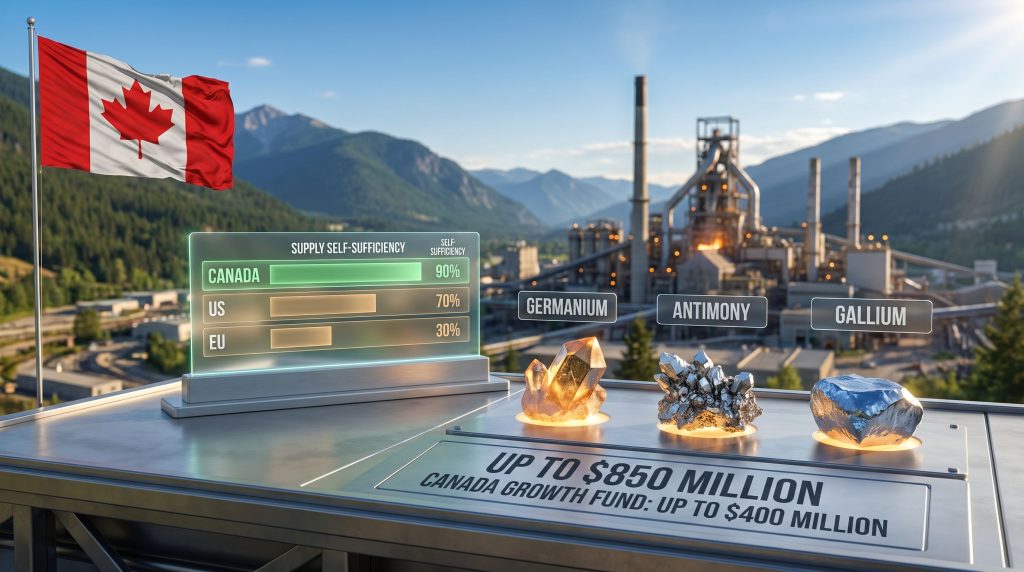
The Canada Growth Fund has committed up to $400 million to support what could become a total investment of up to $850 million by Teck Resources in the Trail Strategic Metals Initiative. The financing structure is described as equity-like, which carries important implications that distinguish it from a direct government grant or subsidised loan. Teck's agreement with the Canada Growth Fund marks a landmark moment in Canada's approach to securing domestic processing of strategic metals.
| Capital Component | Amount | Provider | Structure |
|---|---|---|---|
| Total Teck investment target | Up to $850 million | Teck Resources | Corporate capital |
| Federal contribution | Up to $400 million | Canada Growth Fund | Equity-like instrument |
| Implied Teck equity portion | ~$450 million | Teck Resources | Corporate balance sheet |
| Offtake rights | Portion of future output | Government of Canada | Strategic procurement |
An equity-like financing instrument positions the federal government as a risk-sharing partner rather than a passive grant provider. The structure is designed to generate financial returns for the government, which can then be recycled into future critical mineral investments under the same program framework. This recycling mechanism is a meaningful design feature: it attempts to make critical mineral investment self-funding over time rather than requiring repeated parliamentary appropriations.
Beyond the financial return mechanism, the federal government secured offtake rights over a portion of future germanium, antimony, and gallium production. This creates an embryonic strategic stockpiling capacity for Canada, an instrument that most Western nations, including the United States, have identified as a gap in their critical mineral resilience frameworks.
The Canada Critical Minerals Accelerator: A New Policy Tool
The Trail commitment is the inaugural transaction under the Canada Critical Minerals Accelerator, a $2 billion federal program introduced in Budget 2025. Previously referred to as the Critical Sovereign Fund, the Accelerator is designed to provide capital certainty to large-scale critical mineral processing projects that might otherwise stall in the face of global market volatility.
Canada's Minister of Energy and Natural Resources Tim Hodgson emphasised that the program's purpose is to convert Canada's existing resource abundance into operational projects by reducing the investment uncertainty that private capital alone cannot always bridge in strategically important but commercially complex sectors.
The Trail investment joins a broader wave of federal critical minerals demand commitments in 2025 and 2026, including a $500 million investment directed toward Newmont's Red Chris block cave expansion in British Columbia and $459 million in debt financing for Nouveau Monde Graphite's Matawinie graphite project in Quebec. Together, these commitments signal a deliberate effort to build out the full critical mineral value chain on Canadian soil.
What the Expansion Will Actually Produce
Germanium: Doubling the Continent's Only Significant Hub
The expansion's most immediately impactful component is the doubling of Trail's existing germanium production capacity. Given Trail's current status as North America's only significant germanium producer and the sole source of germanium dioxide for the United States, a doubling of output would represent a material shift in the Western hemisphere's supply position relative to Chinese-sourced material.
The end markets for expanded germanium output are well-established and growing:
- Fibre optic cable manufacturing for broadband and data centre infrastructure
- Infrared optical components for military night-vision and thermal imaging systems
- Semiconductor substrates for specialised electronics applications
- Solar cell technology in certain high-efficiency photovoltaic designs
Antimony: Strategic Timing After the Export Restriction Shock
The doubling of antimony production capacity arrives at a moment of heightened market sensitivity. Chinese export restrictions introduced in late 2024 caused significant price dislocations in global antimony markets, exposing the depth of Western import dependency. Trail's expanded antimony output would, consequently, serve a range of end markets:
- Flame retardant compounds for textiles, electronics housings, and construction materials
- Lead-acid battery hardening agents for automotive and industrial storage applications
- Military-grade alloys used in ammunition, armour, and specialist components
- Emerging grid storage battery chemistries where antimony is attracting research interest
Gallium: Canada's Industrial First and Its Uncertainties
The most novel and uncertain element of the Trail Strategic Metals Initiative is the proposed introduction of commercial gallium processing, which would represent Canada's first-ever gallium production capability. Teck's CEO Jonathan Price confirmed publicly that no production timeline has been established for gallium. This transparency is significant because it acknowledges that gallium recovery at commercial scale from Trail's existing process streams is a technically complex challenge that has not yet been fully resolved.
From an engineering standpoint, gallium recovery in a zinc smelting context requires different chemical separation processes than germanium recovery. The fact that Trail has not previously produced gallium commercially suggests that meaningful process development and capital investment in new recovery circuits will be required before any output materialises. For investors and policymakers, the gallium component should therefore be understood as a medium-to-long-term aspiration rather than a near-term production commitment.
Key Output Summary
| Metal | Current Trail Status | Post-Expansion Target | Primary Applications |
|---|---|---|---|
| Germanium | North America's largest producer | 2× current capacity | Fibre optics, IR optics, semiconductors |
| Antimony | Active production | 2× current capacity | Batteries, flame retardants, military alloys |
| Gallium | No production | First-ever Canadian output | 5G, radar, semiconductors, solar |
The next major ASX story will hit our subscribers first
British Columbia's Role: The Look West Framework
The Trail Strategic Metals Initiative has been designated as one of British Columbia's 18 priority resource projects under the province's Look West economic strategy. This designation creates pathways to streamlined permitting processes and access to provincial financial support mechanisms, adding a layer of provincial policy alignment to the federal investment structure.
The Look West strategy reflects British Columbia's recognition that shifting Pacific trade dynamics require a more deliberate approach to resource export market diversification, particularly as trade tensions with the United States create uncertainty around traditional north-south commodity flows. However, it is worth noting that priority designation under Look West provides potential access to streamlined processes only. It does not guarantee specific timelines, and the actual permitting pathway for Trail's expansion will depend on the scope of the physical modifications required at the existing facility.
Three Scenarios for What Comes Next
Scenario 1: Full Execution Across All Three Metals
In a scenario where the expansion proceeds on plan, Trail doubles germanium and antimony output and establishes gallium production within a five-to-seven year horizon. North American critical mineral supply chains gain a reliable, allied-nation source for all three metals. The U.S. defence and semiconductor industries reduce their Chinese import exposure meaningfully. Canada's critical minerals strategy would be significantly reinforced, potentially attracting additional downstream industrial investment to the region.
Scenario 2: Gallium Stalls While Core Metals Expand
The more probable near-term trajectory involves germanium and antimony capacity expansions proceeding with greater speed and certainty than gallium, given that both metals are already produced at Trail and the engineering challenges are better understood. In this scenario, gallium development faces delays due to technical complexity, capital prioritisation, or gallium market pricing dynamics that affect project economics.
The federal government exercises its offtake rights on germanium and antimony, building strategic reserves. Gallium remains a medium-term target rather than an early deliverable.
Scenario 3: Geopolitical Escalation Compresses Timelines
If Chinese export restrictions on critical minerals escalate further in 2025 and 2026, the political and commercial pressure to accelerate Trail's output would intensify significantly. Supply shortages in Western markets would improve the project economics for all three metals simultaneously. Under this scenario, Trail could emerge as the centrepiece of a broader North American critical mineral processing corridor, with allied nations seeking direct offtake arrangements. Indeed, analysts tracking Trail's expansion suggest this geopolitical pressure may already be building.
"Strategic Risk Note: Capital commitment from the federal government provides financial certainty, but it does not resolve the engineering, commercial, and regulatory execution challenges that will determine whether the Trail expansion delivers on its strategic promise. The offtake market for Canadian-origin germanium, antimony, and gallium will need to be built in competition with established Chinese supply chains that benefit from decades of production cost optimisation."
Frequently Asked Questions
What is the Teck Trail smelter germanium and antimony expansion?
It is a planned capacity upgrade at Teck Resources' Trail Operations complex in British Columbia, designed to double germanium and antimony production and introduce gallium processing for the first time. The initiative is backed by up to $400 million from the Canada Growth Fund as part of a potential $850 million total investment.
Why are germanium, antimony, and gallium classified as critical minerals?
Each metal plays an essential role in defence electronics, telecommunications, semiconductor manufacturing, or energy storage, and each faces a highly concentrated global supply chain dominated by China, creating strategic vulnerability for Western nations in the event of export restrictions or geopolitical disruption.
Is Trail currently the only germanium producer in North America?
Yes. Trail Operations is Canada's only germanium producer and North America's largest. It is also the sole supplier of germanium dioxide to the United States, a status that predates the expansion announcement and underscores the facility's existing strategic significance.
When will gallium production begin at Trail?
No commercial timeline has been established. Teck's CEO publicly confirmed this point, making gallium the most uncertain and longest-dated component of the Trail Strategic Metals Initiative.
What is the Canada Critical Minerals Accelerator?
A $2 billion federal program introduced in Budget 2025, designed to de-risk large-scale critical mineral processing investments through equity-like financing instruments. The Trail investment is its first committed transaction.
Does the federal government receive a return on its $400 million commitment?
The equity-like financing structure is specifically designed to generate investment returns for the government, which can be reinvested in future critical mineral projects. The government also negotiated offtake rights over a portion of future germanium, antimony, and gallium production from Trail.
The Larger Question: Is Processing Capacity Now the Real Battleground?
The Teck Trail smelter germanium and antimony expansion draws attention to a dimension of the critical mineral competition that raw material extraction alone cannot resolve. Even if Canada and its allies successfully identify and develop new mineral deposits, the processing and refining capacity to convert those ores into battery-grade or semiconductor-grade materials remains heavily concentrated in China.
Trail's polymetallic smelting model offers a rare counterexample: a Western facility with genuinely world-class processing capability across multiple strategic metals simultaneously. The institutional knowledge embedded in Trail's operations, built across decades of zinc and lead metallurgy with progressive byproduct recovery expansion, represents a competitive moat that cannot be purchased off a shelf or accelerated through policy declaration alone.
Whether the $850 million investment target ultimately delivers doubled germanium and antimony capacity alongside Canada's first gallium production will depend on engineering execution, market development, regulatory efficiency, and the trajectory of Chinese supply competition. What is already clear is that the strategic logic behind investing in Trail's expansion is well-founded, and that the facility's existing position as North America's critical germanium hub makes it one of the most consequential industrial assets in the Western hemisphere's critical mineral landscape.
Want To Stay Ahead of the Next Major Critical Minerals Discovery?
Discovery Alert's proprietary Discovery IQ model scans ASX announcements in real time, instantly identifying significant mineral discoveries across critical commodities — including those at the heart of Western supply chain sovereignty — and delivers actionable alerts directly to subscribers. Explore why early-stage discoveries in strategically vital metals have historically generated substantial returns on Discovery Alert's dedicated discoveries page, and begin your 14-day free trial today to position yourself ahead of the broader market.