May 21, 2026
The development of next-generation telescopic systems requires unprecedented precision in optical engineering, particularly in the fabrication of mirror substrates that must maintain nanometer-level accuracy across enormous surface areas. Glass-ceramic materials with ultra-low thermal expansion coefficients represent the technological foundation enabling these massive observational instruments to function effectively in challenging environmental conditions.
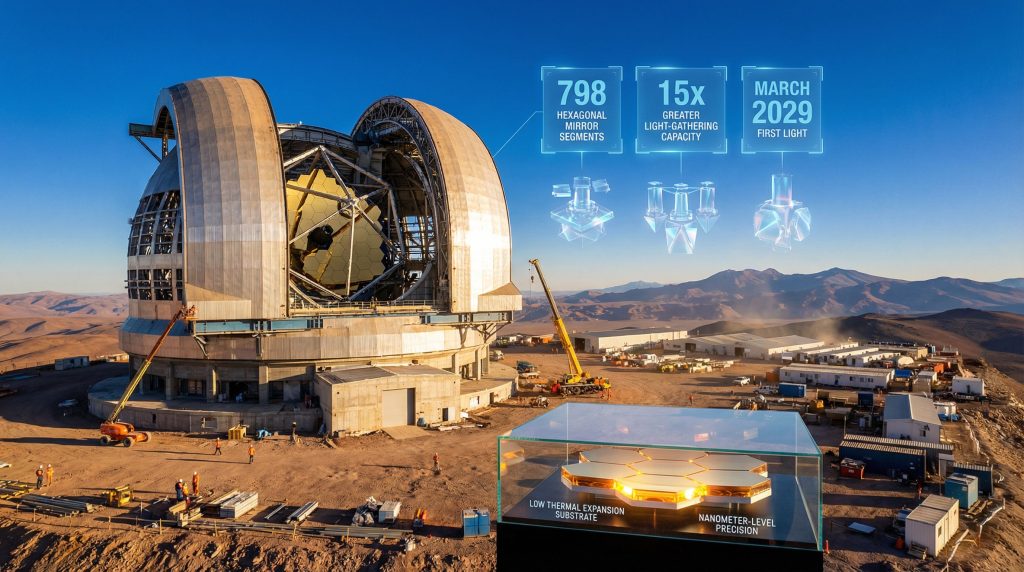
Modern astronomical mirror systems utilise segmented architectures where hundreds of individual hexagonal components operate collectively as unified optical surfaces. The 39-metre diameter primary mirror configuration incorporates approximately 800 individual segments, each requiring precise positioning and phase alignment to achieve optimal light-gathering performance. This segmented approach allows for manufacturing flexibility while maintaining the structural integrity necessary for large-scale optical systems.
Thermal Stability Requirements in Desert Environments
The Atacama Desert's extreme temperature variations demand exceptional thermal stability from optical components. Glass-ceramic substrates must demonstrate thermal expansion coefficients below 0.1 parts per million per degree Celsius to prevent optical distortions during temperature fluctuations that can exceed 40 degrees between day and night cycles.
High-purity lithium compounds serve as critical additives in these specialised glass formulations, providing enhanced thermal stability characteristics essential for precision optical applications. Furthermore, australia lithium innovations showcase how advanced lithium processing technologies can contribute to high-tech applications beyond traditional industrial uses.
Manufacturing processes for these advanced materials require controlled atmospheric conditions and specialised furnace technologies capable of achieving uniform heating profiles across large glass-ceramic billets. Quality control specifications demand surface roughness measurements below 1 nanometre RMS, with flatness tolerances measured in fractions of optical wavelengths.
When big ASX news breaks, our subscribers know first
Cerro Armazones: Exceptional Atmospheric Conditions for Deep Space Observation
The selection of astronomical observatory sites depends on quantifiable atmospheric parameters that directly impact observational capabilities. Cerro Armazones, positioned at 3,046 metres elevation in the Atacama Desert, demonstrates world-class conditions for optical and infrared astronomy through measurable criteria including atmospheric seeing, water vapour content, and light pollution levels.
Quantified Environmental Advantages
Atmospheric seeing measurements at Cerro Armazones consistently achieve sub-arcsecond values, with median seeing conditions of approximately 0.7 arcseconds under optimal atmospheric conditions. This exceptional optical quality results from the site's positioning above the atmospheric boundary layer, minimising turbulence effects that degrade image quality at lower-elevation locations.
Annual precipitation levels remain below 10 millimetres per year, creating exceptionally dry atmospheric conditions that minimise water vapour absorption across infrared wavelengths. This atmospheric transparency enables observations across extended spectral ranges, particularly important for exoplanet atmospheric characterisation and early universe studies requiring infrared sensitivity.
Light pollution measurements classify the region as Bortle Scale Class 1, representing the darkest possible sky conditions with minimal artificial illumination. Sky brightness measurements indicate natural background levels approaching theoretical limits, enabling detection of extremely faint astronomical objects requiring long-exposure photometry.
Infrastructure Development Specifications
Site preparation activities included 18 metres of mountain peak reduction to create the necessary flat construction area for the observatory dome and supporting structures. This extensive earthwork project required careful environmental impact assessment and mitigation strategies to preserve the surrounding desert ecosystem.
Access infrastructure development encompasses a 20-kilometre paved road connection from the existing Paranal Observatory, enabling transportation of heavy construction equipment and optical components. Utility installations include dedicated power transmission lines and high-speed data communication networks supporting real-time observatory operations and data transmission requirements.
Advanced Materials Science in Ultra-Precision Optics
The fabrication of metre-class optical components demands materials science innovations that push the boundaries of glass-ceramic technology. SCHOTT AG's proprietary glass-ceramic formulations incorporate specialised additives that achieve unprecedented thermal and dimensional stability requirements for astronomical applications.
Lithium Compound Integration Technology
High-purity lithium compounds function as network modifiers in glass-ceramic matrices, reducing thermal expansion coefficients whilst maintaining optical transparency across visible and near-infrared wavelengths. In addition, lithium brine insights demonstrate how mineral processing technologies can achieve the purity specifications required for advanced optical applications.
These additives must meet parts-per-million purity specifications to prevent optical absorption or scattering effects that could compromise telescope performance. The glass-ceramic manufacturing process involves controlled crystallisation cycles where lithium-containing phases precipitate within the glass matrix, creating a composite material with enhanced thermal stability.
Temperature cycling protocols during manufacturing must precisely control cooling rates to achieve optimal crystal size distributions and minimise internal stress concentrations. Quality assurance protocols include spectroscopic analysis of lithium compound purity levels, thermal expansion measurements across operational temperature ranges, and optical homogeneity testing using interferometric methods.
Coating Technologies and Reflectivity Optimisation
Mirror coating systems utilise aluminium deposition processes to achieve reflectivity levels exceeding 85% across optical wavelengths. Protective overcoat layers extend coating durability in desert environmental conditions whilst maintaining optical performance throughout extended operational periods.
On-site recoating facilities enable periodic mirror maintenance without transportation to external facilities, minimising observatory downtime. Automated coating chambers accommodate individual mirror segments, applying uniform aluminium layers through vacuum deposition processes with precise thickness control.
Revolutionary Research Capabilities Through Enhanced Light-Gathering Power
The 15-fold increase in light-gathering capacity compared to existing large telescopes enables transformative research capabilities across multiple astronomical disciplines. This enhanced sensitivity opens new observational windows for studying extremely faint astronomical objects previously beyond detection limits.
Exoplanet Characterisation Capabilities
Direct imaging of rocky exoplanets within habitable zones becomes feasible through advanced adaptive optics systems capable of correcting atmospheric distortions in real-time. Contrast ratios of 10^-10 between host stars and orbiting planets can be achieved through coronagraphic techniques combined with adaptive optics correction.
Atmospheric spectroscopy of exoplanets enables detection of potential biosignature molecules including water vapour, oxygen, and methane through high-resolution spectroscopic analysis. Radial velocity measurements achieve precision levels below 1 metre per second, enabling detection of Earth-mass planets around nearby stars.
Transit photometry capabilities detect brightness variations as small as 10 parts per million, sufficient for characterising terrestrial-class exoplanets transiting across sun-like stars. Temporal resolution enables detailed analysis of atmospheric dynamics and cloud structure variations on exoplanetary surfaces.
Deep Space Archaeological Studies
Observations of the early universe benefit from enhanced sensitivity enabling detection of first-generation galaxies at redshifts exceeding z=15, corresponding to cosmic ages less than 300 million years after the Big Bang. These observations provide direct evidence of galaxy formation processes in the primordial universe.
Gravitational lensing studies achieve unprecedented precision in dark matter distribution mapping through weak lensing measurements of background galaxy shapes. Statistical analysis of galaxy shape distortions enables three-dimensional mapping of dark matter structure across cosmic time scales.
Engineering Solutions for Extreme-Scale Construction Projects
The construction of an 80-metre diameter rotating dome supporting a 2,800-tonne telescope system requires innovative engineering solutions addressing seismic stability, thermal management, and precision positioning requirements. However, these challenges demand interdisciplinary collaboration between structural engineers, precision mechanics specialists, and control systems experts.
Seismic Engineering in Active Tectonic Zones
Chilean seismic conditions require comprehensive vibration isolation systems capable of protecting sensitive optical components during earthquake events. Base isolation technologies utilise elastomeric bearing systems that decouple the telescope structure from ground motion whilst maintaining precise positioning accuracy.
Finite element analysis modelling predicts structural responses to seismic accelerations up to 0.3g horizontal ground acceleration, ensuring optical alignment preservation during moderate earthquake events. Emergency shutdown protocols automatically secure mirror segments and sensitive instruments when seismic monitoring systems detect potentially damaging ground motion.
Precision Positioning and Control Systems
Mirror segment alignment systems achieve positioning accuracy better than 10 nanometres through laser metrology and computer-controlled actuator systems. Each mirror segment incorporates three-axis positioning capability with sub-nanometre resolution feedback systems enabling real-time optical surface corrections.
Thermal management across the 39-metre primary mirror aperture utilises active temperature control systems maintaining uniform thermal conditions within ±0.1 degrees Celsius. Air circulation systems prevent thermal gradients that could induce optical distortions affecting image quality.
Project Timeline Analysis and Construction Milestones
The systematic progression toward operational capability requires coordination of multiple parallel construction activities, each with critical dependencies and quality assurance requirements. Consequently, current progress indicates significant advancement toward the projected operational timeline.
Mirror Production Progress Assessment
Manufacturing status indicates completion of over 200 mirror segments with approximately 600 units remaining in production. Each segment requires individual testing and certification before shipment to the construction site, creating a critical path dependency for installation scheduling.
Quality control protocols demand comprehensive optical testing of each mirror segment, including surface accuracy measurements, reflectivity assessments, and thermal stability verification. This extensive testing process limits production throughput whilst ensuring compliance with demanding optical specifications.
The next major ASX story will hit our subscribers first
Economic Impact and Scientific Research Transformation
The operational phase of this astronomical infrastructure will generate substantial economic benefits through employment creation, international collaboration expansion, and technology transfer opportunities. Research output projections indicate annual publication volumes exceeding 1,000 peer-reviewed papers across multiple astronomical disciplines.
Regional Development Opportunities
Permanent employment creation includes over 200 specialised technical positions encompassing telescope operations, maintenance, instrumentation support, and administrative functions. These positions require advanced technical training and create long-term economic benefits for the Atacama region.
Tourism development potential includes scientific education programmes and public outreach activities showcasing astronomical research capabilities. For instance, industry innovation trends highlight how advanced technology projects can stimulate broader economic development.
International Scientific Collaboration Networks
The 16 member nations of the European Southern Observatory contribute to operational funding and research programmes, creating extensive international collaboration opportunities. Scientific partnerships extend beyond ESO membership through guest observer programmes and collaborative research initiatives.
Technology transfer applications from precision optics, adaptive optics systems, and control technologies find commercial applications in medical imaging, industrial measurement systems, and semiconductor manufacturing equipment.
Chile's Strategic Position in Global Astronomical Infrastructure
The concentration of world-class observatories in northern Chile results from the unique combination of exceptional atmospheric conditions, stable geological characteristics, and supportive regulatory frameworks. This positioning creates competitive advantages for continued astronomical infrastructure development.
Natural Resource Integration in Advanced Technology Applications
The utilisation of Chilean-produced lithium compounds in advanced glass-ceramic formulations demonstrates the potential for domestic mineral resources to contribute to high-technology applications beyond traditional industrial uses. Moreover, critical minerals transition initiatives show how strategic mineral resources support advanced technological applications.
High-purity lithium applications extend beyond energy storage technologies into specialised materials science applications requiring exceptional chemical purity and consistent quality specifications. These niche applications often command premium pricing compared to commodity-grade lithium products.
Technological Ecosystem Development
The establishment of specialised technical capabilities supporting astronomical infrastructure creates broader technological competencies applicable to other precision engineering applications. Local technical expertise development enables support for additional high-technology projects requiring similar capabilities.
Educational partnerships between international organisations and Chilean universities create research collaboration opportunities and advanced technical training programmes. These initiatives develop domestic capabilities in precision engineering, optical sciences, and astronomical instrumentation.
Future Astronomical Discovery Potential
The enhanced observational capabilities enabled by this next-generation telescope system will address fundamental questions in cosmology, astrobiology, and stellar evolution. Research programmes will investigate potentially habitable exoplanets, early galaxy formation processes, and dark matter distribution across cosmic scales.
Breakthrough Research Applications
Direct characterisation of Earth-analogue planets around nearby stars becomes feasible through coronagraphic observations combined with high-resolution spectroscopy. These observations will search for atmospheric biosignatures including water vapour, oxygen, and organic compounds indicating possible biological activity.
Black hole physics research will benefit from unprecedented resolution enabling detailed observations of matter dynamics near event horizons. These observations will test general relativity predictions under extreme gravitational conditions and advance understanding of spacetime physics.
Multi-Messenger Astronomy Integration
Coordination with gravitational wave detection networks enables rapid follow-up observations of cosmic merger events, providing complementary information about neutron star collisions and black hole formation processes. Real-time alert systems enable automated telescope pointing within minutes of gravitational wave detection.
Future instrumentation development will incorporate artificial intelligence algorithms for automated discovery of transient astronomical phenomena and anomalous objects requiring detailed follow-up observations. Furthermore, asteroid mining advances suggest that space-based resource utilisation could eventually support astronomical infrastructure development beyond Earth.
The Extremely Large Telescope project represents a transformative milestone in astronomical research capabilities, combining unprecedented light-gathering power with exceptional observational conditions. The integration of advanced materials technology, precision engineering solutions, and international collaboration creates a world-class research infrastructure positioned to advance human understanding of the universe for decades to come.
This remarkable project stands as testament to human ingenuity, representing the pinnacle of current astronomical technology. As construction continues toward the projected operational timeline, the Extremely Large Telescope in Atacama will fundamentally reshape our capacity to explore cosmic mysteries and answer profound questions about our place in the universe. The European Southern Observatory's construction update provides additional insights into this groundbreaking astronomical infrastructure project.
Looking for Investment Opportunities in Advanced Materials and Mining?
Discovery Alert's proprietary Discovery IQ model delivers real-time alerts on significant ASX mineral discoveries, particularly focusing on critical materials like lithium that power advanced technologies from telescope optics to energy storage systems. Explore historic mining discoveries and their exceptional returns to understand why positioning yourself ahead of major announcements can provide substantial market advantages.