May 21, 2026
The tensions between Water Corporation and Alcoa highlight fundamental challenges in resource management when mining operations intersect with critical water infrastructure. Complex regulatory frameworks governing water resources and mining operations create inherent tensions between economic development and environmental protection. When multiple agencies oversee different aspects of resource management, coordination challenges often emerge that can compromise both operational efficiency and public safety. These systemic issues become particularly acute when mining activities occur near critical water infrastructure, where the stakes of regulatory failure extend far beyond environmental damage to encompass fundamental questions of public water security.
Understanding Multi-Agency Jurisdiction Challenges in Mining-Water Management
The intersection of mining operations and water resource protection creates a complex regulatory landscape where multiple agencies must coordinate oversight responsibilities. In Western Australia, this challenge has become evident through documented tensions between Water Corporation and Alcoa regarding access restrictions and information sharing protocols around critical drinking water sources.
The Department of Water and Environmental Regulation (DWER) holds primary responsibility for environmental compliance monitoring, while the Water Corporation maintains operational oversight of public water supplies. However, this division of authority creates potential blind spots in comprehensive risk assessment. Internal documents reveal that Water Corporation has experienced significant limitations in accessing mining sites near Serpentine Dam, a major drinking water source for Perth, since May 2025 when Alcoa began implementing fencing restrictions.
Furthermore, understanding the mining permitting fundamentals becomes crucial when evaluating how these regulatory frameworks interact with water protection requirements.
Information Asymmetry Challenges
Water utilities consistently report difficulties obtaining timely and comprehensive operational data from mining companies. The Water Corporation has documented repeated requests for critical information including reports detailing chemical spills, drainage failures, and other incidents deemed pertinent to water supply operations. According to internal documentation, this exchange of information has remained limited, creating systematic gaps in risk assessment capabilities.
Technical standards between mining environmental monitoring and water quality assessment often diverge significantly. Mining operations typically focus on compliance with extraction-specific environmental conditions, while water utilities require continuous data streams aligned with public health protection standards. This divergence creates challenges in establishing unified monitoring protocols that serve both regulatory frameworks effectively.
Timeline delays in incident reporting represent another critical vulnerability. When mining operations experience environmental incidents, the reporting chain often flows through mining regulatory authorities before reaching water management agencies. These delays can compromise rapid response capabilities essential for protecting public water supplies during contamination events.
When big ASX news breaks, our subscribers know first
Physical Access Restrictions and Water Security Vulnerabilities
Site access limitations create substantial challenges for independent water quality monitoring near mining operations. The implementation of security fencing around active mining sites, while serving legitimate operational safety purposes, can significantly restrict environmental monitoring capabilities. Water Corporation documents indicate that such restrictions have substantially diminished their ability to conduct routine water quality assessments near critical infrastructure.
Moreover, recent policy developments such as the executive order on permits demonstrate evolving approaches to regulatory streamlining that may impact these access challenges.
Key monitoring challenges include:
• Restricted access to water quality testing locations within mining lease boundaries
• Limited helicopter survey permissions over active extraction areas
• Equipment placement restrictions near operational mining zones
• Emergency response access complications during potential contamination events
Legal Framework Analysis for Site Transparency
The regulatory framework governing mining site access involves complex interactions between commercial confidentiality requirements, public safety obligations, and environmental protection mandates. Mining lease conditions often include provisions for restricting access to operational areas for safety and security reasons. However, these restrictions can conflict with water utilities' monitoring requirements and emergency response protocols.
Regulatory compliance gaps emerge through:
- Competing interpretations of mining lease conditions versus public utility access rights
- Commercial confidentiality claims limiting environmental data disclosure requirements
- Insurance liability frameworks affecting site access permission protocols
- Emergency powers activation thresholds that may delay urgent water quality responses
Legal frameworks generally provide water utilities with limited direct enforcement powers over mining operations. Water Corporation's authority appears confined to collaborative monitoring arrangements coordinated through environmental regulators rather than independent access rights to mining sites within water catchment areas.
Additionally, the development of industry regulatory innovations offers potential pathways for addressing these transparency challenges through technological solutions.
Financial Risk Management Mechanisms for Water Contamination
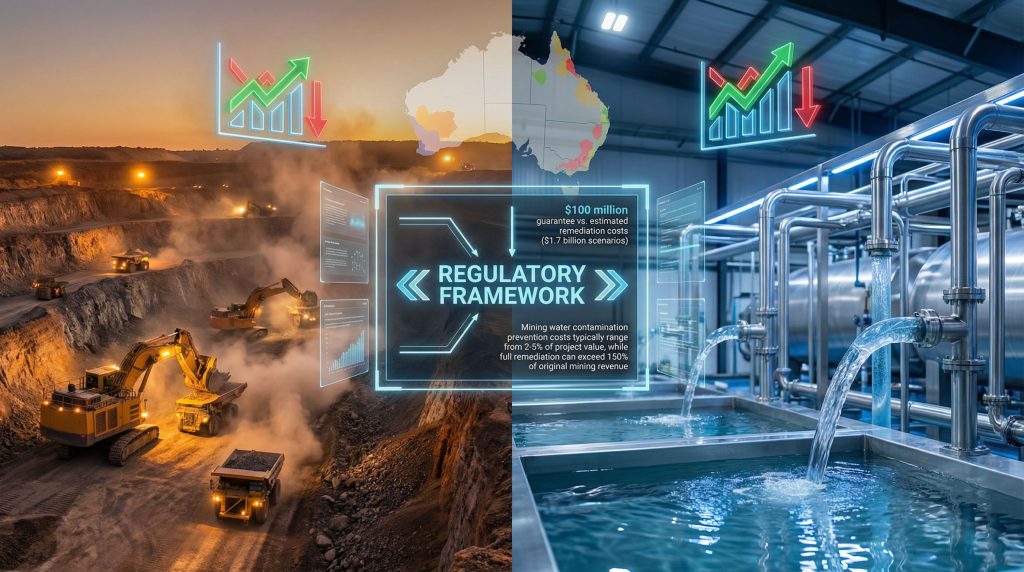
Financial security instruments represent a critical component of mining-water risk management frameworks. Alcoa has provided a $100 million guarantee to fund government responses in the event of impacts to Perth's drinking water supplies. However, Water Corporation internal assessments characterise this amount as insufficient for comprehensive remediation of major pollution incidents, describing it instead as serving primarily as a reasonable disincentive mechanism.
| Financial Security Comparison | Amount | Purpose | Adequacy Assessment |
|---|---|---|---|
| Alcoa Water Guarantee | $100 million | Emergency response funding | Characterised as insufficient for major remediation |
| Typical Mining Bonds | Varies by project | Site rehabilitation | Often inadequate for water infrastructure impacts |
| Insurance Coverage | Project-specific | Operational liability | Gaps commonly exist for long-term water treatment |
The economic modelling of prevention versus remediation strategies reveals significant cost disparities. Prevention measures, including enhanced monitoring systems and protective infrastructure, typically represent a small percentage of total project costs. In contrast, comprehensive water supply remediation following major contamination can require massive infrastructure investments and long-term treatment systems.
Consumer cost implications of water supply disruptions extend beyond immediate remediation expenses to include alternative supply development, infrastructure redundancy requirements, and potential long-term water treatment obligations. These broader economic impacts often exceed the financial security instruments typically required from mining operations.
Environmental Impact Assessment Processes and Water Security Integration
Current environmental impact assessment frameworks often evaluate mining projects through sector-specific lenses that may inadequately address cumulative water security implications. The assessment of individual projects within broader catchment systems requires integrated analysis capabilities that traditional EIA processes may not fully accommodate.
Environmental impact assessments frequently focus on direct operational impacts without comprehensively modelling cumulative effects on regional water system resilience and long-term supply security.
Multi-stage approval processes involve sequential reviews through different regulatory agencies, each applying specific evaluation criteria. While this approach ensures thorough technical assessment, it can create coordination challenges when water security considerations span multiple jurisdictions and regulatory frameworks.
Independent scientific review panels provide additional oversight, but their effectiveness depends significantly on access to comprehensive operational data and the authority to require adaptive management responses. Community consultation requirements add important stakeholder perspectives but may lack technical frameworks for evaluating complex hydrogeological impacts.
Adaptive Management Requirements
Effective mining-water governance requires dynamic regulatory responses that can adapt to changing environmental conditions and emerging risks. Real-time monitoring systems enable continuous assessment of water quality parameters, but their implementation depends on establishing appropriate trigger points and response protocols.
Dynamic regulatory components include:
• Automated water quality monitoring with immediate alert capabilities
• Graduated response protocols linking monitoring results to operational modifications
• Technology upgrade requirements ensuring monitoring systems maintain current standards
• Regular review mechanisms for updating environmental management plans
Automatic operation suspension protocols represent the most stringent adaptive management tool, but their implementation requires clear trigger criteria and established enforcement mechanisms. The effectiveness of such protocols depends on integrated monitoring systems and coordination between regulatory agencies.
International Regulatory Framework Comparisons
Comparative analysis of global mining-water governance models reveals diverse approaches to managing resource extraction near water infrastructure. Canadian mining water protection standards emphasise comprehensive watershed management and mandatory community consultation throughout project lifecycles. These frameworks often require detailed hydrogeological modelling and long-term monitoring commitments extending beyond operational periods.
European Union water framework directives establish integrated catchment management approaches that require mining operations to demonstrate compatibility with broader water resource protection objectives. These frameworks prioritise water security as a fundamental public interest that can override specific sectoral development priorities under defined circumstances.
Furthermore, examining global exploration licenses reveals varying international approaches to balancing resource development with environmental protection requirements.
| International Framework | Key Features | Water Protection Priority |
|---|---|---|
| Canadian Standards | Watershed management focus | High integration requirements |
| EU Water Directive | Catchment-based approach | Water security prioritisation |
| Chilean Protocols | Water allocation transparency | Balanced resource access |
| South African Bonds | Comprehensive rehabilitation | Long-term liability coverage |
Technology integration requirements in advanced regulatory frameworks increasingly emphasise continuous monitoring, data transparency, and predictive modelling capabilities. These systems enable proactive risk management rather than reactive incident response, potentially reducing both environmental impacts and regulatory compliance costs.
Regulatory Reform Pathways for Enhanced Water Protection
Integrated mining-water management legislation could address current coordination challenges by establishing unified oversight authorities with comprehensive jurisdiction over both mining operations and water resource protection within designated catchment areas. Such frameworks would require mandatory water utility participation in mining approval processes and establish clear protocols for information sharing and site access.
Effective water-mining regulation requires structured dialogue between utilities, mining companies, environmental groups, and affected communities throughout entire project lifecycles, from initial planning through post-closure monitoring.
Enhanced insurance requirements represent another potential reform mechanism. Mandatory comprehensive water contamination coverage could internalise long-term remediation costs and provide stronger financial incentives for prevention-focused operational practices. Such requirements would need careful calibration to avoid creating barriers to legitimate mining activities while ensuring adequate protection for water infrastructure.
Public interest override provisions could establish clear legal frameworks for prioritising water security when conflicts arise between mining development and public water supply protection. These mechanisms would require detailed criteria for activation and established processes for balancing competing interests fairly.
The development of comprehensive mining claims framework models provides valuable insights into structuring these regulatory relationships effectively.
Stakeholder Engagement Framework Improvements
Independent advisory panel structures can facilitate ongoing dialogue between mining operators, water utilities, and community representatives. Effective panels require diverse expertise, access to operational data, and authority to recommend binding management modifications when water security risks emerge.
Structured engagement protocols should include:
• Regular public reporting on water quality monitoring results
• Community participation standards in mining approval processes
• Conflict resolution mechanisms for competing resource use claims
• Long-term monitoring obligations extending beyond operational periods
Public participation standards need enhancement to ensure meaningful community input into technical decisions affecting water security. This includes providing accessible information about hydrogeological impacts and establishing forums for ongoing dialogue about adaptive management decisions.
The next major ASX story will hit our subscribers first
Economic Implications of Strengthened Mining-Water Regulation
Enhanced regulatory compliance requirements would impose additional costs on mining operations, including investments in advanced monitoring systems, expanded insurance coverage, and enhanced reporting capabilities. However, these costs must be evaluated against the potential economic impacts of water supply disruptions and long-term environmental remediation obligations.
| Compliance Enhancement | Estimated Cost Impact | Risk Reduction Benefit |
|---|---|---|
| Continuous monitoring systems | Moderate capital investment | Significant early warning capability |
| Comprehensive insurance coverage | Ongoing premium increases | Complete remediation cost protection |
| Enhanced reporting protocols | Administrative burden increase | Improved risk assessment accuracy |
| Technology upgrade requirements | Periodic capital investments | Sustained monitoring effectiveness |
Regional economic considerations extend beyond direct compliance costs to encompass broader implications for investment attraction and long-term economic sustainability. Robust regulatory frameworks can enhance investor confidence by providing clear operational parameters and reducing uncertainty about environmental liability exposure.
Employment implications of stricter environmental standards require careful analysis. While enhanced compliance requirements may increase operational costs, they also create opportunities for environmental services, monitoring technology, and specialised expertise development. Long-term employment sustainability often benefits from ensuring the environmental integrity of regional water resources.
Water security provides foundational support for diversified economic development, including agricultural activities, urban expansion, and industrial operations requiring reliable water supplies. Investment in robust mining-water governance frameworks supports broader regional economic resilience through sustainable resource management practices.
Frequently Asked Questions: Mining-Water Regulatory Challenges
What enforcement powers do water utilities possess regarding mining operations?
Water utilities typically possess limited direct enforcement authority over mining operations within their catchment areas. Their influence generally operates through collaborative arrangements with environmental regulators rather than independent enforcement capabilities. Water Corporation's approach involves engaging through established advisory groups and working with DWER to address access and data-sharing challenges rather than exercising direct regulatory authority.
How are mining companies held accountable for water-related environmental incidents?
Accountability mechanisms include financial penalties, remediation requirements, and operational modifications mandated through environmental regulators. Recent enforcement actions demonstrate regulatory willingness to impose substantial penalties, with Alcoa facing a $55 million fine for unlawful forest clearing activities, though this penalty addressed environmental rather than specific water contamination violations.
Mining companies may also face ongoing monitoring obligations and requirements for adaptive management responses when environmental incidents occur. However, the effectiveness of these mechanisms depends significantly on detection capabilities and coordination between regulatory agencies.
What role can communities play in mining-water governance?
Community involvement operates through multiple channels including public consultation during approval processes, ongoing monitoring and advocacy activities, and participation in advisory structures. Environmental advocacy organisations like the WA Forest Alliance have successfully used Freedom of Information requests to obtain critical documents revealing regulatory challenges and have called for enhanced government action on water protection issues.
Formal consultation requirements exist for major mining approvals, but the effectiveness of community input depends on access to technical information and meaningful opportunities to influence decision-making processes. Enhanced community engagement frameworks could provide more structured roles for public participation in ongoing monitoring and adaptive management decisions.
Furthermore, recent investigations have revealed concerning patterns of limited oversight at mining operations, highlighting the importance of community vigilance in protecting water resources.
Integrated Mining-Water Governance for Sustainable Resource Management
The complex regulatory challenges surrounding mining operations near water infrastructure require comprehensive governance frameworks that integrate environmental protection, economic development, and public safety considerations. Current regulatory gaps, including information sharing limitations, site access restrictions, and coordination challenges between agencies, demonstrate the need for systematic reform approaches.
Effective mining-water regulation requires proactive integration of water security considerations into all stages of mining project development and operation, from initial planning through long-term post-closure monitoring and management.
The documented tensions between Water Corporation and Alcoa exemplify broader systemic challenges that require coordinated regulatory responses. Successful regulatory modernisation will likely require enhanced stakeholder engagement protocols, strengthened financial security mechanisms, and improved technology integration for real-time monitoring and risk assessment. International best practices suggest that unified regulatory approaches with clear water security prioritisation can provide effective frameworks for managing competing resource demands.
However, the ongoing tensions between Water Corporation and Alcoa regarding site access and information sharing highlight persistent challenges in achieving this coordination. Long-term sustainability depends on establishing governance mechanisms that can adapt to changing environmental conditions, emerging technologies, and evolving community expectations. Investment in robust mining-water regulatory frameworks supports both environmental protection and economic development by providing clear operational parameters and reducing uncertainty for all stakeholders involved in complex resource management decisions.
In conclusion, addressing the tensions between Water Corporation and Alcoa requires systematic reform that acknowledges the fundamental importance of water security while providing clear frameworks for sustainable mining operations. These challenges demand immediate attention to prevent further deterioration of regulatory relationships and ensure the protection of critical water infrastructure for future generations.
Looking to capitalise on mining investment opportunities in Western Australia?
Discovery Alert's proprietary Discovery IQ model delivers real-time alerts on significant ASX mineral discoveries, instantly empowering subscribers to identify actionable opportunities ahead of the broader market. Begin your 14-day free trial today and secure your market-leading advantage in the dynamic Australian mining sector.