May 19, 2026
Understanding Terminal Automation: Beyond Traditional Coal Handling
The evolution of bulk commodity handling represents a fundamental shift in how industrial operations approach efficiency, safety, and environmental stewardship. Advanced automation systems are transforming traditional coal terminals from labour-intensive operations into precision-engineered facilities that maximise throughput whilst minimising environmental impact. Furthermore, this transformation aligns with broader data-driven mining operations trends reshaping the industry.
Modern coal export terminals operate under increasing pressure to optimise performance across multiple dimensions simultaneously. These facilities must balance operational efficiency, environmental compliance, workforce stability, and competitive positioning in global markets. The integration of automated systems addresses these challenges through coordinated technological solutions.
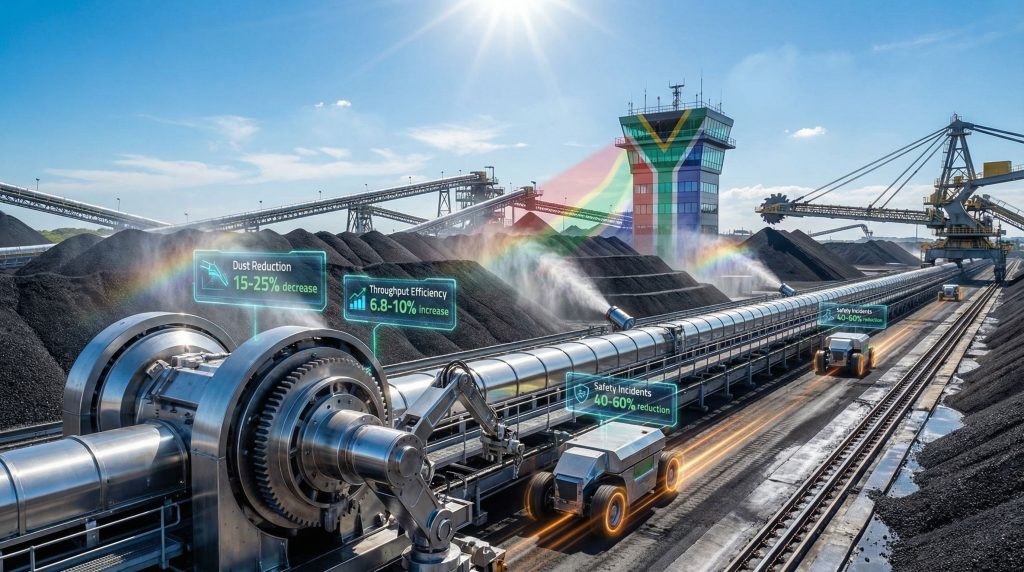
Key Performance Indicators for Automated Coal Terminals:
| Metric | Traditional Operations | Automated Systems | Improvement Range |
|---|---|---|---|
| Dust Reduction | Manual monitoring | Real-time sensors | 15-25% decrease |
| Throughput Efficiency | Operator-dependent | Algorithm-optimised | 6.8-10% increase |
| Positioning Accuracy | ±500mm tolerance | ±50mm precision | 90% improvement |
| Safety Incidents | Higher exposure risk | Remote operation | 40-60% reduction |
The transition to automated coal handling systems represents more than technological upgrading. It fundamentally alters how terminals approach operational planning, workforce development, and environmental management. This transformation creates opportunities for enhanced precision in coal stacking, improved quality control, and reduced operational risks.
Advanced stacker-reclaimer systems achieve millimetre-accurate positioning through integrated control architectures. These systems coordinate multiple operational parameters simultaneously, enabling continuous operation during optimal conditions whilst maintaining strict environmental compliance standards.
When big ASX news breaks, our subscribers know first
What Strategic Benefits Drive Coal Terminal Automation Investment?
The economic justification for terminal automation extends beyond simple efficiency gains to encompass comprehensive operational transformation. Strategic automation initiatives deliver measurable returns through multiple interconnected value streams that compound over time. In addition, this trend reflects the broader mining industry evolution towards technologically advanced operations.
Primary Value Drivers:
• Precision Stacking: Millimetre-accurate coal placement maximises stockyard capacity utilisation
• Continuous Operation: 24/7 unmanned capabilities during optimal weather windows
• Predictive Maintenance: Real-time equipment monitoring prevents costly breakdowns
• Quality Control: Automated sampling ensures consistent coal grade management
The South African coal sector demonstrates how public-private collaboration can achieve significant performance improvements. Recent industry developments show that coordinated efforts between government entities and private operators have generated substantial operational gains through systematic implementation of best practices. Engineering News reports that these initiatives have resulted in enhanced vessel loading efficiency.
Secondary Benefits:
• Environmental compliance through dust suppression
• Workforce upskilling rather than displacement
• Enhanced safety through remote operation protocols
• Data-driven decision making for vessel scheduling
Terminal automation creates opportunities for workforce development rather than job displacement. The zero-retrenchment approach demonstrates how technological advancement can coexist with employment stability through strategic skills transition programs.
How Do Modern Stacker-Reclaimer Systems Achieve Operational Efficiency?
Contemporary automated coal handling relies on sophisticated control systems that manage complex operational sequences with unprecedented precision. These systems integrate multiple technological components to create seamless operational workflows. Furthermore, AI in mining efficiency has contributed significantly to these advancements.
Core Technology Components:
• Inverter-Controlled Travel Systems: Enable precise positioning across stockyard areas
• Regenerative Braking: Captures energy during deceleration cycles
• PLC Integration: Coordinates sequencing between multiple machines
• Central Control Rooms: Provide comprehensive operational oversight
The implementation of fully automated stacker-reclaimer systems at major terminals represents a significant technological milestone. These systems operate with efficiency levels that exceed traditional manual operations whilst simultaneously reducing environmental impact through optimised dust suppression.
Operational Workflow Optimisation:
-
Coal Receipt Planning: Automated systems calculate optimal stacking patterns
-
Stockyard Management: Dynamic allocation prevents cross-contamination
-
Reclaim Scheduling: Coordinated with vessel arrival forecasts
-
Quality Assurance: Continuous monitoring throughout handling process
Advanced automation systems achieve performance improvements in the range of 6.8% to 10% over traditional operations. These gains result from optimised equipment utilisation, reduced idle time, and improved coordination between different operational components.
The environmental benefits of automated systems extend beyond operational efficiency. Dust reduction capabilities represent a significant advantage for terminals operating in proximity to residential areas or sensitive ecological zones. Moreover, this aligns with mine reclamation innovations focusing on environmental stewardship.
What Economic Models Support Zero-Retrenchment Automation Strategies?
The integration of automation technology with workforce preservation strategies demonstrates how technological advancement can enhance rather than replace human capabilities. This approach requires comprehensive economic modelling that accounts for long-term value creation.
Workforce Development Framework:
• Skills Migration: Equipment operators transition to system supervisors
• Technical Training: Enhanced competencies in automation management
• Safety Enhancement: Remote operation reduces workplace hazards
• Career Progression: New opportunities in data analysis and system optimisation
The successful implementation of zero-retrenchment automation demonstrates that technological advancement can coexist with employment stability. This model requires strategic planning that addresses both immediate operational needs and long-term workforce development objectives.
Economic Justification Model:
| Investment Category | Traditional Approach | Automation Strategy | Long-term Impact |
|---|---|---|---|
| Labour Costs | High turnover risk | Stable, skilled workforce | Reduced recruitment |
| Training Investment | Basic equipment operation | Advanced system management | Higher productivity |
| Safety Costs | Incident-reactive | Prevention-focused | Lower insurance |
| Efficiency Gains | Incremental improvements | Step-change optimisation | Competitive advantage |
Automation strategies that prioritise workforce preservation require comprehensive training programs that prepare employees for enhanced roles in system management and oversight. These programs represent significant upfront investment but generate sustained returns through improved operational stability. Additionally, this approach supports women in mining leadership development initiatives.
The economic benefits of zero-retrenchment automation extend beyond immediate cost savings to include enhanced organisational knowledge retention, improved employee morale, and reduced recruitment expenses.
Which Automation Technologies Deliver Maximum ROI in Coal Terminals?
Strategic automation implementation requires phased approaches that minimise operational disruption whilst maximising return on investment. Successful terminals adopt systematic technology deployment strategies that build capabilities incrementally.
Phase 1: Foundation Systems
• Core stacker-reclaimer automation
• Central control room establishment
• Initial operator training programs
• Performance baseline establishment
The foundation phase establishes essential automation infrastructure whilst maintaining operational continuity. This approach allows terminals to validate system performance before expanding automation scope.
Phase 2: Expansion
• Additional equipment integration
• Advanced predictive analytics
• Cross-system coordination protocols
• Environmental monitoring enhancement
Phase 3: Optimisation
• Autonomous stockyard operations
• AI-driven scheduling algorithms
• Integrated supply chain coordination
• Continuous improvement protocols
The phased implementation approach enables terminals to capture immediate benefits whilst building toward more sophisticated automation capabilities. This strategy reduces implementation risk whilst providing opportunities to refine operational procedures.
Investment prioritisation focuses on technologies that deliver measurable performance improvements with acceptable payback periods. Terminal operators evaluate automation technologies based on their potential to enhance throughput, reduce operating costs, and improve environmental compliance.
How Does Terminal Automation Impact South African Coal Export Competitiveness?
Automated coal terminals provide significant competitive advantages in international markets through enhanced operational reliability and cost-effectiveness. These advantages become increasingly important as global coal markets evolve.
Operational Reliability:
• Consistent vessel turnaround times
• Reduced weather-related delays
• Predictable throughput capacity
• Enhanced coal quality control
The South African coal export sector demonstrates how coordinated industry efforts can generate substantial performance improvements. Public-private collaboration has achieved approximately 10% performance enhancement through systematic implementation of operational best practices and technological improvements. Daily Maverick highlights the significant export volume increases achieved through these initiatives.
Cost Structure Optimisation:
• Lower operational costs per tonne
• Reduced demurrage charges
• Improved asset utilisation
• Enhanced maintenance efficiency
Automation enables terminals to respond more effectively to market demand fluctuations whilst maintaining consistent service quality. This flexibility provides competitive advantages in dynamic global coal markets where operational reliability commands premium pricing.
Market Responsiveness:
• Flexible handling of different coal grades
• Rapid response to market demand changes
• Optimised logistics coordination
• Enhanced customer service delivery
The competitive positioning of South African coal exports benefits significantly from terminal automation investments. These improvements support the sector's economic contribution whilst positioning operators for success in evolving international markets.
The next major ASX story will hit our subscribers first
What Risk Management Considerations Apply to Coal Terminal Automation?
Comprehensive risk assessment and mitigation strategies are essential for successful automation implementation. Terminal operators must address technical, operational, and business continuity risks throughout the automation lifecycle.
Technical Risk Mitigation:
• Redundant system architecture
• Manual override capabilities
• Comprehensive backup procedures
• Regular system testing protocols
Automation systems require robust risk management frameworks that address potential failure modes and operational contingencies. These frameworks ensure operational continuity even when primary automation systems experience disruptions.
Operational Risk Management:
• Gradual transition timelines
• Parallel system operation periods
• Extensive operator training
• Performance monitoring systems
The transition to automated operations requires careful management of operational risks during implementation phases. Successful transitions maintain service levels whilst building operator confidence in new systems.
Risk management strategies must address cybersecurity considerations as automation systems become increasingly networked and data-dependent. Terminal operators implement comprehensive security protocols to protect operational systems from potential cyber threats.
How Do Environmental Benefits Align with Automation Investment?
Modern coal handling automation delivers measurable environmental improvements that support regulatory compliance and community relations. These benefits represent significant value beyond operational efficiency gains.
Dust Management Systems:
• Real-time monitoring and suppression
• Optimised water spray systems
• Weather-responsive operation protocols
• Community impact reduction
Environmental considerations play an increasingly important role in terminal operations as regulatory requirements become more stringent. Automation systems enable proactive environmental management through continuous monitoring and responsive control systems.
The dust reduction capabilities of automated systems provide significant environmental benefits for terminals operating near populated areas. These improvements support community relations whilst ensuring compliance with atmospheric emission standards.
Energy Efficiency Gains:
• Regenerative braking systems
• Optimised equipment utilisation
• Reduced idle time operations
• Smart grid integration potential
Energy efficiency improvements from automation contribute to reduced operational costs whilst supporting environmental sustainability objectives. These benefits align with broader industry trends toward more sustainable operations.
What Future Developments Will Shape Coal Terminal Automation?
The automation landscape continues evolving with new capabilities that promise further operational improvements. Terminal operators monitor emerging technologies for potential integration opportunities that enhance competitiveness.
Artificial Intelligence Applications:
• Predictive maintenance algorithms
• Optimal scheduling systems
• Quality prediction models
• Supply chain optimisation
Artificial intelligence technologies offer potential for significant operational improvements through enhanced decision-making capabilities and predictive analytics. These technologies enable terminals to optimise operations proactively rather than reactively.
Internet of Things (IoT) Integration:
• Comprehensive sensor networks
• Real-time data analytics
• Remote monitoring capabilities
• Integrated reporting systems
IoT integration enables comprehensive monitoring and control capabilities that extend automation benefits throughout terminal operations. These technologies support data-driven decision making and continuous operational optimisation.
Digital Twin Technology:
• Virtual system modelling
• Scenario planning capabilities
• Training simulation environments
• Performance optimisation tools
Digital twin technologies provide opportunities for enhanced system optimisation through virtual modelling and simulation capabilities. These tools enable operators to test operational strategies without disrupting actual operations.
Strategic Implementation Framework for Terminal Modernisation
Successful automation implementation requires comprehensive planning that addresses operational, financial, and organisational considerations. Terminal operators benefit from systematic approaches that minimise risk whilst maximising operational improvements.
The automation at the Richards Bay Coal Terminal demonstrates how strategic technology implementation can simultaneously improve operational efficiency, maintain workforce stability, and enhance environmental performance. This approach provides a blueprint for modernisation initiatives that balance technological advancement with social responsibility.
The key to successful automation lies in comprehensive planning that addresses immediate operational needs whilst building capabilities for future expansion. This requires coordination between technical implementation, workforce development, and environmental management objectives.
Strategic automation initiatives create competitive advantages through improved operational reliability, reduced costs, and enhanced environmental performance. These benefits position terminals for success in evolving global markets whilst supporting sustainable operational practices.
Disclaimer: This analysis is based on available industry information and expert observations. Performance metrics and projections may vary depending on specific operational conditions and implementation approaches. Readers should consult with qualified professionals before making investment or operational decisions based on this content.
Want to Capitalise on the Next Major Mining Discovery?
Discovery Alert's proprietary Discovery IQ model delivers real-time alerts on significant ASX mineral discoveries, instantly empowering subscribers to identify actionable opportunities ahead of the broader market. Understand why historic discoveries can generate substantial returns by visiting Discovery Alert's dedicated discoveries page, and begin your 14-day free trial today to position yourself ahead of the market.