July 15, 2026
The Blast Face Problem Underground Mining Has Never Truly Solved
Every technology revolution in underground mining has confronted the same stubborn reality: the blast face remains one of the most hazardous locations in any hard-rock operation. Despite decades of mechanisation, the fundamental sequence of drilling, charging, blasting, ventilating, and re-entering headings has kept workers uncomfortably close to the most dangerous zones in the mine. The question that has occupied engineers and safety professionals alike is not whether automation can help, but how to redesign the entire blast cycle workflow so that human proximity to the active face becomes a choice rather than a necessity.
It is within this context that the TesMan Dyno Nobel partnership in underground mining technology takes on its full significance. This collaboration is not simply a product integration announcement. It represents a structural rethinking of how explosives handling, robotic deployment, and blast cycle management can be combined into a unified operational system — one that addresses both the safety deficit and the productivity ceiling that have long constrained underground hard-rock mining.
When big ASX news breaks, our subscribers know first
Why the Blast Face Is a Uniquely Hostile Environment
To understand why this partnership matters technically, it is worth examining exactly what makes the blast face so dangerous. Underground headings, particularly in narrow-vein hard-rock operations, create a combination of hazards that are difficult to manage simultaneously:
- Residual post-blast gases, including carbon monoxide, nitrogen oxides, and undetonated fume, accumulate in confined headings before ventilation fully clears the area
- Loose ground, fractured rock, and disturbed stope walls create falling material risks that are difficult to assess remotely
- Restricted geometry limits both visibility and escape routes for personnel working at the face
- The charging phase, when workers physically load explosives into drilled holes, places them at maximum proximity to all of these hazards simultaneously
The conventional underground blast cycle involves a sequential series of tasks: drilling blast holes, charging them with explosive product, connecting initiation systems, firing the round, ventilating the heading, and re-entering to begin mucking. Each transition between these stages involves decisions about when it is safe to return and, critically, how long workers must remain in proximity to the charged face during the loading phase itself.
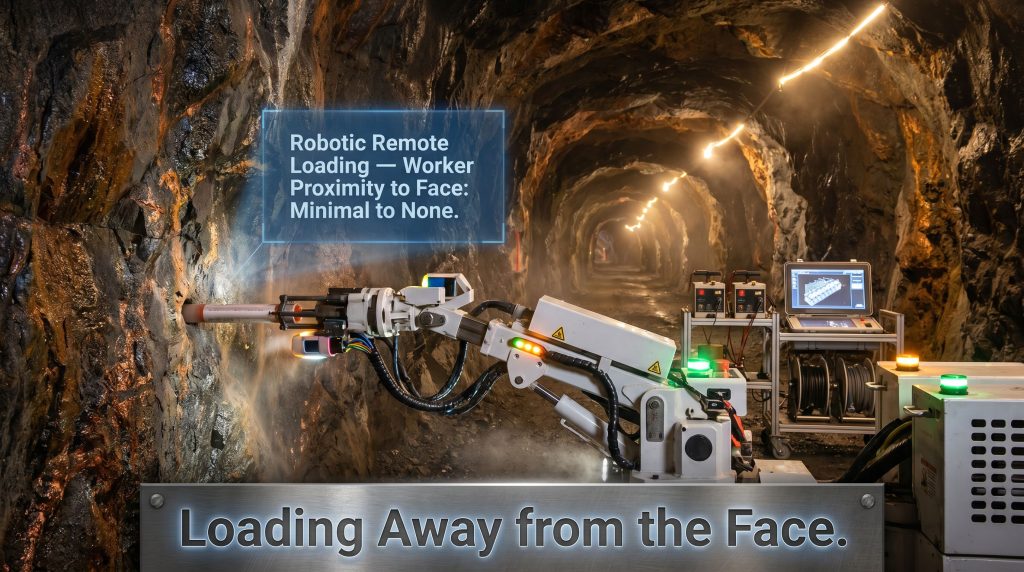
The concept of loading away from the face reframes this problem entirely. Rather than asking how to make face proximity safer, it asks how to eliminate the requirement for face proximity during the charging phase altogether. This is the operational philosophy at the core of what TesMan has been developing from its base in Sudbury, Ontario. Furthermore, underground sensing technology is increasingly enabling real-time awareness of heading conditions that supports this shift in workflow design.
TesMan's Technology Architecture: What Makes It Different
TesMan operates as what might be described as a catalyst technology provider — a company whose value lies not in manufacturing conventional equipment but in integrating hardware and software systems to solve specific workflow problems in underground environments.
The distinction between TesMan's hard and soft technologies is important to understand:
- Hardware systems encompass the robotic platforms capable of navigating confined underground headings, handling explosive payloads, and positioning charges within blast holes without direct human presence at the face
- Software systems include the control interfaces, sensor integration frameworks, environmental monitoring capabilities, and real-time feedback loops that allow operators to manage robotic deployment from a safe standoff distance
Sudbury's role as TesMan's development hub is not incidental. The Sudbury Basin hosts some of the most complex and productive deep hard-rock nickel and copper operations in the world, providing a real-world testing environment of unusual richness. The irregular heading geometries, challenging ground conditions, and operational intensity of Sudbury's underground mines create validation conditions that no controlled test facility could replicate.
Remote Loading: The Step-by-Step Operational Workflow
Understanding what remote loading actually looks like in practice is essential to evaluating the partnership's potential impact. A fully realised remote loading operation under the TesMan model would proceed through a structured sequence:
- The robotic charging platform is deployed into the blast heading from a safe staging area
- Explosive product is loaded into the robotic system at a standoff distance, removing the initial loading exposure from the face environment
- The robot navigates autonomously or under remote operator control through the heading to the blast face
- Charge placement is performed through automated or remotely directed mechanisms, without personnel at the face
- Workers remain in designated safe zones throughout the charging and initiation phases
- The blast round is fired using a digital electronic detonation system, also operated remotely
- Automated environmental sensors confirm atmospheric clearance before any re-entry authorisation is issued
This workflow depends on several enabling technologies operating in concert: reliable underground communication infrastructure (typically mesh networking capable of maintaining signal integrity in complex heading geometries), real-time underground positioning systems, proximity detection sensors, and integration with blast management software platforms. In addition, underground ore analysis tools are beginning to feed directly into these integrated workflows, providing richer data at the face.
What Dyno Nobel Brings Beyond the Product
Dyno Nobel, a subsidiary of the Australian industrial chemicals group Incitec Pivot, occupies a position in the explosives sector that goes well beyond product supply. The company has evolved its commercial model toward what the industry describes as integrated blasting solutions, combining explosives products with on-site technical services, blast design engineering, and field support capabilities.
This evolution matters for the TesMan partnership because the blast cycle is a system, not a collection of independent procurement decisions. An explosives company with deep blast design expertise can optimise the interface between robotic charge placement and the physical outcomes of the blast itself, including fragmentation quality, overbreak control, and vibration management.
Pierre Labelle, General Manager of Sales and Commercial for Canada East and Great Lakes at Dyno Nobel, has described the alignment between the partnership and the company's zero harm core value as central to the collaboration's commercial logic. The operational translation of a zero harm commitment is significant: it means safety performance is treated as an engineering design constraint rather than a compliance metric, which in turn shapes which technology partnerships are pursued and on what terms.
When safety functions as a foundational design principle rather than a regulatory obligation, it fundamentally reorders which technology collaborations make commercial sense and which cannot be justified regardless of their productivity case.
The commercial logic extends further. Mines that demonstrably reduce face-proximity incidents lower their insurance exposure, reduce regulatory compliance burden, and protect their social licence to operate — particularly in jurisdictions where community and Indigenous relations are increasingly scrutinised as part of mine development approvals.
Comparing Loading Approaches: Why the Differences Matter
To appreciate the operational step-change that robotic remote loading represents, it is useful to compare it against existing approaches across several dimensions:
| Parameter | Manual Loading | Mechanised Loading | Robotic Remote Loading |
|---|---|---|---|
| Worker Proximity to Face | High | Moderate | Minimal to None |
| Post-Blast Gas Exposure Risk | High | Moderate | Low |
| Cycle Time Flexibility | Variable | Moderate | High |
| Integration with Digital Blasting | Limited | Partial | Full potential |
| Capital Requirement | Low | Medium | High (offset by risk reduction) |
| Overbreak and Dilution Control | Operator-dependent | Improved | Optimisable |
The overbreak and dilution row deserves particular attention. Inconsistent charge placement by manual loaders introduces variability into fragmentation outcomes that can affect ore recovery across the life of mine. A robotic system with precision positioning capability has the potential to place charges with greater consistency, which translates into more predictable blast outcomes, tighter fragmentation size distributions, and reduced dilution of ore with waste material. Over a multi-decade mine life, these gains compound significantly.
The Three Technology Streams Converging Underground
The TesMan Dyno Nobel partnership in underground mining technology sits at the intersection of three distinct automation streams that have been developing in parallel but largely independently across the global underground mining sector:
- Stream 1: Autonomous Equipment — Loaders, haulage trucks, and drill rigs capable of operating without continuous human control, now commercially established at several major underground operations globally
- Stream 2: Digital Blasting Systems — Electronic detonators, remote initiation platforms, and blast optimisation software that have progressively replaced analogue initiation systems over the past two decades
- Stream 3: Robotic Deployment Platforms — Purpose-built robotic systems designed for hazardous or confined underground tasks, the least mature of the three streams in terms of commercial deployment
The TesMan and Dyno Nobel collaboration occupies precisely the convergence point between Streams 2 and 3 — a zone that has been theoretically identified as critical for decades but has seen limited integrated commercial development until now.
This convergence dynamic is meaningful for mine operators evaluating automation roadmaps. Mines that have already invested in digital blasting infrastructure are better positioned to integrate robotic loading platforms because the communication and control systems required for both overlap substantially. Consequently, the TesMan-Dyno Nobel partnership may accelerate adoption among operations that have already committed to electronic detonation systems. Broader mining automation trends suggest that mines investing in digital infrastructure today are best placed to capture these compounding productivity and safety gains.
The next major ASX story will hit our subscribers first
Canada's Sudbury Basin as a Global Proving Ground
The geographic context of this partnership is worth examining on its own terms. Sudbury's mining history stretches back to the 1880s, and the basin's geological complexity — hosting massive sulphide nickel and copper deposits at depths reaching beyond 2,000 metres at some operations — has driven continuous innovation in underground hard-rock technique over more than a century.
Several factors make Sudbury an unusually effective environment for validating new underground technology:
- Active deep operations provide genuine complexity rather than simplified test conditions
- Proximity to a dense network of mining supply chain companies, research institutions, and technical workforce creates rapid iteration capability
- Ontario's regulatory environment, while demanding, has historically supported technology pilots when safety cases are robustly documented
- The concentration of major operators, including Vale's Sudbury operations and Glencore's Nickel Rim South and Fraser mines, creates a receptive early-adopter market within close geographic reach
This compares favourably with other global hard-rock underground automation hubs. Australian programmes, particularly in Western Australian nickel and gold, have focused heavily on autonomous haulage and drill automation. Scandinavian initiatives, led by Swedish and Finnish operators, have advanced automated drill jumbos and remote mucking. Neither cluster has fully resolved the charging and initiation phase of the blast cycle, which is precisely where TesMan and Dyno Nobel are focusing. Furthermore, AI in drilling and blasting is beginning to intersect with robotic charging in ways that could further compress blast cycle times in the years ahead.
Implementation Challenges That Should Not Be Underestimated
Clara Steele, co-owner of TesMan, has framed the company's technology as a catalyst for simultaneously achieving risk reduction and productivity improvement, positioning these as complementary rather than competing objectives. That framing is commercially compelling, but it should not obscure the genuine implementation challenges that remote loading technology faces at scale.
Technical Barriers
- Underground communication networks in complex heading geometries can suffer from signal dropout that interrupts robotic control, requiring redundant mesh network architecture that adds infrastructure cost
- Robotic navigation in truly unstructured underground environments — where floor conditions, water accumulation, and heading dimensions vary unpredictably — remains an unsolved challenge at the frontier of mobile robotics
- Regulatory frameworks governing explosives handling certification have historically been written with human operators in mind and may require revision before robotic systems can be fully certified for autonomous charge placement in all jurisdictions
Workforce and Change Management
The labour dimension of underground automation is often underestimated in technology-focused discussions. In Canadian underground mining, unionised workforces have well-established consultation rights in relation to changes in working conditions and technology deployment. Positioning remote loading as a safety enhancement for existing workers — reducing their exposure to hazardous heading environments rather than eliminating their roles — is both technically accurate and strategically important for managing the transition.
The skills evolution required is also real. Underground crews transitioning to robotic-assisted charging will need competency in remote operation interfaces, robotic system maintenance, and real-time data monitoring. These are different capabilities from the physical proximity tasks they replace, and training pipelines will need to be developed alongside the technology itself. Indeed, mining technology innovation across the sector is demonstrating that workforce upskilling and technology deployment must advance together for adoption to succeed.
The Long Arc Toward Zero-Entry Blast Cycles
The current TesMan Dyno Nobel partnership in underground mining technology represents a meaningful step along a longer trajectory. The near-term target is demonstrable remote loading capability in active underground headings. The medium-term ambition is integration with broader mine automation systems so that robotic charging platforms communicate directly with drill navigation systems, blast management software, and ventilation control to compress the total blast cycle time while removing human presence from hazardous zones.
The long-term destination, as envisioned by the most forward-looking operators and technology developers in the sector, is a zero-entry blast cycle: a complete sequence from hole drilling through to mucking readiness in which human presence in the active heading is not required at any stage. This is not a near-term commercial reality, but it is the logical endpoint of the three automation streams converging in underground mining.
Partnerships like TesMan and Dyno Nobel are establishing the operational and technical foundation on which that future will be built. As reported by International Mining, the collaboration brings together explosives and robotics expertise in a way that reflects growing industry recognition that blast cycle automation requires integrated rather than incremental solutions.
The upcoming Mining Transformed event in Sudbury, where both companies will present and field industry questions about the partnership, represents more than a product showcase. It is an invitation to the underground mining community to engage with a model of integrated blast cycle technology that treats safety and productivity as a unified engineering problem rather than a political trade-off. For those tracking how the sector is evolving, analysis from Geomechanics.io offers additional technical perspective on what the explosives-robotics joint venture means for safety and cycle time in practice.
This article is intended for informational purposes only and does not constitute financial or investment advice. References to operational outcomes, productivity improvements, and technology capabilities reflect current industry research and stated company objectives. Actual results from technology deployment will vary based on mine-specific conditions, regulatory requirements, and implementation factors. Readers considering technology adoption decisions should conduct independent due diligence.
Want to Track the Next Wave of ASX Mining Discoveries Before the Market Does?
The shift toward robotic blast cycle automation and integrated underground technology signals a broader transformation in how mineral resources are found and extracted — and the companies leading that change often create significant investor opportunities. Discovery Alert's proprietary Discovery IQ model scans ASX announcements in real time, instantly identifying significant mineral discoveries and turning complex data into actionable insights for both traders and long-term investors — explore historic discoveries that have delivered exceptional returns or begin a 14-day free trial to position yourself ahead of the market.