May 21, 2026
Why the Tia Maria copper project in Peru matters beyond one mine
Copper markets rarely move in a straight line. Demand expectations can surge on electrification themes, while actual mine supply remains constrained by permits, water access, community acceptance, and construction execution. That gap between global copper optimism and local project reality is exactly why the Tia Maria copper project in Peru attracts so much attention.
Rather than being just another proposed mine, Tia Maria has become a test of whether Peru can translate mineral potential into operating output without repeating the governance failures that have delayed major projects across the country. Furthermore, the project sits at the intersection of mining policy, water politics, rural livelihoods, and investor confidence.
Public reporting as of 29 April 2026 indicates that Southern Copper is targeting first copper cathode production in 2027. On paper, that sounds like momentum. In practice, the credibility of that timeline depends far less on geology than on whether regulatory approvals remain durable and whether social conflict stays contained. Recent coverage from Mining.com on the 2027 start-up target shows how strongly the market is focused on that date.
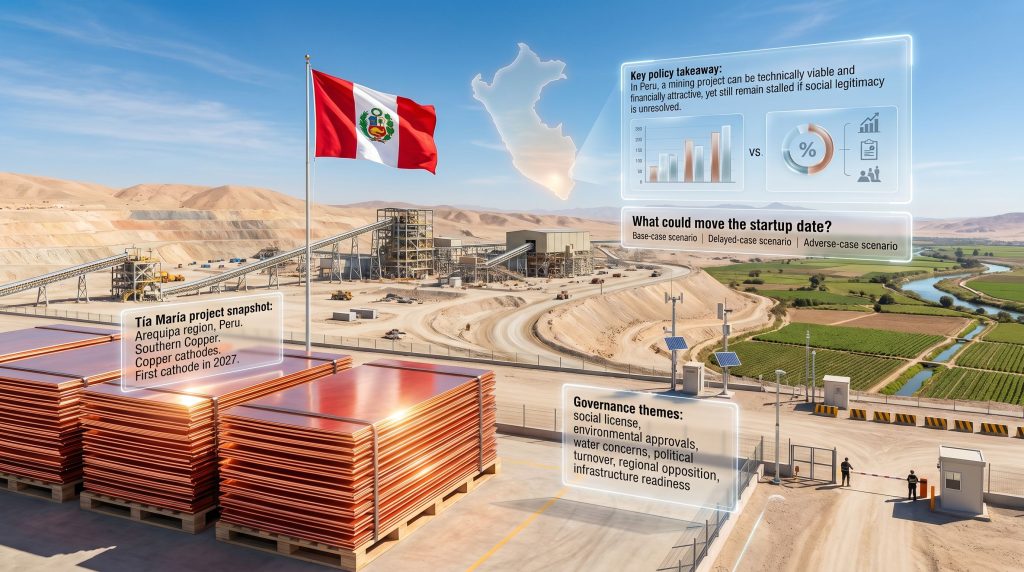
Tia Maria at a glance
The project is a proposed copper cathode development in the Arequipa region of southern Peru, led by Southern Copper. It is widely viewed as important because it could add new copper output, stimulate construction and services activity, and influence wider perceptions of Peru’s ability to advance large mining investments.
At the same time, it has long faced scrutiny over environmental management, especially water, as well as deep opposition in agricultural communities concerned about risk to the Tambo Valley. In addition, basic project references, such as the Tia Maria mine overview, underline just how long the development has remained under public examination.
| Project attribute | Publicly reported detail |
|---|---|
| Jurisdiction | Peru |
| Region | Arequipa |
| Developer | Southern Copper |
| Product | Copper cathodes |
| Public milestone target | First cathode in 2027 |
| Key non-technical risks | Social conflict, local opposition, legal or political delays |
| Core permitting issues | Environmental compliance, water management, construction readiness, local coordination |
When big ASX news breaks, our subscribers know first
How the project fits into Peru’s copper pipeline
Peru remains one of the world’s largest copper-producing countries, so new mine development matters well beyond a single company’s production forecast. Copper supports export earnings, tax collection, royalties, contractor activity, and regional procurement. When a large project advances, markets often read it as a signal that the broader investment climate may be stabilising.
When it stalls, the opposite message can spread quickly. Consequently, Tia Maria is strategically important in policy terms. It is not only about adding tonnes. It is also about whether Peru can improve coordination between the national state, regional authorities, regulators, local communities, and project developers.
This broader setting also connects with wider copper supply crunch concerns, where future demand may outpace viable new production. Likewise, Peru’s development pipeline is often assessed alongside discoveries and district-scale opportunities such as a major copper system.
What policymakers and investors usually watch
For a project like Tia Maria, the most important signals are often non-geological:
- Investment confidence and whether large-scale private capital is still willing to commit to Peru
- Permitting durability and whether past approvals are secure against fresh legal or political turbulence
- Social conflict risk and whether mobilisation on the ground disrupts contractors, roads, or workforce access
- Water governance and whether technical solutions are credible to regulators and local communities
- Execution capability during the transition from announcements to visible construction activity
| Constraint | Why it matters | Likely effect on timeline | Typical mitigation tool |
|---|---|---|---|
| Social licence | Local resistance can stop work regardless of engineering readiness | Delays of months or longer | Community engagement, benefit-sharing, grievance processes |
| Environmental approvals | Legal compliance underpins construction and operations | Can halt or slow mobilisation | Updated studies, regulatory responses, monitoring plans |
| Water concerns | Often the most emotionally and politically sensitive issue | High risk of dispute or injunction attempts | Alternative water sourcing, disclosure, third-party oversight |
| Political turnover | New officials can alter tone, scrutiny, or local alignment | Adds uncertainty | Institutional continuity, formal documentation |
| Regional opposition | Local authorities can complicate logistics and legitimacy | Slows implementation | Intergovernmental coordination |
| Infrastructure readiness | Roads, power, camps, and contractor access affect schedule realism | Pushes out start-up dates | Early-stage pre-construction planning |
Why opposition has been so persistent
For Tia Maria, community conflict is not a side story. It is the central project variable.
The project has for years been associated with resistance linked to environmental fears, distrust of mining commitments, and concern that agriculture could bear the downside while outsiders capture much of the upside. In the Tambo Valley, farming is not a marginal issue. Rather, it is a livelihood base, a source of identity, and a political organising point.
Key concerns commonly raised in public debate include:
- Potential harm to agriculture and irrigation-dependent activity
- Doubts about how water would be sourced and protected
- Concern over dust, emissions, and transport-related impacts
- Weak trust in whether promises on jobs or local development would be fulfilled
- Long memories of earlier unrest and fatalities tied to past conflict episodes
Key policy takeaway: A mining project can be technically viable and financially attractive, yet remain stalled for years if local legitimacy is unresolved.
A crucial misunderstanding in mining commentary is the belief that a strong commodity market can override opposition. However, higher copper prices can improve project economics, but they do not automatically fix social acceptance. In some cases, stronger prices can even sharpen local demands for a larger share of benefits.
The regulatory and permitting issues that really matter
Headline announcements often oversimplify project readiness. For Tia Maria, readers should separate formal approvals from practical executability.
A project can have important environmental milestones in place and still face serious delays if protests return, contractors hesitate, or legal challenges emerge. That is especially true in Peru, where the interaction between national ministries, regional politics, and local mobilisation can shape outcomes in ways that a simple permit checklist does not capture.
Understanding those layers matters because mining permitting is rarely a one-step process in contested jurisdictions. Moreover, project developers often rely on strong stakeholder alignment or even copper project partnerships to reduce financing and execution risk.
Regulatory topics that deserve close attention
- Environmental impact framework and whether all underlying conditions remain current and defensible
- Water management commitments including source design, monitoring, and emergency safeguards
- Land access and local coordination needed for construction and movement of equipment
- Construction permit dependencies that may not be obvious in corporate headline guidance
- Exposure to protests or injunctions that can disrupt timing even without permit cancellation
- National versus regional influence over implementation and local acceptance
What readers often misunderstand
- A company target does not equal irreversible project execution
- An approved environmental framework does not guarantee community acceptance
- National-level policy alignment does not ensure local cooperation
- Start-up schedules can shift quickly if conflict re-emerges during mobilisation
This distinction matters because markets often reward momentum language early, then reprice risk later if on-the-ground progress turns out to be slower than expected.
Is the 2027 first-cathode target realistic?
The short answer is yes in theory, but conditional in practice.
If the question is whether first cathode in 2027 is possible on paper, the answer is that it may be. If the question is whether that target should be treated as highly secure, the answer is no. The biggest swing factor is not likely to be orebody quality alone. Instead, it is whether social, legal, political, and logistical conditions remain stable long enough for uninterrupted execution.
Scenario framework for the start-up date
| Scenario | Trigger | Operational effect | Timeline implication |
|---|---|---|---|
| Base case | Limited disruption and improving local dialogue | Construction progresses broadly as planned | 2027 target remains possible or slips only modestly |
| Delayed case | Renewed protests, administrative friction, or contractor slowdown | Mobilisation and build sequence lose momentum | Start-up moves back by several quarters or longer |
| Adverse case | Escalating opposition, court action, or political weakening | Work pauses despite earlier progress | Timeline becomes open-ended |
A useful investing lens here is to track verifiable milestones rather than optimistic language. In mining, markets can overreact to projected dates while underweighting the importance of access roads, contractor mobilisation, camp set-up, procurement flow, and the absence of disruption for sustained periods.
Important caution: Any timeline discussion is forward-looking and inherently uncertain. Readers should treat production targets as management guidance, not guaranteed outcomes.
Economic upside versus local scepticism
If developed successfully, the Tia Maria copper project in Peru could matter on several economic levels. Nationally, it would support Peru’s broader copper narrative, add export capacity, and contribute to tax and contractor activity. Regionally, it could generate construction jobs, operating roles, service demand, and local procurement opportunities.
But expected benefits and perceived benefits are not the same thing. That gap often explains why mining projects with obvious macroeconomic logic still face intense resistance at the local level. For investors, this is where disciplined copper investment strategies become useful, especially when balancing upside against permitting and social risk.
| Expected benefit | Who benefits first | What could limit that benefit |
|---|---|---|
| Employment | Construction workers, contractors, service firms | Hiring mismatches, low local participation, project delays |
| Procurement | Suppliers, transport, maintenance, catering | Limited local capability or centralised procurement |
| Royalties and taxes | National and subnational public finances | Delays, lower output, governance inefficiency |
| Infrastructure spillovers | Nearby towns and logistics networks | Weak project-community alignment, poor public execution |
| Long-term regional development | Local governments and residents | Failure to convert mining revenue into visible services |
For policymakers, this is a recurring lesson in mining governance: economic models can show value creation, yet if communities do not trust how that value will be shared or protected, those benefits may carry little persuasive force.
The next major ASX story will hit our subscribers first
Why water is the decisive environmental issue
Across mining disputes in agricultural zones, water is often the point where technical design meets public trust. That is especially true for the Tia Maria copper project in Peru.
Communities usually want clear answers to practical questions:
- Where will the project’s water come from?
- Will mining compete with agriculture for supply?
- How will contamination risk be prevented and monitored?
- What happens if there is a failure, spill, or dust-related effect on crops?
Because water concerns are so central, broad reassurance is rarely enough. Therefore, high-quality analysis should link environmental claims to official filings, ministry documents, and clearly attributed company materials rather than generic statements of confidence.
Environmental controls investors and residents should watch
- Water source design, including whether non-traditional supply options reduce pressure on local freshwater systems
- Dust suppression and emissions management during construction and operation
- Monitoring systems and public reporting of compliance results
- Emergency response capability for contamination or operational incidents
- Credible independent oversight or third-party verification mechanisms
Trust signal: Environmental credibility improves when claims are supported by official documentation and transparent monitoring, not by promotional language alone.
What stakeholders should watch next
For anyone tracking the Tia Maria copper project in Peru, the next signals that matter are practical, not rhetorical.
A monitoring framework
- Policy signal: Is Lima still maintaining a consistent line on the project and the regulatory path?
- Local signal: Are district and provincial voices converging towards acceptance or staying resistant?
- Execution signal: Are pre-construction activities, contractor steps, and logistical preparation visible and verifiable?
- Social signal: Is opposition fading, fragmented, reorganising, or escalating?
- Timeline signal: Are milestone dates being met without interruption?
The most useful discipline for investors and analysts is to rank evidence. Visible mobilisation usually matters more than promotional commentary. Likewise, fresh legal disputes may matter more than broad macro copper bullishness. A calm period on the ground can be more informative than a bullish slide deck.
What Tia Maria says about mining governance in Peru
The broad lesson from Tia Maria is that Peru’s copper future depends on execution quality, not just project inventory. A country can have world-class mineral endowment and still struggle to convert pipeline into production if environmental regulation, benefit-sharing, local legitimacy, and political coordination fail to align.
In that sense, Tia Maria is more than a mine development story. It is a case study in how social conflict can become the dominant cost centre, how regulatory certainty can fall short without local trust, and how strong copper demand does not automatically accelerate mine construction.
FAQ
Where is the Tia Maria copper project located?
It is in the Arequipa region of Peru, in the country’s south.
Who is developing the Tia Maria project?
Public reporting identifies Southern Copper as the developer.
What does first cathode in 2027 mean?
It refers to the company’s stated target for initial production of copper cathodes, a refined copper product.
Why has Tia Maria been controversial?
The main issues have been water concerns, environmental risk perceptions, agricultural impacts, distrust of commitments, and a long history of social conflict.
Has Tia Maria received environmental approval?
The project has long been associated with environmental approval debates, but readers should verify the latest status through official Peruvian regulatory documentation and current company filings because approval status and conditions can evolve over time.
What are the main risks to the project timeline?
The biggest risks are renewed protests, legal or administrative challenges, weak local cooperation, water-related disputes, and construction interruption.
How important is Tia Maria to Peru’s copper sector?
It is important not only for potential output, but as a signal about whether Peru can advance large, contested copper investments in a disciplined and durable way.
Final take
The project offers genuine upside, but it also demands caution. It could strengthen Peru’s copper pipeline and support investment sentiment if it moves into stable construction and operation. Still, the central question has not changed: can formal project momentum translate into durable social legitimacy and uninterrupted execution?
That is why the 2027 target should be viewed as a possibility rather than a certainty. For Tia Maria, the path to production will be determined not only by project design or market demand, but by the harder task of aligning regulation, water governance, political consistency, and community trust.
Disclaimer: This article is for informational purposes only and does not constitute financial, legal, environmental, or investment advice. Some timeline discussion involves forward-looking statements based on public reporting available as of 29 April 2026. Actual outcomes may differ materially depending on regulatory, social, political, technical, and market conditions.
Could the Next Major Copper Discovery Re-rate the Market?
Discovery Alert’s proprietary Discovery IQ model delivers real-time ASX mineral discovery alerts that help investors cut through permitting noise and focus on actionable opportunities as they emerge. See how major discoveries have historically driven exceptional returns on the Discovery Alert discoveries page and start a 14-day free trial at the Discovery Alert home page.