May 19, 2026
Understanding Titanium Mineralization Styles in Australian Geology
Global titanium supply chains face increasing pressure as demand grows across aerospace, defense, and industrial applications. Traditional production methods rely heavily on energy-intensive processes and geographically concentrated deposits, creating vulnerability in critical mineral supply networks. Understanding geological formation mechanisms becomes essential for evaluating new discoveries that could reshape titanium availability and processing economics.
Conventional Heavy Mineral Sands vs. Hydrothermal Systems
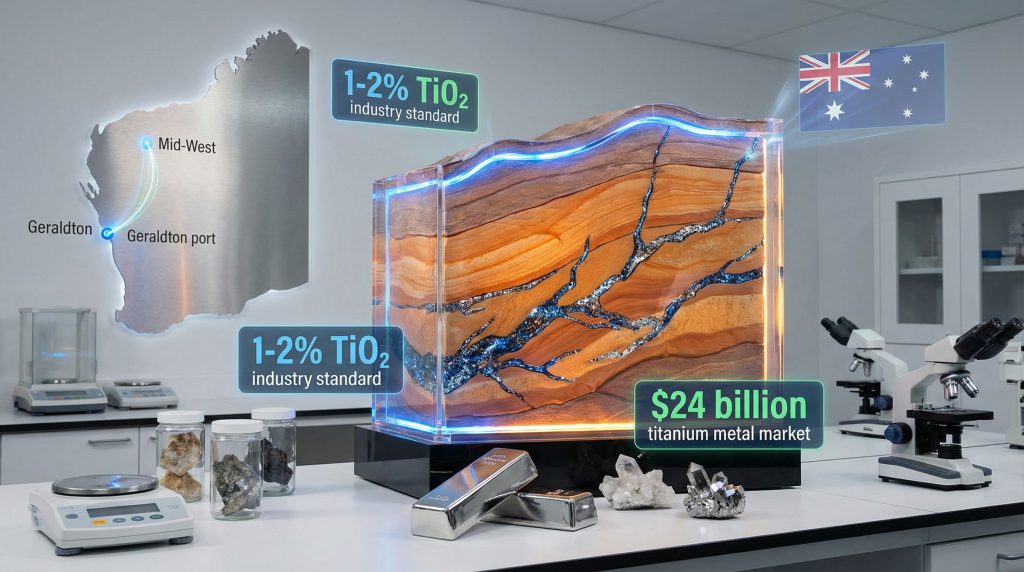
Australia's titanium production has historically centered on coastal mineral sands operations stretching from Geraldton to Perth. These deposits typically contain 1-2% titanium dioxide (TiO₂) distributed through heavy mineral assemblages requiring extensive beneficiation. Processing involves magnetic separation, gravity concentration, and subsequent upgrading to produce rutile and ilmenite concentrates.
The recent titanium discovery in Western Australia at the Pitfield project presents a fundamentally different geological model. This sedimentary basin-hosted system achieved formation through ancient hydrothermal fluid migration, creating mineralization patterns unlike conventional coastal placers or hard rock ilmenite bodies.
| Deposit Type | Average TiO₂ Grade | Processing Method | Energy Requirements |
|---|---|---|---|
| Mineral Sands | 1-2% | Magnetic/gravity separation + kiln processing | High |
| Hard Rock Ilmenite | Variable | Smelting at >1200°C | Very High |
| Pitfield Hydrothermal | 5.1% | Chemical digestion | Moderate |
The Mid-West Region's Geological Foundation
Western Australia's Mid-West region sits above Archean basement structures that influenced basin formation over geological time scales. These ancient rock formations created structural frameworks that guided sediment deposition and subsequent hydrothermal alteration processes. Furthermore, these mineral exploration insights reveal the importance of understanding such geological complexities.
Basin evolution in this region involved multiple episodes of sediment accumulation, structural deformation, and fluid migration. The Pitfield deposit represents the culmination of these processes, where titanium-bearing solutions concentrated within sedimentary sequences over millions of years.
Hydrothermal fluid migration patterns followed structural controls established during Archean crustal formation. These fluids carried dissolved titanium species that precipitated within favorable sedimentary environments, creating the massive mineralized system currently being explored.
When big ASX news breaks, our subscribers know first
How Do Titanium Grades Compare Across Global Deposits?
Industry Benchmark Analysis
The titanium discovery in Western Australia stands out dramatically when compared against established global operations. Traditional mineral sands deposits worldwide maintain grades between 1-2% TiO₂, representing the industry standard for commercially viable operations. Moreover, AI in mining operations is revolutionising how these comparisons are made.
Hard rock ilmenite deposits vary significantly in grade but typically require energy-intensive smelting processes to achieve usable concentrates. These operations face substantial processing costs and carbon footprint challenges due to high-temperature requirements exceeding 1200°C for effective mineral separation.
Pitfield's 5.1% average TiO₂ grade exceeds conventional mineral sands by 2.5-5 times, fundamentally altering mining economics. Higher-grade zones within the deposit approach 10% TiO₂, creating opportunities for selective mining of premium-grade material.
Western Australia's Resource Quality Metrics
Surface weathering processes at Pitfield have created extraordinary advantages for mineral processing. Natural oxidation transformed the upper 40-60 meters of mineralization into anatase—a pure titanium dioxide mineral with characteristics comparable to high-value rutile.
The absence of deleterious elements sets Pitfield apart from many global titanium deposits. Traditional operations often struggle with uranium, thorium, chromium, and vanadium contamination that complicates downstream processing and increases purification costs.
Critical Processing Advantage: Clean geochemical signature eliminates multi-stage purification requirements, reducing both capital expenditure and operating costs compared to conventional titanium operations.
Test work achieved 99.25% pure TiO₂ without conventional battles against problematic elements. This purity level matches high-specification pigment-grade products typically commanding premium market pricing in aerospace and industrial applications. Additionally, understanding mineral deposit tiers guide helps classify such exceptional discoveries.
What Processing Advantages Exist in WA's Titanium Geology?
Metallurgical Characteristics of Weathered Zones
The titanium discovery in Western Australia benefits from unique metallurgical properties created through natural weathering processes. Friable ore structure permits direct excavation without crushing requirements, reducing energy consumption in the initial mining phase.
Natural concentration through surface oxidation created self-upgrading mechanisms over geological time. This process eliminated the need for complex beneficiation circuits typically required in mineral sands operations, where multiple separation stages concentrate titanium minerals from quartz and other gangue materials.
Direct mining without overburden stripping represents a fundamental cost advantage. The 40-60 meter weathered zone provides immediate access to high-grade material without waste rock removal, contrasting sharply with operations requiring significant overburden management.
Chemical Processing Pathways
Processing sequence optimization takes advantage of Pitfield's unique mineralogical characteristics:
-
Mining & Primary Beneficiation
- Free-dig extraction of weathered surface material
- Scrubbing to disaggregate ore particles
- Screening to remove fine material
- Gravity separation to concentrate heavy minerals
-
Flotation Concentration
- Further upgrading of titanium mineral concentrate
- Removal of remaining silicate minerals
- Production of high-grade titanium concentrate
-
Chemical Digestion
- Simplified chemical processing of concentrate
- No smelting or kiln calcination required
- Direct dissolution pathway to titanium-rich solution
-
Product Recovery
- High-purity titanium dioxide precipitation
- Byproduct recovery opportunities (kaolin, other minerals)
- Advanced processing to titanium tetrachloride (TiCl₄)
Energy efficiency gains emerge from avoiding energy-intensive smelting operations required for hard rock ilmenite. Conventional producers utilize rotary kilns exceeding 1200°C for synthetic rutile production, while Pitfield's anatase responds to lower-temperature chemical digestion processes.
How Does Infrastructure Position WA for Titanium Development?
Regional Infrastructure Assessment
Strategic positioning 160km south of Geraldton provides the titanium discovery in Western Australia with exceptional infrastructure access. Established rail connectivity links the Mid-West region directly to port facilities, eliminating the need for new transportation infrastructure development.
| Infrastructure Element | Distance/Availability | Capacity | Development Status |
|---|---|---|---|
| Geraldton Port | 160km via rail/road | Bulk commodity export | Operational |
| Gas Pipeline | Regional network access | Industrial supply | Available |
| Power Grid | WA electricity network | Grid connection | Established |
| Rail System | Mid-West to port | Bulk transport | Operational |
Regulatory Framework for Critical Minerals
Western Australia maintains established environmental assessment processes designed to support large-scale mineral development. The state's regulatory framework provides clear pathways for critical minerals projects, with streamlined approval processes for strategic commodities. In addition, the critical minerals facility demonstrates increasing government support.
The $4.5 billion Critical Minerals Facility managed by Australian Export Finance represents dedicated government support for projects addressing supply chain diversification. This facility specifically targets developments that enhance Western supply chain security for aerospace and defense applications.
Strategic Advantage: Tier 1 jurisdiction status combined with demonstrated infrastructure positions Pitfield as a credible alternative source for Western manufacturing supply chains.
Perth-based metallurgical laboratories provide established technical infrastructure for pilot-scale testing and process development. Multiple internationally recognised institutions offer specialised capabilities in titanium processing metallurgy, accelerating development timelines compared to remote locations requiring field-based research facilities.
What Are the Technical Challenges in Large-Scale Titanium Processing?
Scaling From Laboratory to Commercial Production
The titanium discovery in Western Australia faces critical technical hurdles in transitioning from successful laboratory results to commercial-scale operations. Continuous pilot-scale testing planned for early 2026 represents the next crucial development phase. However, industry innovation trends suggest new technologies may ease this transition.
Pilot plant development requirements include:
- Continuous processing system design capable of handling variable ore compositions
- Quality control protocols ensuring consistent 99.25% TiO₂ purity across production campaigns
- Equipment optimisation for chemical digestion processes unique to Pitfield's mineralogy
- Integration of beneficiation circuits with downstream chemical processing
Commercial production scaling involves substantial engineering challenges beyond laboratory demonstrations. Processing equipment must accommodate the 2.2 billion tonne resource over projected mine life exceeding several centuries, requiring robust systems capable of sustained operation.
Supply Chain Integration Considerations
Developing aerospace-grade titanium tetrachloride production capabilities presents complex technical requirements. This compound serves as the essential feedstock for titanium metal production, requiring precise chemical specifications for aerospace and defence applications.
Market positioning against Chinese production dominance requires establishing reliable supply chains meeting Western quality standards. Current global titanium metal markets valued at approximately $24 billion annually show 4% annual growth, creating opportunities for alternative suppliers offering supply chain security.
Development Timeline: Multiple-year pathway from pilot demonstration to commercial titanium metal production, with intermediate milestones including pigment-grade TiO₂ and titanium tetrachloride achievement.
Strategic supply chain development focuses on serving aerospace manufacturers and defence departments seeking long-term supply security. These customers prioritise supply chain diversification beyond single-country dependencies, creating market opportunities for Western alternative sources.
How Do Geological Dimensions Impact Resource Economics?
Resource Continuity Analysis
The titanium discovery in Western Australia demonstrates exceptional geological continuity across a 40km strike length and 10km width. Geophysical modelling indicates mineralisation continues to depths exceeding 5km, suggesting substantial exploration upside beyond current resource definitions. Furthermore, this extraordinary discovery has captured international attention.
Current drilling has tested approximately 20% of the prospective area, indicating significant resource expansion potential. Systematic exploration across the remaining 80% could substantially increase the 2.2 billion tonne resource base already established.
| Exploration Scenario | Resource Expansion Multiple | Potential Tonnage | Mine Life Impact |
|---|---|---|---|
| 50% area tested | 2.5x current | 5.5 billion tonnes | 500+ years |
| 75% area tested | 3.8x current | 8.4 billion tonnes | 800+ years |
| 100% area tested | 5x current | 11 billion tonnes | 1000+ years |
Mining Method Optimisation
Surface mining advantages in weathered zones create exceptional economic conditions for initial production phases. The 40-60 meter anatase zone permits free-dig extraction without overburden stripping, minimising mining costs and environmental disturbance.
Transition planning for deeper hard rock zones requires different mining methodologies as operations progress beyond the weathered surface. Underground mining techniques may become necessary at depth, though the massive scale suggests open-pit methods could remain viable for extended periods.
Carbon footprint optimisation emerges from reduced waste rock movement compared to conventional operations. Higher grades mean less tonnage movement per unit of titanium dioxide produced, substantially reducing fuel consumption and associated emissions.
The next major ASX story will hit our subscribers first
What Role Does Western Australia Play in Global Titanium Security?
Critical Minerals Strategy Implementation
The titanium discovery in Western Australia aligns directly with national critical minerals strategy objectives focused on supply chain diversification. Tier 1 jurisdiction advantages include political stability, established mining law, and transparent regulatory processes attractive to international investment.
Defence industry supply chain requirements increasingly emphasise supplier diversification beyond single-country dependencies. Aerospace manufacturers face pressure to establish multiple supply sources for critical materials, creating strategic opportunities for Western alternative producers.
Australia's $4.5 billion Critical Minerals Facility provides dedicated financing support for projects meeting strategic objectives. This facility specifically targets developments enhancing Western supply chain security for aerospace, defence, and advanced manufacturing applications.
Market Positioning Against Established Producers
Chinese market dominance in titanium metal production creates supply concentration risks for Western manufacturers. Current production patterns concentrate substantial capacity within single geographic regions, creating vulnerability for aerospace and defence supply chains.
Western alternative source development addresses these strategic concerns through geographically diversified production capacity. The scale of Pitfield's resource base enables long-term supply commitments spanning decades, providing supply security attractive to major industrial consumers.
Strategic Value: Centuries of potential mining life from proven resources, with substantial exploration upside, positions the project as a long-term alternative to concentrated Asian production.
Market entry strategies focus on high-value applications where supply security commands premium pricing. Aerospace-grade titanium tetrachloride and subsequent metal production represent strategic commodities where Western customers prioritise supply reliability over cost optimisation alone.
Technical Processing Specifications and Quality Control
Advanced Metallurgical Pathways
The titanium discovery in Western Australia enables unique processing pathways unavailable to conventional operations. Anatase mineralogy responds to simplified chemical digestion processes, avoiding energy-intensive smelting or kiln calcination typically required for titanium concentrate production.
Chemical processing optimisation focuses on maximising titanium dioxide recovery while maintaining consistent product quality. Test work achieved 99.25% purity without multi-stage purification battles against deleterious elements plaguing conventional operations.
Titanium tetrachloride (TiCl₄) production represents the critical pathway to titanium metal synthesis. This compound requires precise chemical specifications for aerospace applications, demanding rigorous quality control throughout the production process.
Byproduct Recovery and Economic Optimisation
Integrated processing strategies identify opportunities for kaolin and other mineral recovery as valuable byproducts. These secondary revenue streams enhance overall project economics while maximising resource utilisation efficiency.
Waste minimisation through comprehensive mineral recovery reduces environmental footprints compared to single-product operations. Integrated processing approaches align with sustainability objectives while optimising economic returns across multiple product streams.
Regional Development and Agricultural Integration
Land Use Compatibility
The titanium discovery in Western Australia sits beneath established agricultural lands in the wheatbelt region. Mining operations require careful planning to accommodate continued agricultural activities across non-mining areas of the property. Additionally, this development follows recent industry developments that highlight changing approaches to land use.
Progressive rehabilitation strategies enable return of mined areas to agricultural use following resource extraction. The absence of acid-generating minerals simplifies rehabilitation requirements compared to sulfide-bearing operations.
Employment and Economic Impact
Regional development opportunities extend beyond direct mining employment to include processing operations, transportation services, and support industries. Centuries of potential mining life create long-term employment stability attractive to regional communities.
Skills development programmes align with Western Australia's established mining workforce capabilities while addressing specialised requirements for titanium processing operations. Technical training opportunities emerge across geological, metallurgical, and chemical processing disciplines.
Disclaimer: This analysis is based on publicly available information and technical reports. Mineral resource estimates, processing capabilities, and economic projections are subject to further technical studies, market conditions, and regulatory approvals. Investment decisions should consider comprehensive due diligence beyond the scope of this article.
Looking to Stay Ahead of Major Mineral Discovery Announcements?
Discovery Alert instantly alerts investors to significant ASX mineral discoveries using its proprietary Discovery IQ model, turning complex mineral data into actionable insights. Understand why historic discoveries can generate substantial returns by visiting Discovery Alert's dedicated discoveries page, showcasing historic examples of exceptional outcomes, and begin your 30-day free trial today to position yourself ahead of the market.