May 13, 2026
The Engineering Gamble Beneath 4,000 Metres of Ocean
The world's most consequential mineral frontiers have historically been defined by geography. From the copper belts of Central Africa to the nickel laterite deposits of the Philippines and Indonesia, terrestrial geology has dictated the shape of global supply chains for over a century. But the next chapter in critical mineral extraction may not be written on land at all. It may be written on the floor of the Pacific Ocean, nearly four and a half kilometres below the surface, where billions of potato-sized metallic formations have been accumulating over millions of years, largely undisturbed.
The TMC and Allseas nodule collection system represents the most serious commercial attempt yet to access that resource, and the engineering, regulatory, and strategic questions surrounding it are far more complex than a simple mining story.
When big ASX news breaks, our subscribers know first
What Polymetallic Nodules Actually Are and Why They Matter
Before examining the machinery, the commercial structure, or the regulatory environment, it helps to understand the geological reality at the centre of this project. Polymetallic nodules explained are not ore bodies in any conventional sense. They are accretionary formations, built up layer by layer over millions of years through chemical precipitation from seawater and sediment pore water, forming concentrically around a tiny nucleus such as a shark tooth or a fragment of shell.
What makes them extraordinary from a supply chain perspective is their multi-metal composition. A single nodule recovered from the Clarion-Clipperton Zone (CCZ) of the Pacific Ocean carries commercially meaningful concentrations of four minerals that are directly relevant to battery manufacturing:
- Nickel used in cathode chemistries for lithium-ion batteries, particularly NMC formulations
- Cobalt a critical input for energy density and thermal stability in battery cells
- Copper the backbone of electrical conductivity across the entire energy transition
- Manganese increasingly important as battery chemistry shifts toward higher manganese content cathodes to reduce cobalt dependency
In terrestrial mining, these four metals are typically found in separate deposits, each requiring its own mine, its own processing circuit, and its own supply chain. The multi-metal profile of CCZ nodules is geologically unusual and commercially significant, because a single recovery operation theoretically yields feedstock relevant to multiple points of the battery manufacturing process.
The Clarion-Clipperton Zone itself is a roughly 4.5 million square kilometre abyssal plain stretching between Hawaii and Mexico. It hosts some of the highest known concentrations of polymetallic nodules on Earth, sitting loosely on the seafloor surface rather than buried within rock formations, which is the physical characteristic that makes mechanical collection conceptually feasible.
The TMC and Allseas Nodule Collection System: What Has Actually Been Agreed
The Metals Company (TMC) and Allseas, a Netherlands-based subsea construction and engineering firm, have formalised a development and operational contract for what the parties describe as the world's first commercial-scale nodule collection system. The agreement was confirmed in reporting by Canadian Mining Journal on May 12, 2026, with TMC's chair and CEO Gerard Barron describing the contract as the cornerstone of the partnership, establishing the commercial framework for completing development and commissioning of the system before offshore recovery operations begin.
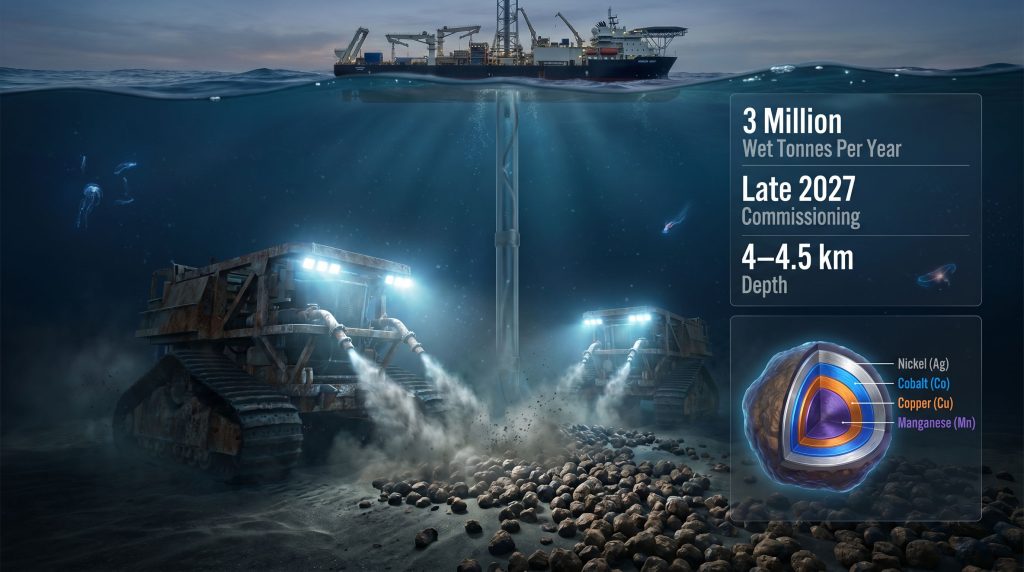
The system is designed to recover 3 million wet tonnes of polymetallic nodules per year from the CCZ, using vehicles that will operate at depths exceeding four kilometres. Commissioning is targeted for late 2027, a timeline that runs parallel to TMC's ongoing engagement with both the International Seabed Authority (ISA) and the US regulatory pathway through the National Oceanic and Atmospheric Administration (NOAA).
What makes this agreement commercially notable is not just the scale of ambition but the funding architecture. Allseas, as the engineering and construction counterpart, carries a substantial portion of the upfront development cost, with cost recovery structured through future production revenue. This arrangement reduces TMC's capital exposure during the pre-production phase while creating a strong incentive alignment between both parties around successful commissioning and operational performance. For further context, Allseas details their nodule collection approach on their official platform.
How the Two-Vehicle Collection Architecture Works
The physical design of the TMC and Allseas nodule collection system reflects a deliberate departure from the extractive logic of conventional mining. Rather than drilling, blasting, or mechanically cutting rock, the system is built around a fundamentally different principle: gentle hydraulic dislodgement.
The collection architecture centres on two self-propelled, tracked vehicles that will traverse the seafloor at depths greater than four kilometres. These vehicles use directed seawater jets to loosen nodules from the surface sediment layer, gathering them without the need for mechanical force against consolidated rock. The tracked mobility system allows the vehicles to navigate the abyssal terrain while maintaining collection efficiency across large seafloor areas.
Once nodules are gathered, they are transported from the seafloor to the surface via a vertical riser pipe using air-lift technology, a method that uses compressed air injection to create an upward flow within the pipe column. At depths of four to four and a half kilometres, this represents a significant engineering feat, requiring precise pressure management across the full column height to maintain stable, continuous flow without damaging the nodules or losing material.
| System Component | Primary Function | Key Design Feature |
|---|---|---|
| Collector Vehicles (x2) | Nodule dislodgement and gathering | Seawater jet propulsion, tracked mobility |
| Vertical Riser Pipe | Nodule transport from seafloor to surface vessel | Air-lift technology across 4-4.5 km depth |
| Launch and Recovery Systems | Deployment and retrieval of collector vehicles | Engineering design at advanced conceptual stage |
| Hidden Gem Production Vessel | Surface processing and logistics hub | Converted bulk carrier platform |
| Transfer Vessel | Nodule offloading to bulk carriers | Seabed-to-shore supply chain link |
The Hidden Gem, a converted bulk carrier vessel, serves as the surface hub for this operation, receiving nodules from the riser system, handling primary processing, and facilitating transfer to bulk carrier vessels for onshore delivery. The conversion of an existing vessel rather than commissioning a purpose-built platform reflects a pragmatic approach to capital management during the development phase.
What the 2022 Pilot Trials Demonstrated
The technical credibility of the TMC and Allseas nodule collection system does not rest on theoretical modelling alone. In 2022, TMC conducted integrated collector vehicle trials in the CCZ that produced the first meaningful seabed nodule collection data since experimental programmes conducted in the 1970s. The scale of those early trials was limited, but the results provided engineering validation for the commercial system concept.
More than 4,500 tonnes of nodules were collected during the CCZ trials, with over 3,000 tonnes successfully lifted to the surface via the riser system. These figures confirmed that the core mechanical concept was operationally viable, even at pre-commercial scale, and that the transition to a three million tonne per year system was an engineering challenge rather than a fundamental physics problem.
Environmental monitoring conducted during and after the trials provided early data on sediment plume behaviour, with observations suggesting that disturbed sediment settled relatively quickly following collection. Follow-up surveys conducted in 2023 documented early indicators of biological activity returning to areas affected by the collector vehicles, though it would be premature to characterise these observations as conclusive evidence of full ecosystem recovery. This remains one of the most closely watched and contested dimensions of the deep-sea mining controversy.
The 2022 trials were significant not because they proved commercial viability at scale, but because they produced real engineering data that no theoretical model could provide. The difference between a concept and a confirmed technical pathway is precisely what those trials were designed to establish.
The Regulatory Landscape: ISA Uncertainty and the NOAA Pathway
Perhaps the most consequential variable sitting outside TMC's direct control is the regulatory environment. Deep-sea mining regulations in international waters fall under the jurisdiction of the International Seabed Authority, an intergovernmental body established under the United Nations Convention on the Law of the Sea. The ISA has been engaged in an extended process of developing a formal mining code, a framework that would govern exploration, extraction, environmental standards, and royalty arrangements for seabed mineral activities in the international zone known as the Area.
As of mid-2026, the ISA continues to deliberate on that regulatory framework, and no final mining code has been adopted. TMC has chosen to advance engineering development in parallel with this process rather than waiting for regulatory resolution, a calculated strategic position that carries both opportunity and risk. If the ISA framework is resolved on a timeline compatible with TMC's 2027 commissioning target, the company stands to capture a meaningful first-mover position.
In parallel, TMC has pursued a US regulatory pathway through NOAA under the Deep Seabed Hard Mineral Resources Act, which provides a mechanism for US-flagged or US-connected operations to obtain a commercial recovery licence for deep seabed minerals. NOAA's assessment of TMC's application has reportedly found it to be compliant with regulatory requirements, which, if a final licence is issued, could position the company for commercial authorisation by early 2027. This timeline aligns directly with the late 2027 commissioning schedule. Furthermore, TMC and Allseas have outlined the commercial terms of this agreement publicly, providing additional transparency for observers tracking regulatory progress.
Investors and industry observers should note that advancing engineering development ahead of final regulatory approval is standard practice in large-scale resource projects. However, it also means that capital deployed before approval is exposed to the risk that approval conditions, delays, or framework changes could alter the commercial equation.
The next major ASX story will hit our subscribers first
Deep-Sea Nodule Mining vs. Terrestrial Mining: An Honest Comparison
One of the more nuanced debates in the critical minerals sector concerns how deep-sea nodule collection compares with conventional terrestrial mining across environmental, operational, and supply chain dimensions. The comparison is not straightforward, and framing it as a binary choice between good and bad extraction misrepresents the complexity involved.
| Dimension | Deep-Sea Nodule Collection | Conventional Terrestrial Mining |
|---|---|---|
| Land Disturbance | No surface land clearing required | Significant, often involving open-cut pits or underground workings |
| Multi-Metal Recovery | Single operation yields Ni, Co, Cu, Mn | Typically single or dual commodity per operation |
| Extraction Method | Seawater jet dislodgement of surface nodules | Drilling, blasting, crushing of consolidated rock |
| Waste Profile | No tailings dams or waste rock piles on land | Tailings dams, overburden piles, acid rock drainage risks |
| Ecosystem Impact | Localised benthic disturbance, plume effects | Surface habitat removal, catchment impacts, community displacement |
| Supply Chain | Seabed-to-vessel-to-shore via maritime logistics | Mine-to-mill-to-refinery-to-port on land |
| Regulatory Maturity | Evolving international framework (ISA) | Established national and jurisdictional frameworks |
TMC has consistently positioned nodule collection as lower-impact than land-based alternatives, noting that the nodules sit unattached on the seafloor surface, requiring no blasting or rock removal. This framing has attracted both support and scrutiny. Marine ecologists have raised concerns about the disturbance of abyssal sediment communities, which are characterised by extremely slow biological processes and potentially very long recovery timescales.
The deep-sea floor hosts unique organisms, many poorly understood, that are adapted to extraordinarily stable low-energy environments. The degree to which those communities can recover from mechanical disturbance remains an active area of scientific inquiry rather than a settled question.
What is clear is that the comparative framing cannot be evaluated in isolation from demand. The global energy transition requires substantial quantities of nickel, cobalt, copper, and manganese regardless of where they come from. The relevant question for policymakers and investors is not whether these minerals should be extracted, but under what conditions, from which sources, and at what environmental cost.
The Strategic Context: Why First-Mover Position in Deep-Sea Mining Has Lasting Implications
The race to establish commercial deep-sea nodule collection capability is not taking place in a strategic vacuum. The concentration of terrestrial critical mineral supply in a small number of countries and jurisdictions has become a visible concern for governments across Europe, North America, and East Asia as they build out domestic clean energy and electrification infrastructure. Furthermore, critical minerals and energy security have become central policy priorities across multiple jurisdictions seeking to reduce supply chain vulnerabilities.
Cobalt supply, for instance, is heavily concentrated in the Democratic Republic of Congo, a jurisdiction characterised by significant political risk and documented human rights concerns. Nickel supply has increasingly shifted toward Indonesian laterite processing, much of it linked to Chinese-controlled smelting capacity using high-pressure acid leach technology. These supply chain concentrations have prompted intensive interest in alternative sourcing strategies, and deep-sea nodules represent one of the few geographically distinct, high-volume alternatives to existing supply chains.
The commercial agreement between TMC and Allseas should be understood against this backdrop. It is not merely a mining engineering story. It is a potential inflection point in the structure of critical mineral supply chains, with implications for battery manufacturers, energy storage developers, and governments that have staked industrial policy commitments on securing diversified mineral supply. Consequently, the battery metals investment landscape is increasingly shaped by developments like this one, as institutional capital reassesses where future supply will originate.
Frequently Asked Questions: The TMC and Allseas Nodule Collection System
What is the TMC and Allseas nodule collection system designed to do?
The system is designed to recover polymetallic nodules from the floor of the Pacific Ocean at commercial scale, targeting an annual production rate of three million wet tonnes. The nodules contain nickel, cobalt, copper, and manganese, all critical inputs for battery manufacturing and clean energy infrastructure.
Where will the system operate?
Operations are planned for the Clarion-Clipperton Zone, an abyssal plain in the central Pacific Ocean between Hawaii and Mexico, at depths exceeding four kilometres.
How do the collector vehicles work?
Two self-propelled, tracked vehicles use directed seawater jets to dislodge nodules from the seafloor surface without mechanical cutting. The gathered nodules are then transported to the surface via an air-lift riser pipe.
What minerals are recovered?
The CCZ nodules contain commercially meaningful concentrations of nickel, cobalt, copper, and manganese, all of which are foundational to lithium-ion battery cathode production and broader electrification supply chains.
When is commercial production expected to begin?
TMC has targeted system commissioning for late 2027, contingent on completing the engineering programme and receiving final regulatory approvals.
Has this technology been tested?
Yes. TMC conducted integrated collector vehicle trials in the CCZ in 2022, collecting more than 4,500 tonnes of nodules and lifting more than 3,000 tonnes to the surface, providing engineering validation for the commercial concept.
Who regulates deep-sea mining?
In international waters, deep-sea mining is regulated by the International Seabed Authority under the UN Convention on the Law of the Sea. TMC is also pursuing a separate commercial licence through NOAA under US law.
How does Allseas recover its development investment?
Allseas carries a significant share of the upfront development cost, with recovery structured through future production revenue once commercial operations commence.
Key Takeaways for Industry Observers and Investors
- Commercial framework confirmed between TMC and Allseas for the world's first commercial-scale polymetallic nodule collection system
- 3 million wet tonnes per annum production capacity targeted using a two-vehicle, air-lift riser architecture operating at 4+ kilometre depths in the CCZ
- Late 2027 commissioning target aligns with active US regulatory proceedings through NOAA and ongoing ISA framework deliberations
- 2022 pilot trial data confirmed mechanical viability of the collection concept, with more than 4,500 tonnes collected and 3,000+ tonnes lifted to surface
- Allseas-funded development model reduces TMC's pre-production capital exposure while aligning both parties around operational success
- Multi-metal nodule profile addresses nickel, cobalt, copper, and manganese supply simultaneously from a single seabed operation
- ISA regulatory uncertainty remains the primary external risk variable for the 2027 timeline
- Environmental science on benthic ecosystem recovery is still evolving, and this remains a credible risk to social licence and regulatory approval conditions
This article is intended for informational purposes only and does not constitute financial, investment, or legal advice. Forward-looking statements, including commissioning timelines, production targets, and regulatory outcomes, involve uncertainty and should not be relied upon as guarantees of future performance. Readers should conduct independent due diligence before making any investment decisions.
Want to Track the Next Major Mineral Discovery Before the Broader Market Does?
Discovery Alert's proprietary Discovery IQ model delivers real-time alerts on significant ASX mineral discoveries across critical commodities — including the nickel, cobalt, copper, and manganese driving the global energy transition — turning complex data into actionable insights for investors at every level. Explore historic discoveries and the returns they generated to understand the opportunity, then begin your 14-day free trial to position yourself ahead of the market.