August 4, 2026
The Commodity Architecture Behind One of West Africa's Fastest-Growing Trade Corridors
Fertilizer markets rarely make headlines in the way that oil or gold do, yet the quiet mechanics of phosphate supply chains have done more to reshape certain African trade relationships than almost any diplomatic initiative. When a country of roughly 8 million people becomes the primary commodity supplier to one of the world's most populous agricultural economies, the dynamics at work deserve serious examination. Togo exports to India represent precisely that kind of story: driven not by geopolitical design but by the structural logic of global food production, mineral scarcity, and the geography of bulk shipping.
Data published by Togo's national statistics institute, INSEED, for the fourth quarter of 2025 provides a detailed snapshot of how this relationship currently stands, and what it reveals about both economies goes well beyond the headline numbers.
When big ASX news breaks, our subscribers know first
Togo's Q4 2025 Export Performance: The Headline Figures
Togo's total exports reached 253.5 billion CFA francs in Q4 2025, according to INSEED data reported by Ecofin Agency. That represents a 1.7% rise quarter-on-quarter and, more significantly, a 23.4% increase year-on-year — a growth rate that substantially outpaced the country's import expansion of 9.5% over the same period.
Total imports stood at 536.4 billion CFA francs, leaving a trade deficit of 282.9 billion CFA francs. While the deficit narrowed modestly on an annual basis, its scale underscores a structural reality common across West African economies: export revenues from raw commodities remain insufficient to offset the volume and value of manufactured goods, energy inputs, and food imports flowing in the opposite direction.
What makes the Q4 2025 data particularly noteworthy is the composition of the growth. The 23.4% year-on-year export increase was not distributed evenly across product categories — it was anchored by the continued dominance of phosphates and supported by agricultural commodities, with India absorbing the largest share of the entire export basket.
Togo's Top 10 Export Products, Q4 2025
| Rank | Product | Share of Total Exports | Estimated Value (CFA francs) |
|---|---|---|---|
| 1 | Phosphates | 16.2% | ~41.1 billion |
| 2 | Motorcycles | 7.9% | ~20.0 billion |
| 3 | Refined petroleum products | 6.6% | ~16.7 billion |
| 4 | Plastic bags and packaging | 6.4% | ~16.2 billion |
| 5 | Soybean meal | 5.8% | ~14.7 billion |
| 6 | Beauty and cosmetic products | 5.5% | ~13.9 billion |
| 7 | Refined palm oil | 3.6% | ~9.1 billion |
| 8 | Soybeans | 3.4% | ~8.6 billion |
| 9 | Clinker | 3.4% | ~8.6 billion |
| 10 | Cocoa | 3.1% | ~7.9 billion |
| Top 10 Combined | 61.9% | ~156.8 billion |
Source: INSEED via Ecofin Agency, May 2026. CFA franc values estimated from published percentage shares applied to 253.5 billion CFA total.
The concentration of export value in the top 10 products — representing nearly 62% of the total — signals a relatively narrow export base. This has important implications for trade resilience: commodity price swings or demand shocks in any single category carry outsized consequences for Togo's overall export revenue.
Why India Has Become Togo's Single Largest Export Market
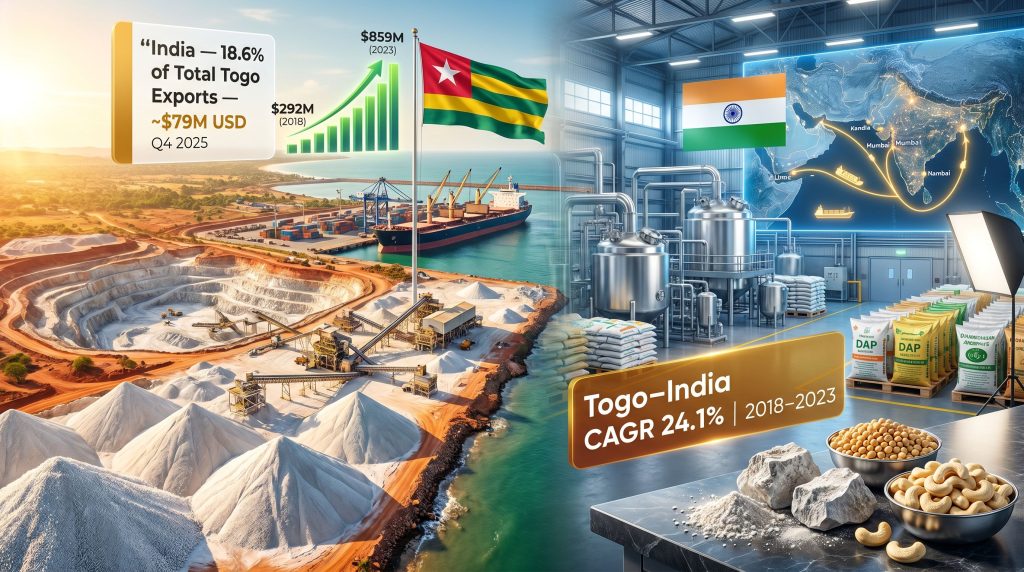
Among all destination markets, India captured 18.6% of Togo's total Q4 2025 exports, equivalent to approximately 47.2 billion CFA francs (roughly $79 million USD at prevailing exchange rates). That places India ahead of every regional neighbour and every traditional European partner. Furthermore, Togo-India trade reaches 3.48 billion in 2025, underlining just how rapidly this bilateral relationship has expanded.
Togo's Top Export Destinations, Q4 2025
| Rank | Country | Share of Total Exports | Estimated Value (CFA francs) |
|---|---|---|---|
| 1 | India | 18.6% | ~47.2 billion |
| 2 | Côte d'Ivoire | 13.4% | ~34.0 billion |
| 3 | Burkina Faso | 11.4% | ~28.9 billion |
| 4 | Benin | 9.4% | ~23.8 billion |
| 5 | Ghana | 6.4% | ~16.2 billion |
| 6 | France | 5.6% | ~14.2 billion |
| 7 | United States | 5.1% | ~12.9 billion |
| Top 10 Combined | 81.2% | ~205.8 billion |
Source: INSEED via Ecofin Agency, May 2026.
The gap between India at 18.6% and second-placed Côte d'Ivoire at 13.4% is not marginal — it reflects a fundamentally different trade dynamic. Togo's exports to regional neighbours are predominantly manufactured goods, petroleum products, and food staples: high-frequency, lower-unit-value flows that serve immediate consumption needs within ECOWAS markets. India, by contrast, imports high-volume, bulk raw commodities — particularly phosphate rock and oilseeds — where individual shipments involve significantly larger transaction values.
This distinction matters when interpreting the 18.6% share figure. Because phosphates and agricultural bulk commodities carry higher per-shipment values than packaged consumer goods or refined fuels destined for landlocked neighbours, India's share of Togo's export revenue likely exceeds its share of export volume. In practical terms, India is not just Togo's largest destination by count of trade flows — it may represent an even more disproportionate share of actual foreign exchange earnings.
The Structural Logic of Indian Demand
India's position as a dominant buyer of Togolese exports is not coincidental. It reflects a set of structural conditions that have been building for over a decade. The country's reliance on global phosphate reserves and the limited domestic supply of phosphate rock have made import diversification a strategic priority:
-
India is among the world's largest consumers of phosphate-based fertilizers, relying heavily on imports to meet the needs of its agricultural sector, which supports food security for over 1.4 billion people.
-
Domestic phosphate rock production in India is limited relative to demand, making the country systematically dependent on external suppliers, particularly for the calcium phosphates used in manufacturing diammonium phosphate (DAP) and single superphosphate (SSP) fertilizers.
-
The global fertilizer supply disruptions that followed the 2022 geopolitical crisis in Eastern Europe accelerated India's interest in diversifying its phosphate sourcing beyond established suppliers in Morocco and the Middle East.
-
Togo's established phosphate extraction operations, combined with the logistical efficiency of the Port of Lomé, positioned the country as a commercially viable and geographically distinct alternative within India's sourcing strategy.
Strategic context: Phosphate rock is classified as one of the most important critical raw materials by multiple major economies due to its irreplaceable role in fertilizer production. Unlike nitrogen fertilizers, which can be synthesized from atmospheric sources, phosphate must be mined. There are no substitutes in food production systems at scale.
What began as opportunistic purchasing has, over roughly a decade, hardened into a structurally embedded supply corridor. Indian fertilizer manufacturers have incorporated Togolese phosphate into their procurement planning, and Togo's export infrastructure has oriented toward serving bulk commodity demand from Asian markets.
Phosphates: The Commodity That Defines the Relationship
Phosphates are not merely the largest single line item in Togo's export basket — they are the gravitational centre around which the entire relationship driving Togo exports to India orbits. In Q4 2025, phosphates represented 16.2% of Togo's total exports, or approximately 41.1 billion CFA francs, and the dominant destination for those exports is India.
Understanding why requires a brief look at how phosphate rock moves through the value chain:
-
Extraction: Phosphate rock is mined from sedimentary deposits. Togo's deposits are located primarily in the southern coastal region near Hahotoé and Kpémé, where open-cast mining operations have been active since the 1960s.
-
Beneficiation: Raw phosphate rock is processed to increase its phosphorus pentoxide (P₂O₅) content through washing, screening, and flotation — a stage that can occur in the exporting country or at the destination.
-
Fertilizer manufacturing: Processed phosphate is reacted with sulphuric acid to produce single superphosphate, or with phosphoric acid to produce triple superphosphate or DAP — the forms that actually reach farmers.
A critical and often underappreciated aspect of this value chain is that Togo currently exports primarily at the raw or lightly processed stage, meaning Indian manufacturers capture the majority of processing value. This is a common pattern across African mineral exporters and represents one of the most significant structural constraints on Togo's ability to maximise foreign exchange earnings from its phosphate endowment. Consequently, phosphate project development in comparable exporting nations offers instructive lessons in how processing integration can reshape export revenue profiles.
Industry insight: The difference in value between raw phosphate rock (typically traded at $60-$120 per tonne depending on grade and market conditions) and finished DAP fertilizer (which has traded at $400-$700 per tonne in recent years) illustrates the magnitude of value that remains uncaptured at the extraction stage. Moving up the processing chain even one step — to beneficiated phosphate concentrate or merchant-grade phosphoric acid — would meaningfully alter Togo's export revenue profile.
Agricultural Commodities: The Secondary Export Engine
Beyond phosphates, Togo's export basket to India is supported by a cluster of agricultural commodities that reflect India's growing demand for protein crops and vegetable oils.
Soybean meal (5.8% of total exports) and soybeans (3.4%) together represent a meaningful combined share of Togo's export base. India's livestock and aquaculture sectors have expanded significantly over the past decade, driving demand for high-protein feed ingredients of which soybean meal is the primary source. Togo's role in this supply chain is partly that of a direct producer from its agricultural hinterland, and partly that of a regional aggregation point.
Refined palm oil at 3.6% of exports adds another agricultural dimension. India has historically been the world's largest importer of palm oil, though its import patterns shift with domestic oilseed production cycles and government policy on cooking oil prices. Togolese refined palm oil enters this broader import stream as one of multiple sourcing options available to Indian edible oil processors.
Cocoa at 3.1% rounds out the agricultural category, with India representing a relatively minor but growing destination as consumer demand for chocolate and cocoa-derived products expands within India's urban middle class.
The Port of Lomé plays a distinctive role in amplifying these agricultural export flows. As the only natural deep-water port on the West African coastline capable of accommodating large bulk carriers without dredging dependency, Lomé functions as a commodity aggregation hub for landlocked countries including Burkina Faso, Mali, and Niger. Agricultural commodities from these hinterland nations move through Togo's port infrastructure before being consolidated into bulk shipments bound for Asian destinations.
The Re-Export Dimension: Motorcycles, Petroleum, and the Port of Lomé Effect
One of the more analytically complex aspects of Togo's export data is the presence of motorcycles at 7.9% and refined petroleum products at 6.6% within the top 10 export categories. These figures require contextual interpretation.
Togo does not manufacture motorcycles domestically at any significant scale. The appearance of motorcycles as the second-largest export product category almost certainly reflects Lomé's function as a re-export hub, where Asian-assembled units transit through the port before being distributed across the West African region. The destination classification in trade statistics can be complex in such cases, and readers should treat the destination-level figures for these product categories with appropriate caution.
Similarly, refined petroleum products moving through Togo's storage and distribution infrastructure serve regional distribution functions rather than representing Togolese industrial output. However, it is worth noting that resource export challenges of this kind — where transit trade inflates headline export figures — are not unique to Togo and are increasingly scrutinised in commodity-focused sovereign trade analysis.
Disclaimer: The re-export interpretation of motorcycle and petroleum export data is based on structural analysis of Togo's industrial capacity and port function. Readers seeking precise commodity-level destination breakdowns should consult INSEED's detailed trade releases directly.
The next major ASX story will hit our subscribers first
The Trade Imbalance: What India Sends Back
The Togo-India relationship is not a balanced exchange. Historical trade data suggests India's exports to Togo substantially exceed Togo's exports in the opposite direction — a pattern consistent with a broader structural dynamic in India-Africa trade where African nations export raw commodities and import manufactured goods, refined energy products, and food staples.
India's principal exports to Togo have historically included:
-
Refined petroleum products, which serve Togo's role as a regional fuel distribution centre for the Sahel
-
Rice, addressing food security requirements across Togo and its landlocked neighbours
-
Pharmaceuticals and generic medicines, reflecting India's dominant position in global generic drug manufacturing
-
Textiles and manufactured goods, competing with Chinese imports across West African consumer markets
This structural imbalance — where Togo ships raw materials to India and receives processed goods and energy in return — is a defining feature of the economic relationship. Furthermore, India's commodity trade strategy more broadly reflects a deliberate approach to securing raw material inputs from multiple African partners simultaneously, ensuring supply resilience across critical agricultural input categories.
Strategic Risks Embedded in Export Concentration
The concentration of Togo's export dependence on India, combined with the narrow commodity base driving that relationship, creates identifiable risk vectors that any serious analysis of this trade corridor must address.
Demand-side risks from India include:
-
Shifts in India's domestic fertilizer subsidy policy, which directly determine the volume of phosphate imports required by Indian manufacturers
-
India expanding long-term supply agreements with Morocco, which holds the world's largest known phosphate reserves and has the logistical scale to offer more competitive supply terms
-
Commodity price corrections reducing the CFA franc value of each tonne exported, even where export volumes remain stable
-
Seasonal and policy-driven fluctuations in India's agricultural sector that affect fertilizer consumption patterns on multi-year cycles
Supply-side and logistical risks from Togo's perspective include:
-
Production disruptions at Togo's phosphate extraction operations, which have historically experienced both technical and labour-related interruptions
-
Port of Lomé congestion or infrastructure constraints during peak commodity shipment seasons
-
Regional instability in the Sahel affecting hinterland commodity aggregation flows that pass through Lomé
Investor note: Export concentration ratios above 15% to a single buyer country are generally considered a concentration risk flag in sovereign trade analysis. Togo's India exposure at 18.6% in Q4 2025 sits above this threshold, though the relationship's structural underpinnings provide a degree of durability not present in purely price-driven trade flows.
Value-Chain Upgrading: Where the Opportunity Lies
The most significant medium-term opportunity within the Togo-India trade relationship lies not in volume expansion at the current processing stage but in moving up the value chain. Several pathways merit consideration, and understanding these resource export challenges as experienced by comparable commodity exporters provides useful strategic context:
-
Beneficiated phosphate concentrate rather than raw phosphate rock would capture more value per tonne exported while still serving Indian fertilizer manufacturers' input requirements
-
Merchant-grade phosphoric acid production within Togo would represent a more substantial processing step, though it requires sulphuric acid feedstock and significant capital investment
-
Refined soybean oil and protein concentrates rather than raw soybeans and soybean meal, targeting India's edible oil and speciality protein ingredient markets
-
Certified sustainable or organic agricultural products targeting India's emerging premium import market segments, where unit values are substantially higher than commodity grades
The African Continental Free Trade Area (AfCFTA) provides a regulatory framework that could, in principle, support the development of regional processing capacity by reducing barriers to intra-African trade in intermediate goods. Whether this translates into investment in Togolese processing infrastructure depends on factors well beyond trade policy alone, including access to capital, energy costs, and logistics connectivity.
Frequently Asked Questions: Togo Exports to India
What is the main product Togo exports to India?
Phosphates — specifically calcium phosphates used as fertilizer manufacturing inputs — are consistently the leading commodity in Togo exports to India. In Q4 2025, phosphates represented 16.2% of Togo's total exports, with India as the primary destination for these shipments.
Is India Togo's largest export market?
Yes. According to INSEED data for Q4 2025, India ranked as Togo's single largest export destination, accounting for 18.6% of total exports by value — ahead of Côte d'Ivoire (13.4%), Burkina Faso (11.4%), Benin (9.4%), and Ghana (6.4%).
Why does India buy so much from Togo?
India's primary motivation is securing phosphate rock supplies for its domestic fertilizer manufacturing industry. India is a major net importer of phosphates, and Togo's deposits offer a geographically distinct and commercially viable supply source. Agricultural commodities including soybeans, soybean meal, and palm oil provide secondary demand drivers linked to India's expanding food processing and livestock sectors.
How fast are Togo's total exports growing?
Togo's total exports grew by 23.4% year-on-year in Q4 2025, significantly outpacing the country's import growth rate of 9.5% over the same period, according to INSEED data published in May 2026.
What risks exist in Togo's trade dependence on India?
The primary risks include commodity price volatility in phosphate markets, potential shifts in India's fertilizer subsidy policy, competition from larger phosphate exporters such as Morocco, and the structural vulnerability of depending on a single buyer nation for nearly one-fifth of total export revenues.
Disclaimer: This article is intended for informational and analytical purposes only. It does not constitute financial, investment, or trade advice. Historical trade figures cited beyond the verified Q4 2025 INSEED data are sourced from public trade databases and should be independently verified before use in commercial or policy decision-making. Commodity price references are indicative and subject to market fluctuation.
Want to Stay Ahead of the Next Major Mineral Discovery?
Discovery Alert's proprietary Discovery IQ model delivers real-time alerts on significant ASX mineral discoveries — including phosphate and other critical minerals driving global food and fertiliser supply chains — turning complex commodity data into actionable investment insights. Explore historic discoveries and their returns to understand the scale of opportunity, and start your 14-day free trial at Discovery Alert to position yourself ahead of the broader market.