May 21, 2026
TotalEnergies Africa production expansion represents one of the most comprehensive continental energy strategies currently deployed across emerging markets. The company's sophisticated multi-basin approach demonstrates how major energy producers navigate complex regulatory frameworks while balancing near-term cash generation against long-cycle exploration investments. Furthermore, this expansion model addresses critical energy security trends affecting global hydrocarbon markets.
Understanding TotalEnergies' Multi-Basin Production Framework
The scale of TotalEnergies' continental commitment becomes apparent when examining production concentration metrics. African assets contribute approximately 50% of the company's operated production, positioning the continent as the primary driver of upstream performance. This concentration reflects deliberate capital allocation decisions prioritising regions with established infrastructure networks and favourable fiscal regimes.
Portfolio diversification across TotalEnergies' African operations spans multiple development categories:
• Brownfield optimisation projects targeting immediate production increases through existing infrastructure
• Greenfield developments requiring substantial infrastructure investment and longer payback periods
• Frontier exploration programmes focusing on high-impact discoveries in underexplored basins
• Gas monetisation initiatives converting stranded reserves into exportable LNG
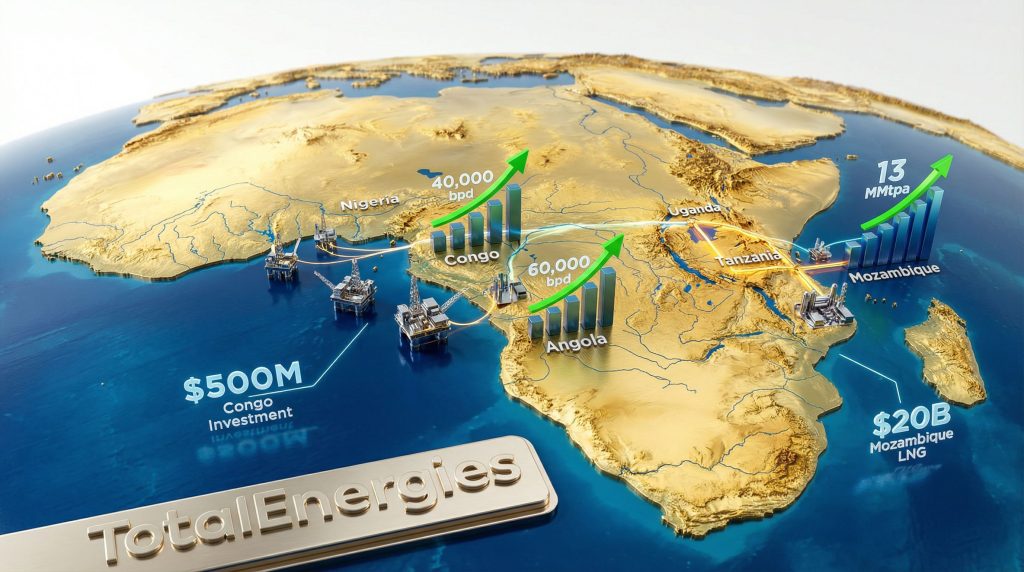
The Republic of Congo's Moho Nord field exemplifies brownfield optimisation strategies. TotalEnergies committed $500 million in 2025 to drill additional wells targeting 40,000 barrels per day (bpd) incremental production. This investment approach maximises existing infrastructure utilisation while minimising development timeline and capital intensity per incremental barrel.
How Continental Energy Giants Structure Long-Term Growth
Multi-basin production frameworks require sophisticated risk management across varying geological, political, and commercial environments. TotalEnergies' African strategy demonstrates how operators balance portfolio risk through geographic diversification while maintaining operational excellence across 40+ African countries.
Development timeline optimisation becomes critical when managing projects spanning different phases. Near-term production growth from 2026 developments generates cash flow supporting longer-cycle exploration programmes targeting 2030+ production. This temporal sequencing ensures continuous capital availability for high-risk, high-reward frontier opportunities.
Integrated value chain approaches maximise asset value by controlling multiple development phases. TotalEnergies' expanding African operations encompass upstream production, midstream processing, pipeline transportation, and LNG export infrastructure. This vertical integration reduces third-party dependencies while capturing margin expansion across the value chain.
When big ASX news breaks, our subscribers know first
Which African Basins Drive Maximum Production Growth?
West African deepwater basins continue demonstrating exceptional production potential through advanced subsea development technologies. Angola's offshore fields represent established production centres where infrastructure optimisation can deliver significant incremental volumes without major capital commitments.
The Begonia project targets 60,000 bpd production through existing Floating Production Storage and Offloading (FPSO) infrastructure optimisation. This approach demonstrates how mature basin development can achieve substantial production increases through technological upgrades and operational efficiency improvements rather than entirely new field developments.
Nigeria's offshore expansion involves securing new exploration permits in deepwater blocks, positioning TotalEnergies for long-term production growth in one of Africa's most prolific hydrocarbon provinces. These permits provide access to underexplored acreage adjacent to proven production areas, reducing exploration risk while maintaining upside potential.
Central African Onshore Enhancement Strategies
The Congo's Moho Nord field development illustrates how strategic brownfield investments can significantly impact national production profiles. The field currently represents approximately half of Congo's total oil production, making TotalEnergies' $500 million commitment nationally significant.
Brownfield optimisation versus greenfield development economics favour existing infrastructure utilisation in mature basins. The 40,000 bpd incremental production target at Moho Nord demonstrates how additional drilling within established field boundaries can achieve attractive development economics without extensive infrastructure construction.
Country-level production significance becomes apparent when examining TotalEnergies' role in national energy sectors. The company's position as Congo's dominant oil producer creates strategic relationships with government authorities while establishing operational expertise transferable across regional operations.
East African Pipeline-Enabled Growth
Uganda's Tilenga project represents a paradigm for landlocked resource development requiring cross-border infrastructure coordination. The project's advancement toward first oil depends entirely on the East African Crude Oil Pipeline (EACOP), which will transport crude to Tanzania's port of Tanga.
EACOP infrastructure investment demonstrates how major pipeline projects enable basin-wide development by providing market access for previously stranded resources. The pipeline's 1,443-kilometre route crosses multiple jurisdictions, requiring coordinated regulatory approvals and environmental compliance across Uganda and Tanzania.
Regional crude oil evacuation hub development transforms Tanzania's port facilities into continental export infrastructure serving multiple producing countries. This hub model creates economies of scale reducing per-barrel transportation costs while establishing Tanzania as a strategic energy logistics centre.
How Do Major LNG Projects Transform Regional Gas Markets?
Mozambique's LNG development represents one of Africa's most significant gas monetisation projects, with $20 billion investment targeting 13 million tons per annum (MMtpa) capacity. The project's restart following operational suspensions demonstrates the challenging security and political environment affecting major infrastructure developments in emerging markets.
Global LNG market positioning requires substantial scale to achieve competitive economics. The 13 MMtpa capacity positions Mozambique's project among the world's major LNG suppliers, capable of serving multiple international markets including Asia, Europe, and regional African demand centres.
Gas reserve monetisation strategies in frontier markets must overcome infrastructure, security, and financing challenges significantly more complex than conventional oil developments. LNG projects require extensive processing infrastructure, specialised export terminals, and long-term purchase agreements with creditworthy counterparties.
| LNG Project Metrics | Mozambique Development | Regional Significance |
|---|---|---|
| Total Investment | $20 billion | Largest African LNG project |
| Production Capacity | 13 MMtpa | ~15% of African LNG capacity |
| Development Timeline | Restart phase 2026+ | Critical for gas monetisation |
| Market Positioning | Global export focus | Transforms regional gas sector |
Gas-to-Power Integration Across Operations
TotalEnergies' zero routine flaring initiatives across African operations demonstrate how gas utilisation projects can simultaneously reduce emissions and generate additional revenue streams. These programmes capture associated gas previously flared during oil production, converting waste streams into power generation or gas sales.
Local power generation projects support energy access improvement while monetising gas resources lacking pipeline export infrastructure. These projects create immediate local economic benefits while establishing TotalEnergies as a comprehensive energy solutions provider rather than solely a hydrocarbon extraction company.
Carbon emissions reduction through gas utilisation optimisation addresses environmental, social, and governance (ESG) requirements while improving project economics. Flare reduction programmes can generate carbon credits under international emissions trading mechanisms, creating additional revenue streams from environmental improvements.
What Role Does Frontier Exploration Play in Long-Term Strategy?
Namibia's Orange Basin represents one of Africa's most promising frontier exploration regions, with TotalEnergies targeting a final investment decision (FID) on the Venus discovery by late 2026. The Orange Basin's geological characteristics suggest potential for multiple significant discoveries across various operators.
Deepwater exploration risk assessment requires comprehensive evaluation of geological, technical, commercial, and political factors before committing to major development investments. The Venus discovery must demonstrate sufficient reserves, favourable reservoir characteristics, and economic development scenarios justifying substantial capital deployment.
Commercial viability thresholds for deepwater developments continue increasing due to rising development costs, regulatory requirements, and competition from alternative energy sources. Projects must demonstrate robust economics across multiple commodity price scenarios and regulatory environments.
South Africa's Block 3B/4B Regulatory Navigation
South Africa's exploration activities demonstrate the complex regulatory approval processes required for frontier basin development. TotalEnergies is preparing to drill Block 3B/4B pending final approvals, illustrating how regulatory timelines can significantly impact exploration scheduling and capital deployment.
Environmental impact assessment requirements in emerging basins often exceed those in established producing regions, reflecting increased environmental awareness and local community consultation requirements. These processes, while extending development timelines, ensure sustainable development practices and social licence to operate.
Exploration-to-production development pathways in frontier basins require decade-long commitment and substantial capital investment before achieving first production. This timeline demands exceptional geological confidence and stable regulatory environments to justify exploration programme initiation.
How Does Capital Allocation Drive Production Growth Targets?
TotalEnergies' 3% annual upstream growth target across its global portfolio requires strategic investment strategy components balancing immediate production increases against long-term reserve replacement. Consequently, African operations play a central role in achieving these growth objectives through diversified project portfolios spanning multiple development phases.
Investment prioritisation across TotalEnergies' African portfolio demonstrates sophisticated capital allocation methodology:
• Near-term developments (Congo, Angola, Uganda) generating 2026-2027 production increases
• Medium-term projects (Mozambique LNG restart, Namibian FID) targeting 2027-2029 production
• Long-term exploration (South African deepwater, regional frontier basins) supporting 2030+ growth
Production growth modelling requires integration of development schedules, reservoir performance assumptions, and regulatory approval timelines. African projects contribute disproportionately to company-wide growth due to favourable geological characteristics and established operational infrastructure.
Production Growth Modelling Through 2030
Gas versus oil production mix optimisation reflects evolving global energy markets favouring natural gas as a transition fuel toward renewable energy systems. However, the current OPEC production impact continues influencing TotalEnergies' African strategy, which emphasises gas monetisation projects while maintaining oil production from established fields.
The following production growth targets demonstrate TotalEnergies Africa production expansion priorities:
| Production Category | 2026 Targets | Strategic Priority |
|---|---|---|
| Congo (Moho Nord) | +40,000 bpd | Brownfield optimisation |
| Angola (Begonia) | +60,000 bpd | Infrastructure utilisation |
| Uganda (Tilenga) | First oil achievement | Pipeline-enabled growth |
| Mozambique LNG | 13 MMtpa capacity | Gas monetisation |
Reserve replacement ratios become critical for sustainable long-term growth, requiring continuous exploration success to offset natural field decline. TotalEnergies' frontier exploration programmes in Namibia and South Africa target discoveries capable of supporting production growth beyond 2030.
Which Infrastructure Developments Enable Basin-Wide Growth?
Cross-border pipeline networks represent essential infrastructure enabling landlocked resource development across multiple African countries. The East African Crude Oil Pipeline (EACOP) demonstrates how regional infrastructure investment can unlock stranded resources while creating economies of scale for multiple producers.
EACOP's 1,443-kilometre route from Uganda to Tanzania establishes precedent for similar cross-border infrastructure projects across Africa. The pipeline's successful development could catalyse additional regional pipeline networks connecting landlocked producers to coastal export facilities.
Regional infrastructure investment coordination requires multilateral government cooperation, standardised technical specifications, and equitable cost-sharing arrangements. These projects often receive international development finance support due to their regional economic development benefits.
LNG Export Infrastructure Development
Angola LNG Plant expansion through Quiluma and Maboqueiro field tie-ins demonstrates how existing LNG infrastructure can accommodate additional gas supplies without duplicating expensive liquefaction facilities. These tie-ins optimise existing asset utilisation while providing market access for previously unconnected gas reserves.
Mozambique LNG facility restart represents one of Africa's largest infrastructure reconstruction projects following security disruptions. The facility's 13 MMtpa capacity requires substantial workforce redeployment, equipment refurbishment, and security infrastructure development before resuming operations.
Regional gas processing and liquefaction hub strategies position major LNG facilities as continental infrastructure serving multiple producing countries. This hub model reduces per-unit development costs while establishing strategic relationships across regional gas producers.
The next major ASX story will hit our subscribers first
What Makes This Expansion Model Replicable Across Africa?
TotalEnergies' operational presence across 40+ African countries demonstrates scalable operational excellence and regulatory relationship management capabilities. This geographic diversification provides geological risk mitigation while establishing deep institutional knowledge across diverse African markets.
Local content development and training programme implementation creates sustainable operational capacity while addressing government requirements for domestic workforce development. These programmes establish long-term social licence to operate while developing local technical expertise supporting future expansion.
Regulatory relationship management across diverse jurisdictions requires sophisticated government relations capabilities and legal compliance expertise. TotalEnergies' African operations demonstrate how consistent regulatory performance can facilitate expansion into additional countries and licensing rounds.
Energy Transition Integration
Hydrocarbon production growth alongside renewable energy investments reflects comprehensive energy portfolio strategies addressing changing global energy demand patterns. Furthermore, renewable energy integration across TotalEnergies' African operations increasingly includes solar development projects, wind, and energy storage projects supporting operations while providing local energy access.
Carbon capture and emissions reduction technology deployment across African operations demonstrates how traditional energy producers can maintain production growth while achieving environmental performance improvements. These technologies become increasingly important for maintaining social licence to operate and accessing international capital markets.
Local energy access improvement through integrated power projects creates significant social and economic development benefits supporting long-term operational sustainability. These projects establish TotalEnergies as a comprehensive energy solutions provider rather than solely a hydrocarbon extraction company.
Future Scenario Planning for Continental Energy Growth
Accelerated development scenarios assume favourable regulatory environments, stable security conditions, and supportive commodity price environments enabling faster project progression than baseline assumptions. Under these conditions, Mozambique LNG could restart earlier than projected while Namibian developments advance ahead of schedule.
Regulatory-constrained growth scenarios model potential delays from environmental approval processes, local content requirements, or political instability affecting project timelines. These scenarios require enhanced contingency planning and alternative development pathway preparation, particularly given ongoing energy export challenges affecting global markets.
Market-driven expansion scenarios analyse how evolving global energy demand patterns, particularly increasing Asian gas consumption and European energy security requirements, could accelerate African project development through improved project economics and strategic partnerships.
The evolution of TotalEnergies Africa production expansion continues demonstrating how major energy companies can achieve substantial growth through comprehensive continental strategies balancing immediate production increases against long-term strategic positioning. Success requires sophisticated capital allocation, regulatory relationship management, and operational excellence across diverse African markets.
Investment Considerations: This analysis is provided for informational purposes only and should not be considered investment advice. Energy sector investments involve substantial risks including commodity price volatility, regulatory changes, political instability, and technical challenges. Potential investors should conduct comprehensive due diligence and consult qualified financial advisors before making investment decisions.
Want to Capitalise on Africa's Energy Discovery Boom?
Discovery Alert's proprietary Discovery IQ model delivers instant notifications when significant mineral and energy discoveries are announced on the ASX, helping investors identify opportunities in the expanding African resource sector before broader market awareness develops. Begin your 14-day free trial today to position yourself ahead of the market and gain actionable insights into discovery-driven investment opportunities.