
August 24, 2026
What Drove TotalEnergies' Strategic Pivot from U.S. Offshore Wind to LNG?
The TotalEnergies offshore wind exit represents a calculated capital reallocation based on comparative development economics across energy sectors. Multiple factors contributed to this strategic pivot, including cost structure differences, market demand trajectories, and risk-adjusted return expectations across geographic markets.
Furthermore, the company's decision reflects broader challenges facing offshore wind development in North American markets. These developments signal shifting priorities within the global energy transition landscape.
Capital Efficiency Analysis – Comparing Development Costs Across Energy Sectors
U.S. offshore wind projects face significantly higher capital expenditure requirements compared to European counterparts, with cost differentials reaching 15-25% across multiple project phases. The Vineyard Wind 1 project off Massachusetts required approximately $2.6 billion for 800 MW capacity, translating to roughly $3.25 million per MW compared to European projects typically operating at $2.0-2.5 million per MW.
Development timeline disparities create additional capital efficiency considerations. U.S. offshore wind permitting and development typically requires 7-10 years from lease award to commercial operation, compared to 3-5 years for LNG terminal expansions at existing facilities. This timeline differential significantly impacts net present value calculations and capital deployment strategies for energy majors operating under strict return thresholds.
Installation vessel availability represents a critical bottleneck in U.S. markets. North America maintains approximately 2-3 operational heavy-lift installation vessels for offshore wind, versus 20+ vessels available in European markets. Vessel day rates in U.S. markets average $200,000-$350,000 per day compared to $150,000-$250,000 per day in European waters.
Consequently, these elevated costs directly impact project economics through extended installation timelines and elevated equipment costs. The supply chain constraints particularly affect developers seeking to establish large-scale operations.
Market Demand Dynamics Shaping Energy Investment Decisions
Global LNG demand projections through 2030 demonstrate robust growth trajectories that support long-term infrastructure investment strategies. The International Gas Union projects global LNG trade reaching 600+ million tonnes per annum (Mtpa) by 2035, up from approximately 380 Mtpa in 2022. This 58% growth trajectory over 13 years provides substantial market expansion opportunities for LNG export infrastructure investments.
Moreover, US natural gas forecast models indicate sustained domestic production capacity supporting export infrastructure development. Current operational capacity of approximately 10-11 Mtpa across existing terminals could expand to 450+ Mtpa by 2030 under current development plans, though this figure reflects pre-final investment decision authorisations subject to financing and market conditions.
Power purchase agreement challenges in offshore wind markets create revenue uncertainty that contrasts with long-term LNG supply contracts. Recent PPA prices for U.S. offshore wind range $60-80 per MWh versus $30-50 per MWh for onshore wind, creating affordability concerns for utility customers.
In addition, regulatory resistance to rate increases has emerged as a significant consideration for project developers navigating utility procurement processes.
When big ASX news breaks, our subscribers know first
How Do Regional Economics Impact Major Energy Companies' Portfolio Decisions?
Regional cost structures, regulatory frameworks, and supply chain maturity create significant variations in project economics across geographic markets. These differences drive portfolio allocation decisions for energy majors seeking optimal risk-adjusted returns while maintaining geographic diversification strategies.
However, the complexity of navigating multiple regulatory jurisdictions presents additional challenges for international energy companies.
U.S. vs. European Offshore Wind Development Cost Structures
| Cost Factor | U.S. Market | European Market | Impact on ROI |
|---|---|---|---|
| Installation vessels | Limited availability (2-3 vessels) | Established fleet (20+ vessels) | 15-25% cost difference |
| Grid connection | Complex permitting (24-36 months) | Streamlined process (18-24 months) | 2-3 year timeline variance |
| Supply chain | Emerging infrastructure | Mature ecosystem | 10-20% equipment premium |
| Regulatory framework | State-by-state variation | Harmonised EU standards | Compliance cost differential |
European offshore wind markets benefit from established supply chains, standardised transmission infrastructure operating at 220+ kV, and harmonised permitting frameworks under the EU Habitats Directive. U.S. markets face added complexity from state-specific voltage harmonisation requirements and Federal Energy Regulatory Commission interconnection studies averaging 2-3 years.
Supply chain equipment costs demonstrate meaningful regional disparities. European suppliers offer 8-12% lower pricing for offshore wind turbines and subsea cables due to production volume economies, with European markets generating approximately 45 GW annually versus 5-8 GW annually in U.S. markets.
This volume differential creates sustained cost advantages for European project development. Furthermore, Canada energy transition experiences demonstrate similar supply chain maturation benefits in established renewable energy markets.
Strategic Asset Portfolio Optimisation in Energy Transition
Modern portfolio theory applications in energy sector capital allocation suggest diversification benefits across technologies, geographies, and commodity exposures. Energy majors employ multi-criteria decision analysis incorporating regulatory certainty, commodity price exposure, execution risk, and long-term policy stability when evaluating investment opportunities.
Risk-adjusted return models indicate significant variance across energy infrastructure investments:
- Onshore conventional oil/gas: 20-30% internal rate of return (IRR)
- LNG export infrastructure: 12-18% IRR
- U.S. offshore wind: 6-10% IRR (constrained by PPA pricing)
- European offshore wind: 8-12% IRR
These return differentials reflect technology maturity, market competitiveness, and regulatory risk factors that influence capital allocation decisions across energy portfolios. Additionally, energy transition strategies require careful balance between growth investments and established cash-generating assets.
What Does TotalEnergies' LNG Focus Signal About Global Energy Markets?
The strategic pivot toward LNG infrastructure reflects broader market dynamics including supply chain disruptions, energy security considerations, and the role of natural gas as a transitional fuel in decarbonisation pathways. This reallocation signals confidence in sustained demand for gas-based energy solutions across multiple end-use sectors.
LNG Infrastructure Investment Surge – Rio Grande and Alaska Projects
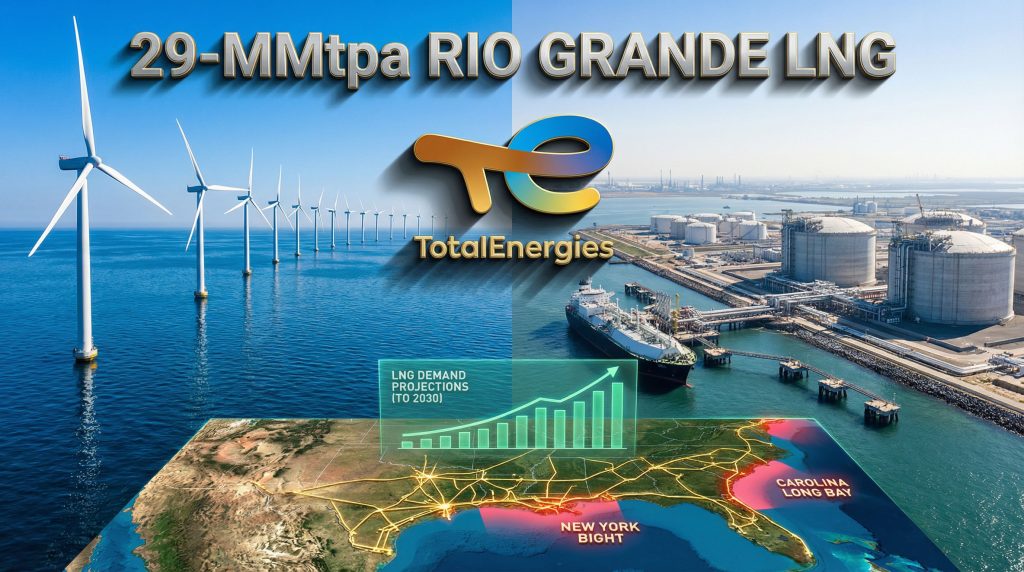
The 29-MMtpa Rio Grande LNG project in San Patricio County, Texas represents mid-scale expansion in U.S. export capacity targeting European and Asian markets. As a potential greenfield terminal development, it would serve demand through multi-decade offtake agreements typically structured at $10-15 per million BTU, providing stable revenue streams for capital-intensive infrastructure investments.
Alaska LNG development represents a smaller-scale export opportunity focused on Asia-Pacific markets with proposed 2-MMtpa capacity. The project's Arctic location creates unique technical challenges and extended development timelines typically exceeding 10 years from initial concept to final investment decision, illustrating the complexity of frontier energy infrastructure development.
U.S. Gulf Coast export terminal capacity expansion leverages existing industrial infrastructure and deepwater port access. Brownfield LNG expansions at facilities like Corpus Christi or Sabine Pass cost approximately 40-50% less per unit capacity than greenfield terminals, with shorter execution timelines that improve capital efficiency metrics.
According to Reuters analysis, TotalEnergies' strategic shift represents broader industry recognition of LNG infrastructure advantages in current market conditions.
Long-term supply contract negotiations with European and Asian buyers reflect energy security priorities following supply disruptions in global gas markets. European LNG imports reached peak crisis-driven levels of approximately 130 Mtpa in 2023 following Russian supply curtailments, though 2024-2026 levels are expected to moderate to 90-100 Mtpa as market equilibrium restores.
Natural Gas as Transition Fuel – Investment Thesis Analysis
Natural gas serves a strategic role in energy transition scenarios, providing baseload power generation reliability while carbon-intensive coal plants are retired from service. LNG exports align with strategic objectives to strengthen energy security partnerships during a period of geopolitical uncertainty affecting traditional supply routes.
Industrial heating and petrochemical feedstock demand provides additional demand durability for natural gas infrastructure investments. These applications face limited substitution options compared to power generation, creating sustained demand even as renewable electricity penetration increases across grid systems.
Carbon intensity comparisons demonstrate natural gas advantages over coal-fired power generation, with combined-cycle gas turbines producing approximately 50-60% lower CO2 emissions per MWh compared to conventional coal plants. This emissions profile supports natural gas positioning as a transitional technology in decarbonisation strategies.
Key Market Signal: Energy majors are prioritising infrastructure investments with established demand visibility and proven operational track records over emerging technologies facing regulatory uncertainty and cost inflation pressures.
How Are Energy Majors Restructuring Renewable Energy Strategies?
The TotalEnergies offshore wind exit illustrates broader strategic recalibrations across the energy sector, where companies are reassessing renewable energy portfolio composition, geographic concentration, and technology-specific investment priorities. These adjustments reflect lessons learned from early renewable energy investments and evolving market conditions.
Selective Market Entry vs. Broad Renewable Portfolio Approaches
Geographic concentration strategies in proven offshore wind markets offer execution risk reduction compared to broad geographic diversification approaches. European markets with 20+ years of offshore wind experience present lower execution risk profiles but offer limited greenfield development opportunities with premium valuations.
Technology-specific investment focus allows energy majors to develop operational expertise and supply chain relationships within concentrated areas rather than spreading resources across multiple emerging technologies. This approach contrasts with diversified renewable portfolios that may lack operational depth in specific technologies.
Partnership structures for risk sharing in emerging technologies have evolved beyond traditional joint ventures toward more sophisticated arrangements including technology licensing agreements, operations and maintenance partnerships, and structured financing collaborations that distribute different risk categories among specialised participants.
Build versus buy decisions in renewable energy asset acquisition reflect varying approaches to market entry timing. Acquiring operational assets provides immediate cash flows and operational experience but typically commands premium valuations, while greenfield development offers higher potential returns at elevated execution risk.
Policy Environment Impact on Energy Investment Flows
U.S. energy policy shifts favouring domestic production create supportive frameworks for LNG export infrastructure while introducing uncertainty for import-dependent renewable energy supply chains. The Jones Act requirements for vessel transportation and domestic content provisions in renewable energy incentives create additional cost considerations for offshore wind development.
European renewable energy incentive structures provide greater regulatory certainty through harmonised frameworks, though market saturation in premium wind resources creates competitive pressures for new project development. Feed-in tariff mechanisms and renewable energy certificate systems provide revenue visibility that supports long-term capital commitments.
Tax credit optimisation strategies across different energy sectors demonstrate varying policy support levels. The federal investment tax credit for solar projects and production tax credit for wind projects provide different risk profiles compared to depletion allowances and percentage depletion benefits available for oil and gas investments.
Furthermore, US economy & tariffs considerations increasingly influence supply chain decisions for renewable energy projects requiring imported components.
What Are the Financial Implications of Major Energy Portfolio Reshuffling?
Portfolio restructuring decisions by energy majors create ripple effects across capital markets, debt structures, and stakeholder relationships. Understanding these financial implications provides insights into corporate strategy execution and market positioning considerations beyond immediate project economics.
Capital Recovery and Reinvestment Mechanics
The Department of Interior lease fee recovery arrangement enables dollar-for-dollar reinvestment into gas infrastructure projects, representing an uncommon precedent in federal lease modifications. Typical federal offshore lease structures include bonuses ranging $0.5-5 million per lease block (5,760 acres), annual rent of $2 per acre, and royalties of 12.5% of revenue that would normally be forfeited upon lease relinquishment.
This capital recovery mechanism provides financial flexibility for strategic reallocation while avoiding writedown impacts on corporate balance sheets. The ability to redirect committed capital toward alternative energy investments without regulatory penalties reduces the financial friction associated with strategic pivots in evolving energy markets.
According to the Department of Interior press release, this agreement establishes new precedents for federal lease modifications in changing energy market conditions.
Reinvestment timing considerations allow energy majors to capitalise on market opportunities across different development cycles. LNG infrastructure investments may benefit from current commodity price environments and supply-demand imbalances that could support favourable contract negotiations for long-term revenue commitments.
Investor Relations and Market Positioning Considerations
Stock market response to strategic pivot announcements reflects investor sentiment regarding technology risk, execution capabilities, and long-term positioning in energy transition scenarios. Markets typically reward clarity in strategic direction and capital discipline over broad diversification strategies that may lack operational focus.
ESG investor concerns about renewable energy retreat require careful communication regarding overall sustainability commitments and emissions reduction pathways. Energy majors must balance stakeholder expectations for climate action with fiduciary responsibilities for capital efficiency and shareholder returns.
Dividend sustainability through cash flow optimisation becomes increasingly important as energy majors navigate volatile commodity environments and capital-intensive technology transitions. Maintaining dividend coverage ratios while funding growth investments requires careful portfolio balance between established cash-generating assets and emerging opportunities.
Credit rating implications of sector reallocation decisions affect financing costs for future capital projects. Rating agencies evaluate strategic consistency, operational expertise in target sectors, and balance sheet flexibility when assessing credit profiles during major portfolio transitions.
How Do Lease Relinquishment Agreements Work in Energy Development?
Federal lease modification processes involve complex negotiations between energy companies, regulatory agencies, and various stakeholders to address changing project economics, environmental considerations, and strategic priorities. Understanding these mechanisms provides insights into regulatory flexibility and precedent-setting arrangements in energy development.
Federal Lease Modification Process and Precedent Setting
Department of Interior negotiation frameworks for lease modifications typically involve environmental impact assessments, stakeholder consultations, and financial arrangements that balance public interest considerations with commercial realities. The Bureau of Ocean Energy Management oversees offshore energy leases with authority to approve modifications under specific circumstances.
Carolina Long Bay and New York Bight lease areas represent strategically located offshore wind development zones with substantial commercial potential. These federal waters offer wind resources, transmission proximity, and water depth characteristics suitable for commercial-scale offshore wind development, making lease relinquishment decisions particularly significant for industry development.
Environmental review requirements for project cancellations may involve modified National Environmental Policy Act assessments to evaluate the impacts of cancelled development versus alternative land uses. These reviews address marine ecosystem considerations, fishing industry impacts, and other environmental factors affected by development decisions.
Precedent implications for other developers seeking similar arrangements could influence future lease policy and industry approaches to strategic pivots in offshore energy development. Standardised modification procedures may emerge if strategic reallocations become more common across different energy sectors.
Legal and Regulatory Framework for Energy Project Exits
Force majeure considerations in offshore development projects address circumstances beyond developer control that may affect project viability. These provisions typically cover regulatory changes, extreme weather events, supply chain disruptions, and other factors that could impact development timelines or economics.
Stakeholder notification requirements for major project changes involve coordination with fishing interests, environmental organisations, coastal communities, and other affected parties. Public comment periods and community engagement processes ensure transparent communication of project modifications and their implications.
State and federal coordination in offshore energy planning requires alignment between federal lease administration and state energy policy objectives. Coastal states maintain authority over transmission infrastructure and onshore facilities that connect to federal offshore developments, creating coordination requirements for project modifications.
The next major ASX story will hit our subscribers first
What Does This Mean for U.S. Offshore Wind Industry Development?
The TotalEnergies offshore wind exit creates both opportunities and challenges for U.S. offshore wind sector development. Market consolidation effects, supply chain implications, and policy responses will shape industry trajectory and competitive dynamics in this emerging sector.
Market Consolidation Opportunities for Remaining Developers
Available lease areas following major player exits could create acquisition opportunities for remaining developers with established U.S. market presence and operational capabilities. Reduced competition in future lease auctions may moderate bonus payments and improve project economics for qualified bidders.
Technology transfer opportunities from cancelled projects include engineering studies, environmental assessments, and supply chain relationships that could benefit continuing developments. Knowledge sharing across industry participants accelerates learning curves and reduces duplicative development costs.
Supply chain capacity reallocation to active developments may improve equipment availability and installation scheduling for remaining projects. Vessel capacity, turbine manufacturing slots, and installation services could become more accessible as project portfolios consolidate among fewer developers.
Enhanced focus on proven developers with established track records may improve overall sector execution performance and reduce project delays that have affected early U.S. offshore wind developments. Market maturation through selective participation could strengthen investor confidence in sector viability.
Long-term Power Affordability Concerns in Renewable Energy
Electricity pricing impacts from high-cost offshore wind projects raise concerns about consumer rate implications and regulatory resistance to expensive renewable energy mandates. Power purchase agreement pricing in the $60-80 per MWh range for offshore wind compares unfavourably to $30-50 per MWh for onshore alternatives.
Grid integration costs for intermittent renewable sources include transmission infrastructure, energy storage systems, and grid balancing services required to manage variable power output. These ancillary costs may not be fully reflected in initial PPA pricing but affect overall system costs for ratepayers.
Alternative renewable energy pathways for decarbonisation goals may include increased focus on onshore wind, solar photovoltaic systems, and energy storage technologies that offer more favourable cost trajectories. Portfolio approaches combining multiple renewable technologies could provide cost optimisation opportunities.
Consumer rate implications of renewable energy mandates require careful policy design to balance environmental objectives with affordability concerns. Rate impact analysis and cost recovery mechanisms become increasingly important as renewable energy penetration increases across utility systems.
How Should Investors Interpret Energy Sector Strategic Realignments?
Strategic portfolio modifications by energy majors provide insights into sector dynamics, technology maturation, and capital allocation priorities that inform broader investment decision-making across energy markets. Understanding these signals helps investors position portfolios for evolving energy sector opportunities.
Portfolio Diversification Lessons from TotalEnergies' Decision
Risk management through geographic and technology diversification must be balanced against operational expertise and execution capabilities in specific markets. Broad diversification strategies may dilute operational focus and reduce competitive advantages in core business areas.
Market timing considerations in emerging energy technologies suggest advantages for selective entry strategies that prioritise market maturity, regulatory certainty, and supply chain development over first-mover positioning. Late-follower strategies may offer superior risk-adjusted returns in capital-intensive sectors.
Regulatory risk assessment methodologies should incorporate policy stability, permitting predictability, and stakeholder alignment factors that affect long-term project viability. Multi-jurisdictional projects face compounded regulatory risks that may justify risk premiums in return expectations.
Currency and commodity price hedging strategies across energy sectors require consideration of different exposure profiles and correlation patterns. Natural gas price trends typically fluctuate between $2-8 per MMBtu, while renewable energy investments face different risk factors including technology cost trends and policy support stability.
Future Energy Investment Trends and Implications
Capital flow predictions between fossil fuels and renewables suggest continued bifurcation based on geography, technology maturity, and policy environments rather than uniform transition patterns. Regional advantages in resource endowments, supply chains, and regulatory frameworks will influence investment allocation patterns.
Technology maturation curves affecting investment timing decisions favour selective approaches that align capital deployment with commercial readiness and market acceptance. Early-stage technology investments require different risk tolerance and return expectations compared to mature technology deployments.
Geopolitical factors influencing energy security investments include supply chain resilience, strategic resource access, and alliance structures that affect energy trade patterns. Energy infrastructure investments increasingly incorporate geopolitical risk assessment alongside traditional commercial and technical analysis.
Climate policy evolution impacts on long-term energy strategies remain subject to political cycles, international cooperation frameworks, and technological development trajectories that create uncertainty around regulatory environments and market incentives for different energy technologies.
Disclaimer: This analysis is based on publicly available information and industry data current as of March 2026. Energy sector investments involve significant risks including commodity price volatility, regulatory changes, and operational challenges. Readers should conduct independent research and consult financial advisors before making investment decisions. Project timelines, capacities, and financial terms are subject to change based on market conditions, regulatory approvals, and corporate strategy modifications.
Ready to Capitalise on Energy Sector Strategic Shifts?
Discovery Alert's proprietary Discovery IQ model instantly identifies significant ASX mineral discoveries that could benefit from evolving energy transition dynamics and commodity market reallocations. Stay ahead of strategic pivots like TotalEnergies' move by accessing real-time alerts on actionable mining and exploration opportunities before broader market recognition occurs.