May 20, 2026
Underground coal mining operations face persistent challenges from toxic gas release incidents that threaten both worker safety and surrounding communities. A toxic gas leak from underground coal mine operations represents one of the most serious hazards in industrial mining, requiring comprehensive understanding of gas dynamics, detection technologies, and emergency response protocols. The complex interaction between geological formations, combustion processes, and atmospheric conditions creates environments where gas concentrations can rapidly escalate from routine operational concerns to life-threatening emergencies.
What Are the Primary Toxic Gases Released from Underground Coal Mining Operations?
Methane Emissions and Explosion Risks
Underground coal extraction inevitably releases methane gas, a byproduct of the geological processes that formed coal deposits over millions of years. The International Labour Organisation identifies methane as a primary hazard in underground coal mining, with concentration thresholds creating critical danger zones in confined spaces. When methane concentrations reach 5% Lower Explosive Limit (LEL), the atmosphere becomes potentially explosive, requiring immediate evacuation and ventilation intervention.
Natural seepage rates vary significantly based on coal rank and geological conditions. Bituminous coal seams typically release 2-5 cubic metres of methane per ton of coal extracted, according to historical mining engineering literature. This release occurs through multiple mechanisms: direct liberation during cutting and blasting operations, gradual seepage from exposed coal faces, and sudden outbursts during roof collapses or pillar failures.
| Methane Concentration | Hazard Level | Required Action |
|---|---|---|
| 0.25% – 1.0% | Low Risk | Continue monitoring |
| 1.0% – 2.5% | Elevated Risk | Increase ventilation |
| 2.5% – 5.0% | Dangerous | Evacuate personnel |
| Above 5.0% | Explosive Range | Emergency response |
Mining engineering principles reveal that methane accumulates preferentially in mine galleries due to its lower density than air. Dead zones and improperly ventilated areas create pockets where concentrations can exceed explosive thresholds within hours during active extraction. The U.S. Mine Safety and Health Administration establishes that methane concentrations exceeding 2.5% in the return airway represent a dangerous accumulation requiring immediate ventilation action.
Spontaneous methane release events often correlate with sudden pressure changes during roof collapses or pillar failures, creating surge events that disrupt established ventilation patterns. These geological disturbances can release accumulated methane from sealed areas, as demonstrated in the Dhanbad incident where disturbance of overlying galleries triggered smoke and gas release from previously contained underground fires.
Carbon Monoxide: The Silent Underground Killer
Carbon monoxide presents perhaps the most insidious threat in underground coal mining operations due to its complete lack of sensory warning properties. The gas forms primarily through incomplete combustion processes, including diesel equipment operation, electrical equipment malfunctions, and coal seam fires. The Occupational Safety and Health Administration sets an 8-hour Time-Weighted Average permissible exposure limit of 50 parts per million (ppm), while MSHA establishes a 10-ppm ceiling for underground coal mines, meaning exposure cannot exceed this level at any time.
The physiological impact of carbon monoxide stems from its extraordinary affinity for haemoglobin. Carbon monoxide binds to haemoglobin with an affinity 200-250 times greater than oxygen, forming carboxyhaemoglobin (COHb) that prevents oxygen transport throughout the body. This mechanism creates a progressive poisoning effect where victims may not recognise symptoms until cognitive impairment has already occurred.
Critical exposure thresholds include:
- 50 ppm: Maximum 8-hour workplace exposure (OSHA standard)
- 200 ppm: Short-term exposure limit for 10 minutes maximum
- 400 ppm: Headache and nausea within 1-2 hours
- 1,600 ppm: Loss of consciousness within 2-3 minutes
Carbon monoxide production in coal seams occurs through the Boudouard reaction: C + CO₂ → 2CO, which accelerates at temperatures above 600°C. In confined mine spaces, CO concentrations can increase at rates of 5-10 ppm per minute during active fire propagation, depending on ventilation efficiency. This rapid accumulation makes early detection systems absolutely critical for personnel safety.
Hydrogen Sulfide and Sulfur Compound Hazards
Hydrogen sulfide represents a dual threat in underground coal mining through both its immediate toxicity and its characteristic pooling behaviour in low-lying mine areas. Furthermore, OSHA and MSHA both establish a ceiling limit of 10 ppm for H₂S in underground operations, with an Immediately Dangerous to Life or Health (IDLH) level of 100 ppm.
Critical Safety Alert: Olfactory adaptation occurs at H₂S concentrations above 50 ppm, meaning workers may lose the ability to detect the hazard even as exposure increases to potentially fatal levels.
Hydrogen sulfide originates from several sources within mine environments:
- Bacteriological activity in stagnant water pools
- Organic material decomposition in sealed areas
- Reactions between sulfur-bearing minerals and groundwater
- Coal seam chemistry in high-sulfur deposits
The gas's density characteristics create particular hazards in underground mining engineering operations. Hydrogen sulfide is 1.19 times denser than air, causing it to accumulate in sumps, low-lying galleries, and sealed sections where it can reach lethal concentrations without proper monitoring.
When big ASX news breaks, our subscribers know first
How Do Underground Fires Trigger Large-Scale Gas Release Events?
Spontaneous Combustion Mechanisms in Coal Seams
Coal's inherent tendency toward spontaneous combustion creates the foundation for most toxic gas release events in underground mining operations. This process begins when exposed coal surfaces oxidise at temperatures above 40-50°C in the presence of moisture and oxygen. Auto-ignition temperatures vary significantly by coal rank, typically ranging from 200-500°C depending on coal composition and particle size.
The oxidation process follows distinct thermal phases:
- Slow oxidation phase (40-100°C): Initial heat generation begins
- Accelerated oxidation (100-150°C): Visible coal discolouration occurs
- Rapid oxidation (150-200°C): Smoke becomes visible
- Spontaneous ignition (200-300°C+): Open flame combustion begins
Each 10°C temperature increase approximately doubles the reaction rate, following standard Arrhenius relationship principles. Consequently, mining innovation trends increasingly focus on advanced temperature monitoring systems to detect early signs of coal oxidation.
Moisture content significantly influences self-ignition risk. Research indicates that coal with 10-15% moisture content exhibits faster oxidation rates than either completely dry or fully saturated coal. This optimal moisture range creates ideal conditions for the chemical reactions that lead to spontaneous combustion.
Equipment-Related Fire Incidents and Gas Release
Equipment failures represent a significant source of underground fire incidents and subsequent toxic gas release from underground coal mine scenarios. MSHA data indicates that approximately 15-25% of underground coal mine fires originate from equipment-related causes, including electrical system failures, conveyor belt fires, and diesel equipment malfunctions.
Conveyor belt fires occur at rates of approximately 1-3 per 100 million tons of coal handled in underground mining operations. When conveyor belts containing polymeric materials ignite, combustion produces multiple toxic compounds:
- Carbon monoxide (CO)
- Nitrogen oxides (NOx)
- Hydrogen cyanide (HCN)
- Sulfur dioxide (SO₂)
Electrical system failures in high-methane environments require specialised intrinsically safe equipment designs. High-voltage systems operating at 600-3000V generate significantly higher arc energies than low-voltage systems. In addition, ungrounded faults can produce surface temperatures exceeding 2000°C at arc sites, sufficient for immediate coal dust ignition.
Which Detection Technologies Provide Early Warning Systems?
Fixed Monitoring Infrastructure in Active Mines
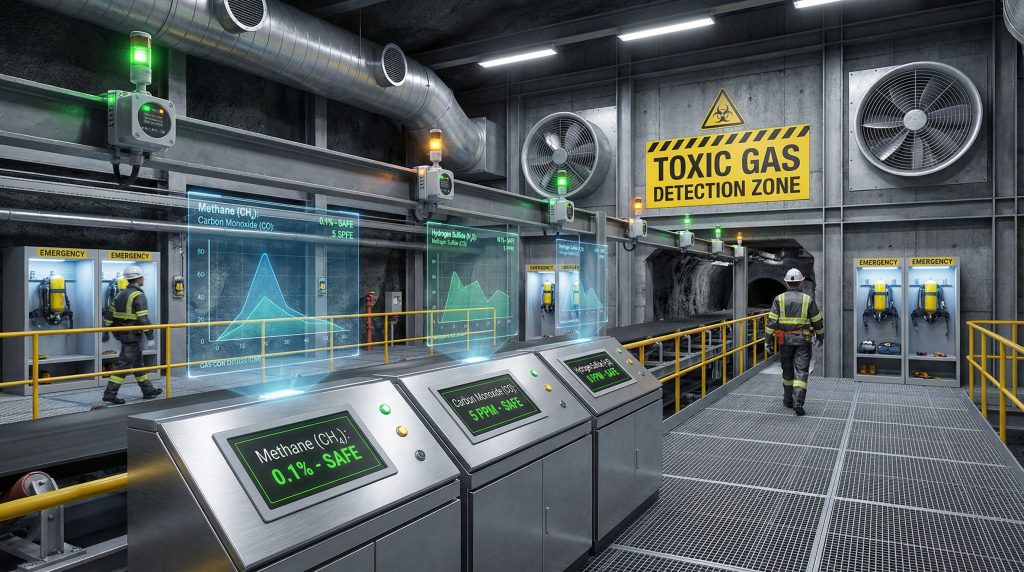
Modern underground coal mining operations deploy sophisticated atmospheric monitoring networks designed to provide continuous surveillance of gas concentrations throughout active workings. These systems integrate multiple sensor technologies to create comprehensive early warning capabilities that can trigger automatic ventilation responses and personnel evacuation procedures, effectively boosting mining safety standards across the industry.
| Detection Technology | Response Time | Detection Range | Typical Applications |
|---|---|---|---|
| Electrochemical Sensors | 15-30 seconds | 0-500 ppm CO | Continuous monitoring |
| Catalytic Bead Sensors | 10-20 seconds | 0-100% LEL methane | Explosion prevention |
| Infrared Gas Detectors | 5-15 seconds | 0-5% methane | High-accuracy detection |
| Pellistor Sensors | 20-30 seconds | 0-100% LEL | Multi-gas detection |
Strategic sensor placement follows established protocols for maximum coverage effectiveness. Primary monitoring locations include:
- Return airways where gases concentrate naturally
- Working face areas during active extraction
- Equipment rooms with electrical hazards
- Sealed area boundaries where breakthrough may occur
- Ventilation fan stations and control points
Remote Sensing Applications for Abandoned Mine Monitoring
Satellite-based methane detection capabilities provide large-scale monitoring of emissions from abandoned coal mines and surface coal operations. However, AI in mining technology enables more sophisticated analysis of emission patterns and predictive modelling for potential gas release events.
Drone-mounted sensor arrays enable detailed surface emission mapping around abandoned mine sites. These aerial platforms can:
- Access hazardous areas unsafe for personnel
- Provide real-time gas concentration mapping
- Monitor emission trends over multiple survey flights
- Identify specific emission sources within large mining complexes
Emergency Response Scenario: In the event of a large-scale toxic gas leak from underground coal mine operations, detection timeline becomes critical. Remote sensing can identify the emission within 15-30 minutes of onset, while ground-based sensors provide precise concentration data within 5-10 minutes for areas under active monitoring.
What Ventilation Strategies Prevent Toxic Gas Accumulation?
Primary Ventilation System Design Principles
Underground mine ventilation systems operate on fundamental fluid dynamics principles, creating controlled airflow patterns that dilute and remove toxic gases before they reach dangerous concentrations. Optimal air velocity calculations require maintaining minimum flow rates of 0.5-1.0 m/s in working areas to ensure adequate gas dilution while preventing dust entrainment that could create additional hazards.
Critical design parameters include:
- Pressure drop calculations: Accounting for airway resistance and elevation changes
- Air distribution networks: Ensuring adequate flow to all working areas
- Recirculation prevention: Avoiding contaminated air re-entry into intake systems
- Emergency backup capacity: Maintaining minimum safe ventilation during equipment failures
Modern data-driven mining operations utilise sophisticated computational fluid dynamics models to optimise ventilation system design and predict gas dispersion patterns under various operational scenarios.
Emergency Ventilation Protocols During Gas Events
Rapid response ventilation activation requires pre-planned procedures that can be implemented immediately upon detection of hazardous gas concentrations. Emergency protocols typically include automatic fan speed increases, airflow direction reversals, and auxiliary ventilation deployment to specific affected areas.
Critical Decision Point: Emergency response teams must determine within minutes whether to increase ventilation to dilute gases or initiate immediate evacuation. This decision depends on gas concentrations, rate of increase, and proximity to ignition sources.
How Do Mining Companies Respond to Toxic Gas Emergency Incidents?
Community Impact Management and Public Safety
The Dhanbad incident demonstrates how underground coal mine toxic gas releases can affect surrounding communities, requiring coordination between mining companies and local authorities. Residents in Baghmara area staged road blockades protesting smoke and gas emissions from abandoned Bharat Coking Coal Limited underground fires.
Community response protocols include:
- Air quality monitoring: Continuous measurement of gas concentrations in residential areas
- Evacuation planning: Pre-established routes and shelters for affected neighbourhoods
- Public notification: Emergency communication systems for immediate community alerts
- Health services coordination: Medical response for residents experiencing exposure symptoms
- Road closure management: Traffic control and alternative route designation
According to police reports from the incident, the demonstration intensified when an outsourcing company began work on mine galleries, causing increased smoke production that affected nearby homes. The situation was resolved after BCCL and contracted personnel doused the flames and stopped smoke emission from the affected land area.
Post-Incident Investigation and Prevention Measures
Root cause analysis methodologies for gas release events employ systematic investigation techniques to identify contributing factors and prevent recurrence. Furthermore, specialised agencies focus on managing toxic gas in underground coal mines through comprehensive safety protocols and technological solutions.
| Regulatory Jurisdiction | Investigation Requirements | Reporting Timeline | Enforcement Actions |
|---|---|---|---|
| United States (MSHA) | Comprehensive incident analysis | 10 days initial report | Fines up to $70,000 per violation |
| Australia (State authorities) | Independent safety investigation | 48 hours notification | Licence suspension possible |
| European Union (National authorities) | Technical investigation report | 72 hours preliminary | Criminal prosecution potential |
| India (DGMS) | Departmental inquiry | Immediate notification | Operations shutdown authority |
What Are the Long-Term Health and Environmental Consequences?
Occupational Health Impacts on Mining Personnel
Chronic exposure to low-level gas concentrations creates cumulative health effects that may not become apparent until years after initial exposure. Research indicates that coal miners face elevated risks of respiratory disease, cardiovascular problems, and neurological disorders related to long-term toxic gas exposure in underground environments.
Chronic exposure effects from specific gases include:
- Carbon monoxide: Cardiovascular stress, reduced exercise capacity, neurological impairment
- Methane: Generally non-toxic but creates oxygen displacement hazards
- Hydrogen sulfide: Eye irritation, respiratory system damage, olfactory nerve injury
- Coal dust: Progressive massive fibrosis, silicosis, black lung disease
Medical monitoring protocols for at-risk workers require regular pulmonary function testing, cardiovascular assessment, and neurological evaluation. These monitoring programmes typically include annual chest X-rays, spirometry testing, and blood gas analysis to detect early signs of occupational disease development.
Environmental Contamination from Persistent Gas Emissions
Groundwater quality impacts from underground fires occur through multiple contamination pathways. Combustion products can dissolve into groundwater systems, creating long-term contamination plumes that affect water supplies for surrounding communities. These contaminants may include heavy metals, organic compounds, and acidic byproducts from coal combustion.
Ecosystem Impact Scenario: Long-term methane emissions from abandoned coal mines can alter local soil chemistry, affecting plant growth patterns and soil microbial communities. Continuous methane flux may create zones of altered vegetation growth and soil carbon storage capacity.
Environmental remediation challenges include:
- Inaccessible contamination sources in sealed mine workings
- Continuous contaminant release from ongoing underground fires
- Large geographic areas affected by groundwater contamination
- Long-term monitoring and treatment requirements spanning decades
Climate Change Implications of Methane Releases
Coal mine methane represents a significant greenhouse gas emission source, with methane having approximately 28 times the global warming potential of carbon dioxide over a 100-year timeframe according to IPCC assessments. However, underground coal mining operations worldwide release an estimated 40-50 million tons of methane annually.
| Emission Reduction Technology | Capture Efficiency | Implementation Cost | Economic Viability |
|---|---|---|---|
| Pre-mining degasification | 60-80% | $2-5 million per system | High for active mines |
| Ventilation air methane oxidation | 90-95% | $10-20 million per unit | Moderate for high-flow mines |
| Post-mining gas recovery | 70-90% | $1-3 million per wellfield | High for abandoned mines |
| Flaring systems | 95-99% | $0.5-1 million per site | High for all applications |
Carbon credit opportunities for methane capture projects provide economic incentives for emission reduction investments. Methane destruction projects can generate carbon credits valued at $10-50 per ton of CO₂ equivalent, depending on market conditions and project verification standards.
The next major ASX story will hit our subscribers first
Which Regulatory Frameworks Govern Underground Mine Gas Safety?
International Mining Safety Standards and Compliance
Regulatory frameworks governing underground mine gas safety vary significantly across mining jurisdictions, reflecting different industrial histories, geological conditions, and political priorities. The International Labour Organisation Convention No. 176 establishes fundamental principles for mine safety, requiring signatories to implement comprehensive gas monitoring and ventilation standards.
| Country/Region | Gas Monitoring Requirements | Enforcement Authority | Penalty Structure |
|---|---|---|---|
| United States | Continuous monitoring, 10 ppm CO limit | MSHA | Up to $70,000 per violation |
| Australia | Real-time gas detection systems | State mining departments | A$3 million maximum fines |
| European Union | Automated safety systems required | National mining authorities | Variable by member state |
| Canada | Provincial safety standards | Provincial mining ministries | C$25,000-500,000 penalties |
| India | DGMS safety regulations | Directorate General of Mines Safety | Operations shutdown authority |
Enforcement mechanisms include regular safety inspections, unannounced compliance audits, and incident investigation requirements. Regulatory authorities maintain the power to halt mining operations immediately upon discovery of serious safety violations, creating strong economic incentives for compliance.
Technology Innovation Requirements and Safety Mandates
Mandatory safety equipment specifications continue evolving as new technologies demonstrate improved reliability and performance. Recent regulatory trends emphasise real-time monitoring capabilities, automated emergency response systems, and integration of multiple safety technologies into comprehensive mine-wide networks.
Current technology mandates typically include:
- Continuous atmospheric monitoring: Real-time gas concentration measurement
- Automated ventilation control: Computer-controlled airflow management systems
- Personal gas detection: Individual monitoring devices for all underground personnel
- Emergency communication: Redundant communication systems for emergency response
- Data logging and analysis: Historical record keeping and trend analysis capabilities
Community Rights and Corporate Responsibility Frameworks
Legal Framework Alert: Mining companies face increasing legal obligations for community notification during gas events, with failure to provide timely warnings potentially resulting in criminal liability for corporate officers and significant financial penalties.
Environmental impact assessment requirements for new mining operations now routinely include comprehensive gas emission modelling, community health impact analysis, and long-term monitoring commitments. These assessments must address potential impacts on air quality, groundwater contamination, and community health over the entire mine lifecycle, including post-closure monitoring obligations.
Corporate responsibility frameworks typically address:
- Community engagement: Regular consultation and information sharing
- Environmental monitoring: Independent verification of emission levels
- Health impact assessment: Population health studies and medical monitoring
- Emergency response coordination: Integration with local emergency services
- Financial assurance: Bonding and insurance for environmental liabilities
In conclusion, a toxic gas leak from underground coal mine operations represents a complex challenge requiring comprehensive understanding of gas dynamics, advanced detection technologies, and coordinated emergency response capabilities. The integration of modern monitoring systems with traditional safety protocols continues to evolve as the industry adapts to emerging technologies and regulatory requirements.
Disclaimer: This article contains forward-looking statements and technical analysis based on currently available information. Actual mining conditions, regulatory requirements, and safety performance may vary significantly from projections discussed herein. Readers should consult qualified mining engineers and regulatory authorities for specific safety guidance applicable to particular mining operations.
Looking to Capitalise on the Resources Sector's Safety and Technology Advances?
Mining companies implementing advanced safety technologies and environmental monitoring systems often present compelling investment opportunities as they reduce operational risks and regulatory compliance costs. Discovery Alert's proprietary Discovery IQ model delivers instant notifications when ASX-listed mining companies announce significant technological breakthroughs, safety improvements, or operational advances that could impact share prices, helping investors identify actionable opportunities ahead of the broader market.