May 22, 2026
The Silent Crisis Beneath Europe's Green Energy Ambitions
Somewhere between the factory floor and the recycling bin lies one of the most consequential industrial gaps of the clean energy era. Across Europe, millions of electric vehicles are accumulating mileage, their battery packs aging toward end-of-life thresholds that will arrive in substantial volumes by the late 2020s. Yet the infrastructure needed to recover the critical materials locked inside those cells barely exists at meaningful scale. This is not a distant problem. It is an unfolding structural vulnerability with a fixed regulatory deadline — and the window to close the gap is narrowing fast.
When big ASX news breaks, our subscribers know first
Europe's Critical Materials Dependency: A Supply Chain Built on Risk
Battery manufacturing requires four materials above all others: lithium, graphite, cobalt, and nickel. Each carries its own supply concentration risk. The European Union imports approximately 100% of its primary lithium from non-EU sources, with processing capacity overwhelmingly concentrated in China, which controls roughly 60% of global lithium conversion infrastructure despite not being the largest raw ore producer. (USGS Mineral Commodity Summaries, 2024.) This processing bottleneck is distinct from mining geography — Europe could theoretically access ore from Australia or South America and still remain dependent on Chinese refining capacity to produce battery-grade lithium carbonate or hydroxide.
Cobalt presents a different but equally acute problem. Approximately 65% of global cobalt production originates from the Democratic Republic of Congo, a single-country concentration that introduces geopolitical and supply security risk into every battery pack assembled in Europe. (IEA, Critical Minerals Market Review, 2023.) Nickel's supply security was demonstrated dramatically in 2021 to 2022, when prices surged from roughly $8,000 per tonne to a peak exceeding $100,000 per tonne following geopolitical disruption — a move that sent shockwaves through battery cell cost models across the continent. (London Metal Exchange historical pricing data, 2021 to 2022.)
Graphite, however, is the least discussed and arguably the most strategically overlooked. It constitutes 15 to 25% of a lithium-ion battery cell by weight, functions as the anode material in virtually every commercial cell chemistry in production today, and is sourced almost entirely from China. Unlike lithium or cobalt, graphite has no near-term substitute in conventional cell architecture — and until very recently, no European facility had demonstrated the ability to recover it at industrial scale from end-of-life batteries.
The critical minerals demand trajectory compounds these vulnerabilities. EU battery demand is projected to grow from approximately 100 GWh in 2023 to over 1,000 GWh annually by 2030, driven by accelerating EV adoption that reached roughly 24% of new car sales across the bloc in 2023. (IEA, Global EV Outlook 2024.) End-of-life battery volumes, relatively modest today, are forecast to reach 500,000 to 700,000 cumulative tonnes by 2030 from passenger EVs alone, creating a recycling feedstock wave that will arrive faster than most infrastructure investment timelines allow. (IVL Swedish Environmental Research Institute, Circular Economy Potential in Lithium-Ion Battery Recycling, 2024.)
The emerging industry consensus frames battery recycling not as a waste management obligation but as a strategic secondary supply chain — one capable of offsetting an estimated 25 to 30% of primary material demand by the end of this decade if sufficient processing capacity is built in time.
What the EU Battery Regulation Actually Requires
The EU Battery Regulation (2023/2626), which entered force in December 2023, establishes binding minimum recovery rates for critical materials extracted from end-of-life batteries. These targets are not aspirational. They are compliance obligations with defined enforcement timelines.
| Material | Recovery Rate Target (2027) | Recovery Rate Target (2031) |
|---|---|---|
| Lithium | 50% | 80% |
| Cobalt | 95% | 98% |
| Nickel | 90% | 98% |
| Copper | 90% | 98% |
Source: EU Battery Regulation 2023/2626, Article 62, Official Journal of the European Union, December 2023.
The regulation is deliberately technology-neutral — it mandates outcomes, not methods. This creates competitive space for alternative recycling approaches that can meet or exceed these thresholds without necessarily replicating existing industrial processes. Recovery rates under the regulation are calculated as the mass of recovered material outputs divided by the mass of battery waste inputs, measured separately for each critical material fraction, and include recovered metal in intermediate compound form — meaning lithium carbonate counts toward lithium recovery targets. (EU Battery Regulation 2023/2626, Annex VI.)
The compliance pressure is immediate. The 2027 milestone for 50% lithium recovery is the most technically challenging near-term target, because the dominant existing recycling technology — pyrometallurgy, or high-temperature smelting — achieves lithium recovery rates of below 5%. At smelting temperatures of approximately 1,400°C, lithium vaporises rather than being captured as a recoverable product. Cobalt, nickel, and copper survive the process in recoverable form, but lithium does not.
Fewer than five European facilities currently operate at industrial scale with demonstrated lithium recovery rates above 50%, according to industry assessments from the European Battery Innovation Consortium. This gap between regulatory obligation and installed capacity defines the urgency of the current investment cycle — and explains why the opening of new hydrometallurgical recycling facilities in Germany carries significance well beyond any single company's commercial story.
Extended Producer Responsibility schemes accompanying the regulation require battery manufacturers and importers to finance end-of-life collection and recycling, with initial EPR contributions estimated at €15 to €40 per kWh of battery capacity in the first compliance phase. (European Environment Agency, Extended Producer Responsibility in the Circular Economy, 2023.) Germany, already Europe's highest-performing battery collection market at approximately 52% collection rate in 2023, is positioned to serve as both a feedstock source and a processing hub as these obligations bite. (German Federal Environment Agency, Battery Collection and Recycling Report, 2023.)
Inside the tozero Battery Recycling Plant in Germany
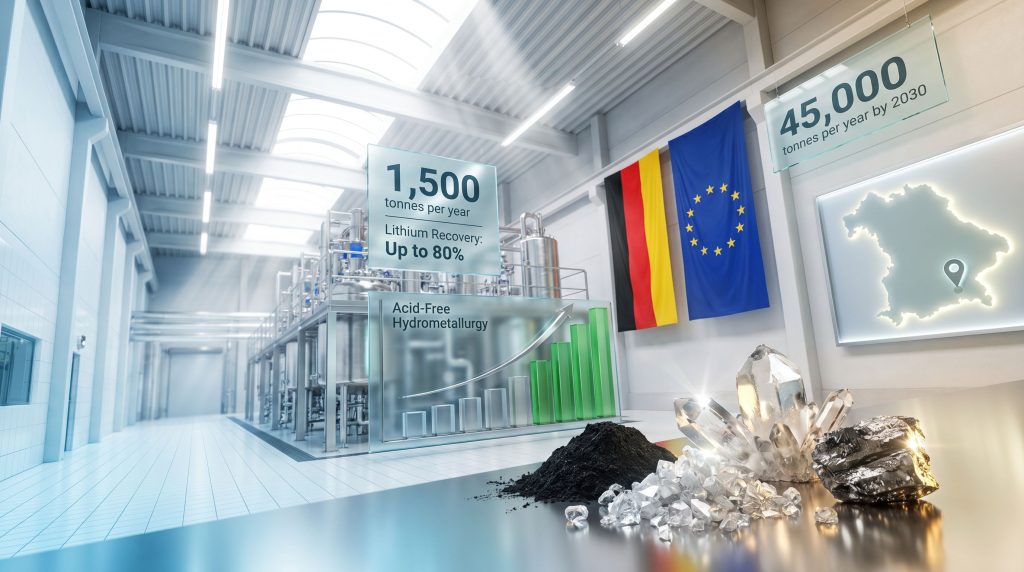
The tozero battery recycling plant in Germany, situated at Chemical Park Gendorf in Bavaria, represents the first industrial demonstration facility for lithium-ion battery recycling on the continent built with full graphite recovery capability. The Munich-based startup constructed the facility in approximately six months from groundbreaking to operational status — a timeline that, for a complex chemical processing plant handling hazardous battery materials, is notably compressed.
The facility's core specifications are as follows:
- Location: Chemical Park Gendorf, Burghausen, Bavaria, Germany
- Annual processing capacity: More than 1,500 tonnes of battery waste per year
- Lithium carbonate output: Up to 100 tonnes per year at demonstration scale
- Lithium recovery rate: Up to 80% from end-of-life cells
- Graphite recovery rate: 100% — a first at this scale in Europe
- Funding: Co-financed through the EU EIC Accelerator Program
The selection of Chemical Park Gendorf as the host site was not arbitrary. Chemical Parks — large integrated industrial complexes with shared utilities, chemical processing infrastructure, wastewater treatment, and established regulatory frameworks — significantly reduce the permitting and operational risk associated with complex chemical processes. (European Chemical Industry Council, CEFIC, industrial site planning guidelines.) The Gendorf site provides access to existing steam, nitrogen, and utilities infrastructure, while its location within Bavaria places it at the geographic centre of Germany's automotive manufacturing corridor — the primary source of end-of-life battery feedstock over the coming decade.
How Acid-Free Hydrometallurgy Works — and Why It Changes the Equation
Understanding why the tozero process is technically significant requires a clear-eyed comparison between the three primary recycling methodologies currently deployed or in development across Europe.
| Method | Energy Intensity | Material Recovery | Lithium Recovery | Environmental Profile |
|---|---|---|---|---|
| Pyrometallurgy (smelting) | Very high (~1,400°C) | Moderate — cobalt, nickel, copper only | Below 5% | High CO₂ emissions; slag waste |
| Conventional hydrometallurgy | Moderate | High across most metals | 20 to 50% | Generates hazardous acid waste streams |
| Acid-free hydrometallurgy (tozero) | Lower | High — lithium, graphite, nickel, cobalt | Up to 80% | Reduced chemical waste; no strong acid leaching |
Conventional hydrometallurgy improves on smelting by dissolving battery materials in acidic solutions, isolating individual metal compounds through selective precipitation. The problem is that strong acid leaching — typically using sulphuric acid — generates hazardous waste streams requiring expensive treatment, complicates permitting at scale, and introduces chemical inputs that raise operating costs. Graphite, which does not dissolve into acid leach solutions in a recoverable form under standard conditions, is typically lost as contaminated waste in conventional hydrometallurgical processes.
Acid-free hydrometallurgy eliminates the strong acid leaching step entirely. The tozero process uses alternative dissolution chemistry — the precise reagents are proprietary — that selectively targets metal compounds while preserving the structural integrity of graphite for separate recovery. This is not a theoretical improvement. The facility has demonstrated 100% graphite recovery at industrial demonstration scale, a milestone with profound strategic implications given graphite's near-total sourcing dependency on China. Furthermore, the development of a recycled graphite product at this scale signals a broader shift in how Europe approaches anode material supply security.
The process flow involves several sequential stages: mechanical pre-processing to separate battery components, selective dissolution of cathode materials, precipitation of individual metal compounds (lithium carbonate, nickel-cobalt intermediates), and graphite separation and purification. Each stage is calibrated to produce battery-grade output material meeting the purity specifications required by cathode and anode manufacturers — a higher bar than laboratory certification alone.
A critical but underappreciated distinction in battery recycling is the difference between achieving high recovery rates in a laboratory setting and producing material that a real cathode manufacturer will accept into their production process. The latter requires consistent purity at scale, demonstrating process stability over time, not just a single test result.
tozero has reportedly qualified its recycled lithium carbonate and graphite with leading cathode and anode manufacturers — a commercially significant threshold that validates the industrial process, not just the chemistry. The company has also announced the production of a battery cell manufactured entirely from 100% recycled graphite, representing a milestone in closed-loop battery manufacturing that no European recycler had previously achieved at this scale. According to Recycling International, this achievement positions tozero among Europe's most technically advanced battery recycling operations.
Benchmarking the Gendorf Facility Against Europe's Recycling Landscape
To appreciate what the tozero battery recycling plant in Germany has achieved, it helps to place it within the broader context of European recycling capacity development.
| Metric | tozero (Gendorf) | Typical European Pilot Plant | EU Compliance Target (2031) |
|---|---|---|---|
| Annual processing capacity | 1,500+ tonnes | 100 to 500 tonnes | Multi-thousand tonne scale |
| Lithium recovery rate | Up to 80% | 20 to 50% | 80% (mandatory) |
| Graphite recovery | 100% | Minimal to none | Not yet mandated |
| Process type | Acid-free hydrometallurgy | Pyro or conventional hydro | Technology-neutral |
| OEM material qualification | Achieved | Pre-qualification stage | Required for supply chain entry |
Belgium's Umicore operates established pyrometallurgical recycling infrastructure with expanding hydrometallurgical capabilities, but its legacy process architecture was not designed for lithium recovery at the rates now mandated by EU regulation. Northvolt's Revolt Ett facility in Sweden, operational since 2023 and processing an initial estimated 120 to 150 tonnes per year, pioneered integrated gigafactory recycling loops but remains limited in scale relative to commercial requirements. (Northvolt official announcements, 2023 to 2024.) France's Veolia and Eramet are developing hydrometallurgical recycling partnerships but remain in earlier stages of deployment.
What distinguishes the tozero facility is not simply capacity, but the combination of recovery performance, OEM qualification, and graphite recovery achieved simultaneously at demonstration scale. Most European facilities meeting high cobalt and nickel recovery targets have done so through pyrometallurgical routes that sacrifice lithium entirely. Facilities targeting lithium via conventional hydrometallurgy have done so without capturing graphite. No European facility had previously demonstrated all three simultaneously at industrial scale before the Gendorf plant became operational. In addition, the evolution of critical minerals recycling more broadly reflects a growing recognition that secondary supply chains must complement primary extraction.
The next major ASX story will hit our subscribers first
The 2030 Commercial Scale-Up: What 45,000 Tonnes Per Year Would Mean
tozero has outlined a commercial scale-up target of 45,000 tonnes of battery waste per year by 2030, representing approximately a 30-fold increase from the Gendorf demonstration plant's current capacity. The Gendorf facility functions explicitly as a technology validation platform — its purpose is to de-risk the process engineering, confirm material qualification pathways, and establish the operational learning base required to design a full commercial facility with confidence.
The economics of scaling acid-free hydrometallurgy are structurally more attractive than conventional methods at commercial volumes. Eliminating strong acid leaching reduces reagent input costs, simplifies waste treatment obligations (reducing both operational cost and permitting complexity), and preserves graphite as a revenue-generating output rather than a contaminated waste stream. Revenue from a commercial-scale facility would combine recycling service fees charged to battery manufacturers and OEMs with direct product sales of recovered lithium carbonate, graphite, and nickel-cobalt intermediates.
To contextualise the scale-up target: if a 45,000-tonne-per-year facility achieves consistent 80% lithium recovery across its input battery waste stream, the theoretical lithium carbonate output could support battery pack production for several hundred thousand electric vehicles annually, depending on pack chemistry and energy content. This represents a meaningful but partial contribution to European battery material circularity — significant enough to reduce primary import dependency, but not sufficient on its own to close the full supply gap.
Note: The above represents a hypothetical scenario based on stated capacity targets and demonstrated recovery rates. Actual output will depend on feedstock composition, operational efficiency, and market conditions. This should not be construed as a financial forecast or investment recommendation.
The EU Battery Regulation's compliance horizon for 80% lithium recovery runs to 2031. A 45,000-tonne commercial facility operational by 2030 would place tozero's capacity ahead of this mandatory threshold by approximately one year, providing commercial first-mover positioning relative to the regulatory compliance wave that will drive procurement decisions across the battery supply chain in the late 2020s.
Why Germany Is Emerging as Europe's Battery Recycling Centre
Germany's emergence as the focal point for European battery recycling activity is not accidental. Several reinforcing structural factors converge in a single geography.
Industrial infrastructure density: Germany's Chemical Park model — exemplified by Gendorf, Leverkusen, and Ludwigshafen — provides the integrated processing environments that complex hydrometallurgical operations require. Shared utility infrastructure, established waste management systems, and co-location with chemical processing expertise reduce both capital costs and regulatory friction for new entrants.
Feedstock proximity: Germany is Europe's largest EV market and automotive manufacturing base. The co-location of battery feedstock generation (end-of-life vehicle batteries) with recycling infrastructure eliminates cross-border logistics costs and collection complexity, a significant operational advantage as collection volumes scale.
Research ecosystem: The Fraunhofer Institute network and Germany's university research infrastructure represent one of Europe's deepest concentrations of applied research capability in battery materials, electrochemistry, and process engineering — providing the talent and knowledge base that industrial battery recycling operations require.
Collection performance: Germany's battery collection rate of approximately 52% is among the highest in the EU, creating a more reliable domestic feedstock supply relative to markets with underdeveloped collection infrastructure.
The EU EIC Accelerator Program's role in co-financing the Gendorf facility deserves specific attention. The EIC Accelerator provides up to €17 million in grant funding plus equity investment to deep-tech companies addressing EU strategic priorities, with battery recycling explicitly qualifying as a critical materials and circular economy priority. (European Innovation Council official program guidelines, 2024.) This public co-financing mechanism serves to bridge the commercial valley of death — the funding gap between successful pilot-scale validation and the capital-intensive investment required for full commercial deployment — a gap that has historically caused promising recycling technologies to stall before reaching market impact. The wider critical minerals supply chain challenge facing Europe makes this kind of targeted public investment increasingly essential.
Structural Challenges That the Sector Must Still Navigate
The enthusiasm around facilities like the tozero battery recycling plant in Germany should be balanced against the structural barriers that remain unresolved across the broader sector.
Feedstock timing mismatch: The first large wave of end-of-life EV batteries from consumer vehicles will not arrive in substantial volumes until the late 2020s to early 2030s. Commercial recycling facilities being designed today will operate at partial capacity for their first several years of operation, creating a cash flow gap between capital deployment and full revenue generation.
Battery chemistry diversity: The battery recycling process must be adapted to handle multiple cell chemistries. NMC (nickel-manganese-cobalt), LFP (lithium iron phosphate), NCA (nickel-cobalt-aluminium), and emerging solid-state chemistries each present different material compositions, requiring process flexibility that adds engineering complexity.
Black mass standardisation: Black mass — the powdered intermediate product created by mechanically shredding battery cells — varies significantly in composition depending on input battery chemistry, age, and pre-processing method. This input variability creates challenges for hydrometallurgical plants calibrated for specific material ratios, and the lack of industry-wide black mass quality standards complicates feedstock procurement.
The chicken-and-egg capital problem: Recyclers need guaranteed feedstock volumes to justify large-scale capital investment. Battery manufacturers and OEMs need guaranteed recycling capacity to meet regulatory obligations. Long-term offtake and feedstock supply agreements are emerging as the contractual mechanism to break this deadlock, with Extended Producer Responsibility schemes creating mandatory collection obligations that underpin feedstock flow guarantees.
Capital intensity at commercial scale: Full commercial-scale hydrometallurgical facilities require hundreds of millions of euros in investment. This places battery recycling in the same capital intensity bracket as primary mining and processing operations — requiring either deep-pocketed industrial backers, structured public-private co-financing, or long-term revenue visibility through binding supply agreements before construction can be justified. Consequently, shifts in the battery raw materials market — particularly lithium carbonate pricing — will directly influence the investment calculus for commercial-scale facilities.
Frequently Asked Questions: tozero Battery Recycling Plant in Germany
What is the tozero battery recycling plant and where is it located?
The tozero battery recycling plant in Germany is an industrial demonstration facility for lithium-ion battery recycling located at Chemical Park Gendorf in Burghausen, Bavaria. Operated by Munich-based startup tozero GmbH, the facility processes more than 1,500 tonnes of battery waste annually using a proprietary acid-free hydrometallurgical process. Silicon Republic has highlighted the facility's graphite and lithium recovery capabilities as a landmark development for European materials strategy.
What materials does the tozero plant recover from used batteries?
The Gendorf facility recovers lithium carbonate (up to 80% recovery rate), graphite (100% recovery), a nickel-cobalt mixed product for reintegration into cathode supply chains, and additional fractions including manganese and copper current collectors.
What makes tozero's recycling process different from conventional methods?
The acid-free hydrometallurgical process eliminates the strong acid leaching steps used in conventional hydrometallurgy, removing the hazardous acid waste streams that complicate permitting and raise operating costs at scale. Critically, it preserves graphite for full recovery — a material almost entirely lost in competing processes — while achieving lithium recovery rates comparable to the EU's 2031 mandatory targets.
How much battery waste can the Gendorf facility process?
The demonstration facility processes more than 1,500 tonnes of battery waste per year. tozero's stated target for its full commercial facility is 45,000 tonnes per year, with an operational target date of 2030.
Has tozero's recycled material been validated for use in new batteries?
Yes. tozero has qualified its recycled lithium carbonate and graphite with cathode and anode manufacturers, and has reported the production of a battery cell manufactured from 100% recycled graphite — a closed-loop manufacturing milestone at industrial demonstration scale.
Is tozero receiving EU funding?
The Gendorf facility received co-financing through the EU's European Innovation Council (EIC) Accelerator Program, which supports deep-tech companies addressing strategic European priorities including critical materials and the circular economy.
What the Gendorf Facility Signals for European Battery Strategy
The tozero battery recycling plant in Germany is best understood not as a finished achievement, but as a proof of concept with strategic implications that extend far beyond its current processing volume. Industrial demonstration plants occupy a specific and critical position in the technology commercialisation chain — they are the step at which laboratory chemistry becomes process engineering, and process engineering becomes supply chain infrastructure.
Several conclusions emerge from what the Gendorf facility has demonstrated:
- Acid-free hydrometallurgy can achieve EU 2031 lithium recovery targets at industrial scale, not just theoretical projections
- Full graphite recovery at industrial scale is technically achievable, addressing Europe's most acute but least-discussed critical material dependency
- OEM qualification of recycled materials is commercially attainable within a demonstration facility framework, validating the revenue model before full commercial investment
- A six-month construction timeline for an industrial chemical processing facility demonstrates that deployment speed in battery recycling can match the urgency of the regulatory and supply security challenge
The broader lesson for European industrial strategy may be this: the critical missing link between laboratory innovation and gigafactory-scale deployment is not more research funding, but more industrial demonstration capacity — facilities that operate at real commercial conditions, generate real qualification data, and prove that novel chemistries can hold up under the demands of continuous industrial operation.
Europe's battery recycling sector is undergoing a fundamental recharacterisation. What began as a compliance-driven waste management obligation is becoming the foundation of a domestic critical materials supply chain. Whether this transition proceeds fast enough to meet the 2027 and 2031 regulatory milestones will depend on how quickly demonstration-scale successes like the Gendorf facility can be replicated and expanded to commercial volumes across the continent.
This article contains forward-looking statements and scenario projections based on publicly available information, company announcements, and regulatory documents. Capacity targets, recovery rates, and commercial timelines represent stated objectives and should not be interpreted as guaranteed outcomes or investment advice. Readers should conduct independent due diligence before making any investment or commercial decisions related to the battery recycling sector.
Want to Identify the Next Major Resource Discovery Before the Market Does?
Discovery Alert's proprietary Discovery IQ model delivers real-time alerts on significant ASX mineral discoveries — including the critical minerals driving Europe's battery revolution — instantly translating complex data across more than 30 commodities into clear, actionable insights for investors at every level. Explore how historic mineral discoveries have generated extraordinary returns and begin your 14-day free trial today to position yourself ahead of the market.