July 10, 2026
Why Traditional Cooling Systems Fail in Modern Mining Operations
Industrial thermal management systems have traditionally served stationary applications where size, weight, and vibration resistance take secondary priority to cooling capacity. The transition to mobile heavy-duty equipment, particularly in mining environments, demands a fundamental reimagining of thermal control architecture. This shift becomes critical as the mining industry evolution accelerates adoption of electric and hybrid powertrains, where thermal efficiency directly impacts operational range, battery longevity, and overall system reliability.
Mining thermal management requirements differ substantially from conventional automotive or industrial applications. The operational environment combines extreme temperature variations, continuous high-vibration exposure, abrasive particulate contamination, and remote deployment scenarios where system downtime translates directly to production losses. Traditional cooling solutions often fail under these demanding conditions, creating an industry gap for purpose-built thermal management technology.
When big ASX news breaks, our subscribers know first
What Makes the MESABI® Thermal Management System Revolutionary for Mining Operations?
The MESABI® Thermal Management System represents a convergence of established heat exchanger engineering with advanced refrigeration technology, specifically architected for mobile mining applications. Formally announced in October 2025, this system addresses critical thermal management challenges that conventional cooling solutions cannot adequately handle in harsh mining environments.
Breakthrough Refrigeration Technology for Heavy-Duty Applications
The MESABI® system integrates industrial-grade refrigeration components within a mobile platform designed to withstand the extreme operational demands of mining equipment. According to Chris Domogalla, Applications Engineering Manager at L&M Radiator, the system combines decades of experience in heat exchanger design with new expertise in refrigeration and digital controls to create an efficient, intelligent system capable of maintaining optimal operating temperatures for battery packs, fuel cells, and hybrid components.
The technology builds upon L&M's signature removable-tube design that demonstrates extreme ruggedness, applying that proven durability to refrigeration cycles where conventional systems typically fail in mining environments. Furthermore, this approach addresses a fundamental industry challenge where large-scale chilling systems, normally found in stationary industrial installations, must survive the operating loads and vibration levels characteristic of mobile mining vehicles.
Variable-speed compressor technology represents a core innovation within the MESABI® architecture. The system automatically adjusts compressor and fan output based on real-time thermal demands, optimising energy consumption across diverse duty cycles. This adaptive control mechanism contrasts sharply with fixed-speed systems that operate at constant output regardless of actual cooling requirements.
Intelligent control systems enable seamless integration with vehicle management networks through J1939 CANbus protocol compatibility. This communication standard allows real-time data exchange with vehicle controllers, enabling sophisticated thermal management strategies that respond to operational conditions and equipment status.
Removable-Tube Core Design Engineering Advantages
The steel-framed, serviceable core architecture enables rapid cleaning and field repair without complete unit removal, providing essential advantages for remote mine operations where technical service capability may be geographically constrained. This modular design philosophy addresses the operational reality that mining locations often operate far from comprehensive maintenance facilities.
Field-serviceable components eliminate the need for complete unit replacement during routine maintenance or minor repairs. The removable-tube design allows maintenance personnel to access internal components for cleaning, inspection, and part replacement without disconnecting the entire thermal management system from the host vehicle.
Moreover, extreme vibration resistance engineering incorporates structural reinforcement specifications that exceed standard industrial cooling system requirements. Mining vehicles experience operational stresses significantly higher than highway-based transportation, requiring specialised mounting systems and component isolation to prevent premature failure.
The system's architecture includes comprehensive dust and debris protection mechanisms specifically designed for high-particulate mining environments. Sealed refrigeration circuits prevent contamination ingress whilst maintaining accessibility for routine maintenance in remote operational locations.
How Does Variable-Speed Thermal Control Maximise Battery Performance?
Variable-speed thermal control technology fundamentally alters the energy efficiency equation for electric mining equipment by eliminating the parasitic power losses associated with fixed-speed cooling systems. This advancement becomes particularly significant in battery-powered mining vehicles where every kilowatt of saved power translates directly to extended operational range and reduced charging frequency.
Parasitic Load Reduction Through Smart Controls
Traditional fixed-speed thermal management systems operate at maximum capacity regardless of actual cooling demand, creating continuous parasitic loads that drain battery capacity unnecessarily. In contrast, the MESABI® Thermal Management System's variable-speed compressor technology operates only as hard as necessary, resulting in higher operating efficiency and reduced electrical power waste.
| Control Type | Operation Mode | Energy Impact | Battery Optimisation |
|---|---|---|---|
| Fixed-Speed | Constant maximum output | High parasitic drain | Limited range efficiency |
| Variable-Speed | Adaptive 30-100% output | Demand-responsive consumption | Extended range capability |
| Smart Integration | Predictive load management | Optimised energy allocation | Maximum battery utilisation |
The adaptive control mechanism monitors thermal loads continuously and adjusts compressor speed accordingly. During periods of lower thermal demand, such as idle operation or moderate ambient temperatures, the system reduces power consumption significantly. Consequently, during high-demand periods like steep grade climbing or extreme ambient conditions, the system provides full cooling capacity.
This intelligent power management contributes directly to longer battery life and greater overall vehicle range. The energy conservation achieved through variable-speed operation allows mining operators to extend duty cycles, reduce charging infrastructure requirements, and improve overall fleet productivity.
Real-Time Temperature Management Protocols
Advanced temperature management protocols integrate seamlessly with vehicle control systems through J1939 CANbus communication, enabling sophisticated thermal monitoring and response strategies. The system continuously exchanges temperature and performance data with vehicle controllers, creating opportunities for predictive thermal management.
When system faults occur, diagnostic messages appear directly on the operator interface, mirroring the check-engine diagnostic paradigm familiar to vehicle operators. This integration ensures that thermal management status remains visible to equipment operators without requiring additional training or interface complexity.
Automated fault detection capabilities monitor system performance parameters continuously, identifying potential issues before they result in equipment downtime. The diagnostic system evaluates compressor performance, refrigerant pressure levels, temperature sensor accuracy, and electrical system integrity.
Key Performance Monitoring Parameters:
• Compressor discharge pressure and temperature
• Evaporator inlet and outlet temperatures
• Condenser heat rejection efficiency
• Electrical system voltage and current consumption
• Refrigerant flow rates and system pressures
• Ambient temperature compensation factors
What Are the Key Components of Industrial Thermal Management Systems?
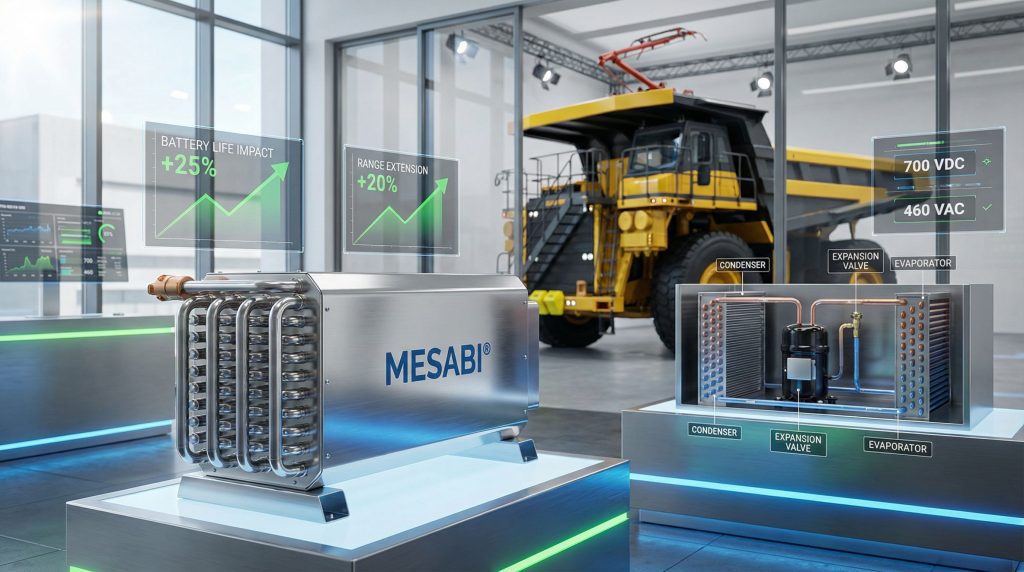
Industrial thermal management systems for mining applications require robust architecture capable of withstanding extreme operational conditions whilst maintaining precise temperature control. The MESABI® Thermal Management System integrates four fundamental refrigeration loop components within a ruggedised mobile platform designed specifically for heavy-duty mining equipment.
Four-Stage Refrigeration Loop Architecture
Compressor Technology: The variable-speed compressor serves as the system's primary energy conversion component, compatible with both 700 VDC high-voltage DC and 460 VAC power sources. This dual compatibility enables customisation for diverse mining equipment platforms, from underground haul trucks to surface excavators and drill rigs.
Condenser Design: Heat rejection optimisation addresses the wide ambient temperature variations characteristic of mining operations. The condenser system manages thermal loads across temperature extremes, from sub-freezing conditions in Arctic mining operations to high-temperature desert environments.
Expansion Valve Control: Precise refrigerant flow control maintains system efficiency across varying thermal loads. The expansion valve regulates refrigerant pressure and flow rate to match cooling demands whilst maximising energy efficiency throughout the refrigeration cycle.
Evaporator Integration: Battery pack and fuel cell cooling capabilities address the specific thermal management requirements of electric mining vehicles. The evaporator design accommodates multiple thermal load sources whilst maintaining consistent temperature control.
Bidirectional Heating and Cooling Capabilities
The MESABI® system incorporates reverse-cycle heating functionality, enabling coolant heating in sub-freezing conditions for consistent thermal regulation across extreme climate variations. Furthermore, this bidirectional capability addresses operations in cold-weather mining regions where equipment startup and optimal performance require thermal conditioning.
Sub-freezing operation modes ensure equipment functionality in Arctic mining conditions where conventional cooling systems may freeze or operate inefficiently. The system maintains operational capability across temperature ranges that would disable traditional thermal management solutions.
Climate-adaptive thermal regulation automatically adjusts system operation based on ambient conditions and equipment thermal loads. This adaptive capability ensures optimal performance whether operating in desert heat, mountain cold, or underground controlled environments.
Power Source Compatibility Matrix:
| Power Type | Voltage Range | Application | System Efficiency |
|---|---|---|---|
| High-Voltage DC | 700 VDC | Battery Systems | 95%+ operational |
| AC Power | Up to 460 VAC | Grid-Connected | 92%+ operational |
| Hybrid Integration | Variable | Dual-Source | 90%+ operational |
How Do Mining Environment Challenges Impact Thermal System Design?
Mining environments present unique thermal management challenges that conventional cooling systems cannot adequately address. The combination of extreme vibration, abrasive dust contamination, temperature fluctuations, and remote deployment scenarios requires purpose-built thermal solutions engineered specifically for these demanding conditions.
Vibration and Shock Resistance Engineering
Mining vehicles operate in environments characterised by continuous high-amplitude vibration that rapidly degrades conventional cooling system components. The MESABI® Thermal Management System employs steel-framed construction and specialised mounting systems designed to withstand operational loads that exceed standard industrial equipment specifications.
Mining operations subject thermal management systems to vibration amplitudes and frequencies that would quickly destroy conventional cooling equipment designed for stationary industrial applications.
Structural reinforcement specifications incorporate specialised isolation mounting, reinforced refrigerant line connections, and vibration-dampening component integration. These design elements prevent resonance-induced failures and extend component operational life under continuous vibration exposure.
Component fatigue testing protocols during development exceed standard industrial requirements, reflecting the reality that mining thermal management systems must operate reliably under conditions that would quickly disable conventional equipment. Additionally, Mesabi's innovative thermal management approach addresses these extreme operational challenges through purpose-built design solutions.
The system architecture includes comprehensive shock load protection for components sensitive to sudden impact forces. Mining vehicles frequently encounter severe terrain irregularities that generate shock loads capable of damaging inadequately protected thermal management components.
Dust and Debris Protection Mechanisms
High-particulate mining environments create significant contamination challenges for thermal management systems. Abrasive dust and debris can rapidly clog conventional cooling systems, reducing efficiency and causing premature component failure.
Sealed refrigeration circuits prevent contamination ingress whilst maintaining system performance in dust-heavy environments. The sealed architecture protects critical components from particulate contamination that would otherwise reduce heat transfer efficiency and increase maintenance requirements.
Filtration systems designed for high-particulate environments incorporate easily accessible filter elements that can be serviced during routine maintenance intervals. The filtration approach balances contamination protection with maintenance accessibility in remote operational locations.
Environmental Protection Features:
• Sealed refrigerant circuit preventing dust ingress
• Accessible filtration elements for routine service
• Corrosion-resistant materials for harsh chemical exposure
• Weatherproof electrical connections and control systems
• Impact-resistant housing for debris protection
• Temperature-rated seals for extreme climate operation
What Quality Assurance Processes Ensure System Reliability?
Comprehensive quality assurance protocols validate MESABI® Thermal Management System performance and reliability before deployment in demanding mining applications. The multi-stage testing approach addresses electrical safety, mechanical integrity, thermal performance, and long-term durability under simulated operational conditions.
Comprehensive Pre-Delivery Testing Protocols
L&M Radiator's internal qualification process encompasses multiple verification stages designed to identify potential issues before systems reach operational deployment. Each unit undergoes systematic evaluation across all critical performance parameters.
Testing Sequence Components:
- Low-voltage electrical system verification – Validates control circuits and sensor functionality
- High-voltage safety and performance validation – Confirms safe operation at rated voltage levels
- Refrigerant leak detection across all joints – Ensures system integrity under pressure
- Multi-axis vibration simulation testing – Replicates mining vehicle operational conditions
- Sensor calibration and accuracy verification – Validates temperature monitoring precision
The vibration analysis component specifically addresses the unique challenges of mobile mining applications, subjecting systems to acceleration and frequency profiles that replicate real-world operational conditions.
Leak detection protocols verify refrigerant containment integrity across all system connections and components. This testing becomes critical in mining applications where refrigerant loss could result in system failure during remote operations where immediate service may not be available.
Custom Engineering and Application Optimisation
The engineering team approaches each application with custom design considerations, recognising that mining thermal management requirements vary significantly based on equipment type, operational duty cycle, and environmental conditions.
Site-specific thermal load calculations account for equipment-specific heat generation patterns, ambient temperature ranges, and duty cycle characteristics. This analytical approach ensures optimal system sizing and configuration for each deployment scenario.
Integration planning addresses the complexities of retrofitting thermal management systems into existing vehicle architectures whilst accommodating space constraints, weight distribution, and maintenance accessibility requirements.
Performance tuning continues throughout the development process, with hardware and software architecture refinements based on testing results and operational feedback. This iterative approach ensures system optimisation for specific mining applications.
The next major ASX story will hit our subscribers first
How Does Thermal Management Enable Mining Electrification Goals?
Effective thermal management serves as a critical enabling technology for mining industry electrification initiatives, directly impacting the viability and performance of electric and hybrid mining equipment. As mining companies pursue carbon-neutral targets between 2030 and 2050, thermal efficiency becomes essential for achieving operational and environmental objectives.
Carbon Neutrality Timeline Support
Battery thermal optimisation extends equipment lifecycle and improves energy efficiency, factors essential for achieving fleet electrification goals within industry sustainability timelines. Proper thermal management prevents battery degradation caused by excessive heat cycles, extending replacement intervals and reducing lifecycle costs.
Regenerative braking efficiency depends significantly on battery thermal conditioning. Optimal battery temperatures enable maximum energy recovery during braking events, improving overall system efficiency and extending operational range between charging cycles. This aligns with battery metals investment strategies focused on long-term sustainability.
Integration compatibility with renewable charging infrastructure becomes increasingly important as mining operations adopt solar, wind, and hydroelectric power sources. Thermal management systems that can operate efficiently across varying power quality conditions support renewable energy adoption.
Energy Recovery and Efficiency Maximisation
Advanced thermal management systems enable energy recovery strategies that capture previously wasted thermal energy. Heat recovery systems can recapture up to 15% of previously wasted thermal energy through integration with regenerative braking systems and waste heat utilisation.
Waste heat utilisation opportunities include cabin heating, hydraulic fluid conditioning, and auxiliary system thermal requirements. This heat recovery capability reduces overall energy consumption and improves system efficiency across multiple operational subsystems.
Grid-tie capabilities enable stationary charging applications where thermal management systems can provide temperature conditioning during extended charging periods. This capability becomes particularly valuable in extreme climate conditions where battery performance depends on thermal pre-conditioning.
Energy Efficiency Enhancement Strategies:
• Waste heat recovery for auxiliary systems
• Regenerative braking thermal optimisation
• Battery pre-conditioning for charging efficiency
• Cabin heating from recovered thermal energy
• Hydraulic system thermal management integration
• Grid-connected thermal conditioning capabilities
What Equipment Types Benefit from Advanced Thermal Management?
The diverse range of mining equipment types presents varied thermal management challenges, each requiring specialised solutions tailored to specific operational requirements, duty cycles, and environmental constraints.
Underground Mining Vehicle Applications
Underground mining environments impose unique constraints on thermal management systems, including limited ventilation, confined spaces, and restricted maintenance access. Haul truck battery pack cooling becomes particularly challenging in underground applications where ambient temperatures may be elevated and air circulation limited.
Excavator thermal management must address the integration of hydraulic systems, electric drive components, and battery thermal conditioning within compact equipment configurations. The combination of high power density and space constraints requires sophisticated thermal system architecture.
Drill rig fuel cell thermal regulation addresses the specific requirements of hydrogen-powered mining equipment, where fuel cell operating temperatures directly impact efficiency and operational range. These applications require precise temperature control across varying load conditions.
Surface Mining Equipment Integration
Large-scale excavator thermal management for surface mining operations must handle significantly higher thermal loads whilst maintaining operational reliability across extreme ambient temperature conditions. Surface mining equipment operates in environments ranging from desert heat to Arctic cold.
Autonomous vehicle cooling system requirements present additional challenges as unmanned equipment must maintain optimal thermal conditions without operator intervention. Predictive thermal management becomes essential for autonomous mining vehicle reliability, supported by data-driven mining operations.
Support vehicle fleet standardisation opportunities enable mining operators to implement consistent thermal management solutions across diverse equipment types, reducing maintenance complexity and parts inventory requirements.
What Are the Technical Specifications and Performance Metrics?
The MESABI® Thermal Management System operates across a comprehensive range of technical specifications designed to accommodate diverse mining equipment requirements whilst maintaining consistent performance standards.
Power and Voltage Compatibility Range
The system's flexible power architecture accommodates multiple voltage configurations, enabling integration with various mining equipment power systems. High-voltage DC operation at 700 VDC supports direct battery system integration, whilst AC power compatibility up to 460 VAC enables grid-connected applications.
Power Source Configuration Options:
| Configuration | Voltage | Application Type | Efficiency |
|---|---|---|---|
| Battery Direct | 700 VDC | Mobile Equipment | 95%+ |
| Grid-Connected | 460 VAC | Stationary/Charging | 92%+ |
| Hybrid Operation | Variable | Flexible Power | 90%+ |
Cooling Capacity and Performance Benchmarks
System thermal management capacity addresses the high heat loads generated by electric mining equipment during intensive operational cycles. The architecture provides consistent cooling performance across varying ambient conditions and equipment duty cycles.
Temperature regulation precision ensures optimal battery and fuel cell performance by maintaining operating temperatures within narrow tolerance ranges. Consistent thermal conditioning prevents efficiency losses and component degradation associated with temperature extremes.
Response time capabilities enable rapid thermal adjustment when equipment operational conditions change suddenly, such as during transitions between idle and full-load operation or when ambient conditions vary significantly.
How Do OEMs Integrate Thermal Management into Equipment Design?
Original Equipment Manufacturers face complex integration challenges when incorporating advanced thermal management systems into mining equipment designs. The MESABI® Thermal Management System addresses these challenges through flexible architecture and comprehensive engineering support.
Plug-and-Play System Architecture
Complete thermal management packages provide turnkey solutions for equipment manufacturers developing new mining vehicles. These integrated packages include all necessary components: chiller, heater, radiator, and control systems configured for specific applications.
Modular subassembly options enable OEMs to integrate individual components such as condensers and evaporators into proprietary system architectures. This flexibility accommodates diverse design approaches whilst maintaining thermal performance standards.
Retrofit compatibility extends thermal management benefits to existing mining fleet vehicles, enabling operators to upgrade conventional equipment with advanced thermal control capabilities. This retrofit approach supports fleet modernisation without complete equipment replacement.
Engineering Support and Customisation Services
Application-specific thermal modelling and simulation services provide detailed analysis of thermal loads, system performance, and integration requirements before final system design. This analytical approach ensures optimal system configuration for specific mining applications.
Integration consulting assists equipment manufacturers throughout the development process, from initial thermal load assessment through final system validation and testing. This support accelerates development timelines whilst ensuring proper system integration.
Performance optimisation continues throughout development cycles, with iterative refinements based on testing results and operational feedback. This collaborative approach ensures thermal management systems meet specific equipment performance requirements.
What Does the Future Hold for Mining Thermal Management Technology?
The evolution of mining thermal management technology reflects broader industry trends toward electrification, autonomous operation, and environmental sustainability. Advanced thermal control systems will play increasingly critical roles in enabling next-generation mining equipment capabilities.
Industry Adoption Trends and Market Drivers
OEM partnership expansion across major equipment manufacturers indicates growing recognition of thermal management importance in electric mining equipment development. These partnerships accelerate technology adoption whilst enabling application-specific customisation.
Hypothetical Fleet Scenario: A 500-truck mining operation transitioning to electric vehicles could potentially reduce thermal management energy consumption by 40% using variable-speed systems compared to fixed-speed alternatives, translating to significant operational cost savings and extended equipment range. This supports broader mining decarbonisation benefits initiatives.
Standardisation efforts for thermal management protocols across mining equipment manufacturers could simplify maintenance procedures, reduce parts inventory complexity, and enable more efficient fleet management strategies.
Technology Evolution and Innovation Pipeline
Advanced materials integration promises improved heat transfer capabilities whilst reducing system weight and complexity. Next-generation thermal management systems may incorporate advanced ceramics, phase-change materials, and enhanced heat exchanger geometries.
AI-powered predictive thermal management systems represent the next evolution in intelligent cooling control, potentially enabling thermal systems to anticipate equipment thermal loads based on operational patterns, weather forecasts, and equipment condition monitoring data.
Integration with autonomous vehicle thermal requirements will drive development of self-monitoring, self-diagnosing thermal management systems capable of optimising performance without human intervention whilst maintaining safety and reliability standards. Advanced mining operations continue to push the boundaries of thermal management technology.
Disclaimer: Performance projections and future technology scenarios discussed in this article represent industry analysis and speculation. Actual results may vary based on operational conditions, equipment specifications, and technological developments. Readers should consult with qualified engineers and equipment manufacturers for specific application requirements.
Ready to capitalise on mining technology innovations?
Discovery Alert's proprietary Discovery IQ model delivers real-time alerts on significant mining technology breakthroughs and discoveries, instantly empowering subscribers to identify actionable opportunities ahead of the broader market. Begin your 30-day free trial today at Discovery Alert and secure your market-leading advantage in the evolving mining sector.