July 16, 2026
Africa's Energy-Minerals Paradox: When Infrastructure Ambition Meets Institutional Risk
The global energy transition has created an uncomfortable paradox at the heart of Africa's minerals economy. The continent holds an estimated 70% of the world's cobalt reserves and a substantial share of global copper deposits, yet the mining operations extracting these transition-critical metals frequently operate under energy conditions that would be considered unacceptable in any developed industrial context. Diesel generators, load-shedding schedules, and voltage instability are routine features of mine-site life across the Democratic Republic of Congo and Zambia, and each of these variables carries a direct cost to output, margin, and long-term investment appetite.
Against this backdrop, the Trafigura Angola power project withdrawal represents far more than a single consortium breaking apart. It exposes a deeper structural tension between the theoretical logic of cross-border power infrastructure and the operational reality of getting it built, financed, and governed in a geopolitical environment where commodity traders carry increasingly complex legal and reputational baggage.
When big ASX news breaks, our subscribers know first
The Structural Energy Problem Underpinning the Angola Opportunity
Central and Southern Africa's mining sector is not energy-poor by accident. The region sits atop some of the most productive hydroelectric geography on earth, including the Congo River system, which holds an estimated 100,000 MW of untapped hydroelectric potential, making it the largest undeveloped hydropower resource globally. Yet the Copperbelt provinces of Lualaba and Katanga, where copper and cobalt production is concentrated, operate in near-perpetual energy deficit.
The reasons are structural rather than geological:
- Chronic underinvestment in transmission and distribution infrastructure during decades of conflict and economic mismanagement
- Grid losses of up to 20-25% across aging DRC transmission networks
- Political fragmentation making cross-border power agreements legally and commercially complex
- The absence of creditworthy offtake counterparties capable of underwriting long-duration power purchase agreements
- Misaligned incentives between state utilities and private mining operators
Angola sits in a uniquely advantageous position relative to these constraints. The country's installed hydroelectric capacity, anchored by assets including the Lauca Dam with a generation capacity of approximately 2,070 MW, produces more electricity than Angola's domestic grid currently absorbs. This surplus represents a commercially rational export opportunity, but translating geographic proximity and surplus generation into functioning cross-border transmission requires exactly the kind of institutional and financial architecture that the Trafigura Angola power project withdrawal has now put in doubt.
Furthermore, the DRC mineral wealth at stake here is considerable, making the energy deficit problem not merely a logistical inconvenience but a genuine constraint on regional economic development.
Key Insight: Angola generates more hydroelectric power than its domestic grid can absorb, while neighbouring DRC and Zambia face persistent energy deficits that constrain their ability to scale copper and cobalt production. This structural imbalance makes cross-border transmission commercially logical, but operationally and politically complex.
What the 2024 MOU Actually Committed To, and What It Didn't
The non-binding Memorandum of Understanding signed in July 2024 between Trafigura, engineering firm ProMarks, and the Angolan government was notable for what it contained and, critically, for what it deliberately avoided committing to.
Project Architecture and Technical Scope:
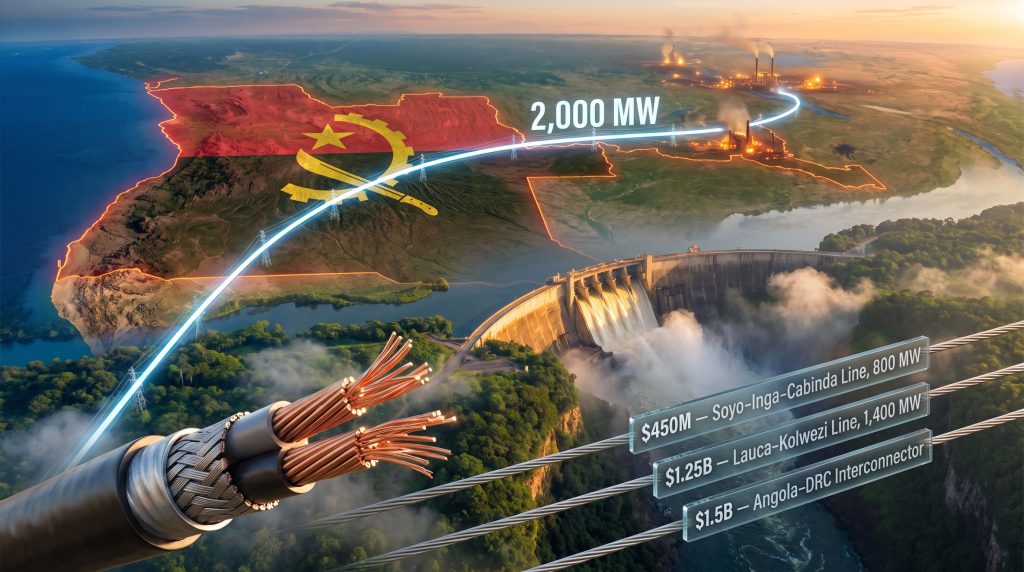
The proposed interconnector was designed as a high-voltage direct current (HVDC) transmission line, the preferred technology for long-distance power transport where alternating current losses become commercially prohibitive. The target capacity of 2,000 MW would have made it one of the largest cross-border transmission projects in sub-Saharan Africa, connecting Angola's hydropower generation assets to DRC and Zambian copper and cobalt operations via integration with the Southern African Power Pool (SAPP).
HVDC technology carries specific advantages in this geographic context. Unlike HVAC systems, HVDC lines experience significantly lower resistive losses over distances exceeding 500-600 kilometres, making them the engineering default for the Angola-to-Copperbelt corridor. The technology also allows precise power flow control, which matters when integrating generation from a single sovereign source into a multi-country grid with varying load and frequency characteristics.
What the MOU Did Not Guarantee:
- Construction commitments or capital expenditure obligations
- Binding offtake agreements with DRC or Zambian mining operators
- Government-backed financing arrangements or sovereign guarantees
- Fixed project timelines or penalty clauses for non-performance
This non-binding architecture, standard practice in early-stage infrastructure development, provided meaningful exit optionality for all parties. In hindsight, that optionality proved consequential.
Project Timeline at a Glance
| Milestone | Date |
|---|---|
| MOU signed between Trafigura, ProMarks, and Angola | July 2024 |
| Trafigura's Swiss Federal Criminal Court bribery conviction | January 2025 |
| US civil society organisations request EXIM Bank loan suspension | 2025 |
| Trafigura confirmed withdrawal from project | July 2025 |
| Competing projects targeted for commercial operation | 2030 |
Unpacking the Withdrawal: Legal Exposure, Financial Pressure, and Strategic Recalibration
The Trafigura Angola power project withdrawal did not occur in a vacuum. Three converging pressures created conditions under which continued participation became institutionally untenable.
The Swiss Conviction and Its Cascading Consequences
In January 2025, Switzerland's Federal Criminal Court issued a conviction against Trafigura for bribery connected to Angolan oil contracts. The court found that approximately $5 million in payments had been made to an Angolan government official between 2009 and 2011 to secure favourable shipping contracts. The financial penalties included a fine equivalent to approximately CHF 3.3 million, with an additional $145 million reserved against potential compensation claims.
The conviction's significance extends well beyond the headline numbers. A criminal finding in a major OECD financial jurisdiction fundamentally alters a company's risk profile when seeking involvement in government-backed infrastructure projects, particularly in markets where reform-oriented administrations are actively attempting to distance themselves from historically corrupt practices.
Angola under President João Lourenço has pursued a visible governance reform agenda since 2017, including high-profile anti-corruption prosecutions of figures connected to the previous administration. For a government cultivating a cleaner governance image, maintaining a visible partnership with a company carrying a fresh bribery conviction in connection with Angolan transactions specifically would have created a politically untenable optics problem.
US Financing Pressure: The EXIM Bank Dimension
Compounding the Swiss legal exposure, civil society organisations formally requested that the US Export-Import Bank (EXIM Bank) suspend $400 million in loan disbursements to Trafigura, citing unresolved corruption convictions and contested environmental assessments. EXIM Bank financing is not simply a capital source; it functions as a reputational signal for multilateral and sovereign co-investors who treat US government-backed participation as a quality filter for project governance.
The combination of active EXIM Bank lobbying pressure and a live criminal conviction in a G10 jurisdiction creates a dual constraint for a commodity trader seeking to anchor a multi-hundred-million-dollar infrastructure project:
- Multilateral development finance institutions become reluctant co-investors
- Sovereign partners face domestic political risk from association with the legally compromised anchor
- Commercial banks applying environmental, social, and governance (ESG) lending criteria may restrict credit availability
- The financing cost premium rises, potentially rendering the project's internal rate of return commercially unattractive
Warning: The combination of a criminal conviction in a major financial jurisdiction and active lobbying against US government-backed financing creates a structurally hostile environment for a commodities trader seeking to anchor multi-hundred-million-dollar infrastructure requiring sovereign and multilateral support.
The Non-Binding MOU as a Strategic Escape Hatch
Trafigura's decision to decline public comment on the withdrawal is itself informative. In infrastructure development, institutional silence following a project exit typically signals one of two things: an orderly withdrawal managed to preserve downstream commercial relationships, or a dispute resolution process that prohibits public disclosure. Given Trafigura's continued participation in the Lobito Corridor Railway consortium, which transports critical minerals from the DRC to Atlantic ports, the former interpretation appears more consistent with the evidence. The company appears to have executed a project-specific retreat rather than a wholesale exit from Angolan commercial engagement.
The Replacement Challenge: What a New Consortium Lead Must Deliver
Angolan government sources confirmed Trafigura's departure while indicating that consortium negotiations continue with revised membership. However, replacing the anchor investor in a project of this scale is not a straightforward process. A credible replacement must satisfy several simultaneous criteria:
- Technical capacity: Demonstrated HVDC project development and engineering expertise at multi-gigawatt scale
- Financial capacity: Balance sheet strength sufficient to anchor debt financing and absorb construction risk
- Sovereign relationship management: Experience navigating multi-government infrastructure frameworks, specifically across the DRC, Zambia, and Angola
- Governance profile: A clean compliance record that satisfies both Angolan reform-era due diligence and multilateral development finance institution standards
- Offtake architecture: Ability to structure bankable power purchase agreements with mining operators who may themselves be capital-constrained
The pool of investors satisfying all five criteria simultaneously is narrow. Sovereign wealth-backed infrastructure funds, particularly those with Gulf capital origins given the Meridia Energy precedent, and development finance institutions such as the African Development Bank and IFC represent the most credible replacement categories. However, each comes with its own timeline, governance, and return-threshold requirements that may reshape the project's commercial architecture materially.
The Competing Projects: A $3.2 Billion Infrastructure Pipeline That Persists
The most important signal embedded in the Trafigura Angola power project withdrawal is what it reveals about the projects that are still moving forward. A combined investment pipeline exceeding $3.2 billion across three active Angola-DRC transmission initiatives suggests the structural case for this power corridor retains institutional support, even as one prominent participant has exited.
Meridia Energy's Dual-Line Programme
| Project | Route | Capacity | Capital Cost | Target Completion |
|---|---|---|---|---|
| Soyo-Inga-Cabinda Line | Angola coast to DRC border | Up to 800 MW | $450 million | 2030 |
| Lauca-Kolwezi Line | Angola interior to DRC Copperbelt hub | 1,400 MW | $1.25 billion | 2030 |
Meridia Energy, a joint venture between Dubai-based Averi Finance and Morocco's Somagec, represents a structurally different investor archetype from Trafigura. Where commodity traders generate revenue from physical flows, infrastructure-focused joint ventures typically target regulated transmission returns with long-duration contracted cash flows. This alignment between the asset's return profile and the developer's business model reduces a key category of strategic risk.
The Kolwezi targeting of the Lauca line is strategically significant. Kolwezi is the DRC's primary copper and cobalt processing hub, home to major operations processing ore from the Tenke Fungurume, Mutanda, and Kamoto deposits. Delivering 1,400 MW of reliable hydropower to this single geographic node would fundamentally alter the energy economics of DRC's most productive mineral zone. In turn, this would meaningfully improve global cobalt supply reliability, given how heavily the world depends on Congolese output.
HYDRO-LINK's $1.5 Billion Interconnector
US-based HYDRO-LINK's proposal targets a 1,200-kilometre transmission corridor connecting Angola to the DRC's Lualaba and Katanga provinces at a project cost of $1.5 billion. The geopolitical dimension of this initiative deserves particular attention. US-backed energy infrastructure in the DRC Copperbelt functions as a strategic counterweight to Chinese dominance in the region's mining sector. China controls processing and offtake across a substantial share of DRC copper and cobalt production through its state-owned enterprises and affiliated trading houses. American infrastructure investment in grid connectivity represents a different mode of strategic engagement, as metals mining geopolitics increasingly shapes how critical mineral corridors are financed and controlled.
Full Regional Infrastructure Comparison
| Project | Developer | Capacity | Investment | Status |
|---|---|---|---|---|
| Trafigura/ProMarks HVDC Line | Trafigura + ProMarks | 2,000 MW | Undisclosed | Withdrawn |
| Soyo-Inga-Cabinda Line | Meridia Energy | 800 MW | $450 million | In development |
| Lauca-Kolwezi Line | Meridia Energy | 1,400 MW | $1.25 billion | In development |
| Angola-DRC Interconnector | HYDRO-LINK | Unspecified | $1.5 billion | In development |
The next major ASX story will hit our subscribers first
What This Means for DRC and Zambia's Mining Energy Security
The near-term implications of the Trafigura Angola power project withdrawal for copper and cobalt production are measured not in immediate output losses but in delayed optionality. The mining operations that were eventually intended to benefit from Angola's hydropower surplus will continue relying on diesel generation and an underperforming grid for longer than previously anticipated.
The cost differential between diesel-powered generation and grid-connected hydropower at the mine site level is substantial. Diesel generation in remote African mining contexts typically costs between $0.25 and $0.40 per kilowatt-hour, compared to hydropower-sourced grid electricity potentially deliverable at $0.06 to $0.10 per kilowatt-hour at scale. For large copper operations consuming hundreds of megawatts continuously, this differential runs to tens of millions of dollars annually in avoidable operating costs, directly compressing margins and reducing capital available for expansion.
Consequently, delays to this infrastructure have broader implications for global copper supply, particularly as electrification and clean energy deployment continue to drive demand upward through the decade.
Industry context: Energy accounts for approximately 20-30% of total cash operating costs at large-scale copper mines. In a market where copper price volatility already creates significant earnings uncertainty, energy cost predictability functions as a strategic hedge, not merely an operational preference.
The medium-term outlook depends heavily on whether Meridia Energy and HYDRO-LINK can credibly deliver their projects by the 2030 targets currently stated. Given that both remain in development phases without confirmed construction commencement, a realistic assessment suggests 2031-2033 as more probable first-power dates, accounting for typical African infrastructure development lead times and financing closure periods.
Frequently Asked Questions: Trafigura Angola Power Project Withdrawal
Why did Trafigura withdraw from the Angola power project?
Multiple converging pressures appear to have driven the decision. Trafigura's January 2025 conviction by Switzerland's Federal Criminal Court for bribery connected to Angolan oil transactions created direct reputational and governance conflicts with a government-backed infrastructure project in the same sovereign market. Simultaneously, civil society pressure on the US EXIM Bank to suspend $400 million in Trafigura loan disbursements constrained the company's financing environment for large infrastructure requiring multilateral backing. Trafigura has not publicly disclosed its internal rationale.
How large was the proposed Angola power transmission project?
The planned interconnector targeted a transmission capacity of 2,000 MW delivered via a high-voltage direct current (HVDC) line connecting Angola's hydropower generation assets to copper and cobalt mining operations in the DRC and Zambia, with integration into the Southern African Power Pool.
Who is replacing Trafigura in the Angola power project?
No confirmed replacement has been announced. Angolan government sources indicated that consortium discussions are ongoing with revised membership, but Angola's Ministry of Energy and Water has yet to issue a formal public statement on the project's future structure.
What other companies are developing Angola-DRC power infrastructure?
Two major initiatives are advancing in parallel:
- Meridia Energy (Averi Finance and Somagec joint venture): developing the $450 million Soyo-Inga-Cabinda line (800 MW) and the $1.25 billion Lauca-Kolwezi line (1,400 MW), both targeting 2030 commercial operation
- HYDRO-LINK: pursuing a $1.5 billion, 1,200-kilometre interconnector targeting the DRC's Lualaba and Katanga provinces
Does Trafigura still operate in Angola?
Yes. Trafigura remains an active participant in the Lobito Corridor Railway consortium, which moves critical minerals from the DRC to Atlantic export ports. The power project exit does not constitute a full withdrawal from Angolan commercial operations.
What was the Trafigura bribery conviction about?
Switzerland's Federal Criminal Court ruled in January 2025 that Trafigura had made approximately $5 million in payments to an Angolan government official between 2009 and 2011 to secure favourable shipping contracts. The ruling resulted in a fine of approximately CHF 3.3 million and $145 million reserved against potential compensation claims.
Key Takeaways: Reading the Angola-DRC Power Corridor's Long-Term Trajectory
The Trafigura Angola power project withdrawal is best understood not as a verdict on the Angola-DRC power corridor concept, but as a case study in how governance failures compound into infrastructure consequences. Furthermore, as critical minerals demand accelerates through the energy transition, the stakes attached to getting this infrastructure right only increase. Several conclusions emerge from the full picture:
- The $3.2 billion-plus pipeline of competing transmission projects confirms that institutional appetite for this corridor persists beyond Trafigura's exit, suggesting the investment thesis is structurally sound even if execution timelines remain uncertain
- Angola's hydropower export strategy retains commercial logic regardless of which consortium ultimately delivers it, given the fundamental supply-demand imbalance between Angolan generation surplus and Copperbelt energy deficit
- For DRC and Zambia's copper and cobalt sectors, the critical variable is not whether cross-border power infrastructure eventually materialises, but whether it materialises fast enough to support the output volumes required as global copper demand accelerates through the 2030s
- Trafigura's retained Lobito Corridor position demonstrates that reputational damage from legal conviction is project-selective in its impact, not necessarily market-terminal for a company with diversified Angolan commercial exposure
- The growing role of development finance institutions and sovereign wealth capital in African energy infrastructure, relative to commodity traders, may reflect a broader rebalancing of who bears the first-loss risk in projects requiring multi-decade horizons and sovereign partnership management
However, Reuters reporting on the withdrawal confirms that while Trafigura has stepped back, the underlying project architecture remains under active discussion with prospective new participants, suggesting Angola's energy ambitions have not been permanently derailed by this setback.
This article contains forward-looking statements and analysis based on information available at the time of writing. Infrastructure timelines, financing arrangements, and consortium structures are subject to change. Readers should conduct independent due diligence before making investment decisions based on any information contained herein.
Want to Stay Ahead of the Next Major Mineral Discovery?
Discovery Alert's proprietary Discovery IQ model delivers real-time alerts on significant ASX mineral discoveries — instantly cutting through complex commodity data to surface actionable opportunities in critical minerals like copper and cobalt. Start your 14-day free trial today and explore Discovery Alert's discoveries page to see how historic finds have generated substantial returns for investors who positioned themselves early.