July 31, 2026
When Geopolitical Chaos Becomes a Trading House's Greatest Asset
Every few decades, a single geographic chokepoint reminds global energy markets just how fragile the architecture of modern oil supply really is. The Strait of Hormuz, a narrow waterway separating Iran from Oman, has long been the pressure valve of the global petroleum system. Roughly 17 to 20 million barrels of crude and refined products pass through it every single day, representing close to 20% of total global oil supply. When that valve closes, even partially, the consequences ripple across every refinery, every fuel terminal, and every trading desk on earth.
The US-Israel conflict with Iran triggered what analysts are now describing as the most significant oil market disruption in modern market history. For consuming nations and industrial economies, this was a crisis. For the world's largest independent commodity trading houses, however, it was a structural opportunity of historic proportions. The Trafigura profit surge since Hormuz closure has become one of the defining financial stories of 2026, offering a rare window into how physical commodity traders generate extraordinary returns not from price speculation, but from logistical mastery during chaos.
When big ASX news breaks, our subscribers know first
The Mechanics of a Chokepoint Crisis
To understand why commodity trading houses thrive during Hormuz disruptions, it helps to separate two distinct phenomena that are commonly conflated: price spikes and logistics premiums.
When supply routes are severed or severely constrained, oil prices rise, but that is not the primary profit driver for firms like Trafigura. The more significant dynamic is the creation of geographic price dislocations, where the same barrel of crude commands dramatically different prices depending on where it sits in the world and who can physically deliver it to deficit markets. Trading houses with deep balance sheets, extensive vessel networks, and pre-existing counterparty relationships become, in effect, the emergency logistics infrastructure of the global energy system.
This is a critical distinction. A price rally benefits anyone holding oil inventory. A logistics premium, however — the additional margin earned by physically solving the delivery problem when standard routes are unavailable — rewards only those with the operational capability to execute complex, multi-leg trades under extreme pressure.
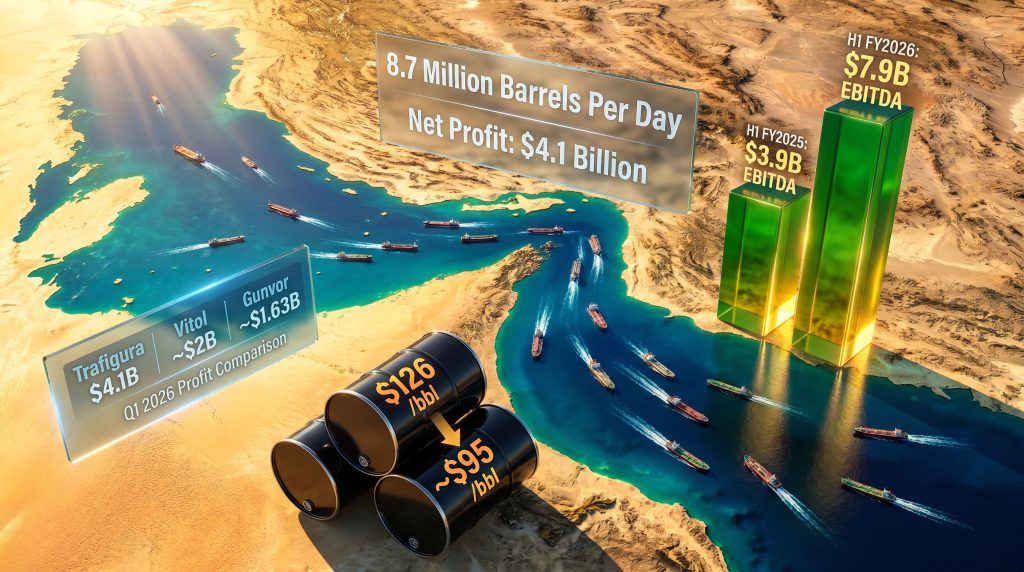
Historical precedent supports this dynamic. The Tanker War of the 1980s and the 2019 drone incidents near the Strait each generated outsized returns for physical traders. The 2026 conflict, furthermore, dwarfs those episodes in scale, pushing Brent crude from approximately $70 per barrel pre-conflict to a peak of $126 per barrel on April 30, before stabilising in the vicinity of $95 per barrel as partial supply rerouting took effect. For an overview of where prices stand today, current crude oil prices provide important context.
The price retreat from $126 to $95 is not a signal of crisis resolution. It reflects rerouting premiums being partially priced in, while the underlying logistics complexity that rewards trading houses remains very much intact.
Trafigura's First-Half FY2026 Results: A Financial Inflection Point
The numbers Trafigura reported for the six months ending March 2026 are striking not just in absolute terms, but in how they reframe the company's entire earnings trajectory.
Key Financial Metrics at a Glance
| Metric | H1 FY2026 | Comparison Period | Change |
|---|---|---|---|
| Net Profit | $4.1 billion | FY2025 full year ($2.7B) | Exceeds full-year figure |
| EBITDA | $7.9 billion | H1 FY2025 ($3.9B) | +103% year-on-year |
| Group Equity Value | $17.5 billion | End FY2025 ($16.2B) | +8% |
| Shareholder Dividends | $3.05 billion | FY2025 full year ($2.9B) | Exceeds full-year payout |
| Oil and Energy Volumes | 8.7 million bpd | FY2025 full year (6.6M bpd) | +32% |
| Impairment Charges | $700 million | N/A | Asset portfolio rationalisation |
The most structurally significant data point in this table is the EBITDA doubling. A 103% year-on-year increase in earnings before interest, taxes, depreciation, and amortisation in a single half-year period signals not a one-off windfall, but a fundamental shift in the firm's earnings capacity under current market conditions.
For context, Trafigura's all-time record annual profit stands at $7.4 billion, recorded in FY2023, with the first half of that year alone contributing $5.5 billion. The H1 FY2026 net profit of $4.1 billion already surpasses the entirety of FY2025's net result, placing the current half-year result as one of the strongest individual reporting periods in the company's history.
The Volume Story Is Just as Important as the Profit Story
The jump in traded volumes from 6.6 million barrels per day across the full year of FY2025 to 8.7 million barrels per day in a single half-year period deserves careful interpretation. This is not simply a function of higher prices attracting more activity. Volume expansion of this magnitude reflects several compounding dynamics:
- Route substitution mandates: buyers locked out of standard Persian Gulf supply chains were forced to source from alternative origins, creating new trading relationships and spot market volumes
- Emergency procurement: refinery operators and state buyers with urgent shortfalls reached out to large traders capable of sourcing and delivering at speed
- Market share capture: when smaller or less-capitalised trading counterparties retreated from complexity, firms with deep balance sheets stepped into the vacuum
- Multi-commodity breadth: Trafigura cited broad contributions from oil, refined fuels, natural gas, and LNG, suggesting the disruption cascaded across energy categories beyond crude alone
What Trafigura's CEO and CFO Are Actually Signalling
Reading between the lines of corporate commentary from Trafigura's leadership reveals a deliberate philosophical positioning. CEO Richard Holtum has emphasised that the firm's financial performance reflects the complexity and cost inherent in physically delivering solutions to customers, rather than simply benefiting from commodity price elevation. This framing is strategically important.
It positions Trafigura not as a speculative beneficiary of a geopolitical windfall, but as an essential service provider whose margin is earned through operational execution. The distinction matters for regulatory optics, for counterparty trust, and for the long-term positioning of independent trading houses in policy discussions about energy security.
CFO Stephan Jansma reinforced this customer-dependency narrative, noting that volatile conditions increase the degree to which Trafigura's clients rely on the firm's capabilities. During stable markets, buyers have more options and more time. During crises, however, the trading house that can guarantee delivery becomes irreplaceable — and irreplaceability commands premium pricing.
Pre-War Performance: The Signal the Market Underappreciated
One of the less-examined dimensions of the Trafigura profit surge since Hormuz closure is what was already happening before the conflict began. Trafigura disclosed that its financial first quarter, covering the period to end of December 2025 and therefore prior to the outbreak of the Iran war, ranked as the second-strongest first quarter in the company's entire history.
This pre-war result is analytically critical. It demonstrates that the platform generating the extraordinary H1 FY2026 numbers was not simply lucky with geopolitical timing. The firm was already operating in an elevated state of commercial performance before the Hormuz disruption amplified returns. For investors and analysts assessing sustainability, this baseline matters enormously.
Competitor Benchmarking: How Trafigura Stacks Up
Trafigura's disclosed results offer a rare reference point in an industry where financial transparency is the exception rather than the norm. The broader geopolitical landscape shaping these results has similarly affected competitor firms, as the following comparison illustrates.
| Trading House | Period | Reported Profit | Disclosure Type |
|---|---|---|---|
| Trafigura | H1 FY2026 (Oct '25 to Mar '26) | $4.1 billion net | Formal disclosure |
| Vitol | Q1 2026 (Jan to Mar) | ~$2 billion estimated | Bloomberg estimate only |
| Gunvor | Q1 2026 | ~$1.63 billion gross profit | CEO public statement |
Vitol, widely regarded as the world's largest independent oil trader by volume, does not formally publish comprehensive financial statements. The Bloomberg-reported estimate of approximately $2 billion in Q1 2026 profit cannot be verified against standardised accounting disclosures, making direct comparison inherently incomplete. What can be said is that Trafigura's disclosed half-year figure materially exceeds Vitol's estimated single-quarter result.
Gunvor's situation adds another dimension. CEO Gary Pedersen flagged an uptick in what he characterised as constructive volatility in late 2025, and the firm subsequently reported that its entire Q1 2026 gross profit was equivalent to its full-year FY2025 gross profit figure of $1.63 billion. The early identification of that volatility signal and the positioning decisions that followed illustrate how crisis anticipation, not just crisis reaction, separates commodity trading giants from the rest of the field.
The next major ASX story will hit our subscribers first
Asset Management and the $700 Million Impairment Question
Not every line in Trafigura's results tells a positive story. The firm recorded $700 million in impairment charges during H1 FY2026, tied directly to asset portfolio management decisions rather than trading operations.
The two primary drivers were:
- The divestment of metals subsidiary Nyrstar's processing assets in Tennessee, United States
- Fuel-supply subsidiary Greenergy's acquisition of French distribution firm Armorine
CFO Jansma's commentary on the broader asset portfolio suggests an ongoing rationalisation process rather than distressed selling. The firm characterises its roughly $10 billion asset base as broadly satisfactory, while maintaining a stated commitment to continuous optimisation. The impairment charges, while significant in isolation, represent approximately 9% of the H1 EBITDA figure, framing them as manageable within the broader earnings picture.
The dividend signal further reinforces management confidence. Allocating a record dividend of $3.05 billion to shareholders in a single half-year period — an amount that exceeds the full FY2025 dividend of $2.9 billion — is a direct statement about the firm's conviction in its near-term cash generation capacity.
The Risks That Could Compress Future Returns
A balanced assessment of Trafigura's position requires honest engagement with the downside scenarios. The same conditions creating extraordinary profitability also carry embedded risk.
Price reversal exposure: Oil's retreat from $126 to approximately $95 per barrel illustrates how rapidly the price component of the profit equation can normalise. Trading houses carrying directional price inventory rather than pure logistics arbitrage face mark-to-market risk as prices compress. This is a known feature of commodities market volatility that even the largest operators must manage carefully.
Geopolitical de-escalation risk: A rapid resolution of the Iran conflict or a managed reopening of Hormuz transit lanes would compress logistics premiums quickly. The complexity premium that drove a significant portion of H1 results would narrow as standard routing became viable again.
Counterparty and credit exposure at scale: Trafigura has itself acknowledged that disruptions of this magnitude introduce outsized financial risks alongside the opportunities. The sheer scale of emergency procurement volumes and the number of new counterparty relationships established under crisis conditions creates credit risk that may not fully crystallise within the reporting period.
Forecasting opacity: Trafigura's own forward guidance is measured, noting that second-half performance has continued positively while explicitly acknowledging that the external environment remains difficult to forecast given ongoing political tensions and market volatility. This is not a firm projecting sustained record performance; it is a firm managing expectations with appropriate caution.
The Systemic Question the Results Raise
The Trafigura profit surge since Hormuz closure prompts a broader question that extends well beyond one company's balance sheet. When three to four independent trading houses effectively function as the emergency logistics backbone of global oil supply during a state-level geopolitical conflict, questions about systemic dependency become unavoidable.
The concentration of physical trading capacity among a small number of private firms, operating with limited public disclosure obligations, raises transparency and accountability questions that policy frameworks have not yet fully addressed. The profitability of disruption creates a structural tension: the entities best positioned to solve supply crises are also those that financially benefit from their continuation.
As geopolitical fragmentation of energy markets deepens, the operational architecture of major independent commodity traders is becoming as strategically significant as national energy infrastructure itself, yet regulatory frameworks have not evolved to reflect this reality.
Disclaimer: This article is intended for informational purposes only and does not constitute financial advice or a solicitation to trade commodities, securities, or other financial instruments. Forward-looking statements, forecasts, and comparative analysis involve inherent uncertainty. Readers should conduct their own research and consult qualified financial advisers before making investment decisions. Financial figures cited are sourced from Reuters reporting via Kitco News and Bloomberg News estimates where noted.
Want to Stay Ahead of the Next Major Commodity Market Shift?
Discovery Alert's proprietary Discovery IQ model delivers real-time alerts on significant ASX mineral discoveries, instantly translating complex commodity data into actionable investment insights — explore historic discoveries and their returns to understand the scale of opportunity, then begin your 14-day free trial at Discovery Alert to position yourself ahead of the broader market.