August 6, 2026
When Pipelines Outlive Their Eras: The Enduring Case for a Caspian Gas Route to Europe
Few infrastructure proposals in modern energy history have been debated as persistently, and built as rarely, as the trans-Caspian pipeline to Europe. The concept has circulated in diplomatic and engineering circles since the late 1990s, survived multiple geopolitical upheavals, attracted EU institutional interest, and yet has never broken ground. What makes 2026 meaningfully different from every prior inflection point is not a single political decision or bilateral agreement. It is the simultaneous convergence of two independent supply crises pressing against the same structural gap.
Understanding why this project keeps returning to the agenda, and why it keeps stalling, requires examining the layers of commercial logic, geopolitical obstruction, and institutional ambiguity that have accumulated around it across three decades.
When big ASX news breaks, our subscribers know first
Europe's Gas Supply Architecture Under Dual Pressure
From Russian Dependency to Structural Fragmentation
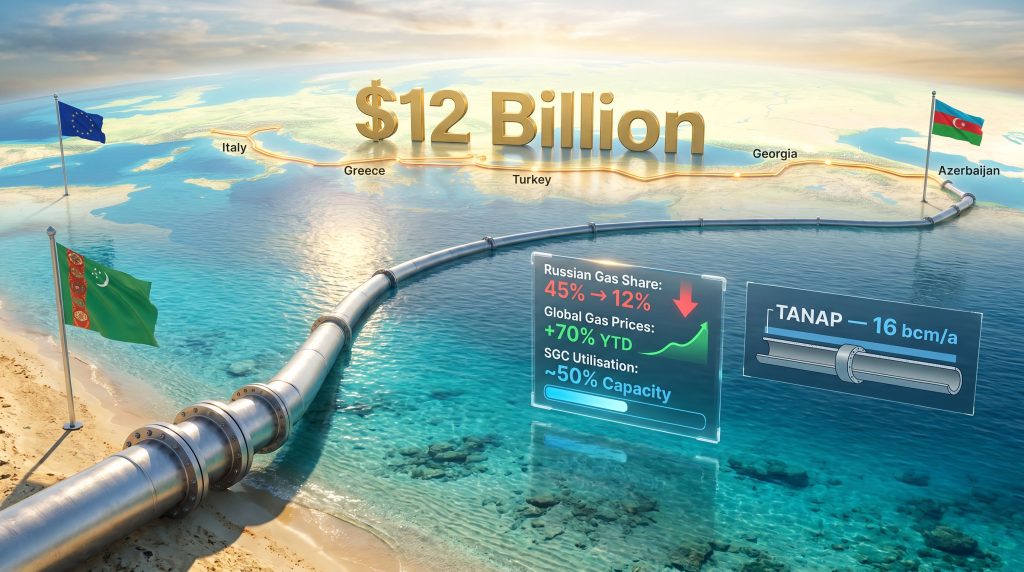
Europe's gas import model was built on a foundation of geographic convenience and price efficiency rather than supply resilience. Russian pipeline gas, delivered through an integrated network of transit corridors, provided approximately 45% of total EU imports as recently as 2022. The political rupture triggered by Russia's actions in Ukraine forced a rapid and disorderly diversification, compressing into months what would normally have taken years of infrastructure planning.
By 2025, Russian gas represented roughly 12% of EU imports, a dramatic contraction achieved through emergency LNG procurement, interconnection upgrades, demand reduction measures, and the gradual ramp-up of Caspian corridor volumes via Azerbaijan. Brussels has since formalised a commitment to eliminate the remaining Russian gas flows entirely by November 2027, a target that implies finding replacement supply for approximately 35 billion cubic metres per year (bcm/a) from sources that do not yet have binding delivery contracts in place.
The Southern Gas Corridor, anchored by Azerbaijani production from the Shah Deniz field, was positioned as a primary pillar of this diversification strategy. That assumption has since proven optimistic. Azerbaijan's gas output expansion has significantly underperformed earlier projections, leaving SGC pipelines operating at roughly 50% of total transmission capacity, according to reporting by Eurasianet. Furthermore, the broader LNG supply outlook for 2025 and beyond adds further complexity to Europe's already strained import architecture.
The Persian Gulf Shock and Its Caspian Ripple Effects
Layered on top of the structural Russian phase-out challenge is an acute supply disruption originating in the Persian Gulf. Conflict in the region has disrupted Qatari LNG flows through the Strait of Hormuz, the chokepoint through which approximately 20–25% of globally traded oil and significant LNG volumes transit daily, according to the U.S. Energy Information Administration. The downstream consequence for gas markets has been severe: Asian LNG imports reached a seven-year low in March 2026, while global gas prices surged approximately 70% year-to-date, with Turkey and southern European buyers among the most exposed.
Turkey's situation illustrates the compounding nature of the crisis with particular clarity. The country imports over 80% of its natural gas, according to Turkish Statistical Institute data, leaving it acutely vulnerable to any supply disruption. Iranian gas, which had supplied roughly 15% of Turkey's total gas needs, ceased flowing in March 2026 following the outbreak of Gulf conflict. A prior arrangement that allowed Turkmen gas to reach Turkey via a swap mechanism through Iran lasted just three months in 2025 before collapsing when Washington expanded its sanctions regime, and the US-China trade war impacts on global energy flows further complicated the situation. That temporary arrangement had delivered only 1.3 bcm of Turkmen gas to Turkey before being terminated, well short of the 3 bcm annually Ankara had hoped to secure in 2026.
It was against this backdrop that Turkish Energy Minister Alparslan Bayraktar, speaking at an energy conference on 24 April 2026, issued a renewed call for urgent international discussions on a dedicated trans-Caspian pipeline capable of delivering Turkmen gas to Turkey and onward to European markets.
"Europe is simultaneously managing two distinct gas supply crises: a deliberate structural exit from Russian energy, and an acute supply shock from Gulf conflict disruption. The trans-Caspian pipeline sits at the intersection of both problems."
What the Trans-Caspian Pipeline Actually Involves
Infrastructure Architecture and Transmission Capacity
The trans-Caspian pipeline (TCP) is a proposed subsea gas transmission corridor approximately 300 kilometres in length, designed to cross the floor of the Caspian Sea from Turkmenistan's western coast to Azerbaijan's eastern shore. From Azerbaijan, gas would enter the existing Southern Gas Corridor (SGC) network, a multi-segment transmission chain that includes the South Caucasus Pipeline through Georgia, the Trans-Anatolian Pipeline (TANAP) across Turkey, and the Trans-Adriatic Pipeline (TAP) into southern Europe.
The current configuration of SGC infrastructure is summarised below:
| Pipeline Segment | Route | Current Capacity |
|---|---|---|
| South Caucasus Pipeline (SCP) | Azerbaijan to Georgia | Operational |
| Trans-Anatolian Pipeline (TANAP) | Georgia to Turkey | 16 bcm/a (expandable to 31 bcm/a) |
| Trans-Adriatic Pipeline (TAP) | Turkey to Greece to Italy | ~10 bcm/a (expandable to ~20 bcm/a) |
TANAP's expandability to 31 bcm/a is confirmed in TANAP Company official technical specifications. TAP's expansion potential to approximately 20 bcm/a is subject to additional investment in Greek and Italian pipeline segments, according to TAP AG project documentation.
TCP would supplement existing Azerbaijani gas flows with Turkmen volumes, with scenario-based projections from European Commission planning documents suggesting total delivery potential of up to 32 bcm per year to European markets under full development conditions. This figure is a planning scenario rather than an engineered specification, and is contingent on both the subsea Caspian crossing being built and SGC expansion proceeding.
A critical detail often overlooked in TCP discussions is that the SGC's current underutilisation may render much of the downstream expansion investment unnecessary in the near term. With pipelines running at 50% capacity, existing infrastructure may be able to absorb initial Turkmen volumes without requiring the full $12 billion capital commitment upfront, provided the subsea crossing itself is constructed. This represents a meaningful shift in the project's economic structure compared to earlier assessments. The oil market impacts of ongoing trade tensions also play into this shifting calculus, as investor confidence across the broader energy infrastructure space remains fragile.
Alternative Routing Options
Beyond SGC integration, secondary routing proposals have surfaced periodically:
- White Stream corridor: A Georgia-to-Romania route connecting to Ukrainian and central European networks, offering an alternative path that bypasses Turkey entirely but faces greater engineering complexity and higher estimated costs of $8–15 billion given the longer distance and terrain challenges
- TANAP/TAP looping and compression expansion: Upgrading existing pipelines to accommodate higher throughput without new subsea construction, estimated at $3–7 billion according to World Bank infrastructure analysis
Turkmenistan's Gas Potential and Its China Orientation
Reserve Scale That Dwarfs Its Export Ambition
Turkmenistan holds approximately 17.2 trillion cubic metres (tcm) of proven natural gas reserves, ranking it among the world's top four reserve holders alongside Russia, Iran, and Qatar, according to the U.S. Energy Information Administration's international database. The centrepiece of this reserve base is the Galkynysh gas field, one of the largest single gas deposits on earth with proven reserves estimated at approximately 26 tcm.
Despite this extraordinary resource endowment, Turkmenistan's export architecture is concentrated almost entirely on a single buyer. The country has been exporting gas to China via the Central Asia-China pipeline (CAC) since January 2009, accumulating cumulative exports exceeding 460 bcm over that period. In March 2026, Turkmenistan's paramount leader Gurbanguly Berdymukhamedov visited Beijing, where meetings with Chinese leader Xi Jinping produced public commitments to expand cooperation in the natural gas sector and elevate bilateral trade and investment levels, according to China's official Xinhua news agency.
The commercial implications of this deepening relationship are substantial. CNPC was recently awarded the contract to design and construct Phase 4 development facilities at the Galkynysh field, a project projected to yield an additional 10 bcm per year of production capacity, with all volumes contractually earmarked for Chinese offtake. Combined with existing Chinese-directed flows estimated at 33–35 bcm/a from earlier development phases, this Phase 4 commitment further reduces the volume of Turkmen gas that could realistically be redirected westward without renegotiating existing Chinese contracts.
The Structural Tension at the Heart of the TCP Debate
Turkmenistan's first meaningful signal of interest in a trans-Caspian export route emerged only in 2023, a remarkably late development for a project debated since the late 1990s. Since that initial signal, expressions of interest have not translated into concrete negotiating positions, volume commitments, or financing discussions.
Turkmen officials have shown little appetite for active lobbying, reflecting a leadership culture that has historically prioritised certainty of existing arrangements over the speculative upside of new infrastructure ventures. This posture creates a fundamental commercial paradox: the country with the gas reserves capable of making TCP viable has limited incentive to divert production westward when its eastern export relationships are actively deepening.
The Real Barriers: Finance, Geopolitics, and Political Will
The $12 Billion Cost Threshold and Investor Risk Calculus
The estimated capital cost of constructing the TCP stands at $12 billion, a figure that encompasses the subsea Caspian crossing, compression infrastructure, and integration with existing SGC network components. Transportation economics for delivering Turkmen gas to European end-markets range from $40 to $107 per thousand cubic metres, depending on routing, compression requirements, and transit fee structures.
At gas prices elevated by approximately 70% relative to early 2026 levels, the project economics are more attractive than at any point in TCP's multi-decade history. However, investor risk tolerance remains the critical constraint. The factors weighing against capital commitment include:
- Geopolitical uncertainty surrounding the Persian Gulf basin and potential for further Strait of Hormuz disruptions
- Caspian Basin legal and environmental ambiguities persisting despite the 2018 Convention's partial resolution of the legal framework
- EU decarbonisation policy trajectories that create long-term demand uncertainty and discourage 20–30 year infrastructure contracts
- The complete absence of firm Turkmen supply volume commitments to underwrite project financing
- Azerbaijan's stated refusal to co-finance any new pipeline capacity
Furthermore, the volatility in European gas prices has made long-term project financing modelling considerably more difficult for institutional investors and development banks alike.
Russia and Iran: The Geography of Opposition
The TCP's 300-kilometre subsea route would traverse Caspian waters flanked by approximately 740 kilometres of Iranian coastline and 695 kilometres of Russian coastline. Both states have structural economic and strategic incentives to oppose a pipeline that would divert Turkmen gas revenues away from their own networks and toward European markets.
Russia's competitive response was visible as early as 2007, when it secured a Central Asia-Center pipeline agreement specifically designed to lock Turkmen gas into its own export network and foreclose westward routing options. Iran's interest in opposing TCP derives partly from its historical role as a transit corridor for Turkmen-Turkish gas swap arrangements, an income stream that would be rendered redundant by a direct Caspian crossing.
The 2018 Caspian Convention represented a significant legal clarification by establishing that pipeline construction in the sea requires consent only from the directly affected coastal states, namely Turkmenistan and Azerbaijan, rather than all five Caspian littoral nations. According to research published on ResearchGate, this bilateral consent model fundamentally altered the legal landscape surrounding TCP, even though Russian and Iranian political pressure on Ashgabat and Baku remains a practical constraint independent of the formal framework.
Azerbaijan's Conditional and Evolving Position
Azerbaijani President Ilham Aliyev confirmed Baku's willingness to permit Turkmen gas transit three years ago, subject to a critical condition: such flows must not utilise Azerbaijan's existing SGC pipelines. Baku simultaneously made clear it would not contribute to financing any new pipeline capacity.
The subsequent underperformance of Azerbaijan's own gas production has inadvertently altered the practical significance of this position. With SGC pipelines operating at 50% capacity, the prohibition on using existing infrastructure is less commercially restrictive than it appeared when Azerbaijan's production was expected to grow substantially. Consequently, energy supply expansion considerations — including prospects explored in the context of energy supply expansion in other regions — highlight how infrastructure underutilisation can reshape commercial negotiations in unexpected ways.
A Three-Decade Timeline: Progress, Stagnation, and Renewed Urgency
The TCP's development history illustrates how strategic logic and commercial execution can remain persistently disconnected over long periods:
| Period | Development Milestone |
|---|---|
| Late 1990s | Initial TCP concept discussions; no formal progress |
| 2011 | EU designates TCP as a Project of Common Interest; €17 million in funding approved |
| 2015 | Ashgabat Declaration signals Turkmen openness to western export diversification |
| 2018 | Caspian Convention establishes bilateral consent model for pipeline construction |
| 2019 | Pre-FEED studies completed for dual-pipeline configuration |
| 2023 | Turkmenistan signals substantive interest in trans-Caspian export route for first time |
| 2025 | Turkmen-Turkish-Iranian gas swap collapses following U.S. sanctions expansion after delivering only 1.3 bcm |
| April 2026 | Turkish Energy Minister calls for urgent international TCP revival discussions at energy conference |
The pattern across this timeline is consistent: external shocks create renewed urgency, political statements of interest are issued, and then the project returns to dormancy when immediate price pressures subside or alternative solutions prove cheaper in the near term.
The next major ASX story will hit our subscribers first
Scenario Analysis: Three Pathways for TCP Development
Whether the trans-Caspian pipeline to Europe progresses toward construction depends on a specific set of conditions converging simultaneously. Analysing the realistic pathway combinations produces three distinct scenarios:
Scenario A: Accelerated Development. Gulf conflict persists beyond 2026, maintaining elevated gas prices. The EU fast-tracks multilateral financing commitments, and Turkmenistan signs preliminary supply framework agreements. A smaller-scale initial Caspian crossing utilising existing SGC spare capacity enters construction in 2028–2029, with first gas delivery achievable by 2033.
Scenario B: Phased Partial Integration. Existing SGC spare capacity absorbs modest initial Turkmen volumes via a scaled-down Caspian crossing at substantially lower capital cost than the full $12 billion estimate. Full 32 bcm/a capacity is deferred to a second development phase contingent on supply volume growth. TCP becomes a staged commercial project rather than a single large infrastructure commitment.
Scenario C: Continued Stagnation. Turkmenistan deepens China ties through Galkynysh Phase 4 and subsequent development phases. Gas prices normalise as Gulf conflict resolves or alternative LNG supply routes are established. The EU pivots toward accelerated renewable deployment and LNG terminal expansion, reducing the political urgency of a multi-decade pipeline investment. TCP remains a policy aspiration without construction mandate.
For Scenario A or B to materialise, the following conditions would need to converge:
- Firm Turkmen supply commitments providing minimum volume guarantees sufficient to underwrite project financing
- EU willingness to sign long-term contracts of 15–20 years despite decarbonisation policy uncertainty
- Clarity on Azerbaijani infrastructure terms establishing whether existing SGC capacity is legally and commercially available for Turkmen transit
- A multilateral financing structure drawing on EU institutions, development banks, and private capital given Baku's refusal to co-finance
- Reduced Russian and Iranian capacity to exert effective political pressure on Ashgabat's decision-making
Europe's Diversification Options in Comparative Context
The TCP's strategic case becomes clearer when positioned against Europe's full menu of alternative supply sources:
| Supply Source | Annual Volume Potential | Infrastructure Status | Geopolitical Risk |
|---|---|---|---|
| Azerbaijani SGC Gas | ~12 bcm/a (current) | Operational | Low |
| Turkmen TCP Gas | Up to 32 bcm/a | Proposed | Medium-High |
| U.S. LNG | Variable | Operational (seaborne) | Low-Medium |
| Norwegian Pipeline Gas | ~100+ bcm/a | Operational | Very Low |
| North African Pipeline Gas | ~40 bcm/a | Partially operational | Medium |
Norwegian production, while the most reliable alternative, is constrained by upstream field decline rates and limited expansion potential. U.S. LNG addresses volume requirements but introduces shipping cost and terminal capacity constraints, particularly for land-locked central European markets. North African supplies face their own political instability risks. TCP's theoretical 32 bcm/a potential is substantial enough to make a material contribution to the 35 bcm/a Russian replacement gap, but only under conditions that have not yet been secured. In addition, analysts at OilPrice.com have noted that the $12 billion TCP cost threshold, while significant, compares favourably to the cumulative economic damage sustained from supply disruptions in recent years.
Frequently Asked Questions: Trans-Caspian Pipeline to Europe
How long would the trans-Caspian pipeline be?
The proposed subsea section crossing the Caspian Sea would span approximately 300 kilometres, connecting Turkmenistan's western coastline to Azerbaijan. From Azerbaijan, gas would travel through the existing Southern Gas Corridor network to Turkey and European end-markets.
How much would the trans-Caspian pipeline cost to build?
Current estimates place the construction cost at approximately $12 billion, covering the subsea Caspian crossing, compression infrastructure, and integration with existing SGC pipelines. A phased or smaller-scale initial crossing could reduce the upfront capital requirement significantly.
Why hasn't the trans-Caspian pipeline been built despite decades of discussion?
Primary obstacles include the absence of firm Turkmen supply commitments, Turkmenistan's commercial preference for Chinese export relationships, historical Russian and Iranian political opposition, high per-unit transport costs, and EU policy uncertainty around long-duration gas infrastructure investment in the context of decarbonisation commitments.
What is Turkmenistan's current gas export structure?
Turkmenistan exports the overwhelming majority of its gas to China via the Central Asia-China pipeline, with cumulative exports exceeding 460 bcm since 2009. CNPC's recently awarded Phase 4 contract at the Galkynysh field will add 10 bcm/a of production capacity, with all volumes committed to Chinese offtake under current arrangements.
Does the 2018 Caspian Convention enable TCP construction?
The Convention established that pipeline construction in the Caspian requires consent only from the directly affected coastal states, specifically Turkmenistan and Azerbaijan, removing the longstanding requirement for all five littoral nations including Russia and Iran to agree. This resolved a major legal ambiguity, though Russian and Iranian political pressure on both countries remains a practical constraint.
What is the Southern Gas Corridor's current utilisation rate?
SGC pipelines are currently operating at approximately 50% of their total capacity following Azerbaijan's failure to deliver projected production growth. This underutilisation creates potential headroom to accommodate initial Turkmen gas volumes without requiring the full TCP capital expenditure upfront, if a Caspian subsea crossing can be built.
A Strategic Option, Not Yet a Strategic Reality
The trans-Caspian pipeline to Europe occupies a distinctive position in the global energy infrastructure landscape: a project whose strategic logic has been broadly accepted for nearly three decades, yet which has consistently failed to bridge the gap between concept and construction. The simultaneous pressure of Europe's Russian gas phase-out deadline and Gulf conflict-driven supply disruption has created the most compelling conditions in TCP's history for that gap to close.
Yet Turkmenistan's accelerating China orientation, the $12 billion financing challenge, Azerbaijan's conditional posture, and the complete absence of binding supply commitments mean the project remains a strategic option on a menu of choices rather than an imminent infrastructure commitment. The window for European policymakers to translate renewed urgency into concrete financing frameworks and supply negotiations is open. Whether TCP's four-decade journey from concept to construction begins in the current cycle, or waits for the next external shock to restart the conversation, depends entirely on decisions that have not yet been made.
This article is intended for informational purposes only and does not constitute investment advice. Projections, scenario analyses, and cost estimates referenced herein represent planning scenarios and analytical frameworks rather than confirmed engineering specifications or contractual commitments. Readers should conduct independent research before making any investment or policy decisions.
Want to Invest Ahead of the Next Major Energy or Mineral Discovery?
Discovery Alert's proprietary Discovery IQ model delivers real-time alerts on significant ASX mineral discoveries, transforming complex data across 30+ commodities into clear, actionable insights for both short-term traders and long-term investors — explore historic discovery returns to understand the scale of opportunity, then begin your 14-day free trial at Discovery Alert to position yourself ahead of the broader market.