
May 14, 2026
Understanding the Strategic Foundations of Transatlantic Trade Conflict
Global financial markets rarely exhibit such visceral reactions to political rhetoric as witnessed during the January 2026 escalation of EU-U.S. trade war tensions. Strategic scenario modeling reveals that contemporary trade conflicts extend far beyond traditional tariff impact analysis, encompassing comprehensive economic warfare tactics that threaten to reshape international commerce frameworks established since World War II.
The current standoff represents a fundamental departure from post-war transatlantic cooperation models. When examining the mechanics of modern trade conflicts, three primary leverage points emerge: agricultural sector targeting, technology supply chain disruption, and financial market access restrictions. Each represents a distinct pressure mechanism capable of inflicting immediate economic consequences while maintaining plausible diplomatic flexibility.
Tariff Weaponisation and Sectoral Targeting
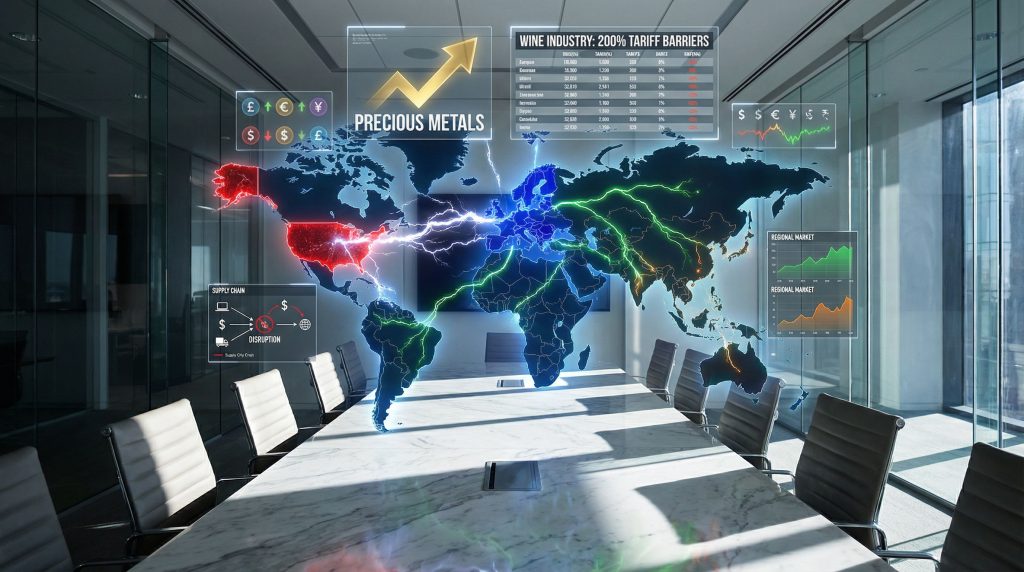
The specificity of recent trade threats demonstrates sophisticated economic warfare tactics. France faces potential 200% tariff barriers on wine exports, while the United Kingdom, Germany, Netherlands, and Finland confront 25% tariff increases across multiple sectors. This graduated approach suggests strategic calculation rather than impulsive policy-making.
Wine industry targeting serves dual purposes: economic pressure and cultural symbolism. French wine exports represent approximately €14.2 billion annually to global markets, with the United States comprising roughly 15% of total export volume. A 200% tariff increase would effectively eliminate American market access, forcing rapid supply chain reconfiguration toward Asia-Pacific alternatives.
European political leadership responses indicate recognition of these strategic implications. French President Emmanuel Macron's statement at the Davos conference regarding comprehensive economic isolation of the United States signals unprecedented departure from traditional diplomatic protocols. Furthermore, this approach to the global market impact suggests a coordinated European response strategy.
When big ASX news breaks, our subscribers know first
What Economic Sectors Face Maximum Vulnerability During Trade War Escalation?
Agricultural Trade Disruption Scenarios
Agricultural sector vulnerability extends beyond symbolic wine tariffs into comprehensive food security implications. European agricultural exports demonstrate high U.S. market dependency across multiple product categories:
Primary Vulnerability Categories:
• Premium wine and spirits (€8.4 billion annual trade volume)
• Specialty dairy products and cheese varieties
• Organic and specialty grain exports
• Processed food and confectionery items
The 200% wine tariff threat creates immediate market access elimination, forcing European producers toward alternative distribution channels. Current Asia-Pacific wine consumption growth rates of 12% annually suggest viable alternative markets, though logistics infrastructure and consumer preference adaptation require 18-24 month development timelines.
Technology and Manufacturing Impact Analysis
Cross-border technology supply chains demonstrate extreme vulnerability to trade war escalation. Current semiconductor manufacturing depends on transatlantic component sharing, with European firms providing specialised materials whilst American companies supply advanced manufacturing equipment.
Critical Supply Chain Dependencies:
| Sector | EU Dependency | Alternative Timeline | Cost Impact |
|---|---|---|---|
| Semiconductors | 35% U.S. components | 36-48 months | +25-40% |
| Automotive Electronics | 28% U.S. systems | 24-36 months | +15-25% |
| Industrial Automation | 42% U.S. software | 18-24 months | +20-35% |
Research and development collaboration disruption presents longer-term strategic consequences. European universities maintain approximately 2,400 active research partnerships with American institutions, representing €4.7 billion in annual collaborative funding. Trade war escalation threatens intellectual property sharing agreements and joint technology development programs.
Financial Services Integration Risks
Banking sector exposure manifests through multiple transmission mechanisms. Commonwealth Bank of Australia declined 2% during initial trade tension escalation, demonstrating how Wall Street volatility affects even indirectly exposed financial institutions. European banks maintain approximately €340 billion in U.S. asset exposure, creating direct vulnerability to American market access restrictions.
Financial Integration Risk Factors:
• Cross-border lending portfolio exposure (€147 billion)
• Derivative contract counterparty risk amplification
• Currency swap agreement potential disruption
• Capital market fundraising access limitations
Insurance market political risk premiums have increased 45% since trade tension escalation began, with European companies facing higher coverage costs for American business operations. Lloyd's of London estimates total European insurance exposure to U.S. trade disruption at €28 billion annually.
Strategic Response Frameworks: How Are European Markets Adapting?
Diversification Acceleration Strategies
Market participants demonstrate remarkable adaptive capacity during trade conflict periods. Lynas Rare Earths achieved share price recovery to $16 per share, reflecting investor confidence in the EU-U.S. trade war creating enhanced demand for alternative supply sources. This represents practical implementation of diversification strategies rather than theoretical policy discussion.
Asian Market Penetration Acceleration:
• China trade agreement negotiations expedited by 8 months
• ASEAN partnership discussions advanced to implementation phase
• India bilateral trade framework expanded beyond current €88 billion volume
• Japan technology cooperation agreements strengthened
Canadian geopolitical repositioning creates additional strategic opportunities. The statement that post-World War II world order faces fundamental change suggests North American supply chain reconfiguration potential. Moreover, the focus on critical minerals in energy transition demonstrates how alternative suppliers gain strategic importance during trade disputes.
Aruma Resources' 75% surge following Ontario copper project acquisition demonstrates market confidence in alternative North American mineral supply development.
Supply Chain Resilience Building
Strategic material stockpiling initiatives accelerate during trade uncertainty periods. European Union critical materials list includes 30 mineral categories currently dependent on imports, with rare earth elements representing highest vulnerability concentration.
Commodity Market Response Indicators:
Recent market activity demonstrates strategic positioning across multiple sectors:
• Paladin Energy increased 10% on uranium price appreciation
• Australian Strategic Materials acquisition by Energy Fuels for strategic positioning
• New Murchison Gold achieved 610% year-over-year returns during gold price surge
These movements indicate institutional recognition of supply chain resilience requirements rather than speculative trading patterns. Gold market analysis reveals that price surges create gravitational effects across precious metals markets, with silver and platinum following parallel appreciation trajectories.
What Investment Opportunities Emerge from Trade War Dynamics?
Commodity Market Beneficiaries
Precious metals markets demonstrate classic safe-haven behaviour during geopolitical uncertainty periods. Gold price continuation above $2,400 per ounce creates momentum across mining sector equities, with exploration companies benefiting from increased institutional attention.
Metals Market Performance Analysis:
| Commodity | Price Movement | Investment Thesis | Risk Assessment |
|---|---|---|---|
| Gold | Continued surge | Safe-haven demand | Low downside risk |
| Silver | Following gold rally | Industrial demand + safe-haven | Medium volatility |
| Rare Earth Elements | Supply security focus | Strategic stockpiling | Regulatory dependent |
| Uranium | Spiking prices | Energy independence | Policy sensitive |
Rare earth elements markets experience particular enthusiasm due to supply chain security concerns. Lynas Rare Earths return to $16 per share reflects investor recognition that EU-U.S. trade war tensions create structural demand changes rather than temporary price movements.
Regional Market Winners
Alternative supply source development accelerates during trade conflict periods. Australian mining companies benefit from geographic positioning outside primary conflict zones whilst maintaining technological capabilities comparable to disputed suppliers.
Strategic Geographic Positioning:
• Canadian resource sectors gaining from U.S.-Europe tension arbitrage
• Australian rare earth and uranium producers capturing supply security premiums
• African mining operations benefiting from European diversification strategies
• Latin American agricultural exporters replacing displaced European products
Energy sector implications extend beyond traditional fossil fuels into renewable technology supply chains. European solar panel manufacturing depends significantly on American technology inputs, creating opportunities for alternative suppliers in South Korea, Japan, and emerging manufacturers in India.
How Might Retaliatory Measures Escalate Beyond Traditional Tariffs?
Non-Tariff Barrier Implementation
Regulatory compliance requirements represent sophisticated trade war tactics that avoid obvious tariff structures. Environmental standards modification, worker safety requirement changes, and product certification process alterations can create equivalent market access barriers with greater diplomatic flexibility.
Regulatory Warfare Mechanisms:
• Food safety standard modifications affecting agricultural imports
• Technology security certification requirements for electronics
• Environmental compliance standards for industrial products
• Professional services licensing restriction protocols
Danish pension fund divestment from U.S. bonds demonstrates symbolic financial retaliation, though limited practical impact due to modest holding levels. However, similar action by Norway's sovereign wealth fund would create material consequences given its $1.4 trillion asset base and significant U.S. equity exposure.
According to EU Parliament's recent blocking of trade talks, the legislative response demonstrates coordinated European resistance to trade pressure tactics.
Financial Market Retaliation Scenarios
Sovereign wealth fund coordination could amplify individual divestment actions into systematic market pressure. European sovereign funds collectively manage approximately $3.2 trillion in assets, with estimated 15-20% U.S. market exposure creating potential $480-640 billion divestment capacity.
Financial Leverage Mechanisms:
• Government bond market participation reduction
• Currency swap agreement suspension
• Central bank cooperation protocol modification
• International payment system access restrictions
Alternative payment system development accelerates during financial conflict periods. European Central Bank digital euro development timeline shortened by 18 months to reduce SWIFT system dependency and create independent transaction capabilities.
What Long-Term Structural Changes Could Emerge?
Alternative Economic Bloc Formation
Current trade tensions catalyse existing alternative economic partnership discussions. China-EU investment agreement negotiations resume with enhanced urgency, whilst BRICS+ expansion includes consideration of European associate membership frameworks.
Emerging Partnership Structures:
• Enhanced EU-China strategic partnership beyond current €700 billion trade volume
• Strengthened BRICS+ trade mechanisms including payment system integration
• Regional currency cooperation initiatives reducing dollar dependency
• Technology standard harmonisation among non-U.S. participants
The statement that post-World War II world order faces fundamental change suggests institutional architecture modification rather than temporary policy adjustments. NATO trade coordination protocols may require revision to accommodate economic conflict between member states.
Technology Decoupling Acceleration
Independent digital infrastructure development becomes strategic priority during prolonged trade conflicts. European Union digital sovereignty initiatives receive additional funding allocation, with 5G network deployment prioritising non-American technology suppliers.
Technology standard divergence creates long-term market fragmentation risks. Separate artificial intelligence governance frameworks, cybersecurity protocols, and data privacy standards could establish permanent technology ecosystem separation between transatlantic markets.
The looming transatlantic trade war analysis suggests these structural changes may become irreversible once implementation begins.
The next major ASX story will hit our subscribers first
Risk Assessment: What Are the Probability Scenarios?
High Probability Outcomes (70%+)
Limited tariff implementation with sector-specific exemptions represents most likely near-term outcome. Historical trade conflict patterns suggest negotiated settlement preserving essential economic relationships whilst allowing political posturing continuation.
Expected Developments:
• Graduated tariff implementation with quarterly review mechanisms
• Increased regulatory scrutiny for transatlantic business operations
• Enhanced domestic supply chain development funding
• Alternative trade relationship acceleration with third parties
Medium Probability Scenarios (40-70%)
Comprehensive trade agreement suspension becomes viable if political rhetoric translates into systematic policy implementation. European Union unified response capacity determines escalation potential, with individual member state preferences potentially limiting collective action effectiveness.
Financial market access restrictions represent escalation beyond current tariff discussions. American capital market participation limitations for European entities would trigger reciprocal measures, creating systematic financial market fragmentation.
Low Probability but High Impact Events (<40%)
Complete economic decoupling initiatives would require sustained political commitment exceeding current demonstrated levels. However, such scenarios create permanent structural changes requiring decades for reversal.
Tail Risk Scenarios:
• NATO trade cooperation framework dissolution
• New international trade organisation formation excluding current WTO participants
• Alternative reserve currency system development
• Technology standard permanent fragmentation
How Should Investors Position for Multiple Scenarios?
Defensive Portfolio Strategies
Precious metals allocation increases represent consensus defensive positioning during trade uncertainty periods. Gold allocation recommendations increase from traditional 5-10% to 15-20% portfolio weights, with silver providing additional industrial demand exposure.
Core Defensive Allocations:
• Precious metals: 15-20% portfolio weight
• Domestic-focused equity selections reducing international exposure
• Currency hedging implementation for international positions
• Short-duration government bonds in stable jurisdictions
Opportunistic Investment Approaches
Supply chain disruption beneficiaries include alternative supplier development and logistics infrastructure enhancement. Companies facilitating trade route diversification benefit from structural demand changes rather than cyclical factors.
Regional market consolidation opportunities emerge as trade restrictions create market access advantages for geographically positioned competitors. Australian mining companies, Canadian resource producers, and Asian manufacturing specialists capture market share from disrupted transatlantic relationships.
Long-Term Structural Positioning
Technology independence themes require multi-year investment horizons but offer substantial return potential during successful implementation periods. European semiconductor manufacturing capacity development, renewable energy independence initiatives, and digital infrastructure enhancement represent strategic positioning opportunities.
Thematic Investment Categories:
• Resource security focused allocations across critical materials
• Emerging market diversification strategies reducing developed market dependency
• Alternative energy infrastructure supporting independence objectives
• Regional champion companies benefiting from domestic preference policies
Additionally, understanding how US tariffs and inflation interplay becomes crucial for long-term positioning strategies.
Navigating the New Trade War Reality
The current EU-U.S. trade war dynamics represent more than temporary policy disputes requiring tactical adjustments. Strategic scenario modelling suggests fundamental restructuring of international economic relationships, with implications extending beyond immediate tariff impacts into comprehensive supply chain, financial market, and technology infrastructure modifications.
Investment positioning requires recognition that traditional transatlantic cooperation frameworks face permanent alteration regardless of near-term negotiated settlements. Commodity market appreciation, alternative supplier development, and regional market consolidation represent structural opportunities rather than cyclical trading themes.
The key strategic insight involves maintaining portfolio flexibility whilst positioning for multiple probability scenarios. High-confidence defensive allocations in precious metals and domestic-focused equities provide downside protection, whilst opportunistic positioning in supply chain beneficiaries and alternative market developers captures upside potential from economic relationship restructuring.
"This analysis involves forward-looking scenarios and speculative assessments regarding potential trade war outcomes. Investment decisions should consider multiple risk factors and consult qualified financial advisors. Political and economic developments may differ significantly from modelled scenarios, affecting actual investment performance."
Market participants navigating this environment must prepare for increased volatility duration extending beyond typical trade dispute timelines. The emergence of alternative economic partnerships and technology decoupling initiatives suggests permanent changes to global economic architecture that will influence investment opportunities for decades to come.
Looking to Capitalise on Resource Security Opportunities?
Discovery Alert's proprietary Discovery IQ model delivers real-time notifications on significant ASX mineral discoveries, helping investors identify companies positioned to benefit from shifting global supply chains and strategic material demands. Begin your 30-day free trial today to secure your market advantage in an increasingly complex geopolitical landscape.